
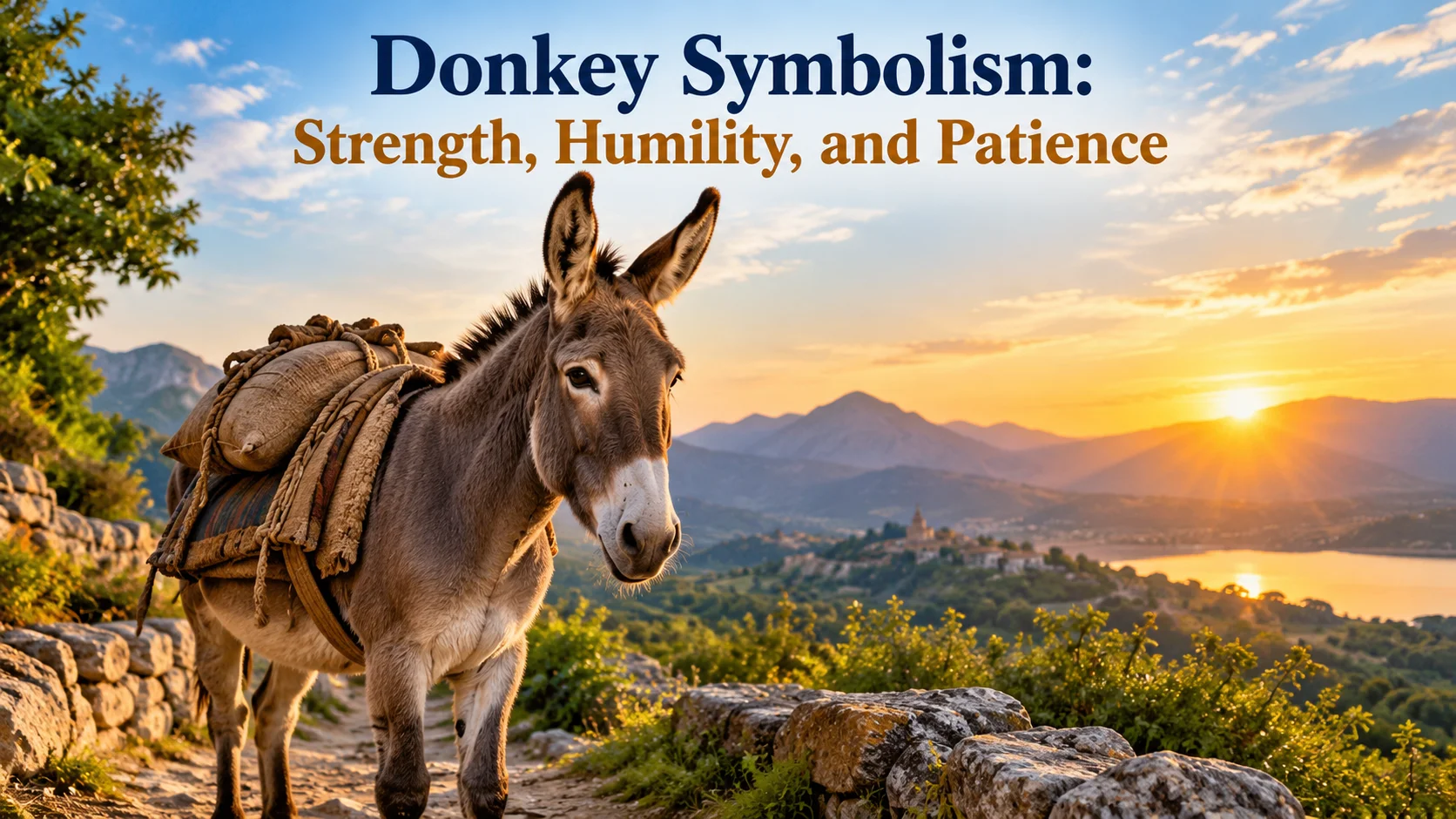
Donkey symbolism explores the qualities people associate with this hardworking animal, including patience, endurance, humility, and determination. In the United States, donkeys often represent stubbornness, but their deeper meaning reaches far beyond that familiar stereotype. They also symbolize quiet strength, dependable service, and the ability to keep moving when life becomes difficult.
Throughout history, donkeys have helped people carry supplies, travel across challenging landscapes, and support agricultural communities. Their steady nature made them valuable companions in many parts of the world. As a result, different cultures connected donkeys with practical wisdom, perseverance, and everyday survival.
Today, the donkey appears in religious stories, political imagery, children’s books, farm decorations, tattoos, and spiritual discussions. Some people admire its independence, while others associate it with foolishness or resistance. However, these contrasting interpretations reveal something interesting about how humans understand strength and personality.
Exploring donkey symbolism helps you recognize the difference between being stubborn and standing firm in your beliefs. It also offers a fresh perspective on patience, hard work, and the value of remaining grounded. Whether you encountered a donkey in a dream, noticed one in nature, or simply feel drawn to this animal, its symbolism offers several meaningful ways to reflect on your life.
Quick Answer:
In the United States, donkey symbolism primarily represents stubbornness, endurance, humility, loyalty, and determination. Spiritually, donkeys may symbolize patience, grounded wisdom, service, and the strength to continue through difficult circumstances. Their meaning depends on the cultural setting and the qualities a person associates with the animal.
TL;DR: Donkey Symbolism at a Glance
- Strength: Donkeys represent the ability to carry burdens and overcome challenges.
- Patience: Their steady nature reflects persistence through slow or difficult periods.
- Humility: Donkeys symbolize modesty, simplicity, and practical service.
- Stubbornness: American culture often associates them with resistance and strong opinions.
- Spirituality: Religious traditions sometimes connect donkeys with peace, service, and humility.
- Modern meaning: Donkeys appear in tattoos, political symbols, art, and personal expressions of resilience.
What Does a Donkey Symbolize?
A donkey is a domesticated member of the horse family, known for its long ears, sturdy body, and remarkable ability to navigate challenging terrain. Its physical characteristics and relationship with humans have influenced the meanings people attach to it. In American culture, the animal can represent both admirable persistence and frustrating resistance.
The Main Symbolic Meanings
Donkey symbolism generally centers on several qualities that reflect how people perceive the animal’s behavior and role in human life.
Endurance and resilience: Donkeys have historically carried heavy loads and traveled through difficult environments. Consequently, they can represent the ability to withstand pressure without giving up.
Humility and service: Unlike animals associated with royalty or dramatic displays of power, donkeys often symbolize modest, practical work. They remind people that valuable contributions don’t always receive public recognition.
Determination and stubbornness: Donkeys are famous for resisting situations they perceive as uncomfortable or unsafe. Symbolically, this behavior can represent either inflexible thinking or the courage to maintain personal boundaries.
Loyalty and dependability: Their longstanding relationship with people has made donkeys symbols of reliable companionship. They can represent individuals who remain supportive during difficult times.
Why the Same Animal Has Different Meanings
The meaning of a donkey depends heavily on the situation.
For example, a donkey carrying supplies might represent responsibility and hard work. However, a donkey refusing to move could symbolize resistance, independence, or an unwillingness to accept pressure.
This flexibility makes the animal an interesting symbol of human character. It encourages you to consider whether persistence serves a worthwhile purpose or prevents necessary change.
Historical Origins of Donkey Symbolism
Donkeys have lived alongside humans for thousands of years. Their importance as working animals shaped their symbolic meanings long before modern American culture developed.
Donkeys in the Ancient World
Domestic donkeys originated in Africa, with their domestication generally traced to northeastern Africa several thousand years ago. They became essential to communities that needed reliable animals for transporting goods across dry landscapes.
Unlike some larger working animals, donkeys can thrive in challenging environments and travel considerable distances with appropriate care. Their usefulness made them important to agriculture, trade, and everyday transportation.
In ancient societies, donkeys often represented practical wealth rather than royal luxury. Owning a donkey could mean having the means to transport food, water, tools, and other necessities.
Their symbolism therefore developed around survival, productivity, and dependable labor.
Donkeys in Ancient Stories and Traditions
Donkeys appear in several ancient literary and religious traditions. Their roles often reflect ordinary life, human limitations, or the contrast between outward status and inner character.
In some stories, a donkey’s apparent simplicity becomes part of the lesson. A humble animal may accomplish something that more impressive characters cannot.
This theme has remained recognizable across generations. It suggests that strength doesn’t always appear in a grand or intimidating form.
From Working Animal to Cultural Symbol
As transportation systems and agricultural technology changed, donkeys became less central to everyday life in many American communities. Nevertheless, their historical associations remained part of storytelling, art, and popular language.
The donkey’s image gradually expanded beyond physical labor. It became a recognizable symbol of stubbornness, modesty, and persistence.
Today, these older associations continue to influence how people interpret donkeys in religious settings, political imagery, and personal symbolism.
Donkey Symbolism in American Culture
In the United States, donkeys carry several meanings that sometimes conflict with one another. The animal can represent hard work and determination, but it also has a strong connection to American politics and the everyday idea of stubbornness.
The Democratic Party’s Donkey Symbol
One of the most recognizable American uses of the donkey is its association with the Democratic Party.
The symbol became widely associated with the party during the nineteenth century, particularly through political cartoons involving Andrew Jackson. His opponents used the donkey to criticize him, while the image eventually developed into a recognizable representation of Democratic politics.
Political cartoonist Thomas Nast helped popularize the donkey as a Democratic symbol during the 1870s. His illustrations contributed to the lasting visual language of American political cartoons.
Today, the donkey frequently appears in election coverage, campaign merchandise, political illustrations, and discussions about party identity.
However, the symbol’s political meaning is distinct from its broader spiritual or historical associations.
The American Idea of Stubbornness
In everyday American English, calling someone a donkey is less common than describing them as stubborn as a mule. Still, the donkey’s reputation for resisting movement influences its cultural image.
This association can be negative when it describes someone who refuses to listen. However, persistence can also be admired when a person stands against unfair pressure.
For example, a student who continues studying despite setbacks might demonstrate determination. A manager who rejects every reasonable suggestion, on the other hand, might be acting inflexibly.
The difference lies in whether resistance serves a meaningful purpose.
Donkeys and American Rural Life
Donkeys also appear in American farm culture, rural photography, petting zoos, and children’s stories.
Their familiar appearance can evoke simplicity, patience, and a connection to traditional ways of living. For some people, they represent a slower pace of life that contrasts with modern pressures.
In this context, the donkey symbolizes practical strength rather than political identity.
Spiritual Meaning of a Donkey
The spiritual meaning of a donkey often centers on humility, patience, service, and the importance of staying grounded. These interpretations vary across traditions and personal beliefs rather than following one universal spiritual rule.
A Symbol of Humility
A donkey may symbolize the willingness to live without constantly seeking attention or praise.
Its association with ordinary work provides a useful metaphor for people who value quiet contributions. Not every meaningful accomplishment requires recognition from others.
Spiritually, this interpretation can encourage you to focus on your values instead of comparing your progress with someone else’s achievements.
A Reminder to Practice Patience
Donkeys can also represent the importance of allowing life to unfold at a reasonable pace.
When progress feels slow, the animal’s symbolism may encourage you to continue taking practical steps instead of abandoning your goals.
However, patience doesn’t mean accepting every difficult situation indefinitely. Sometimes, the wiser choice involves changing direction rather than continuing along an unhelpful path.
Grounding and Practical Wisdom
In modern spiritual discussions, a donkey may represent staying connected to everyday responsibilities.
Rather than escaping ordinary life in search of meaning, this interpretation emphasizes finding purpose through relationships, work, and personal commitments.
For someone feeling overwhelmed, the donkey can serve as a reminder to simplify priorities and concentrate on what genuinely matters.
These meanings are personal interpretations, not proof that an animal carries a supernatural message.
Donkey Symbolism in Christianity and the Bible
Donkeys appear in several biblical narratives, making them important to Christian interpretations of humility, service, and peace.
The Donkey and Jesus’ Entry into Jerusalem
One of the most familiar biblical associations comes from Jesus’ entry into Jerusalem, described in the Gospels.
According to the accounts, Jesus rode a donkey or a young donkey into the city before his crucifixion. This event is commemorated by many Christian communities on Palm Sunday.
The scene is often interpreted as a sign of humility and peaceful kingship. Instead of arriving on a warhorse associated with military power, Jesus enters on an animal connected with ordinary travel and service.
For Christians, the donkey can therefore symbolize a form of authority that doesn’t depend on intimidation or displays of wealth.
Donkeys in Other Biblical Stories
Donkeys also appear in the story of Balaam in the Book of Numbers. In this narrative, Balaam’s donkey sees an angel that Balaam initially fails to recognize.
The animal eventually speaks after God enables it to do so. The story challenges assumptions about who can perceive truth and deliver an important message.
In this context, the donkey can symbolize unexpected insight and the limitations of human understanding.
Other biblical passages mention donkeys in settings involving travel, possessions, and daily work. Their meaning depends on the particular passage rather than a single fixed interpretation.
What Christians May Take From Donkey Symbolism
Christian interpretations commonly emphasize the following themes:
- Humility: Meaningful leadership doesn’t require outward displays of superiority.
- Service: Ordinary work can contribute to a larger purpose.
- Peace: The donkey’s association with Jesus’ entry into Jerusalem can represent peaceful authority.
- Unexpected wisdom: The story of Balaam’s donkey challenges assumptions about understanding and perception.
Not every Christian assigns the animal the same symbolic meaning. Its significance depends on the biblical passage and the individual’s theological tradition.
Donkey Symbolism in Other Cultures
Donkeys have served communities across Africa, Europe, Asia, and the Middle East. Because their practical roles differ by place and historical period, their symbolism also varies.
African and Middle Eastern Connections
In regions where donkeys have long supported farming, water transport, and trade, the animal can represent livelihood and endurance.
For families that depend on working animals, a donkey may have practical importance that goes beyond symbolism. Its health and ability to work can directly affect daily life.
Consequently, interpretations of the donkey as dependable or hardworking often emerge from lived experience rather than abstract spiritual beliefs.
European Folklore and Storytelling
European folktales have frequently portrayed donkeys as humble, foolish, stubborn, or unexpectedly clever.
These stories sometimes use the animal to explore human weaknesses. A stubborn donkey might represent someone who refuses sensible advice, while a dependable donkey can highlight the value of persistence.
In children’s literature, the animal’s familiar appearance also makes it an accessible character for stories about friendship, patience, and responsibility.
Broader Religious and Cultural Interpretations
Donkeys appear in Jewish, Christian, and Islamic cultural contexts, although their roles and interpretations differ.
In Islamic tradition, donkeys appear in religious texts and historical accounts, but it would be inaccurate to assign one universal spiritual meaning to the animal across all Muslim communities.
Likewise, biblical donkey imagery carries particular significance for many Christians and Jews without representing every person’s interpretation.
The broader lesson is that animal symbolism develops through specific stories, practices, and relationships. Respecting these differences helps prevent one culture’s interpretation from being mistaken for a universal belief.
Donkey Symbolism in Dreams
Dreaming about a donkey can feel memorable, especially when the animal behaves in an unusual way. However, dreams don’t have one scientifically established symbolic dictionary, so their meaning depends on personal experiences and emotions.
Dreaming of a Calm Donkey
A calm donkey might remind you of patience, stability, or dependable support.
If you felt comfortable around the animal, consider whether you currently value security or consistency in your life.
The dream may simply reflect a recent experience with animals, a story you encountered, or an emotion that your mind is processing.
Dreaming of a Stubborn Donkey
A donkey that refuses to move might reflect frustration about a situation that feels stuck.
For example, you might be struggling with a difficult decision or dealing with someone who refuses to compromise.
Instead of treating the dream as a prediction, consider whether it resembles a challenge you already recognize.
Dreaming of Riding or Caring for a Donkey
Riding a donkey may bring up ideas about responsibility, direction, or persistence. Caring for one could remind you of loyalty and the effort required to maintain a relationship.
However, the emotions you experienced are important. A pleasant dream may feel reassuring, while a stressful one may reflect worry or exhaustion.
A useful approach is to ask yourself three questions:
- What was the donkey doing?
- How did I feel during the dream?
- Does anything in my current life resemble that situation?
These questions encourage personal reflection without assuming that dreams reveal definite supernatural messages.
The Psychological Meaning of Donkey Symbolism
Donkey symbolism can also help people think about personality, boundaries, and the way they respond to pressure.
Persistence Versus Inflexibility
The donkey’s reputation for stubbornness creates a useful psychological contrast.
Persistence means continuing toward a worthwhile goal despite reasonable obstacles. Inflexibility means refusing to reconsider an approach even when new information suggests a change is necessary.
The same outward behavior can have different causes. Someone who refuses a dangerous task may be exercising good judgment rather than displaying an unwilling attitude.
Similarly, a person who keeps pursuing an unrealistic goal might need to reconsider their strategy.
The donkey therefore offers a reminder to balance determination with sound judgment.
Emotional Associations
People may connect donkeys with different feelings depending on their experiences.
• Comfort: Familiar farm imagery may create a sense of warmth and simplicity.
• Respect: Their hardworking nature can inspire admiration for quiet effort.
• Frustration: Their cultural reputation for stubbornness may suggest difficult interactions.
• Security: Their dependable role in traditional communities can represent stability.
• Independence: Their resistance to pressure may evoke strong boundaries and self-direction.
These associations aren’t universal. A person who grew up caring for donkeys may interpret them differently from someone who knows them mainly through cartoons.
Read More: Wolverine Symbolism: Strength, Courage, and Survival
Using the Symbol for Personal Reflection
If the donkey resonates with you, consider which of its qualities best reflects your current circumstances.
Perhaps you’re working through a demanding period and need endurance. Alternatively, you might be holding onto a belief that deserves another look.
The symbol becomes useful when it helps you examine your choices honestly rather than labeling yourself as naturally stubborn or endlessly strong.
Donkey Symbolism in Tattoos, Art, and Home Decor
Donkeys appear in modern visual culture in ways that reflect both traditional meanings and personal creativity.
Donkey Tattoos
A donkey tattoo can represent perseverance, humility, independence, or a connection to rural life.
Some people choose realistic animal portraits, while others prefer simple outlines or playful illustrations. The design’s style and surrounding elements influence how viewers interpret it.
Common ideas include:
- A standing donkey: Stability, patience, and grounded strength.
- A donkey carrying a pack: Responsibility, endurance, and service.
- A running donkey: Freedom, energy, and independence.
- A playful cartoon donkey: Humor, individuality, and a lighthearted personality.
These interpretations are suggestions rather than established rules. A tattoo may also honor a beloved animal or commemorate a personal experience.
Home Decor and Personal Style
Donkey imagery can suit farmhouse decor, country-inspired interiors, and spaces designed around animals or nature.
Wooden signs, framed illustrations, ceramic figures, and rustic prints often emphasize the animal’s approachable appearance.
In a home, the donkey may represent simplicity and a connection to practical living. A more humorous illustration might instead celebrate an independent personality.
Social Media and Digital Expression
Online, donkey images can communicate humor, frustration, determination, or affection for animals.
A cartoon donkey might represent someone who refuses to follow a trend. Another image could celebrate persistence during a difficult personal challenge.
Context matters, especially when an image is used in a political discussion. The same donkey can communicate party identity, satire, or an unrelated personal message.
Donkey Symbolism Compared With Mule and Horse Symbolism
Donkeys, mules, and horses belong to the same broader animal family, but people often associate them with different qualities.
Understanding these distinctions helps explain why the donkey’s symbolism feels unique in American culture.
| Animal | Common Symbolic Meaning in the USA | Typical Associations | Important Distinction |
| Donkey | Humility, stubbornness, endurance | Service, patience, persistence | Often represents quiet strength and resistance |
| Mule | Toughness and determination | Hard work, practicality, reliability | Frequently associated with exceptional working ability |
| Horse | Freedom, power, nobility | Independence, speed, adventure | Often represents movement, status, and personal freedom |
| Pony | Playfulness and approachability | Childhood, gentleness, companionship | Commonly evokes friendliness and innocence |
These meanings overlap, and none applies to every story or situation.
For example, a horse can symbolize humble service in one context, while a donkey can represent independence in another. The animal’s behavior and cultural setting shape the interpretation.
Negative Meanings and Misunderstandings About Donkeys
Donkey symbolism isn’t always positive. Its association with stubbornness can create unfair assumptions about intelligence, personality, or usefulness.
Does a Donkey Symbolize Foolishness?
In some stories and everyday expressions, donkeys represent foolishness or poor judgment.
However, this is a cultural stereotype rather than an accurate description of the animal’s abilities. Donkeys can be cautious, observant, and responsive to their surroundings.
What appears to be stubbornness may involve hesitation when an animal encounters a situation it considers unsafe.
This distinction changes the symbolism. Instead of representing stupidity, the donkey may suggest caution or resistance to unreasonable demands.
When Stubbornness Becomes a Negative Symbol
The donkey can represent inflexibility when someone refuses to consider evidence or alternative viewpoints.
For instance, a character in a story might ignore helpful advice simply because they dislike being challenged.
In that situation, the donkey serves as a warning about pride or closed-mindedness.
However, the symbol shouldn’t automatically be applied to people who disagree with popular opinions. Independent thinking and unreasonable resistance are not the same thing.
Political and Social Misinterpretations
In American political discussions, the donkey may identify the Democratic Party or communicate criticism of its supporters.
The image’s meaning depends on the person using it, the audience, and the surrounding message.
A political symbol isn’t automatically an insult, just as a humorous illustration isn’t necessarily a serious statement about someone’s character.
Recognizing context helps distinguish political identity, satire, and personal mockery.
How Donkey Symbolism Has Changed Over Time
The donkey’s symbolic meaning has evolved alongside changes in transportation, religion, agriculture, entertainment, and political culture.
Its history shows how a familiar animal can acquire new meanings while retaining older associations.
From Practical Necessity to Symbolic Meaning
In ancient and agricultural societies, donkeys were valued primarily for their usefulness. They transported goods, supported farming, and helped people manage daily responsibilities.
Their connection to endurance and service emerged naturally from these roles.
As technology reduced the need for working animals in many communities, donkeys increasingly appeared in stories, images, and cultural references rather than everyday transportation.
Nevertheless, the qualities associated with their traditional roles remained recognizable.
Religious and Political Interpretations
Religious narratives preserved the donkey’s associations with humility, ordinary life, and service.
Meanwhile, American political cartoons helped establish a separate meaning connected to party identity.
These interpretations developed in different settings. A donkey in a Christian illustration may communicate humility, while one in an American election graphic may identify a political party.
Neither interpretation completely replaces the others.
The Donkey in Contemporary Culture
Today, people can encounter donkey imagery through social media, television, educational materials, animal welfare campaigns, and personal artwork.
Some modern interpretations emphasize compassion toward working animals. Others reclaim stubbornness as a positive quality linked to independence and determination.
The result is a flexible symbol that can represent both traditional values and modern ideas about personal boundaries.
Its meaning continues to change as people use it to express their own experiences and beliefs.
FAQs:
What Does a Donkey Symbolize Spiritually?
A donkey may symbolize patience, humility, endurance, service, and practical wisdom. Some people use it as a reminder to remain grounded while working through challenges. However, spiritual interpretations vary, and no single meaning applies to everyone.
Is a Donkey a Symbol of Good Luck?
Donkeys aren’t universally recognized as good-luck symbols. Some people associate them with prosperity, dependable work, or the ability to overcome difficulties. Whether a donkey represents good fortune depends on personal beliefs and cultural context.
What Does a Donkey Represent in the Bible?
In the Bible, donkeys appear in stories involving travel, everyday work, and important religious events. Jesus’ entry into Jerusalem on a donkey is commonly associated with humility and peaceful kingship. Balaam’s donkey also illustrates how unexpected sources can reveal important truths.
What Does a Donkey Mean in American Politics?
In the United States, the donkey is a widely recognized symbol of the Democratic Party. Its political association developed during the nineteenth century and became more familiar through political cartoons. Outside politics, the animal can still represent endurance, humility, and stubbornness.
Does Seeing a Donkey Have a Spiritual Message?
Some people interpret an encounter with a donkey as an invitation to reflect on patience, independence, or personal responsibilities. However, seeing one doesn’t establish that a supernatural message has been sent. The experience may simply inspire you to consider what the animal represents in your own life.
What Does a Donkey Tattoo Symbolize?
A donkey tattoo can represent perseverance, loyalty, humility, independence, or a connection to farm life. A playful design may express humor, while a realistic image may honor an animal or a meaningful personal experience. Its significance ultimately depends on the wearer’s intentions.
Conclusion:
Donkey symbolism reveals a surprisingly rich combination of strength, patience, humility, endurance, and stubbornness. In American culture, the donkey is especially recognizable as a political symbol and an example of determined resistance. Its religious and historical associations also connect it with service, peaceful leadership, and the value of ordinary work.
The animal’s most meaningful lesson may be the difference between persistence and inflexibility. Standing firm can help you protect your values and overcome difficult circumstances. However, knowing when to change direction is equally important.

1 thought on “Donkey Symbolism: Strength, Humility, and Patience”