
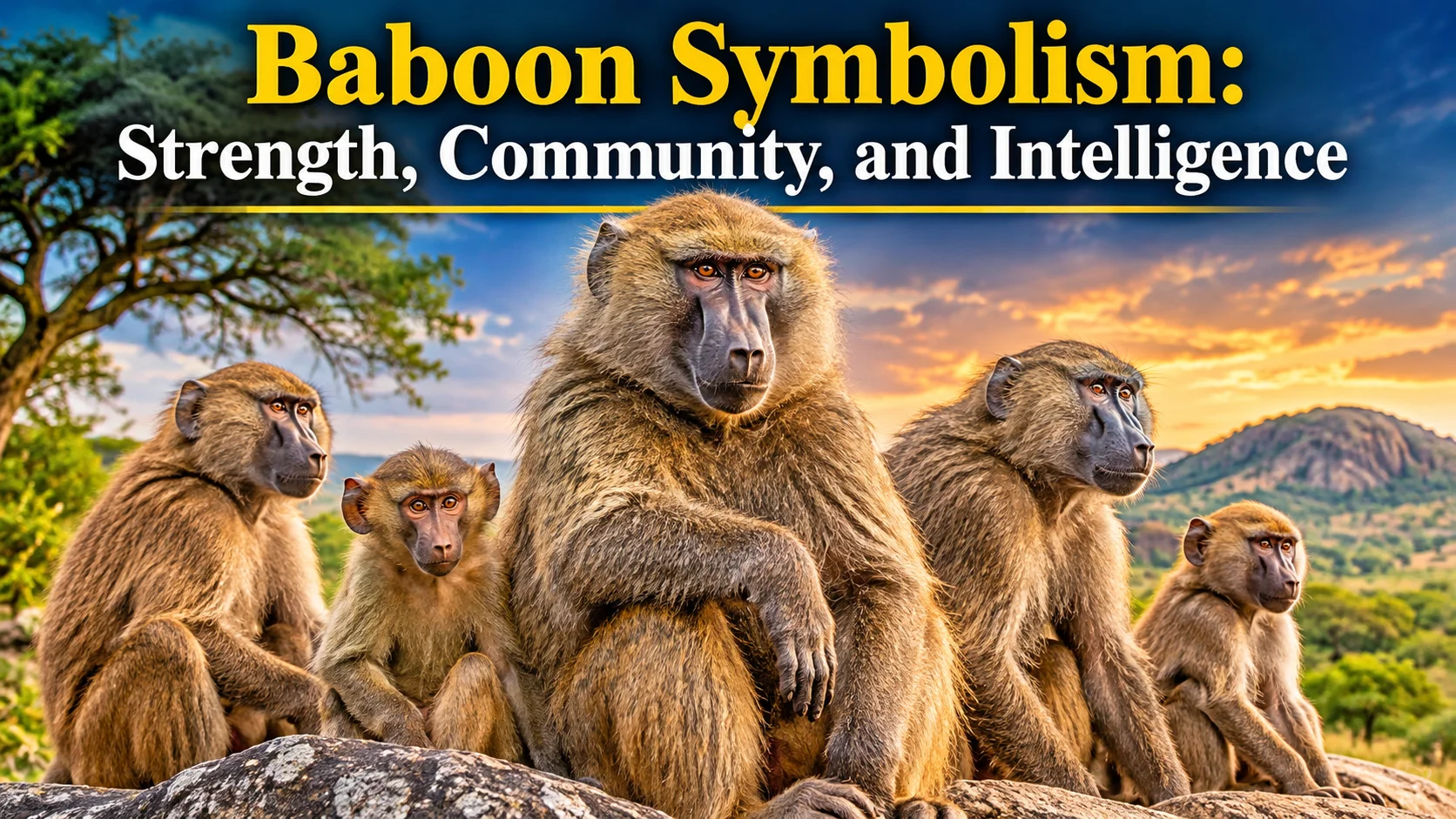
Baboon symbolism explores the meanings people connect with this intelligent, social, and adaptable animal. Across different interpretations, the baboon can represent strength, confidence, family loyalty, cleverness, and the ability to survive challenging situations. Its behavior makes it an interesting symbol of both cooperation and competition.
In the United States, baboons aren’t as common in everyday symbolism as wolves, bears, or eagles. However, their expressive faces, strong social bonds, and complex group behavior make them powerful subjects in wildlife documentaries, art, and spiritual discussions. People may associate them with leadership, independence, and the importance of understanding social relationships.
The baboon also has a complicated image. Its physical strength can suggest protection, while its aggressive behavior may represent conflict, uncontrolled emotions, or the misuse of power. Therefore, its meaning often depends on the setting, the individual’s experiences, and the qualities being emphasized.
Whether you’ve encountered a baboon in a dream, noticed one during a wildlife visit, or are considering its image for a tattoo, understanding its symbolism offers several perspectives. Looking at its natural behavior alongside historical and cultural interpretations helps separate established traditions from modern personal beliefs.
Quick Answer
Baboon symbolism in the United States commonly represents strength, intelligence, social bonds, adaptability, and assertiveness. In broader spiritual interpretations, the baboon may symbolize awareness, protection, cleverness, and the need to balance instinct with thoughtful action.
TL;DR
- Strength: Represents physical power, courage, and the ability to face challenges.
- Intelligence: Reflects problem-solving, observation, and learning through experience.
- Community: Highlights family bonds, cooperation, and social responsibility.
- Leadership: Suggests confidence, authority, and awareness of group dynamics.
- Spirituality: May symbolize vigilance, protection, and self-awareness in modern interpretations.
- Personal growth: Encourages balancing strong instincts with patience and good judgment.
What Does a Baboon Symbolize?
A baboon’s symbolism comes largely from its visible strength, intelligence, and complex social behavior. These traits make it a useful symbol for people exploring confidence, relationships, and personal resilience.
Unlike symbols that carry one widely recognized meaning, the baboon has several possible interpretations. Its behavior can suggest positive qualities or warn against their excessive expression.
Core Symbolic Meanings
- Physical strength: The ability to protect yourself and withstand pressure.
- Social intelligence: Understanding relationships, cooperation, and group behavior.
- Adaptability: Finding ways to survive when circumstances change.
- Assertiveness: Speaking up, establishing boundaries, and defending your position.
- Instinct: Recognizing natural reactions while learning when to control them.
The baboon’s meaning also changes with its posture and surroundings. A relaxed baboon grooming another animal may suggest trust and belonging. An animal displaying its teeth or defending its space may instead represent confrontation, warning, or the need for boundaries.
For American readers, these interpretations often connect with everyday experiences. A person might associate the baboon with standing up for themselves at work, protecting family members, or navigating complicated friendships.
Historical Background of Baboon Symbolism
Baboons have appeared in ancient art, religious imagery, and cultural stories for thousands of years. Their historical significance is especially well documented in ancient Egypt, where particular baboon species were associated with religious figures and sacred ideas.
Understanding this history helps distinguish traditional symbolism from newer spiritual interpretations.
Baboons in Ancient Egypt
Category:Thoth baboon E17496 – Wikimedia Commons
Ancient Egyptians represented baboons in religious art and sculpture. The hamadryas baboon, recognizable by its distinctive appearance, became associated with Thoth, a deity connected with writing, knowledge, wisdom, and the measurement of time.
Baboons also appeared in representations of solar worship. Their raised-arm gestures were sometimes interpreted as welcoming or praising the rising sun. These images reflected religious ideas about the relationship between animals, divine powers, and the natural world.
However, ancient Egyptian imagery wasn’t limited to one universal meaning. Different baboon representations served different religious and artistic purposes.
Baboons and the Afterlife
Baboons also appeared in ancient Egyptian funerary traditions. Hapy, one of the four sons of Horus, was depicted with the head of a baboon and was associated with protecting the lungs of the deceased.
This connection gave the baboon a place in imagery related to death, preservation, and protection. It didn’t mean that every baboon was viewed as a guardian or that all ancient Egyptians interpreted the animal identically.
Today, these historical associations can inspire interpretations involving wisdom, guardianship, and transitions. Still, it’s important to recognize that modern spiritual meanings aren’t necessarily the same as ancient Egyptian beliefs.
Baboon Symbolism in American Culture
In the United States, baboons generally appear in wildlife education, zoos, documentaries, popular entertainment, and discussions about animal intelligence. Unlike the bald eagle or American bison, the baboon isn’t a major national symbol.
Nevertheless, its recognizable appearance and social behavior give it several meanings in contemporary American life.
Strength and Individual Confidence
American culture often celebrates independence, resilience, and the ability to defend personal boundaries. The baboon can represent these qualities because of its physical power and willingness to confront threats.
However, strength doesn’t always mean aggression. A more balanced interpretation emphasizes courage, self-control, and the ability to protect others without unnecessary conflict.
Family and Social Responsibility
Baboon troops maintain complex relationships. Members may groom each other, form alliances, care for young animals, and respond collectively to danger.
These behaviors can remind American readers of family support, friendship, teamwork, and community responsibility. The baboon therefore offers a useful symbol of the tension between personal independence and belonging to a group.
Wildlife Education and Media
American nature programs often present baboons as intelligent, expressive, and socially complicated animals. Their behavior can challenge the simplistic idea that wild animals act only on instinct.
Consequently, the baboon may symbolize curiosity, adaptability, and the importance of understanding behavior before judging it. Its image can also serve as a reminder that wildlife deserves respect rather than being treated merely as entertainment.
Spiritual Meaning of a Baboon
In modern spiritual discussions, the baboon can represent awareness, protection, resilience, and the relationship between instinct and wisdom. These meanings are personal interpretations rather than universal spiritual rules.
For some people, an encounter with a baboon feels meaningful because the animal reflects a quality they’re developing or a challenge they’re facing. Others simply appreciate its natural intelligence and social complexity.
Baboon as a Symbol of Awareness
Baboons spend much of their time observing their surroundings and responding to other group members. Symbolically, this behavior can suggest paying attention before making decisions.
A baboon may therefore serve as a personal reminder to notice patterns, listen carefully, and recognize situations that require caution. Rather than reacting immediately, you can pause and consider your options.
Baboon as a Symbol of Protection
Baboons can defend themselves and respond to threats involving their group. This behavior may inspire associations with courage, family loyalty, and personal boundaries.
However, spiritual protection doesn’t have to mean fighting every challenge. A more balanced interpretation emphasizes preparation, awareness, and knowing when to step away from conflict.
Baboon as a Symbol of Transformation
Some modern interpretations connect the baboon with personal change because it represents adaptability and learning. This can be meaningful during a career transition, a difficult relationship, or a period of personal growth.
The symbol doesn’t predict that change will occur. Instead, it can help you reflect on how you respond when familiar circumstances begin to shift.
Baboon Symbolism in Different Cultures
The baboon doesn’t have one shared meaning across all societies. Its interpretation depends on local history, religious traditions, direct experiences with wildlife, and the stories people tell about animals.
For American readers, understanding these differences is especially important when exploring cultural art or spiritual practices.
Ancient Egyptian Traditions
Ancient Egyptian religion offers the clearest historical example of baboon symbolism. The animal was associated with Thoth, a deity connected with wisdom, writing, knowledge, and the keeping of time.
Baboons also appeared in solar imagery and funerary art. Their presence in religious objects reflected ideas about divine order, protection, judgment, and life after death.
These associations have historical support in Egyptian art and museum collections. They shouldn’t be treated as proof that every modern baboon encounter carries a message about wisdom or the afterlife.
African Cultural Contexts
Baboons live in several African regions, and people have encountered them in different environments for generations. Their relationships with humans can include folklore, practical concerns, admiration, and conflict.
Some communities may view particular animals through local stories or established traditions. However, Africa contains many distinct cultures and languages, so it’s inaccurate to assign one spiritual meaning to all African peoples.
It’s equally important to recognize the baboon as a real wild animal. Its behavior around food, farms, or settlements may create practical challenges that have little to do with symbolism.
Contemporary Spiritual Interpretations
Today, some people use animals as personal symbols during meditation, journaling, or periods of reflection. Within this approach, the baboon may suggest confidence, awareness, or stronger connections with others.
These interpretations can be useful when they encourage thoughtful decisions. However, there isn’t one authoritative spiritual meaning that everyone must accept.
Psychological Meaning of the Baboon
Animal symbols can help people put complicated feelings into words. The baboon is especially interesting because its behavior can suggest both confidence and conflict.
In psychological reflection, the important question isn’t whether a baboon has a fixed meaning. Instead, consider which of its characteristics connect with your current experiences.
Confidence and Assertiveness
A powerful baboon may remind you to express your needs clearly. This association can be useful when you’re learning to speak up, defend your boundaries, or take responsibility for a difficult decision.
However, confidence and domination aren’t the same thing. Healthy assertiveness respects other people’s boundaries while allowing you to protect your own.
Social Awareness and Belonging
Baboons live in groups with complicated social relationships. Their interactions can inspire reflection on friendship, family expectations, workplace dynamics, and the desire to belong.
For example, you might think about whether you’re contributing to a group or constantly competing for approval. The symbol can encourage you to value cooperation without losing your individuality.
Instinct and Self-Control
The baboon’s powerful body and expressive behavior can also represent strong emotions. Anger, jealousy, excitement, and fear sometimes push people toward immediate reactions.
In this context, the baboon can remind you to recognize an emotion before acting on it. Your feelings deserve attention, but they don’t have to control every decision.
Baboon Symbolism in Dreams
Dream interpretations are subjective, and no single explanation applies to everyone. A baboon dream may reflect recent experiences, emotional concerns, personal associations, or something you’ve seen in a film or photograph.
The animal’s behavior and your feelings during the dream can help you explore possible meanings.
Seeing a Calm Baboon
A calm baboon might represent confidence, awareness, or comfort within a social group. If you felt safe around it, consider whether you’re becoming more secure in a relationship or personal decision.
The dream could also reflect simple curiosity about wildlife. You don’t need to assume it carries a supernatural message.
Being Chased by a Baboon
A baboon chasing you might connect with a conflict you’re avoiding or a situation that feels difficult to control. Your reaction in the dream may reveal more about your feelings than the animal itself.
Consider whether you’ve been postponing a conversation or feeling pressured by someone else’s demands. These are possibilities for reflection, not fixed predictions.
A Friendly or Protective Baboon
A friendly baboon may bring to mind trust, companionship, or the support of a group. If it protects you in the dream, you might reflect on where you find security in everyday life.
However, dreams don’t reliably predict future events. Treat their imagery as an opportunity to explore your emotions rather than a guarantee of what’s coming.
Baboon Spirit Animal and Totem Meanings
Terms such as spirit animal and totem have different meanings within different cultural and spiritual traditions. They shouldn’t be treated as interchangeable labels for every animal someone admires.
In contemporary American spirituality, people sometimes use animal symbolism to describe personal values or a quality they want to develop. A baboon can serve as a personal emblem in that setting.
Baboon as a Personal Guide
A person who identifies with baboon symbolism might value courage, social awareness, adaptability, and independence. The animal can also represent a willingness to learn from experience.
These associations work best as prompts for self-reflection. They don’t establish that a person has a supernatural connection with baboons.
Baboon as a Personal Totem
In some Indigenous traditions, totems have specific cultural, familial, or spiritual significance. Their meanings depend on the people and practices involved.
Therefore, it’s best not to claim that the baboon is a traditional totem across Native American cultures. If you’re drawn to the animal, you can appreciate its qualities without borrowing sacred concepts from a community you don’t belong to.
Qualities to Reflect On
If baboon symbolism resonates with you, consider these questions:
- Where would greater confidence help you make a better decision?
- Are your closest relationships based on mutual trust and support?
- When does your instinct help you, and when might it lead you astray?
- How can you protect your boundaries without escalating conflict?
Your answers can make the symbol personally meaningful without requiring a fixed spiritual belief.
Baboon Symbolism in Tattoos, Art, and Decor
In the United States, animal imagery often expresses personality, interests, values, or connections with nature. A baboon design can stand out because of its expressive face, strong build, and distinctive shape.
Its meaning depends on the design and the reason someone chooses it.
Baboon Tattoos
A baboon tattoo can represent resilience, independence, intelligence, or loyalty to family. A person might choose it because they admire primates or feel connected to the animal’s bold appearance.
Different artistic choices can emphasize different qualities.
- A calm, seated baboon: May suggest patience, awareness, or thoughtful observation.
- A powerful male baboon: Can emphasize strength, confidence, or authority.
- A baboon with its troop: May represent family bonds and collective support.
- A stylized baboon face: Can express individuality, humor, or an interest in wildlife.
- An ancient Egyptian-inspired design: May reference historical associations with Thoth or sacred imagery.
When using Egyptian-inspired designs, learning about their original context helps avoid confusing historical religious imagery with generic decoration.
Home Decor and Artwork
Baboon artwork may appeal to people who enjoy wildlife photography, natural history, or bold animal portraits. A realistic image can highlight the animal’s intelligence and social behavior.
In contrast, a playful illustration might communicate humor or curiosity. Neither style has a universally accepted symbolic meaning.
Fashion and Personal Identity
Animal prints and wildlife graphics sometimes express confidence or a connection with the natural world. A baboon design can also reflect someone’s interest in primates, conservation, or travel.
Still, the design alone doesn’t reveal a person’s character. Its meaning comes from the wearer’s intention and the context in which others encounter it.
Read More: Springbok Symbolism: Freedom, Speed, and Resilience
Baboon Symbolism in Pop Culture and Social Media
Modern media can change how people understand an animal. In American entertainment, baboons may appear as comic characters, unusual wildlife, clever troublemakers, or powerful animals that command attention.
These portrayals can influence personal symbolism, although entertainment doesn’t always reflect real animal behavior.
Humor and Mischief
Baboons have expressive faces and conspicuous social behaviors. These characteristics make them appealing subjects for humorous videos, cartoons, and online posts.
A baboon image might communicate playfulness, cheekiness, or a refusal to follow expectations. However, these associations reflect human interpretations rather than evidence that baboons are deliberately trying to entertain people.
Intelligence and Resourcefulness
Wildlife documentaries can highlight baboons solving problems, finding food, and responding to changes in their environment. These observations support their reputation as adaptable, socially complex primates.
Consequently, baboon imagery may appeal to people who value curiosity and practical intelligence. It can also remind viewers that animal behavior deserves careful observation rather than simplistic assumptions.
Representation in Entertainment
Films, animated stories, and online videos sometimes portray baboons as aggressive or unpredictable. Such portrayals can make their symbolic meaning more negative.
However, entertainment often exaggerates animal characteristics for dramatic effect. Real baboons display a range of behaviors, including social grooming, play, cooperation, and conflict.
What Different Baboon Behaviors Symbolize
A baboon’s behavior can influence how people interpret its image. Although symbolic meanings aren’t scientific facts, observing the animal’s actions provides a useful starting point for personal reflection.
The following table separates possible modern interpretations from the behaviors that inspire them.
| Baboon behavior or image | Possible symbolic meaning | Personal reflection |
| Grooming another baboon | Trust and social connection | Are you nurturing important relationships? |
| Watching its surroundings | Awareness and caution | What deserves your attention right now? |
| Defending its group | Protection and loyalty | How can you support people you care about? |
| Searching for food | Resourcefulness and persistence | What practical steps could solve your problem? |
| Displaying aggression | Conflict or assertiveness | Are you responding thoughtfully to pressure? |
These meanings are interpretive, not universal rules. A single behavior may inspire different associations depending on someone’s culture, experiences, and circumstances.
Negative Meanings and Common Misunderstandings
Baboon symbolism isn’t always positive. The animal’s size, powerful jaws, visible teeth, and sometimes aggressive behavior can inspire associations with intimidation, conflict, and excessive dominance.
Understanding these negative meanings helps create a more balanced interpretation.
Aggression and Uncontrolled Power
A threatening baboon may symbolize anger, confrontation, or the misuse of authority. In personal reflection, this image could raise questions about whether someone is pushing boundaries or responding too aggressively.
However, strength itself isn’t negative. The distinction lies in how power is used and whether it protects others or causes unnecessary harm.
Confusing Baboons With Monkeys in General
Baboons are primates, but they’re not apes. They’re classified as Old World monkeys and have distinctive physical features, including long muzzles and, in many species, prominent canine teeth.
This distinction matters when discussing animal symbolism because different primates have different natural behaviors and cultural histories. A meaning associated with a baboon shouldn’t automatically be applied to chimpanzees, gorillas, or other monkeys.
Stereotypes and Dehumanizing Comparisons
Animal comparisons can become harmful when people use them to insult, humiliate, or dehumanize other human beings. Such language may also carry racist implications when used against particular racial or ethnic groups.
The context matters. A baboon illustration used to celebrate wildlife is different from an image used to mock or demean a person.
It’s possible to explore baboon symbolism without using the animal as a negative label for human identity. Respectful interpretation focuses on the animal’s behavior, history, and symbolic qualities rather than stereotypes.
How Baboon Symbolism Has Changed Over Time
Baboon symbolism has shifted as human relationships with animals have changed. In ancient Egypt, the baboon had documented religious significance. In modern American culture, its image is more commonly associated with wildlife, intelligence, physical strength, and entertainment.
These changes reflect different cultural settings rather than a single, universal progression.
Ancient Religious Importance
In ancient Egyptian imagery, the baboon could represent sacred knowledge, connections with the sun, and protection associated with funerary practices.
These associations were embedded in specific religious systems. They weren’t simply modern personality traits assigned to an animal.
Modern Scientific Understanding
Today, primate research provides a better understanding of baboon social structures, communication, and behavior. This knowledge encourages more nuanced interpretations of the animal.
For example, behaviors once viewed only as signs of aggression can be understood within broader contexts involving competition, social relationships, and survival.
Personal Symbolism Today
Modern spiritual communities and individual artists continue to develop personal meanings for animals. Baboons may represent self-confidence, adaptability, family loyalty, or the need for emotional balance.
These interpretations can be meaningful without claiming that they belong to an ancient tradition. Recognizing the difference between historical evidence and contemporary belief makes animal symbolism more thoughtful and accurate.
FAQs:
What does a baboon symbolize spiritually?
A baboon may symbolize awareness, strength, protection, adaptability, and social intelligence in modern spiritual interpretations. These meanings are personal or tradition-dependent rather than universal spiritual facts.
Is seeing a baboon a good sign?
Some people interpret a baboon encounter as a reminder to be confident, observant, or protective of important relationships. However, seeing a baboon doesn’t establish that good or bad events will follow.
What does a baboon symbolize in a dream?
A baboon in a dream might bring attention to confidence, social relationships, conflict, or instinctive reactions. The setting and your feelings during the dream can help you explore what the image means to you.
What did baboons represent in ancient Egypt?
Baboons were associated with Thoth, a deity connected with wisdom, writing, knowledge, and time. They also appeared in solar imagery and funerary traditions, including representations associated with Hapy, one of the four sons of Horus.
What does a baboon tattoo mean?
A baboon tattoo may represent resilience, intelligence, independence, family loyalty, or personal strength. Its meaning depends on the design, the wearer’s intention, and any cultural references included.
What does an aggressive baboon symbolize?
An aggressive baboon can represent confrontation, anger, intimidation, or the misuse of power. Alternatively, it may remind someone to establish healthy boundaries and respond carefully to challenging situations.
Conclusion:
Baboon symbolism brings together strength, intelligence, social connection, adaptability, and the challenge of balancing instinct with thoughtful action. Its meaning can be positive or negative, depending on the behavior being emphasized and the context in which the animal appears.
In the United States, the baboon is primarily recognized as a fascinating wild primate rather than a national emblem. However, its complex social life and distinctive appearance make it a compelling symbol in personal reflection, artwork, tattoos, and modern spiritual discussions. Ancient Egyptian traditions also provide a documented historical connection between baboons, wisdom, sacred knowledge, and protection.

1 thought on “Baboon Symbolism: Strength, Community, and Intelligence”