
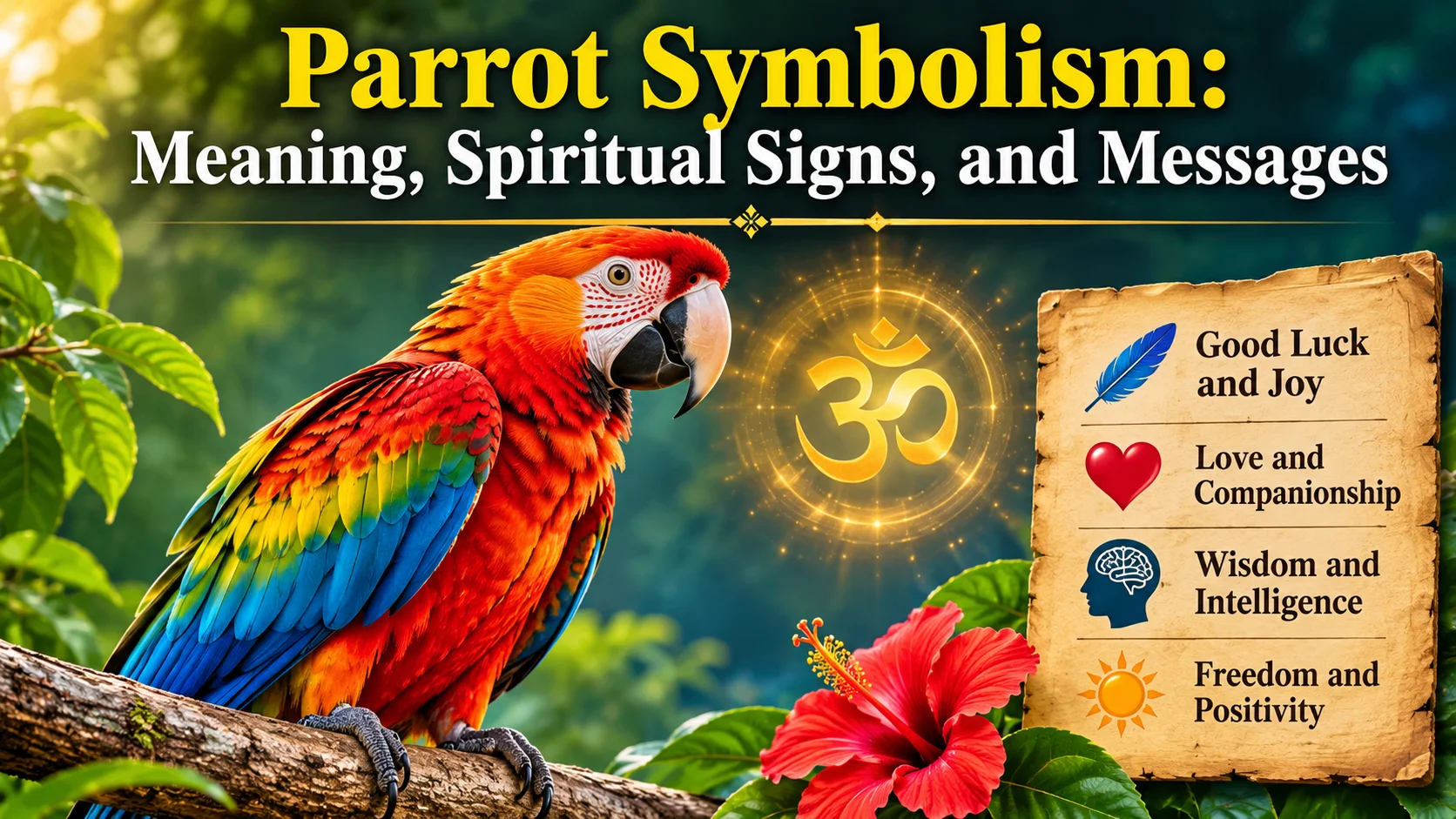
A parrot is more than a colorful bird with an unusual ability to imitate human speech. Across different cultures, it represents communication, intelligence, beauty, freedom, and social connection. Parrot symbolism also explores how people express themselves, share ideas, and find their voices.
In the United States, parrots often bring thoughts of tropical adventures, cheerful personalities, companionship, and exotic wildlife. Their bright feathers and playful behavior make them popular symbols in artwork, tattoos, home decorations, and personal expression. However, their ability to repeat human words gives them another layer of meaning. They can represent both the power of communication and the importance of speaking with intention.
Historically, parrots have appeared in ancient stories, royal collections, religious artwork, and traditional ceremonies. Their meanings vary depending on the culture and setting. Some traditions connect them with wisdom and spiritual communication, while others associate them with beauty, prosperity, and good fortune.
Today, people may see a parrot as a reminder to speak honestly, embrace individuality, or bring more color into everyday life. Understanding these meanings helps explain why this remarkable bird continues to capture human imagination.
Quick Answer
Parrot symbolism in the United States primarily represents communication, intelligence, individuality, freedom, and joy. Spiritually, parrots can symbolize self-expression, meaningful messages, social connection, and the courage to use your own voice.
TL;DR
- Parrots symbolize communication, intelligence, and expressive personalities.
- Their colorful feathers represent joy, creativity, and individuality.
- Historically, parrots represented luxury, beauty, and spiritual connections.
- In American culture, they often suggest tropical freedom and companionship.
- Spiritually, they can encourage honest communication and self-discovery.
- Modern parrot imagery appears in tattoos, fashion, artwork, and home decor.
What Does a Parrot Symbolize?
Parrots carry several meanings because of their unusual appearance and behavior. Their bright feathers attract attention, while their intelligence makes them fascinating companions. Together, these qualities create a symbol associated with expression and personality.
In American culture, parrots often represent someone who isn’t afraid to stand out. However, their symbolism goes beyond being colorful or entertaining.
Communication and Self-Expression
The parrot’s ability to imitate human speech makes communication its strongest symbolic association. It represents conversation, storytelling, listening, and the exchange of ideas.
However, imitation also introduces an important lesson. Repeating someone else’s words isn’t the same as expressing your own thoughts.
A parrot can therefore encourage you to consider how you communicate. It reminds you to speak thoughtfully rather than simply follow what others say.
Joy and Individuality
Parrots display remarkable combinations of colors, from brilliant green and yellow to deep blue and scarlet. Their appearance naturally connects them with creativity and individuality.
They symbolize the confidence to express your personality without constantly seeking approval.
Intelligence and Social Connection
Many parrots recognize familiar people, solve problems, and form strong social bonds. These qualities make them symbols of curiosity, friendship, and emotional connection.
They can represent the importance of learning, maintaining relationships, and staying mentally active.
Historical Background of Parrot Symbolism
Parrots have fascinated humans for thousands of years. Their unusual ability to imitate voices and their striking appearance helped establish their symbolic importance across different civilizations.
However, their historical meanings weren’t always the same. Geography, trade, religion, and social status influenced how people viewed these birds.
Ancient Greek and Roman Associations
Ancient Mediterranean societies encountered parrots through trade and travel. Greek writers described parrots arriving from India and other distant regions.
Following Alexander the Great’s campaigns in India, these birds became more familiar to the Greek world.
In Hellenistic and Roman societies, parrots were valued as unusual pets. Their ability to repeat words made them entertaining companions for wealthy households.
Consequently, they became associated with:
- Wealth and social prestige.
- Exotic beauty and distant lands.
- Intelligence and unusual abilities.
- Entertainment and sophisticated households.
- Luxury and fashionable companionship.
Roman writers also mentioned parrots in literature. The poet Ovid famously wrote about mourning a beloved pet parrot.
This literary connection helped establish the bird as a symbol of affection and companionship.
Medieval European Symbolism
During the Middle Ages, parrots appeared in religious paintings and European literature.
Some Christian artworks associated parrots with purity, the Virgin Mary, and sacred communication. Their unusual voices also inspired wordplay connected with religious greetings.
However, their meanings depended heavily on artistic context.
In other settings, parrots represented luxury and fashionable living. Their colorful feathers made them desirable possessions among wealthy Europeans.
The Influence of Global Trade
As European exploration and international trade expanded, parrots became increasingly visible in European households and collections.
Their arrival connected them with distant tropical regions and unfamiliar wildlife.
Over time, this association influenced Western ideas about exotic beauty, adventure, and wealth.
Parrot Symbolism in American Culture
In the United States, parrots have several cultural meanings. Their connection with tropical environments, colorful entertainment, and companionship makes them recognizable symbols in everyday American life.
Unlike the bald eagle, the parrot doesn’t have an official national identity. Nevertheless, it has a distinctive place in American popular culture.
Tropical Freedom and Adventure
Many Americans associate parrots with warm beaches, palm trees, islands, and tropical vacations.
Their colorful appearance often creates images of relaxation and adventure.
For example, a parrot sitting beside a palm tree might represent an escape from everyday responsibilities. It can also suggest curiosity about unfamiliar places.
Florida and Tropical Communities
Parrots are especially visible in parts of Florida, where established populations of nonnative parrots live alongside native wildlife.
Cities such as Miami have helped shape the bird’s association with tropical urban life.
In these settings, parrots can symbolize:
- Florida’s colorful outdoor identity.
- Tropical weather and relaxed lifestyles.
- Cultural diversity and international connections.
- Urban wildlife and environmental change.
- Tourism, entertainment, and coastal living.
However, not every parrot seen in an American city belongs to a native species.
Popular Entertainment and American Imagination
Parrots have long appeared in American entertainment, particularly stories involving pirates, ships, and tropical adventures.
The familiar image of a pirate with a parrot on their shoulder became a recognizable storytelling tradition.
This image represents adventure, independence, humor, and a rebellious personality.
However, the pirate association is largely a popular cultural image rather than a universal historical tradition.
Parrot Symbolism in Native American Cultures
Parrots have an interesting history in the American Southwest. Although most parrot species aren’t native to the continental United States, they reached Southwestern communities through ancient trade networks.
Archaeological discoveries show that people in the region obtained parrot feathers and sometimes transported living birds over considerable distances.
Ancient Southwestern Connections
Parrots held cultural importance among several ancestral Pueblo communities.
Their feathers appeared in ceremonial objects, and their presence reflected connections with regions farther south.
Trade networks connected communities across what are now parts of the southwestern United States and Mexico.
These exchanges involved more than practical goods. They also carried artistic influences and cultural relationships.
Hopi and Pueblo Traditions
Parrots appear in some Southwestern Indigenous traditions, including Hopi ceremonial imagery.
The Hopi Parrot Kachina is associated with the broader ceremonial world of Kachinas. However, individual meanings belong within specific cultural teachings and practices.
Parrot imagery also appears in Southwestern art and historical ceremonial traditions.
Some accounts connect parrots with fertility, direction, and communication. However, these meanings shouldn’t be treated as universal beliefs shared by every Pueblo community.
Respecting Indigenous Symbolism
Indigenous symbolism belongs to living cultures, not simply historical decoration.
Therefore, using a sacred ceremonial figure as an ordinary decorative image can remove its original meaning.
Understanding the cultural background helps people appreciate parrot imagery without assuming that every tradition interprets it identically.
Spiritual Meaning of a Parrot
Spiritually, parrots are often associated with communication, awareness, personal growth, and meaningful connections.
Their ability to imitate sounds makes them especially interesting symbols when people think about words and their influence.
However, spiritual interpretations vary. There isn’t one universally accepted meaning attached to every parrot encounter.
A Message About Your Voice
A parrot may represent the importance of expressing your thoughts.
If you’re struggling to communicate, its symbolism can encourage you to become more confident.
It may invite you to consider:
- Are you expressing what you genuinely believe?
- Do you listen carefully before responding?
- Are you repeating opinions without questioning them?
- Do you feel comfortable sharing your personality?
The deeper message concerns authenticity rather than simply talking more.
Awareness and Personal Growth
Parrots are observant and socially intelligent birds. Their behavior can inspire reflection about awareness and learning.
Spiritually, they may represent the need to pay attention to your surroundings.
Sometimes, personal growth begins when you recognize patterns in your behavior and become willing to change them.
Joy and Positive Energy
Bright feathers and playful movements make parrots natural symbols of happiness.
Some modern spiritual interpretations connect them with optimism, gratitude, and emotional renewal.
A parrot can serve as a personal reminder to welcome enjoyable experiences without losing sight of meaningful responsibilities.
What Different Parrot Colors Symbolize
Parrot colors add another layer to their symbolism. People often connect particular colors with emotional qualities, personal values, and spiritual ideas.
These interpretations are symbolic rather than fixed meanings found in every cultural tradition.
Red Parrot
Red often represents passion, confidence, energy, and courage.
A red parrot may symbolize the willingness to express strong feelings and stand confidently behind personal beliefs.
Blue Parrot
Blue commonly represents peace, honesty, wisdom, and emotional balance.
A blue parrot can suggest thoughtful communication and the importance of maintaining calm relationships.
Green Parrot
Green is frequently connected with nature, renewal, growth, and harmony.
A green parrot may symbolize personal development, fresh opportunities, and a closer relationship with the natural world.
Yellow Parrot
Yellow often represents happiness, optimism, curiosity, and mental energy.
A yellow parrot can reflect a cheerful personality or a desire to approach life with greater enthusiasm.
White Parrot
White is commonly associated with purity, peace, clarity, and new beginnings.
A white parrot may symbolize emotional simplicity, spiritual reflection, or a fresh perspective.
Multicolored Parrot
A multicolored parrot represents diversity, creativity, and individuality.
It can remind people that different qualities and experiences contribute to a complete personality.
Psychological and Emotional Meaning of Parrots
Parrots can create strong emotional reactions because of their intelligence, appearance, and social behavior.
Some people find them entertaining, while others appreciate their ability to form close relationships.
From a psychological perspective, parrot imagery can represent different aspects of personality and emotional needs.
Confidence and Individuality
A brightly colored parrot naturally attracts attention.
People who connect with this bird may appreciate standing apart from ordinary expectations.
Its symbolism can reflect confidence, originality, and a willingness to express personal interests.
Loneliness and Companionship
Parrots are social animals. Many species develop strong bonds with other birds and their human caregivers.
This behavior makes them meaningful symbols of friendship and belonging.
A parrot may remind someone to maintain relationships and avoid emotional isolation.
However, it can also represent the desire to be heard and understood.
Repetition and Personal Habits
A parrot’s ability to repeat sounds creates an interesting psychological association.
It can represent habits, learned behavior, and the influence of other people’s opinions.
For example, someone who constantly repeats popular opinions might use the parrot as a humorous symbol of unquestioned conformity.
This interpretation provides a useful contrast to the bird’s positive connection with communication.
What Does a Parrot Mean in Dreams?
Dreaming about a parrot can carry different symbolic meanings depending on the bird’s behavior, color, and surroundings.
Dream interpretation isn’t an exact science. Personal experiences and emotions usually matter more than general symbolic explanations.
Seeing a Colorful Parrot
A colorful parrot may represent creativity, happiness, or a desire for self-expression.
It might reflect a situation where you want to show more of your personality.
Hearing a Parrot Speak
A talking parrot can symbolize communication, repeated messages, or something you need to hear.
Consider whether the words in the dream reminded you of a real conversation.
Sometimes, the most important detail isn’t the bird itself. It’s what the bird says.
A Parrot in a Cage
A caged parrot may represent restricted freedom or difficulty expressing yourself.
It could reflect a situation where you feel limited by expectations, responsibilities, or other people’s opinions.
However, it might also represent protection or the desire for security.
A Flying Parrot
A flying parrot can symbolize independence, opportunity, and personal freedom.
It may reflect your desire to explore new experiences or move beyond familiar limitations.
A Parrot Attacking You
An aggressive parrot may represent uncomfortable conversations, gossip, or repeated criticism.
It can encourage you to examine whether certain relationships involve unhealthy communication.
A Dead Parrot
A dead parrot may symbolize the end of a conversation, a lost connection, or a change in how you express yourself.
Although this dream may feel unpleasant, it doesn’t predict an actual death or future tragedy.
Read More: Goose Symbolism: Meaning, Spiritual Signs, and Messages
Parrot Symbolism in Tattoos, Art, and Home Decor
Parrots have become recognizable images in modern visual culture. Their colors and expressive personalities make them suitable for different artistic styles.
In the United States, parrot designs often communicate individuality, adventure, and appreciation for tropical nature.
Parrot Tattoos
A parrot tattoo can represent personal values, memories, or an expressive personality.
Common interpretations include:
- Communication and speaking your truth.
- Freedom and independence.
- Friendship and lasting companionship.
- Creativity and colorful individuality.
- Adventure and appreciation for nature.
Some people choose a parrot tattoo to remember a beloved pet.
Others prefer realistic macaw designs because of their dramatic feathers and striking appearance.
Parrot Artwork and Fashion
Parrot imagery frequently appears in tropical prints, wall paintings, clothing, and accessories.
Designers use its vibrant appearance to create cheerful and energetic visual themes.
A parrot on a shirt or accessory may suggest a playful personality or appreciation for tropical environments.
Home Decorations
Parrot decorations can bring color and personality into living spaces.
Common examples include:
- Colorful ceramic parrot sculptures.
- Tropical wall paintings and framed artwork.
- Decorative cushions featuring exotic birds.
- Garden ornaments inspired by macaws.
- Vintage prints featuring parrots and palm trees.
These designs often create a relaxed, cheerful atmosphere.
Social Media and Digital Expression
Online, parrot images can communicate humor, excitement, confidence, and playfulness.
A parrot emoji can also suggest someone is repeating information or copying another person’s words.
The meaning depends on the surrounding conversation rather than the bird alone.
Negative Meanings and Misunderstandings of Parrot Symbolism
Although parrots usually have positive associations, they can also represent less desirable qualities.
Their ability to imitate speech creates a symbolic connection with repetition, gossip, and thoughtless communication.
Understanding these interpretations prevents overly simple explanations.
The Meaning of a Parrot as a Copycat
Calling someone a parrot can suggest that they repeat other people’s ideas without understanding them.
This expression is sometimes used humorously. However, it can also criticize someone for lacking independent thought.
The distinction matters because communication and imitation aren’t necessarily the same thing.
Gossip and Empty Words
A talking parrot may represent someone who spreads information without checking its accuracy.
In this interpretation, the bird becomes a reminder to think before speaking.
Its symbolic lesson is about responsibility rather than silence.
Captivity and Animal Welfare
One important modern issue involves keeping parrots as pets.
Parrots are intelligent, social animals. Many species require substantial attention, suitable environments, and long-term care.
Some large parrots can live for several decades.
Consequently, the image of a beautiful bird in a small cage can create conflicting feelings.
It may represent companionship and security to one person, but restricted freedom to another.
Cultural Misrepresentation
Parrot imagery sometimes appears in generalized tropical or Indigenous-inspired designs.
However, not every colorful bird represents the same cultural tradition.
Using ceremonial imagery without understanding its background can misrepresent the people and communities connected with it.
Respectful interpretation requires attention to the original context.
Parrot Symbolism Across Different Cultures and Religions
Parrots appear in several cultural traditions beyond the United States. Their meanings often reflect their unusual voices, beautiful feathers, and connections with tropical environments.
However, these interpretations differ significantly between regions.
Hindu Traditions
In Hindu traditions, parrots appear in imagery associated with Kamadeva, the deity connected with love and desire.
The green parrot is also associated with certain representations of goddesses, including Meenakshi.
In these contexts, the bird can suggest love, attraction, beauty, and romantic expression.
Buddhist and South Asian Storytelling
Parrots appear in traditional South Asian stories and moral literature.
The Tuti-nama, or Book of the Parrot, is a famous collection of tales in which a parrot narrates stories.
The bird acts as a storyteller who uses knowledge and speech to influence human behavior.
This literary tradition connects parrots with storytelling, intelligence, and the power of language.
Ancient Mediterranean Traditions
Ancient Greek and Roman accounts associated parrots with distant lands and luxury.
Their ability to imitate human voices also made them remarkable household companions.
Consequently, they could represent wealth, novelty, and social distinction.
Indigenous South American Traditions
Parrots have important places in some Indigenous South American stories and cultural practices.
Their colorful feathers appear in traditional artistic and ceremonial contexts.
Among some communities, parrots also carry associations with knowledge and relationships between humans and the natural world.
However, beliefs differ between individual peoples. No single interpretation represents all Indigenous South American cultures.
How Parrot Symbolism Has Changed Over Time
The parrot’s symbolic meaning has developed alongside changes in trade, art, entertainment, and human relationships with animals.
Its appearance and intelligence have remained recognizable. However, people have interpreted these qualities differently throughout history.
From Exotic Treasure to Household Companion
In ancient Mediterranean and medieval European societies, parrots were unusual animals associated with wealth and distant regions.
Their rarity made them desirable among wealthy households.
Later, greater access to international trade made parrots more familiar in European and American popular culture.
They gradually became associated with companionship and entertainment.
From Royal Luxury to Popular Culture
During earlier periods, owning an exotic bird could demonstrate social status.
Today, parrot imagery appears in ordinary clothing, household decorations, cartoons, and commercial artwork.
Its meaning has become more accessible and less connected with wealth.
From Imitation to Authentic Expression
The parrot’s ability to repeat human speech once made it primarily entertaining.
Modern symbolic interpretations often explore a deeper contrast.
Does repeating someone’s words demonstrate communication, or does it reveal a lack of independent thought?
This question has made the parrot an interesting symbol of authenticity.
Growing Awareness of Freedom and Conservation
Modern attitudes toward wildlife have also influenced parrot symbolism.
Many people now recognize the challenges associated with habitat destruction, illegal wildlife trade, and unsuitable captivity.
As a result, the parrot increasingly represents the importance of protecting natural environments and respecting animal needs.
FAQs:
What Is the Spiritual Meaning of Seeing a Parrot?
Seeing a parrot can symbolize communication, awareness, joy, and personal expression. Some spiritual interpretations view it as a reminder to speak honestly and pay attention to meaningful relationships.
Is a Parrot a Symbol of Good Luck?
In some cultural and modern symbolic interpretations, parrots represent happiness, prosperity, and positive energy. However, they aren’t universally considered good-luck symbols.
What Does a Green Parrot Symbolize Spiritually?
A green parrot often represents growth, renewal, harmony, and connection with nature. It may also suggest personal development and emotional balance.
What Does a Talking Parrot Symbolize?
A talking parrot commonly represents communication, imitation, storytelling, and repeated information. Its symbolism can encourage you to use your own judgment instead of simply repeating others.
What Does a Parrot Tattoo Mean?
A parrot tattoo can represent freedom, individuality, creativity, communication, and companionship. Some people also choose the design to honor a beloved pet or celebrate tropical wildlife.
Does a Parrot Symbolize Love?
Parrots can symbolize affection, loyalty, companionship, and social connection. Their ability to form strong bonds makes them meaningful images for people who value lasting relationships.
Conclusion:
Parrots carry a fascinating combination of meanings. Their bright feathers represent creativity and individuality, while their intelligence connects them with communication and awareness. Across history, they have also symbolized luxury, companionship, storytelling, and cultural exchange. In the United States, parrot symbolism commonly reflects freedom, joy, self-expression, and a colorful personality. Spiritual interpretations add themes of personal growth, honest communication, and meaningful relationships.

1 thought on “Parrot Symbolism: Meaning, Spiritual Signs, and Messages”