
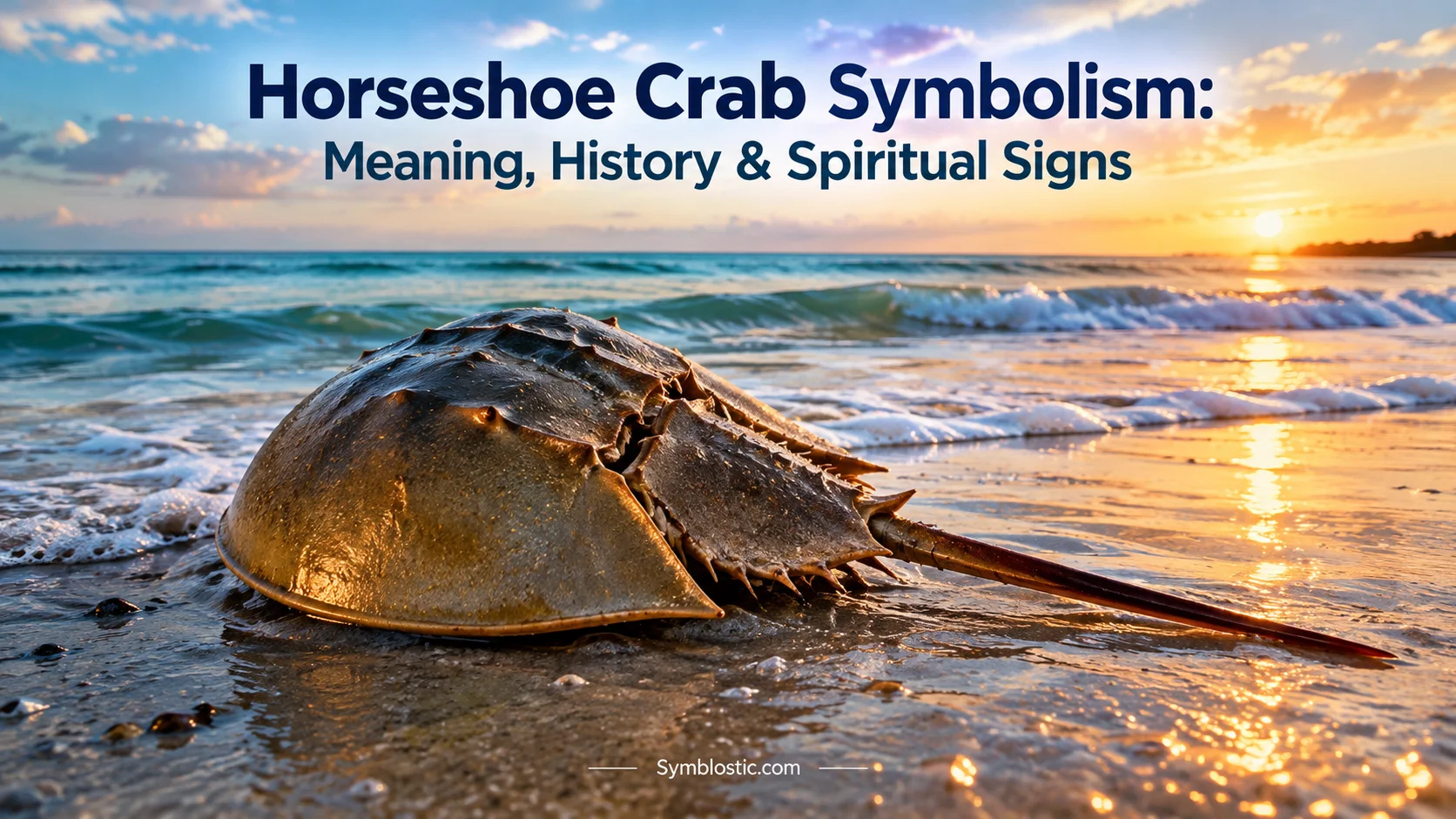
The Horseshoe Crab Symbolism is closely connected with resilience, protection, survival, and ancient wisdom. This unusual coastal animal has survived for hundreds of millions of years, giving it a powerful place in human imagination.
In the United States, horseshoe crabs are especially connected with the Atlantic coast. They appear in nature stories, conservation efforts, beach traditions, and scientific history. Their hard shell and strange appearance also make them natural symbols of protection and endurance.
However, their meaning goes beyond simply being an ancient animal. Their relationship with tides, moon cycles, migration, reproduction, and survival creates deeper symbolic themes. For many people, seeing one can represent patience, adaptability, or continuing forward despite difficult conditions.
Quick Answer
Horseshoe Crab Symbolism in the USA commonly represents resilience, protection, survival, patience, and ancient wisdom. Because horseshoe crabs have existed for hundreds of millions of years, they can also symbolize endurance through enormous changes and the ability to survive when the world around you changes.
TL;DR
- Horseshoe crabs symbolize resilience, protection, survival, and endurance.
- Their ancient history connects them with timeless wisdom and longevity.
- In America, they strongly represent Atlantic coastal ecosystems and conservation.
- Their hard shell naturally suggests boundaries, defense, and emotional protection.
- Their connection with tides can symbolize cycles, timing, and patience.
- Modern uses include tattoos, artwork, education, conservation, and coastal decor.
What Does a Horseshoe Crab Symbolize?
The horseshoe crab looks prehistoric, yet it remains part of modern coastal ecosystems. That combination gives the animal a distinctive symbolic meaning.
Resilience and Survival
The strongest association is resilience. Horseshoe crabs have survived major environmental changes across immense stretches of geological time.
That doesn’t mean they are literally unchanged. Their bodies and behavior have evolved. Still, their long evolutionary history makes them a powerful image of persistence.
For a person, the symbol can suggest:
• Surviving difficult periods without losing your identity
• Adapting when circumstances change around you
• Staying patient during slow personal growth
• Carrying strength quietly rather than showing it
Protection and Boundaries
The horseshoe crab’s hard outer shell creates another obvious association.
Unlike animals that rely on speed, the horseshoe crab has physical armor. Symbolically, this can represent defense, boundaries, and self-protection.
For modern readers, that idea can have an emotional meaning. Someone may connect with the animal because they value privacy or need stronger personal boundaries.
Horseshoe Crab Symbolism in the USA
In American culture, the horseshoe crab is strongly tied to the Atlantic coastline. Its symbolic meaning therefore often begins with nature, beaches, tides, and marine life.
Atlantic Coast Connections
Horseshoe crabs are associated with coastal areas along the eastern United States. Their seasonal movements are especially important around beaches and shallow coastal waters.
In several coastal communities, their arrival has long been part of the natural rhythm of spring and early summer.
That makes the horseshoe crab a symbol of return and natural cycles.
Conservation and Environmental Awareness
Today, horseshoe crabs also represent environmental stewardship.
Their populations support coastal food webs, while their eggs provide an important seasonal food source for migratory shorebirds. As a result, the animal has become connected with discussions about protecting beaches and marine ecosystems.
For Americans who care about conservation, a horseshoe crab can symbolize:
• Respect for coastal ecosystems
• Protection of marine biodiversity
• Responsibility toward wildlife
• Balance between human use and nature
Science and Human Health
Horseshoe crabs also have an unusual place in American scientific history.
Their blood contains a substance used in medical safety testing for bacterial contamination. This has made the species important to biomedical research.
However, this relationship has also raised conservation and animal-welfare questions. Modern practices increasingly include efforts to reduce harm and develop alternatives.
The Ancient History Behind Horseshoe Crab Symbolism
Few living animals create a stronger impression of deep time. Horseshoe crabs belong to an ancient lineage that existed long before humans.
A Survivor From Deep Time
Horseshoe crabs have existed for hundreds of millions of years. Their ancestors lived during periods when Earth’s ecosystems looked very different from today.
This history naturally supports symbolic ideas of longevity and endurance.
When people see a horseshoe crab, they may imagine an animal that has witnessed countless changes. Symbolically, it can therefore represent staying grounded while the world transforms.
Why They Are Sometimes Called “Living Fossils”
The phrase “living fossil” is often used for horseshoe crabs because of their ancient body plan.
However, the term can be misleading if taken literally. Horseshoe crabs are living, evolving animals rather than fossils that simply remained unchanged.
Symbolically, though, the phrase explains why they are associated with ancient wisdom and continuity.
Horseshoe Crab Spiritual Meaning
There isn’t one universal spiritual meaning for horseshoe crabs. Instead, modern spiritual interpretations often develop from their natural traits and behavior.
Ancient Wisdom and Longevity
Their enormous evolutionary history can inspire the idea of ancient wisdom.
In spiritual symbolism, an ancient animal may represent lessons that remain valuable across generations. The horseshoe crab can therefore suggest patience and respect for natural time.
Protection and Grounding
The animal’s armored body can also represent spiritual protection.
Someone may interpret a horseshoe crab encounter as a reminder to protect their energy, values, or emotional space. This is a personal interpretation rather than a universal religious teaching.
Cycles and Timing
Horseshoe crabs are closely linked with tides and seasonal cycles.
That makes them useful symbols for people thinking about timing. Their symbolism can suggest that not everything needs to happen immediately.
Sometimes progress depends on waiting for the right conditions.
Read More: Agouti Symbolism: Meaning, History & Spiritual Signs
Horseshoe Crab Symbolism in Different Cultures
Horseshoe crabs don’t have one globally shared symbolic meaning. Their cultural significance varies according to geography and local traditions.
East Asian Associations
In parts of East Asia, horseshoe crabs have long been known as coastal animals and have been used as food in some communities.
Their shells and unusual appearance have also contributed to local folklore and traditional associations. However, meanings differ between regions, so broad claims about a single “Asian meaning” can be misleading.
Indigenous and Local Coastal Contexts
Horseshoe crabs have existed within North American coastal ecosystems for an extremely long time.
Different Indigenous nations have distinct relationships with coastal animals and environments. It would be inaccurate to assign one universal Indigenous symbolism to the horseshoe crab.
For respectful interpretation, the safest approach is to discuss specific communities and documented traditions rather than treating all Indigenous cultures as one tradition.
What Horseshoe Crabs Represent Emotionally
The animal’s appearance can create surprisingly strong emotional reactions.
Some people see the horseshoe crab as fascinating and ancient. Others find it strange or intimidating because of its armored body and unusual tail.
Strength Without Aggression
A horseshoe crab doesn’t look powerful in the same way as a bear or eagle.
Its strength appears through protection and persistence instead. That makes it a useful symbol for quiet resilience.
You don’t always need to appear dominant to survive difficult situations.
Patience and Acceptance
The animal’s association with tides can also create a sense of patience.
Its symbolism can remind people that natural processes often move in cycles. Some changes happen slowly and cannot be rushed.
Feeling Different
The horseshoe crab doesn’t resemble many familiar animals.
Because of this, it can appeal to people who feel comfortable being unusual or independent. A horseshoe crab tattoo, for example, may express an appreciation for uniqueness.
Horseshoe Crab Symbolism and Personal Boundaries
The shell is perhaps the clearest visual metaphor connected with the animal.
The Shell as a Protective Symbol
A hard outer covering can symbolize emotional protection.
For someone who has experienced difficult situations, the horseshoe crab may represent learning how to create healthy boundaries without becoming completely closed off.
That distinction matters. Protection doesn’t always mean isolation.
The Tail and Direction
The long tail-like structure, called a telson, can also inspire symbolic interpretations.
People sometimes see it as representing direction, balance, or navigating uncertain environments. Biologically, however, the telson serves practical functions and isn’t a symbolic object in itself.
Horseshoe Crab Symbolism in Dreams
Dream interpretations are personal rather than fixed rules.
Still, modern symbolic traditions often connect horseshoe crabs in dreams with protection, survival, patience, or unusual situations.
Seeing a Horseshoe Crab
Seeing one in a dream may reflect a need for protection or emotional distance.
It could also simply reflect something you recently saw, watched, read, or experienced. Dream symbolism shouldn’t automatically be treated as a prediction.
Finding a Horseshoe Crab
Finding one may symbolize discovering something old, hidden, or unexpected.
The meaning can change depending on the dream’s emotional tone. A peaceful encounter suggests something different from fear or disgust.
A Dead Horseshoe Crab
A dead horseshoe crab may symbolize endings, change, or the passing of an old phase.
However, it doesn’t automatically mean something bad will happen. In symbolic language, death often represents transition rather than literal death.
Horseshoe Crab Symbolism in Tattoos and Art
Horseshoe crab imagery can work especially well as a tattoo because its shape is distinctive.
Common Tattoo Meanings
People may choose horseshoe crab tattoos to represent:
• Long-term resilience after difficult experiences
• Connection with the ocean or Atlantic coast
• Appreciation for unusual forms of life
• Protection and strong personal boundaries
• Respect for conservation and marine ecosystems
• Patience through major life changes
The meaning ultimately depends on the person wearing it.
Coastal Art and Decor
Horseshoe crab artwork can also appear in beach homes, marine classrooms, natural-history displays, and coastal design.
In these settings, the animal often communicates a connection with the sea rather than a specific spiritual belief.
Horseshoe Crabs, Tides, and the Meaning of Cycles
One of the most interesting aspects of horseshoe crab symbolism comes from the animal’s relationship with tides.
Following Natural Rhythms
Horseshoe crabs come ashore in connection with particular environmental conditions, including tidal cycles.
This makes them natural symbols of rhythm and timing.
For a modern person, that can become a simple reminder. Not every goal requires constant action. Sometimes timing matters as much as effort.
Returning to the Shore
Seasonal spawning also creates an image of return.
Symbolically, returning can represent homecoming, memory, family, tradition, or reconnecting with something important after time away.
| Context | Meaning in the USA | Common Association | Symbolic Idea |
| Atlantic beach | Coastal identity | Ocean and wildlife | Connection |
| Hard shell | Personal protection | Defense | Boundaries |
| Ancient lineage | Deep history | Survival | Endurance |
| Tidal movement | Natural rhythm | Seasons | Patience |
| Conservation | Environmental awareness | Marine life | Stewardship |
Horseshoe Crab Symbolism in Modern American Life
The horseshoe crab isn’t a major national emblem, but it has a recognizable place in American coastal culture.
Education and Natural History
Museums, aquariums, schools, and coastal organizations often use horseshoe crabs to teach marine biology.
This gives the animal an educational meaning. It becomes a reminder that unfamiliar creatures can have major ecological importance.
Social Media and Nature Content
Today, unusual wildlife often receives attention through photography and short-form videos.
Horseshoe crabs fit this trend because their appearance immediately attracts curiosity. Their ancient history also gives creators an interesting story to share.
Holidays and Coastal Traditions
Horseshoe crabs aren’t strongly tied to a major national holiday.
However, their seasonal appearance can become part of local beach traditions and wildlife events. In this context, the symbolism centers on seasonal return rather than celebration.
Horseshoe Crab Symbolism and Conservation
The species has an important place in environmental discussions.
Why Conservation Matters
Horseshoe crabs support coastal food webs. Their spawning activity also provides an important food source for migratory shorebirds.
This makes them more than an unusual beach animal. They are part of a larger ecological system.
Medical Use and Ethical Questions
The biomedical value of horseshoe crab blood has created a complex relationship between humans and the species.
The process has historically involved collecting blood from living animals. Some animals survive, while concerns remain about mortality and longer-term effects.
Today, conservation efforts and synthetic alternatives are part of the broader discussion. The symbolism here is especially relevant: human progress and environmental responsibility can sometimes pull in different directions.
Misunderstandings About Horseshoe Crab Symbolism
Because horseshoe crabs look unusual, people sometimes attach exaggerated meanings to them.
Not a Literal Sign of Good or Bad Luck
There is no universal rule saying that seeing a horseshoe crab guarantees good fortune or misfortune.
Some modern spiritual interpretations describe encounters as meaningful. Those interpretations are personal rather than established facts.
Not Actually a Crab
Despite its common name, the horseshoe crab isn’t a true crab.
It belongs to a different group of arthropods and is more closely related to arachnids than to ordinary crabs. This fact can strengthen its symbolic association with being unusual or misunderstood.
The “Ancient” Label Needs Context
Calling the animal ancient is reasonable.
However, saying it has remained completely unchanged for hundreds of millions of years oversimplifies evolution. Its lineage is ancient, but living horseshoe crabs are still evolving animals.
How Horseshoe Crab Meaning Has Changed Over Time
The symbolic meaning of an animal often changes as human knowledge changes.
From Strange Beach Animal to Scientific Interest
Historically, many people encountered horseshoe crabs mainly as coastal animals.
Modern science has added new layers of meaning. Their blood, biology, reproduction, and ecological role have made them scientifically important.
From Curiosity to Conservation Symbol
Today, the horseshoe crab can represent environmental responsibility as well as survival.
This shift is especially visible in coastal education and conservation work. People increasingly see the animal as part of a connected ecosystem.
From Ancient Creature to Modern Metaphor
Modern symbolism combines old and new ideas.
Its ancient lineage suggests endurance. Its shell suggests protection. Its tidal behavior suggests timing. Its ecological importance suggests responsibility.
Together, these themes create a surprisingly rich symbol.
FAQs:
What does a horseshoe crab symbolize spiritually?
A horseshoe crab can symbolize resilience, protection, patience, and ancient wisdom. These meanings come mainly from its long evolutionary history, hard shell, and relationship with coastal cycles.
Is seeing a horseshoe crab a good sign?
There is no universal spiritual rule about seeing one. Some people interpret an encounter positively as a reminder of survival, patience, or connection with nature.
What does a horseshoe crab represent in dreams?
A horseshoe crab in a dream may represent protection, emotional boundaries, survival, or adapting to change. The dreamer’s feelings and circumstances matter more than any fixed interpretation.
What does a horseshoe crab tattoo mean?
A horseshoe crab tattoo can represent resilience, coastal identity, protection, uniqueness, or respect for marine life. The personal meaning depends on the design and the person choosing it.
Why are horseshoe crabs considered ancient?
Horseshoe crabs belong to an ancient evolutionary lineage that reaches back hundreds of millions of years. Their basic body plan has remained recognizable, although living species have continued to evolve.
Are horseshoe crabs actually crabs?
No. Despite their name, horseshoe crabs aren’t true crabs. They are arthropods with a closer evolutionary relationship to arachnids.
Conclusion:
Horseshoe crab symbolism centers on resilience, protection, survival, patience, and ancient continuity. In the United States, it also carries strong associations with Atlantic beaches, marine ecosystems, conservation, science, and the natural rhythms of the coast.
The animal’s symbolism becomes especially interesting because its physical traits and natural history work together. Its hard shell suggests protection, its ancient lineage suggests endurance, and its relationship with tides suggests patience and timing.

1 thought on “Horseshoe Crab Symbolism: Meaning, History & Spiritual Signs”