
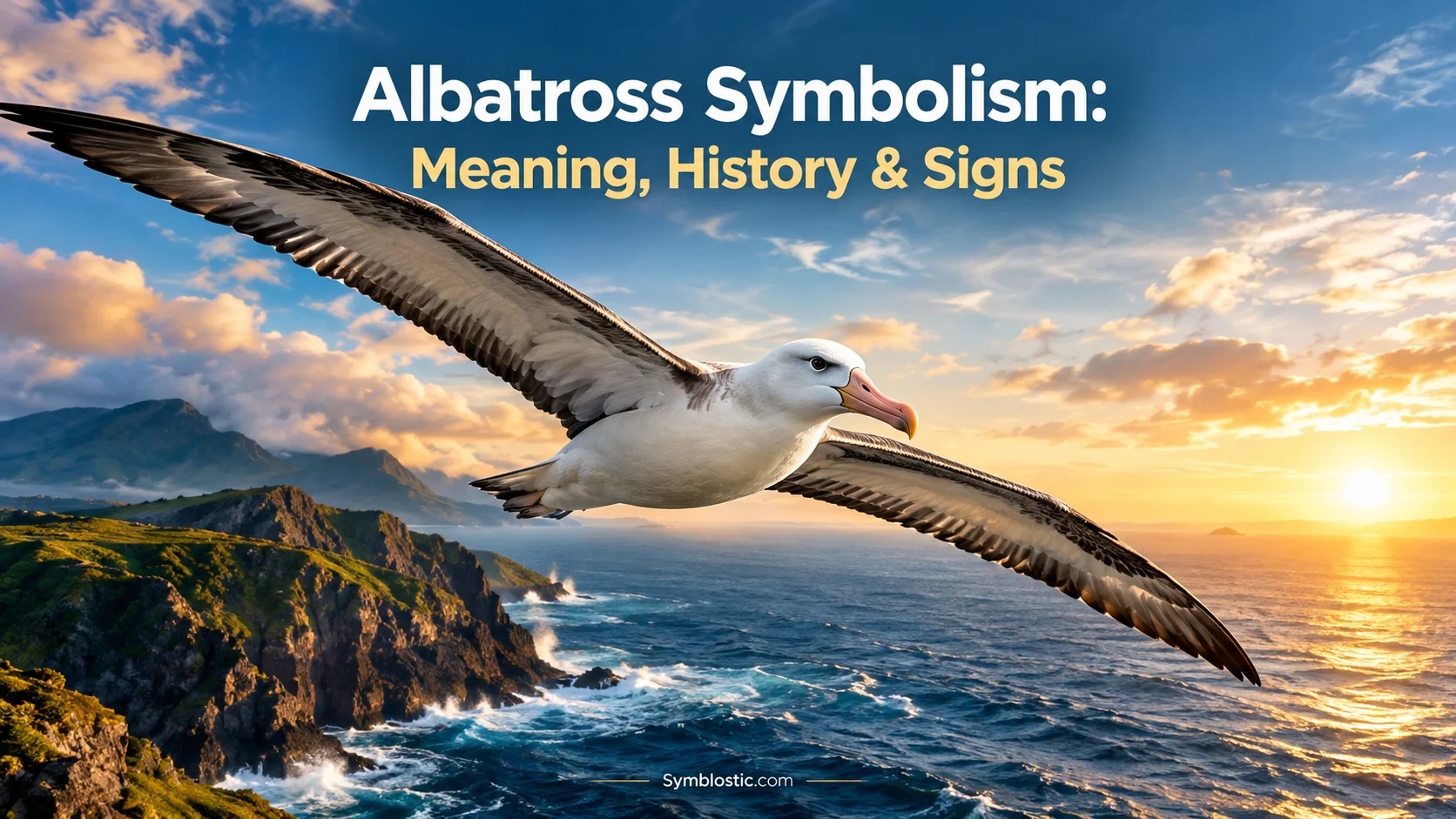
Albatross Symbolism carries two very different ideas: freedom over the open ocean and the heavy burden of guilt. This remarkable seabird has inspired sailors, writers, artists, and modern conservation movements for centuries.
In the United States, the albatross is especially connected with exploration, endurance, the sea, and literature. At the same time, the phrase “an albatross around your neck” gives the bird a darker meaning. It can describe a problem, responsibility, or past mistake that feels difficult to escape.
The real bird helps explain both sides of this symbolism. Albatrosses spend much of their lives over the ocean and can glide for enormous distances with very little effort. Some species also form long-term pair bonds and return to breeding islands year after year.
Quick Answer
Albatross Symbolism usually represents freedom, endurance, loyalty, ocean travel, and spiritual mystery. In American culture, however, it can also symbolize guilt or an unwanted burden because of Samuel Taylor Coleridge’s The Rime of the Ancient Mariner.
TL;DR
- Albatrosses often symbolize freedom, endurance, travel, and long-distance journeys.
- American culture strongly connects the bird with Coleridge’s famous poem.
- “An albatross around your neck” means an inescapable burden.
- Sailors historically connected albatrosses with luck, mystery, and the sea.
- Modern meanings also include loyalty, conservation, resilience, and independence.
- Albatross tattoos can represent freedom, survival, travel, or overcoming hardship.
What Does an Albatross Symbolize?
Freedom and Endless Movement
An albatross is one of nature’s great symbols of freedom. Its enormous wings allow it to travel over open water for long periods.
Because of this, people often associate the bird with independence and unrestricted movement. It can represent someone who wants room to explore rather than remain tied to one place.
Endurance and Resilience
The bird also suggests stamina. Albatrosses can travel enormous distances while using ocean winds to reduce the energy needed for flight.
That makes the bird a natural symbol of persistence. It can represent continuing forward even when the journey is long or difficult.
Burden and Guilt
The darker meaning comes mainly from literature. Coleridge’s 1798 poem transformed the albatross into an enduring image of guilt and punishment.
Today, an “albatross” can mean a problem that follows someone for years. The meaning can involve regret, responsibility, debt, failure, or an unwanted obligation.
Albatross Appearance and Symbolic Features
The Wings
The long wings are perhaps the bird’s strongest visual symbol. They suggest freedom, distance, ambition, and the ability to rise above difficulties.
In artwork, extended wings can make an albatross look powerful and almost limitless. However, folded wings can create a very different feeling, suggesting rest, patience, or restraint.
The Ocean Setting
The ocean adds another layer of meaning. It represents mystery, uncertainty, exploration, and emotional depth.
An albatross flying above waves can therefore symbolize a person moving through uncertain circumstances without losing direction.
White and Dark Plumage
Many albatross species have striking white, gray, or dark feathers. White can suggest purity and peace, while darker feathers can create associations with mystery and the unknown.
However, these meanings depend heavily on artistic context. There is no universal rule that one feather color has only one symbolic meaning.
Albatross Symbolism in American Culture
Literature and the American Imagination
The strongest American association comes from English literature that became part of American literary culture. Coleridge’s The Rime of the Ancient Mariner made the albatross a powerful symbol of consequences.
The story helped establish the phrase “albatross around your neck.” In everyday American English, the expression describes a burden that seems difficult to remove.
The bird therefore has an unusual double identity. It can represent freedom in nature while representing restriction in metaphor.
Ocean Travel and Exploration
The United States has a strong cultural relationship with ocean travel, naval history, fishing, and exploration. Because albatrosses live far from land, they naturally fit this larger cultural idea of the open sea.
They can symbolize adventure, navigation, distance, and the willingness to enter unfamiliar territory.
Hawaii and the Pacific
Albatrosses have an especially important connection with the Pacific. Laysan and black-footed albatrosses breed on Hawaiian and other Pacific islands and range widely across ocean waters.
For American audiences, this makes the bird more than a literary symbol. It is also part of the natural heritage of the Pacific region.
Albatross Meaning in America: A Symbolic Overview
Common Contexts
Different situations can completely change what an albatross represents. A tattoo may celebrate freedom, while a literary reference may suggest guilt.
| Context | Meaning in the USA | Common Association | Symbolic Tone |
| Open ocean | Freedom and exploration | Travel, independence | Positive |
| Literature | Guilt and consequences | Coleridge’s poem | Serious |
| Tattoo | Resilience or freedom | Personal journey | Personal |
| Conservation | Survival and responsibility | Ocean protection | Hopeful |
| Sailing | Endurance and navigation | Long voyages | Adventurous |
| Personal metaphor | Heavy burden | Difficult responsibility | Mixed |
Why Context Matters
There is no single American meaning for every albatross image. The surrounding words, artwork, posture, and setting usually provide important clues.
For example, an albatross flying above calm water feels very different from an albatross hanging around someone’s neck. Both images are culturally recognizable, but they communicate opposite emotional ideas.
Historical Roots of Albatross Symbolism
Early Maritime Associations
Albatrosses became closely associated with sailors because they spend so much time over the ocean. Their ability to appear far from land made them seem mysterious to people traveling across unfamiliar waters.
Some maritime traditions treated these birds with respect or caution. Stories also developed about birds carrying the souls of sailors who had died at sea.
However, such beliefs were not universal. Historical evidence shows that sailors did not always treat albatrosses as untouchable sacred animals.
The 1798 Turning Point
The most important change came with Samuel Taylor Coleridge’s The Rime of the Ancient Mariner, first published in 1798.
In the poem, a sailor kills an albatross without a clear reason. The bird’s death becomes connected with suffering, guilt, punishment, and the need for moral change.
This literary image became much more influential than many earlier and less consistent sailor traditions.
The Birth of a Lasting Metaphor
The dead albatross placed around the mariner’s neck became a visual symbol of guilt that cannot easily be removed.
Over time, “albatross” developed a figurative meaning in English. Today, calling something an albatross can suggest that it creates a serious and persistent burden.
Spiritual Meaning of the Albatross
A Messenger Between Worlds
Birds often appear in spiritual traditions as creatures associated with the sky. They move between land, water, and air, which can make them powerful symbols of transition.
The albatross strengthens this idea because it spends enormous amounts of time far from land. It can therefore represent a journey between the familiar and unknown.
Guidance and Protection
Some modern spiritual interpretations view the albatross as a sign of guidance. Its ability to travel long distances can symbolize staying on course during a major life transition.
These interpretations are personal rather than universal religious teachings. Someone may see the bird as a meaningful reminder without treating that interpretation as a fixed spiritual rule.
Letting Go of a Burden
The darker symbolism can also become spiritually constructive. An albatross may represent something a person needs to release, such as an old mistake or unhealthy attachment.
In this sense, the symbol moves from punishment toward personal reflection.
Albatross Symbolism Across Cultures
Maritime European Traditions
European maritime culture strongly shaped modern albatross folklore. Sailors encountered these enormous seabirds in remote waters and naturally developed stories around them.
Later, literature added powerful themes of guilt, supernatural consequence, and respect for nature.
Māori Connections
The albatross, known as toroa in Māori, has cultural significance in Aotearoa New Zealand. Its relationship with the sea, islands, navigation, and return gives it meanings that extend beyond the narrow “bad luck” idea familiar in English literature.
These traditions should not be reduced to one simple definition. Cultural meanings develop within particular histories and communities.
Pacific Ocean Connections
Across Pacific settings, the albatross can evoke ocean travel, island ecosystems, seasonal movement, and a close relationship with the sea.
Modern conservation work has added another layer. The bird can now represent the need to protect ocean environments and the creatures that depend on them.
Read More: Horseshoe Crab Symbolism: Meaning, History & Spiritual Signs
Emotional and Psychological Meaning of the Albatross
When It Represents Freedom
An albatross may appeal to people who value independence. Its ability to cross huge stretches of ocean creates an image of self-direction.
Someone drawn to the bird may connect it with travel, personal growth, or breaking away from limitations.
When It Represents Burden
The same bird can symbolize something much heavier. The familiar phrase about an albatross around the neck describes a problem that continues affecting someone’s life.
This might involve regret, responsibility, embarrassment, or an obligation that feels difficult to escape.
When It Represents Resilience
The bird can also express endurance without focusing on suffering. It survives long journeys by working with natural forces rather than constantly fighting them.
That idea can appeal to people who value patience, adaptability, and steady progress.
Albatross Symbolism in Dreams
Seeing an Albatross Flying
A flying albatross may be interpreted as a personal image of freedom, movement, or a desire for greater independence.
The emotional tone of the dream matters. A peaceful flight may feel hopeful, while a frightening scene may suggest uncertainty or emotional pressure.
Seeing an Injured Albatross
An injured bird can symbolize vulnerability or a loss of freedom. It may reflect concern about something that once felt strong or independent.
However, dreams don’t have one universal dictionary. Personal experiences usually matter more than fixed symbolic definitions.
Seeing an Albatross Near the Ocean
An albatross above the ocean may combine themes of exploration and uncertainty. It can represent entering unfamiliar territory while trying to maintain direction.
For some people, it may simply reflect a recent memory, image, or interest rather than a deeper message.
Albatross Tattoos and Modern Symbolism
Freedom and Adventure
An albatross tattoo can represent a love of travel and open spaces. The bird’s enormous wings make it especially suitable for designs about movement.
Many people also choose it to mark a major journey or life transition.
Surviving a Difficult Period
The bird can represent resilience after hardship. In this interpretation, its long flight becomes a visual metaphor for continuing despite difficult conditions.
A tattoo may therefore carry a deeply personal meaning that outsiders cannot immediately see.
The Albatross Around the Neck
Some designs deliberately use the darker literary meaning. An albatross around the neck can represent guilt, regret, responsibility, or overcoming a difficult past.
However, tattoo symbolism depends on the owner’s intention. The same bird may mean freedom to one person and burden to another.
Albatrosses in Art, Media, and Everyday Language
Visual Art
Artists often use albatrosses to create a sense of scale. A huge bird above an endless ocean can make a person or ship appear small.
That contrast can suggest humility, wonder, isolation, or freedom.
Social Media
Online, albatross references often use the bird metaphorically. Someone may describe a difficult project, old mistake, or unwanted responsibility as an “albatross.”
At the same time, nature-focused posts often use the bird to celebrate wildlife, migration, and ocean conservation.
Sports and Everyday Language
The word has another unusual American association in golf. An “albatross” describes an extremely rare score of three strokes under par on a single hole.
This meaning is separate from the guilt metaphor. It shows how one word can develop several cultural meanings over time.
Albatross Misunderstandings and Controversies
Was Killing an Albatross Always Considered Bad Luck?
Not necessarily. The idea is often presented as though every sailor throughout history followed one universal rule.
Historical evidence is more complicated. Some sailors respected or feared these birds, while others hunted them or used them for food and materials.
Coleridge’s poem helped make the superstition far more famous.
Is the Albatross Always a Negative Symbol?
No. The negative meaning is only one part of its cultural history.
Today, the bird can represent freedom, endurance, loyalty, exploration, environmental responsibility, and connection with the ocean.
Conservation Changes the Conversation
Modern awareness of fishing bycatch, plastic pollution, and other ocean threats has created another symbolic layer.
The albatross can now represent environmental vulnerability. Its survival can remind people that freedom in nature depends partly on responsible human choices.
How Albatross Symbolism Has Changed Over Time
From Maritime Mystery to Literary Burden
Earlier associations centered on the sea, sailors, luck, and mystery. Coleridge’s poem shifted the strongest English-language association toward guilt and consequence.
That literary meaning eventually became an everyday metaphor.
From Burden to Resilience
Modern audiences often reclaim the bird’s positive qualities. Its long-distance flight makes it an attractive symbol for endurance and independence.
As a result, the albatross can now represent both the burden someone carries and the strength needed to move beyond it.
From Folklore to Conservation
The modern albatross is also a real conservation concern. This has shifted some public attention from superstition toward ecology.
The bird can therefore symbolize a broader relationship between humans and the natural world.
Why the Albatross Is Such a Powerful Symbol
It Holds Opposite Meanings
Few symbols combine freedom and burden so clearly. The real bird represents extraordinary movement, while the literary albatross represents something that weighs a person down.
That contradiction makes it especially powerful in storytelling and personal symbolism.
It Connects Nature and Human Experience
The albatross isn’t simply a fictional symbol. Its actual behavior gives meaning to many interpretations.
Its long flights, ocean life, strong navigation abilities, and repeated journeys provide natural images of endurance and exploration.
It Encourages Personal Interpretation
An albatross can mean different things at different stages of life. Someone beginning a new journey may see freedom in the bird.
Someone dealing with an old responsibility may recognize the darker metaphor instead.
FAQs:
What does an albatross symbolize spiritually?
An albatross can symbolize guidance, freedom, endurance, transition, and a journey through uncertainty. Some people also interpret it as a reminder to release burdens from the past.
What does an albatross mean in American culture?
In American culture, the albatross commonly represents either freedom and ocean travel or a heavy burden. Literature strongly influenced the second meaning through Coleridge’s famous poem.
Why is an albatross considered bad luck?
The bad-luck association comes from maritime folklore and became especially famous through The Rime of the Ancient Mariner. However, historical sailor beliefs were not completely uniform.
What does “an albatross around your neck” mean?
The phrase describes a difficult burden that follows someone and limits their freedom. It often refers to guilt, responsibility, regret, or a persistent problem.
What does an albatross tattoo symbolize?
An albatross tattoo can represent freedom, travel, endurance, independence, or overcoming hardship. If shown around the neck, it may intentionally reference guilt or an unwanted burden.
Is the albatross a symbol of freedom?
Yes, especially in modern symbolic interpretations. Its enormous wings and ability to travel across vast oceans make it a natural image of independence and unrestricted movement.
Conclusion:
Albatross Symbolism is powerful because the bird carries two contrasting ideas. It can represent freedom, endurance, exploration, loyalty, and the vastness of the ocean. Yet it can also represent guilt, responsibility, and a burden that refuses to disappear.
In the United States, both meanings remain recognizable. The bird’s real-life behavior gives it a positive connection with resilience and freedom, while its place in literature gives it a darker emotional meaning.

1 thought on “Albatross Symbolism: Meaning, History & Signs”