
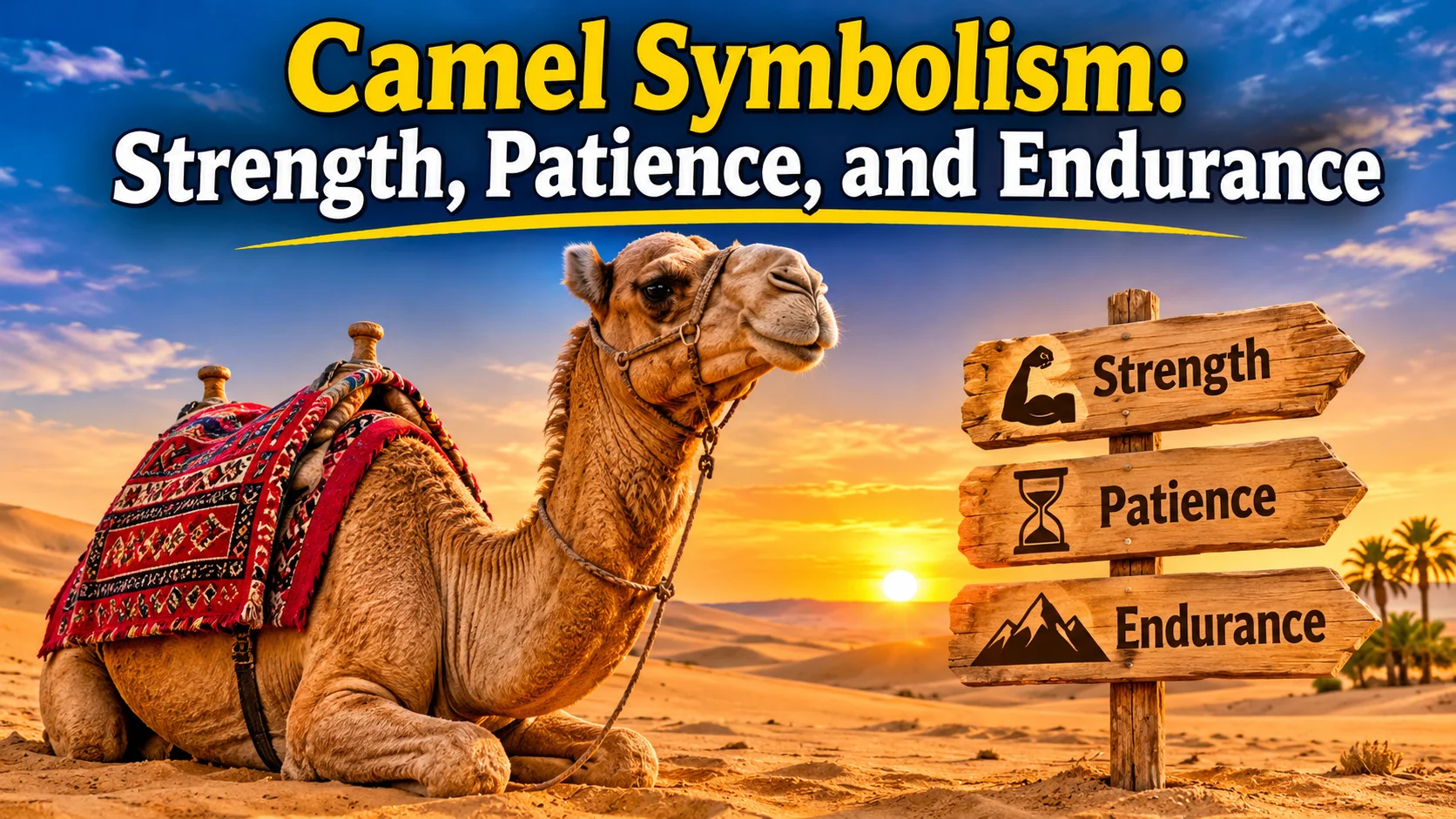
A camel is more than an animal adapted to dry deserts. Across history, it has represented patience, endurance, independence, and the ability to survive difficult conditions. Camel symbolism often reminds people that strength isn’t always loud or powerful. Sometimes, true strength means continuing forward when life becomes uncomfortable.
In the United States, camels are commonly associated with desert landscapes, long journeys, adventure, and survival. Their unusual appearance and remarkable ability to withstand harsh environments make them powerful symbols of determination. They also appear in American history through the nineteenth-century Army Camel Corps experiment.
However, camel symbolism reaches far beyond American history. In Middle Eastern and North African cultures, camels have supported transportation, trade, family life, and survival for centuries. They also appear in religious stories, traditional art, and spiritual interpretations.
Today, people connect camels with personal growth, emotional strength, self-reliance, and patience. Some choose camel tattoos to represent their journey through difficult experiences. Others see the animal as a reminder to conserve their energy and trust their own pace.
Understanding this symbol requires looking at its natural characteristics, cultural history, and changing meanings. Its message is especially meaningful when you’re facing uncertainty or preparing for a long journey.
Quick Answer
Camel symbolism in the United States represents endurance, patience, resilience, independence, and survival through difficult circumstances. Spiritually, camels are also associated with wisdom, resourcefulness, humility, and the ability to carry life’s burdens without giving up.
TL;DR
- Camels symbolize patience, endurance, and the strength to overcome challenges.
- Their desert survival represents adaptability and resourcefulness.
- American history connects camels with exploration and frontier transportation.
- Spiritual interpretations associate them with perseverance and inner wisdom.
- Camel tattoos often represent independence and personal transformation.
- Their image reminds people to conserve energy and keep moving forward.
What Does a Camel Symbolize?
The camel’s physical characteristics explain much of its symbolic meaning. Its long legs, broad feet, distinctive hump, and ability to travel across dry landscapes make it an unusual symbol of survival.
Unlike animals that depend on frequent access to water, camels can withstand extended periods without drinking. Their bodies are specially adapted to conserve water and tolerate extreme temperatures. However, their endurance doesn’t mean they never need rest or care.
Strength and Endurance
Camels are famous for carrying heavy loads across challenging landscapes. This ability makes them symbols of strength that develops through experience.
In everyday life, this meaning connects with people who continue working toward their goals despite setbacks. It represents determination rather than physical power alone.
Patience and Perseverance
A camel doesn’t need to rush through every journey. Its steady movement represents the importance of taking things one step at a time.
For American readers, this can reflect career development, education, personal recovery, or long-term ambitions. Progress doesn’t always happen quickly, but consistency can make a difference.
Adaptability and Survival
Camels survive in environments where many other animals would struggle. Their ability to adjust represents practical intelligence and flexibility.
This symbolism encourages people to develop useful skills instead of expecting every situation to become comfortable.
Historical Origins of Camel Symbolism
Camels have influenced human societies for thousands of years. Their importance developed through transportation, trade, agriculture, warfare, and cultural traditions.
Ancient Domestication
Dromedary camels, which have one hump, were domesticated in the Arabian region during ancient times. Bactrian camels, which have two humps, became important across Central Asian regions.
These animals helped communities travel through difficult landscapes. They also transported food, textiles, salt, and other valuable goods.
As a result, camels became closely associated with wealth, survival, and successful trade.
Camels Along Ancient Trade Routes
Camels played important roles along historic trading networks connecting Arabia, North Africa, and parts of Asia.
Their ability to carry heavy loads made long-distance transportation more practical. Consequently, they became symbols of connection between distant communities.
Their presence also represented opportunity because merchants could transport valuable goods across challenging terrain.
Ancient Religious and Literary References
Camels appear in several ancient religious and literary traditions. In biblical stories, they are associated with travel, wealth, hospitality, and everyday life.
In Islamic traditions, camels also hold historical and religious significance. Stories involving camels appear in the Quran and accounts of early Muslim history.
These references helped establish the camel as an important cultural symbol rather than simply a working animal.
Camel Symbolism in American Culture
Although camels aren’t native to modern American wildlife, they have an interesting place in United States history. Their image connects with exploration, desert survival, transportation, and unusual experiments in frontier development.
The U.S. Army Camel Corps
One of the most interesting American connections began in 1855. Congress authorized $30,000 to purchase camels for military transportation experiments.
The Army wanted to determine whether camels could carry supplies across the dry landscapes of the American Southwest. In 1856, the first group arrived in Texas after being transported from overseas.
Later, camels accompanied an expedition led by Edward Fitzgerald Beale. They demonstrated their ability to carry supplies across difficult desert terrain.
However, the experiment eventually ended. The Civil War disrupted the project, and many camels were sold or released.
Today, this forgotten chapter gives camels a connection with American exploration and frontier history.
The Story of Hi Jolly
Another fascinating American connection involves Hadji Ali, a Syrian camel handler who arrived with the Army’s camel experiment.
Americans commonly called him Hi Jolly. He later became associated with Arizona’s camel history and southwestern folklore.
His story reflects the contributions of immigrants and foreign workers to American exploration.
A pyramid-shaped monument in Quartzsite, Arizona, commemorates him. It also celebrates the unusual history of camels in the American West.
What Camels Represent in the USA Today
For modern American audiences, camels can represent several ideas:
- Adventure: Exploring unfamiliar places and accepting new experiences.
- Resilience: Remaining strong during challenging circumstances.
- Independence: Depending on personal skills and determination.
- Exploration: Traveling beyond familiar surroundings.
- Resourcefulness: Making the most of limited resources.
These meanings make the camel an interesting symbol of the American frontier spirit.
Spiritual Meaning of a Camel
Spiritually, the camel is often interpreted as a symbol of perseverance, inner strength, and trust during difficult periods. Its ability to travel through demanding environments makes it a meaningful image of personal growth.
However, spiritual interpretations differ between individuals and traditions. There isn’t one universal meaning that applies to everyone.
Patience During Difficult Times
A camel can represent the ability to remain patient when life doesn’t follow your plans.
Sometimes, progress requires waiting, learning, and accepting temporary discomfort. The camel reminds people that difficult seasons don’t necessarily last forever.
Carrying Your Responsibilities
Because camels traditionally carry heavy loads, they can represent responsibility and emotional strength.
This interpretation connects with people who support their families, manage demanding responsibilities, or work toward important goals.
However, it also offers a reminder not to carry every burden alone.
Trusting Your Journey
A camel’s long-distance travels can symbolize faith in the journey ahead.
You might not know exactly where life will take you. Nevertheless, you can continue making thoughtful decisions without understanding every detail.
Camel Symbolism in Different Cultures and Religions
Camels have different meanings across cultures because their practical importance has varied throughout history. Understanding these differences provides a richer picture of the animal’s symbolism.
Middle Eastern and Arabian Traditions
In Arabian history, camels represent transportation, wealth, hospitality, and survival.
They helped people travel across deserts and maintain connections between distant settlements. Therefore, their importance extended into family traditions, poetry, and everyday cultural identity.
Camels also appear in traditional celebrations and artistic representations.
Islamic Symbolism
Camels appear in Islamic religious history and literature. One particularly significant example involves the camel of Prophet Salih, mentioned in the Quran.
The story presents the animal as a divine sign and a test for the people of Thamud.
Camels also appear in accounts of early Islamic history. However, their religious significance shouldn’t be reduced to a single spiritual interpretation.
African Cultural Connections
In parts of North and East Africa, camels have supported communities through transportation, milk production, and pastoral livelihoods.
For these communities, the animal can represent practical survival, economic stability, and relationships between people and their environment.
Its meaning is connected to real experiences rather than abstract symbolism alone.
Asian Cultural Traditions
Bactrian camels have played important roles in Central Asian transportation and trade.
Their ability to withstand cold conditions helped travelers move across difficult landscapes. Consequently, they became associated with endurance, travel, and economic exchange.
These meanings reflect the camel’s importance along historic routes connecting different regions.
Psychological Meaning of a Camel
Animals can become powerful psychological symbols because people connect their physical characteristics with human emotions and experiences.
The camel often represents emotional stability, self-control, and the ability to handle pressure.
Emotional Strength
A camel may represent someone who remains composed during stressful situations.
This doesn’t mean ignoring difficult feelings. Instead, it suggests recognizing emotions without allowing every challenge to control your decisions.
People who identify with this symbolism may value patience and emotional maturity.
Independence and Self-Reliance
Camels are strongly associated with surviving demanding environments.
Psychologically, this can represent confidence in your abilities and willingness to solve problems independently.
However, independence doesn’t mean refusing help. Healthy self-reliance also includes understanding when support is necessary.
Managing Your Energy
One interesting lesson from camel symbolism involves conserving energy.
Camels are adapted to use available resources efficiently. This creates a useful connection with modern life, where people often experience pressure to remain constantly productive.
The camel represents a different approach:
- Focus on important responsibilities instead of unnecessary distractions.
- Recognize when your body and mind need rest.
- Save energy for challenges that genuinely matter.
- Understand that consistent effort can outperform constant rushing.
- Accept that personal progress happens at different speeds.
What Does a Camel Represent in Dreams?
Dream interpretations are subjective. A camel appearing in a dream doesn’t establish that something specific will happen.
However, people commonly connect camel dreams with patience, responsibility, travel, and perseverance.
The details of the dream can influence its personal meaning.
Dreaming of a Walking Camel
A walking camel may represent steady progress toward a personal goal.
Perhaps you’re working through a difficult situation or making decisions about your future. The image can reflect your desire to keep moving forward.
Dreaming of Riding a Camel
Riding a camel may symbolize control over your direction or willingness to experience change.
It can also represent a long journey that requires preparation and patience.
Dreaming of a Camel Carrying Heavy Loads
This image may reflect responsibilities that feel difficult to manage.
You might be balancing family expectations, professional duties, or personal commitments.
It can encourage you to consider whether you’re taking on more than you can reasonably handle.
Dreaming of a Baby Camel
A baby camel may represent new beginnings, developing confidence, or responsibilities that are still growing.
It can also symbolize a new project that requires consistent attention.
Dreaming of an Aggressive Camel
An aggressive camel might reflect frustration, pressure, or a situation that feels difficult to control.
Rather than treating the dream as a warning, consider whether something in your waking life needs attention.
Camel Symbolism in Tattoos and Body Art
Camel tattoos can carry personal meanings that connect with travel, independence, and personal transformation.
For some people, the animal represents an important journey. For others, it symbolizes the ability to survive experiences that once seemed impossible.
Popular Camel Tattoo Meanings
Different designs can communicate different ideas:
- Walking camel: Represents persistence and steady progress.
- Camel in a desert: Symbolizes independence and survival.
- Camel silhouette: Represents simplicity, patience, and quiet strength.
- Camel with a sun: Connects with warmth, hope, and new beginnings.
- Camel caravan: Represents community, shared journeys, and cooperation.
- Baby camel: Symbolizes innocence, growth, and fresh opportunities.
Why People Choose Camel Tattoos
Someone who has traveled through desert regions might choose a camel to remember that experience.
Likewise, a person who has overcome personal difficulties might use the animal as a reminder of their resilience.
The design doesn’t need to communicate a universal meaning. Personal experiences often give tattoos their deepest significance.
Read More: Stick Bug Symbolism: Meaning, Patience, and Adaptability
Camel Symbolism in Art, Fashion, and Home Decor
Camels have a recognizable appearance that makes them popular in visual design.
Their distinctive shape, desert associations, and warm natural colors create a connection with travel and traditional craftsmanship.
Camel Colors and Their Meanings
Different visual choices can influence how people interpret camel imagery.
- Golden brown: Suggests warmth, stability, and natural surroundings.
- Sandy beige: Represents simplicity, calmness, and desert landscapes.
- Dark brown: Can suggest strength, maturity, and grounded energy.
- White: May represent peace, purity, or a fresh beginning.
- Black: Often creates associations with elegance, mystery, and strength.
These are general artistic associations, not fixed cultural rules.
Home Decoration
Camel imagery appears in decorative artwork, rugs, cushions, sculptures, and travel-inspired interiors.
In American homes, desert-themed decoration can connect with southwestern landscapes and rustic design.
A camel illustration can also introduce a sense of adventure into a room.
Fashion and Accessories
Camel imagery sometimes appears on clothing, bags, jewelry, and travel accessories.
Meanwhile, the color called camel is widely used in American fashion. It generally refers to a warm tan or brown shade inspired by camel hair.
This color often communicates understated elegance, warmth, and timeless style.
Camel Symbolism in Nature and the Animal Kingdom
A camel’s natural abilities help explain why it represents survival and adaptability.
Its body has developed several features that make desert life possible.
The Meaning of the Camel’s Hump
A common misunderstanding is that camels store water in their humps.
Actually, their humps store fat, which provides energy when food is limited.
Symbolically, this characteristic can represent preparation, stored resources, and the importance of planning ahead.
It also offers a useful lesson about understanding nature before assigning meaning to it.
Survival in Extreme Conditions
Camels have several physical adaptations that help them survive harsh environments.
Their broad feet help them walk on soft sand. Their long eyelashes and closable nostrils offer protection against blowing sand.
Additionally, their bodies tolerate significant changes in temperature and water balance.
These characteristics support their association with resilience and adaptability.
One-Humped and Two-Humped Camels
There are two major living camel species.
The dromedary has one hump and is commonly associated with Arabian and African desert environments. The Bactrian camel has two humps and is adapted to more extreme continental conditions.
Both can symbolize endurance, although their natural environments differ.
Negative Meanings and Misunderstandings About Camels
Camel symbolism is generally positive, but the animal can carry different associations depending on its context.
Understanding these differences prevents oversimplified interpretations.
Stubbornness and Difficult Behavior
Camels sometimes have a reputation for being stubborn.
In everyday expressions, someone might compare a difficult person to a camel because the animal can resist unwanted handling.
However, this association shouldn’t overshadow its intelligence and remarkable adaptability.
The Burden of Responsibility
The camel’s association with carrying heavy loads can have a negative interpretation.
It may represent someone who accepts too many responsibilities or feels emotionally exhausted.
In this context, the symbol encourages balance rather than endless sacrifice.
Historical Controversies in America
The American Camel Corps is often remembered as an unusual transportation experiment.
However, its history also connects with nineteenth-century expansion into the Southwest. Some political supporters viewed improved desert transportation as a way to strengthen American territorial control and expand slavery.
Therefore, the story isn’t simply an entertaining tale about an unusual military experiment.
It also belongs to a complicated period involving expansion, displacement, and competing political interests.
Cultural Misrepresentation
Camel imagery is sometimes used carelessly to represent all Middle Eastern or Muslim communities.
This can create misleading cultural associations because the region contains many different peoples, languages, and traditions.
A camel is an important symbol in certain cultural settings, but it doesn’t represent every person’s identity or beliefs.
How Camel Symbolism Has Changed Over Time
The meaning of camels has evolved alongside changes in transportation, culture, and technology.
In earlier societies, camels were essential working animals. Their value came from their ability to transport people and goods across challenging environments.
Today, their symbolic meaning often focuses more on personal qualities and cultural identity.
From Survival to Personal Growth
Historically, camels represented practical survival and economic stability.
Today, people frequently connect them with emotional endurance, patience, and personal development.
This shift reflects how animals can move from everyday necessities into symbols of human experiences.
From Transportation to Adventure
Modern transportation has reduced the camel’s importance in many parts of the world.
However, its image remains strongly connected with exploration and distant journeys.
In American popular culture, camels often appear in desert photography, travel illustrations, documentaries, and historical storytelling.
Meanings That Remain Relevant
Some associations have remained remarkably consistent:
- Endurance continues to represent the camel’s greatest symbolic quality.
- Travel remains connected with exploration and new experiences.
- Resourcefulness reflects the animal’s ability to survive difficult conditions.
- Patience continues to represent steady progress.
- Strength remains associated with carrying responsibilities and overcoming challenges.
FAQs:
What Does a Camel Symbolize Spiritually?
A camel spiritually symbolizes patience, endurance, perseverance, and inner strength. Many modern interpretations connect it with trusting your journey and remaining determined during difficult periods.
Is a Camel a Symbol of Good Luck?
Some people associate camels with good fortune because of their historical connections with wealth, trade, and successful travel. However, this isn’t a universal belief across cultures.
What Does a Camel Symbolize in American Culture?
In American culture, camels can represent desert exploration, survival, adventure, and frontier history. The nineteenth-century U.S. Army Camel Corps also connects them with American transportation experiments.
What Does a Camel Tattoo Mean?
A camel tattoo commonly represents resilience, independence, patience, and personal growth. Its meaning can also reflect someone’s travel experiences or ability to overcome difficult circumstances.
What Does Seeing a Camel Mean Spiritually?
Some spiritual interpretations connect seeing a camel with patience, preparation, and perseverance. Its appearance can serve as a personal reminder to remain steady during life’s challenges.
What Does a Camel Represent in Dreams?
A camel in a dream can represent responsibility, emotional strength, travel, or a long personal journey. Its meaning depends on the dream’s details and the dreamer’s personal experiences.
Conclusion:
Camel symbolism represents some of the most valuable qualities associated with survival and personal growth. Its strongest meanings include patience, endurance, adaptability, independence, and emotional strength.
In American culture, the camel also connects with desert exploration, frontier history, and the unusual story of the U.S. Army Camel Corps. Across other traditions, it carries associations with trade, transportation, hospitality, and survival.

1 thought on “Camel Symbolism: Strength, Patience, and Endurance”