
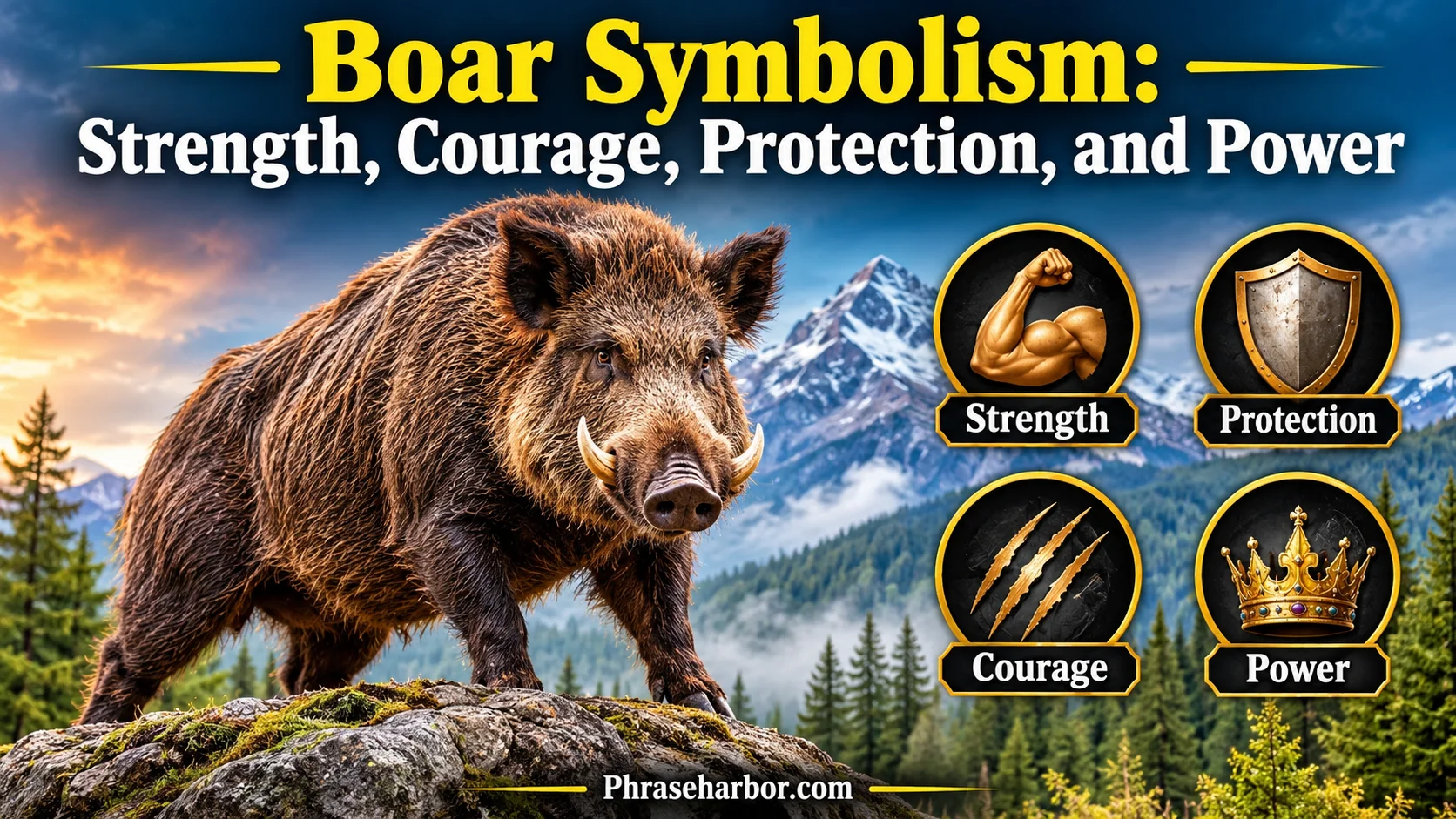
A boar is a powerful animal often associated with courage, strength, independence, and determination. Its muscular body, sharp tusks, and fearless behavior have made it an important symbol across many cultures. Boar symbolism carries a particularly interesting message in American culture, where the animal represents survival, toughness, and the ability to face challenges without backing down.
However, the boar isn’t simply a symbol of physical strength. It also represents confidence, personal boundaries, protection, and the willingness to defend what matters. Its connection with forests, wilderness, and untamed nature gives it another layer of meaning.
Throughout history, people have admired the boar for its impressive appearance and defensive abilities. Ancient warriors, storytellers, and artists used its image to represent bravery and fierce determination. Today, these associations continue through tattoos, artwork, personal symbolism, and popular culture.
Whether you’ve encountered a boar in a dream, noticed one in artwork, or simply feel connected to this animal, understanding its symbolism can reveal several interesting interpretations.
Quick Answer:
Boar symbolism primarily represents strength, courage, protection, determination, and independence. In American culture, it often reflects toughness, survival, and the ability to overcome difficult situations. Spiritually, the boar can represent personal power, resilience, and standing firmly against challenges.
TL;DR: Boar Symbolism at a Glance
- Strength: Represents physical power and inner resilience.
- Courage: Symbolizes facing danger without surrendering.
- Protection: Reflects defending yourself and loved ones.
- Determination: Represents persistence and an unstoppable attitude.
- Independence: Connects with freedom and self-reliance.
- Spiritual Growth: Can symbolize personal transformation and grounding.
What Does a Boar Symbolize?
The boar is one of the most recognizable symbols of wild strength. Its thick body, prominent tusks, and confident posture communicate power and determination. In the United States, these qualities often connect with rugged independence and survival.
However, the animal’s meaning depends on how it appears and the situation surrounding it. A charging boar can represent confrontation, while a calm boar may suggest confidence and self-control.
The Main Symbolic Meanings
The most common associations include:
- Physical strength: The ability to withstand pressure and hardship.
- Fearlessness: Facing difficult situations with confidence.
- Self-protection: Maintaining boundaries and defending personal values.
- Persistence: Continuing forward despite obstacles.
- Wild freedom: Living independently without unnecessary restrictions.
- Fierce loyalty: Protecting family, loved ones, and important responsibilities.
These meanings explain why the boar frequently appears in stories about warriors, hunters, and powerful leaders.
What Makes the Boar a Powerful Symbol?
Its tusks are among its most distinctive features. They represent defense, resistance, and the ability to stand against threats.
Additionally, its strong legs and muscular body suggest endurance. The animal can move through difficult environments while searching for food and shelter.
Therefore, the boar represents someone who doesn’t easily give up when circumstances become challenging.
Historical Origins of Boar Symbolism
Boar symbolism has roots stretching back thousands of years. Ancient societies admired wild boars because they were difficult animals to hunt and could become dangerous when threatened.
Consequently, their images appeared in mythology, weapons, artwork, and warrior traditions. These historical associations help explain why the boar still represents bravery and strength today.
Ancient Greek Symbolism
In ancient Greek mythology, the boar frequently appeared as a dangerous opponent for heroes.
One famous example is the Calydonian Boar, a monstrous animal sent by Artemis. Several hunters joined the dangerous expedition to defeat it.
The story became associated with courage, competition, pride, and the consequences of human conflict.
Another important myth involved Adonis, whose death was connected to a wild boar. This story gave the animal associations with mortality, danger, and the unpredictable forces of nature.
Celtic and Norse Traditions
In Celtic traditions, the boar was associated with bravery, hunting, and warrior identity.
Its image appeared in artistic objects and heraldic designs. Some stories also connected the animal with supernatural power and the wilderness.
Similarly, Norse mythology included Gullinbursti, a remarkable golden-bristled boar associated with the god Freyr.
The creature represented extraordinary strength, brightness, and divine craftsmanship.
Boars in Ancient Warfare
Boar imagery also appeared in ancient military traditions.
Roman military units sometimes used boar symbols on standards and other military objects. The animal’s fierce appearance made it a suitable representation of strength and determination.
For warriors, the boar communicated an important message: never retreat simply because an opponent appears stronger.
Boar Symbolism in American Culture
In the United States, boar symbolism has a somewhat different historical background. The animal isn’t native to North America, but wild pigs became established through human introductions and later spread across several regions.
Today, American associations include wilderness, hunting, rural traditions, survival, and environmental challenges.
The American Frontier Connection
During early European exploration and settlement, domestic pigs were brought to North America as a dependable food source.
Some escaped or were released into the wilderness. Over generations, these animals established free-ranging populations.
Their ability to survive outside farms contributed to associations with independence and adaptability.
For many Americans, wild hogs also represent the rugged character of rural life.
Hunting and Outdoor Traditions
Wild boar hunting has become part of outdoor recreation in several American states, particularly in the South.
Texas, Florida, Georgia, and other southeastern states have histories involving wild hog populations.
In this setting, the boar can symbolize:
- Outdoor adventure and wilderness exploration.
- Hunting traditions and practical survival skills.
- Physical courage and careful preparation.
- Respect for powerful and unpredictable wildlife.
- The challenges of managing natural environments.
However, wild pigs also cause serious ecological and agricultural damage. Therefore, their American symbolism isn’t entirely positive.
American Meanings Compared
| Context | Meaning in the USA | Common Association |
| Wilderness | Survival and adaptability | Untamed nature |
| Hunting | Courage and determination | Outdoor traditions |
| Artwork | Strength and independence | Personal identity |
| Wildlife management | Environmental challenges | Responsibility |
| Personal symbolism | Confidence and protection | Inner power |
The American interpretation combines admiration for the animal’s toughness with awareness of its environmental impact.
Spiritual Meaning of the Boar
Spiritually, the boar is often interpreted as a symbol of courage, grounding, protection, and personal strength.
Its connection with the earth and wilderness makes it an interesting symbol of staying connected to your roots.
However, spiritual interpretations vary between traditions. There isn’t one universal meaning that applies to everyone.
A Symbol of Inner Strength
Seeing a boar as a spiritual symbol can encourage you to recognize your abilities.
Perhaps you’re facing a difficult decision or dealing with a challenging situation. The boar can represent the confidence needed to move forward.
Its message is simple: recognize your strength and don’t allow temporary difficulties to define you.
Protection and Personal Boundaries
The boar’s tusks offer another spiritual interpretation.
They can represent the importance of protecting your emotional space and personal values.
This doesn’t necessarily mean becoming aggressive. Instead, the symbol encourages you to recognize when something deserves your attention and protection.
Grounding and Connection With Nature
Boars spend considerable time searching through the earth for food.
Because of this behavior, they can symbolize grounding, practicality, and a connection with the natural world.
Their symbolism encourages people to remain realistic while pursuing meaningful goals.
Boar Symbolism in Different Cultures and Religions
The boar has different meanings across world traditions. Some cultures associate it with divine protection, while others connect it with danger or undesirable behavior.
Understanding these differences prevents a single interpretation from being applied to every cultural setting.
Hinduism: The Divine Boar
One of the most important religious representations of a boar appears in Hinduism.
Varaha is the third avatar of Vishnu, traditionally represented as a powerful boar or a figure with a boar’s head.
According to the traditional story, Vishnu takes this form to rescue the Earth from the cosmic waters.
Therefore, Varaha represents:
- Protection of the Earth.
- Divine strength and courage.
- Restoration of balance.
- Victory over destructive forces.
This is one of the clearest examples of the boar representing protective power rather than aggression.
Chinese Cultural Associations
In Chinese tradition, the pig is one of the twelve animals of the zodiac.
It is commonly associated with generosity, abundance, comfort, and prosperity.
However, the zodiac pig shouldn’t automatically be treated as identical to the wild boar in every symbolic interpretation.
The distinction between domestic pigs and wild boars matters when understanding cultural imagery.
European Folklore
European folklore frequently connected wild boars with hunting, courage, and dangerous wilderness.
Celtic and Germanic traditions included boar imagery in stories about warriors and supernatural creatures.
In heraldry, boar heads and full-bodied boars often represented bravery and fierceness.
Religious Differences
In Judaism and Islam, pigs are associated with dietary prohibitions.
These religious perspectives differ from traditions that celebrate the boar as a sacred or protective figure.
Therefore, the animal doesn’t carry one universally positive spiritual meaning.
Psychological and Emotional Meaning of the Boar
The boar can represent several powerful emotional qualities. Its appearance often brings thoughts of confidence, aggression, independence, and survival.
From a psychological perspective, these associations can reflect how people understand strength and personal boundaries.
Confidence and Self-Belief
A boar doesn’t have the appearance of a timid animal.
Its physical presence suggests confidence and readiness. As a personal symbol, it can represent someone learning to trust their decisions.
This interpretation is especially meaningful when someone wants to become more assertive.
Anger and Aggression
The boar also has a more challenging emotional side.
Its charging behavior can symbolize uncontrolled anger, frustration, or defensive reactions.
For example, someone who constantly feels attacked might connect with the boar’s protective nature.
However, the symbol can also encourage reflection. Strength becomes more useful when combined with patience and emotional control.
Independence and Determination
Boars are adaptable animals that can survive in different environments.
Psychologically, this quality connects with independence and resilience.
The animal can represent someone who prefers solving problems through personal effort rather than depending entirely on others.
What Does a Boar Represent in Dreams?
Dreams involving boars can carry different personal associations. Their interpretation often depends on the animal’s behavior, your emotions, and the surrounding environment.
A peaceful boar may suggest confidence, while an aggressive one could reflect tension or a perceived threat.
However, dreams don’t have scientifically established universal meanings. Their symbolism is best understood through personal experiences.
Dreaming of a Charging Boar
A charging boar may represent a situation you’re trying to avoid.
It could reflect pressure, conflict, or someone challenging your boundaries.
Consider whether something in your waking life makes you feel defensive or overwhelmed.
Dreaming of a Friendly Boar
A calm or friendly boar may represent growing confidence.
It could symbolize accepting your strengths and becoming comfortable with your independent nature.
Dreaming of a Large Boar
A particularly large boar may represent an overwhelming responsibility or powerful challenge.
Its size might reflect how important or intimidating a situation feels.
Dreaming of a Baby Boar
A young boar may represent developing confidence, new responsibilities, or protective feelings.
It can also symbolize the early stages of personal growth.
Boar Spirit Animal Meaning
In modern spiritual language, a boar spirit animal represents courage, resilience, independence, and strong personal boundaries.
People who identify with this animal often connect with its determined and protective qualities.
However, spirit animal traditions have specific cultural roots. The modern use of animal symbolism shouldn’t be presented as identical to Indigenous spiritual practices.
Characteristics Associated With the Boar
The boar can represent someone who:
- Stands firm when facing difficult situations.
- Protects loved ones and personal values.
- Works persistently toward important goals.
- Prefers independence and personal freedom.
- Doesn’t easily surrender under pressure.
- Understands the importance of personal boundaries.
The Boar as a Personal Guide
As a personal symbol, the boar can encourage you to become stronger without becoming unnecessarily aggressive.
It reminds you that determination requires patience and direction.
Being powerful doesn’t mean fighting every battle. Sometimes, the strongest decision is knowing when to move forward and when to step away.
Read More: Toucan Symbolism: Spiritual Meaning, Colors, and Messages
Boar Symbolism in Tattoos and Modern Art
Boar tattoos have become an interesting way to express strength, confidence, and individuality.
The animal’s recognizable tusks and muscular appearance make it suitable for bold artwork.
In American tattoo culture, a boar can communicate a rugged personality or appreciation for wilderness and hunting traditions.
Popular Boar Tattoo Designs
Traditional and realistic designs
Different styles communicate slightly different ideas:
- Boar head tattoo: Represents courage, strength, and protection.
- Charging boar tattoo: Suggests determination and fearlessness.
- Geometric boar tattoo: Connects natural power with balance and structure.
- Tribal-inspired boar tattoo: Can express heritage or personal connection when designed with cultural awareness.
- Realistic boar tattoo: Highlights respect for wilderness and natural strength.
Boars in Home Decor and Artwork
Boar imagery also appears in paintings, sculptures, decorative objects, and rustic interiors.
A carved boar head might communicate traditional hunting interests or appreciation for wildlife.
Meanwhile, a realistic forest scene featuring a boar can create a connection with wilderness and outdoor life.
Boar Symbolism on Social Media
Online, boar imagery can communicate toughness, independence, confidence, and a fearless personality.
Some people use it as a visual representation of determination.
However, its meaning depends on the accompanying message and context.
Negative Meanings and Misunderstandings of the Boar
Although the boar carries many positive associations, it also represents challenging qualities.
Its aggressive behavior and destructive potential have influenced how people interpret the animal.
Understanding these negative meanings provides a more balanced picture.
Aggression and Recklessness
A charging boar can represent anger, hostility, or an unwillingness to compromise.
Its image may suggest someone who reacts before considering the consequences.
However, aggression isn’t the only interpretation of its defensive behavior. Wild animals often react strongly when threatened.
Stubbornness and Pride
Boars are sometimes used as symbols of stubbornness.
In personal symbolism, this can represent someone who refuses to change their position.
However, persistence and stubbornness aren’t necessarily the same thing.
Determination helps people achieve meaningful goals, while excessive pride can prevent them from recognizing mistakes.
Environmental Controversies in America
Wild pigs are considered invasive in the United States.
They damage agricultural land, disturb natural habitats, and compete with native wildlife.
Their populations have expanded because of historical introductions, escapes, and deliberate movements by humans.
Therefore, celebrating the boar as a symbol of wilderness doesn’t mean overlooking its environmental consequences.
Cultural Misinterpretations
Some interpretations incorrectly assume that every culture considers the boar sacred or positive.
Others confuse domestic pig symbolism with wild boar symbolism.
It’s important to recognize that cultural traditions, religious beliefs, and individual interpretations can differ significantly.
Boar Symbolism in Nature, Wildlife, and Everyday Life
The natural behavior of boars provides much of the foundation for their symbolic meaning.
Observing how they move, search for food, and defend themselves helps explain why people associate them with strength and survival.
Adaptability and Survival
Wild boars are highly adaptable animals.
They can survive in forests, grasslands, agricultural areas, and other environments.
This ability makes them powerful symbols of flexibility and persistence.
Their presence can remind people that adapting to changing circumstances is an important part of survival.
Protection and Family
Female wild pigs, called sows, can be highly protective of their young.
This behavior contributes to associations with motherhood, responsibility, and family protection.
A sow with piglets may symbolize nurturing strength rather than physical aggression.
Strength Through Nature
The boar’s powerful body and digging behavior connect it with the earth.
It can represent practical effort, determination, and the ability to find opportunities in difficult environments.
For American readers, these qualities often connect with outdoor life, rural independence, and respect for nature.
Boar Symbolism in Personality and Personal Identity
Some people connect with particular animals because their characteristics reflect personal values.
The boar is especially meaningful for people who appreciate courage, determination, independence, and loyalty.
What Does It Mean if You Identify With a Boar?
Identifying with the boar may suggest that you value personal strength.
You might prefer facing problems directly rather than avoiding uncomfortable situations.
Additionally, you may feel strongly about protecting your family, responsibilities, and personal beliefs.
Positive Personality Associations
The boar can represent:
- Confidence when making difficult decisions.
- Loyalty toward family and close relationships.
- Persistence during challenging circumstances.
- Independence when pursuing personal goals.
- Courage when defending important values.
- Practical thinking during uncertain situations.
The Importance of Balance
The boar also offers an important reminder about controlling personal strength.
Confidence shouldn’t become arrogance, and determination shouldn’t become unnecessary stubbornness.
A balanced interpretation combines courage with patience, protection with understanding, and independence with respect for others.
FAQs:
What Does a Boar Symbolize Spiritually?
Spiritually, a boar commonly represents courage, protection, grounding, and inner strength. Some traditions also connect it with divine protection and restoring balance. Its meaning depends on the cultural or spiritual context.
Is a Boar a Symbol of Good Luck?
A boar can represent strength, prosperity, and protection in certain cultural interpretations. However, it isn’t universally considered a good-luck symbol. Its meaning changes across different traditions and personal beliefs.
What Does a Wild Boar Symbolize?
A wild boar generally symbolizes independence, survival, courage, and determination. Its untamed nature also connects it with freedom and the ability to adapt to challenging environments.
What Does a Boar Represent in Hinduism?
In Hinduism, Varaha is the boar avatar of Vishnu. He rescues the Earth from cosmic danger, representing divine protection, restoration, and the victory of good over destructive forces.
What Does a Boar Tattoo Mean?
A boar tattoo often represents strength, fearlessness, independence, and protection. Some people choose this design to express their determination or connection with wildlife and outdoor traditions.
Is Seeing a Boar a Sign of Strength?
Some spiritual interpretations view a boar encounter as a reminder of personal courage and resilience. However, seeing a boar doesn’t have a scientifically established spiritual meaning. Its significance depends on your personal beliefs and experiences.
Conclusion:
Boar symbolism represents much more than physical strength. It connects courage, protection, independence, determination, and the ability to survive challenging circumstances. From ancient mythology to modern American culture, the boar has remained a recognizable image of powerful and untamed nature.
Its spiritual interpretations also offer meaningful lessons about personal boundaries, confidence, and grounding. Meanwhile, its negative associations remind us that strength needs patience and self-control.

1 thought on “Boar Symbolism: Strength, Courage, Protection, and Power”