
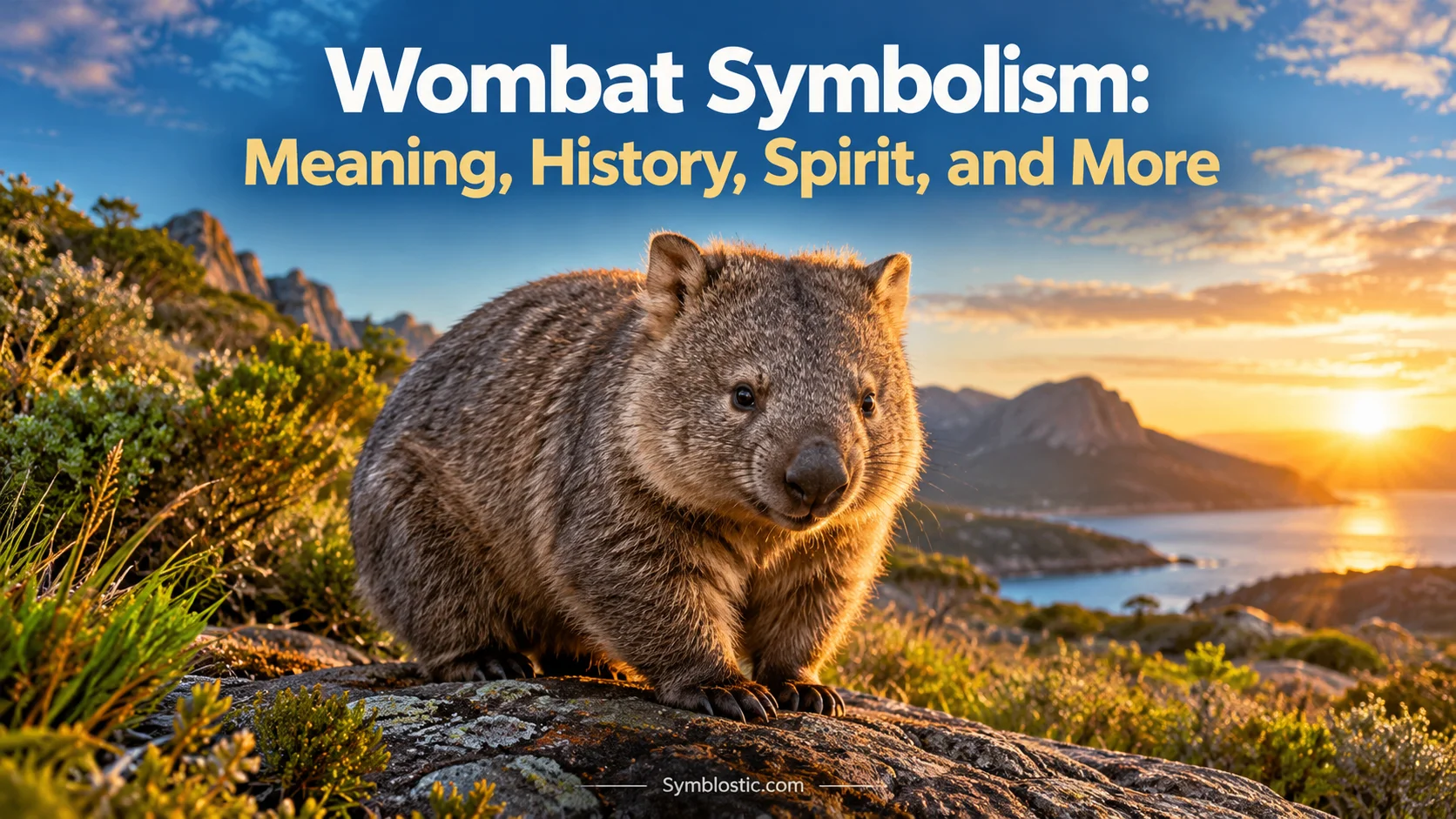
A wombat is a sturdy Australian marsupial known for its powerful digging ability, underground burrows, and calm but determined nature. Wombat symbolism often develops from these real traits, giving the animal meanings connected with grounding, resilience, protection, patience, and independence.
For American audiences, the wombat has a different symbolic history than animals such as bears, eagles, wolves, or deer. It isn’t native to the United States, so Americans usually encounter it through zoos, documentaries, Australian culture, wildlife media, books, and social platforms.
However, that distance hasn’t stopped the wombat from becoming a memorable modern symbol. Its unusual appearance and fascinating behavior make it especially appealing to people who value quiet strength, personal boundaries, self-reliance, and a slower pace of life.
Quick Answer
Wombat symbolism commonly represents grounding, resilience, protection, patience, independence, and the ability to create a secure foundation. In the USA, the wombat is mostly a modern symbolic animal rather than a traditional American emblem, while Australian cultural meanings have much deeper historical roots.
TL;DR
- Wombats commonly symbolize grounding, stability, resilience, and protection.
- Their burrows represent safety, privacy, preparation, and creating a secure foundation.
- In America, wombats are mostly modern cultural and personality symbols.
- Australian relationships with wombats include long-standing Indigenous and practical connections.
- Wombat tattoos often express individuality, persistence, humor, or love of nature.
- Modern interpretations emphasize quiet strength instead of dominance or aggression.
What Does a Wombat Symbolize?
The wombat’s symbolism comes largely from what the animal actually does. It digs, shelters underground, moves efficiently, grazes, and can defend itself when threatened.
For an American reader, these traits create a useful symbolic contrast. The wombat doesn’t represent loud power or constant movement. Instead, it suggests strength that works quietly.
Grounding and Stability
Because wombats spend much of their lives close to or beneath the ground, they naturally suggest grounding.
Symbolically, grounding can mean staying connected to reality during uncertain times. It can also represent having strong personal foundations before trying to expand outward.
Resilience and Persistence
A wombat’s sturdy body and powerful digging ability can suggest persistence.
The symbolism is less about moving quickly and more about continuing steadily. This makes the wombat appealing as a symbol of endurance without unnecessary drama.
Protection and Boundaries
A wombat’s burrow provides shelter from weather and danger. When threatened, the animal can also defend itself effectively.
Therefore, wombat symbolism can represent knowing when to retreat, protect your space, and establish healthy boundaries.
Wombat Symbolism in the United States
Wombats don’t have the same traditional place in American history as bald eagles, buffalo, or bears. Instead, their American symbolism has developed through modern exposure to Australian wildlife.
Today, Americans may encounter wombats in zoos, educational programs, wildlife documentaries, children’s books, online videos, artwork, and travel content.
A Symbol of Quiet Strength
American culture often celebrates speed, competition, visibility, and achievement. The wombat offers a different image.
Its symbolic appeal can come from quiet determination. It suggests that strength doesn’t always need to be obvious.
Why Americans Find Wombats Memorable
Several characteristics make the wombat particularly easy to turn into a modern symbol:
• A compact body suggests sturdiness rather than fragility.
• Burrowing behavior represents privacy, shelter, and preparation.
• Solitary habits can suggest independence and self-containment.
• Nocturnal activity creates associations with mystery and introspection.
• Its unusual appearance adds humor and individuality.
For many Americans, therefore, the wombat functions more like a personality symbol than an inherited cultural emblem.
Wombat Symbolism and Australian History
The wombat has a much older relationship with Australia than its modern internet popularity suggests. Wombats are native to Australia, where different species have lived across varied environments for thousands of years.
Historical evidence also shows that First Nations peoples used wombats as a food resource, and archaeological research documents wombat remains in older human sites.
Indigenous Relationships With Wombats
It’s important not to describe Aboriginal Australian traditions as one single belief system. Australia contains many distinct Indigenous nations, languages, Countries, and cultural traditions.
Some communities have longstanding relationships with wombats involving food, storytelling, land, and local knowledge. These relationships should be understood within their specific cultural settings rather than reduced to one universal “wombat meaning.”
From Survival to Symbolism
The wombat’s practical importance also helps explain why it can carry ideas of endurance and resourcefulness.
Its burrowing lifestyle demonstrates how an animal can survive by creating protection within its environment. Symbolically, that can translate into building security rather than waiting for security to appear.
The Spiritual Meaning of a Wombat
Modern spiritual interpretations often connect the wombat with the earth, inner strength, protection, patience, and personal boundaries.
However, these interpretations should not be presented as universal religious teachings. Much of today’s online “wombat spirit animal” language comes from modern symbolic practice rather than one shared ancient tradition.
Grounding Energy
The wombat’s close relationship with the ground makes it an easy symbol of stability.
In a spiritual context, someone may use the wombat as a reminder to slow down, reconnect with everyday life, and focus on what provides genuine stability.
Protection and Safe Spaces
The burrow is perhaps the strongest symbolic image associated with the wombat.
It can represent the importance of having a private place where you can rest, recover, think, and feel secure.
Persistence Without Hurry
A wombat can also symbolize steady progress.
Instead of suggesting that everything must happen immediately, its symbolic message can emphasize patience and consistent effort.
Wombat Symbolism in Different Cultures
Wombat symbolism changes considerably depending on context. Australia provides the deepest cultural setting because wombats are native there, while American and international meanings are mostly modern interpretations.
The following comparison helps separate established cultural connections from newer symbolic associations.
| Context | Meaning or Association | Common Associations | Notes |
| Modern USA | Grounding and individuality | Nature, resilience, humor | Mostly contemporary symbolism |
| Australian wildlife culture | Native identity and conservation | Land, wildlife, survival | Connected to real Australian ecosystems |
| First Nations contexts | Specific local cultural relationships | Food, land, stories, knowledge | Traditions differ by community |
| Modern spiritual practice | Stability and protection | Grounding, boundaries, patience | Interpretive rather than universal |
| Conservation culture | Vulnerability and resilience | Habitat, stewardship, survival | Particularly relevant to threatened species |
Why Cultural Context Matters
A symbolic interpretation can become misleading when it removes an animal from its real history.
For example, calling every wombat a universal Aboriginal “spirit animal” oversimplifies the many Indigenous cultures of Australia. A more accurate approach recognizes that particular communities have particular relationships with particular animals.
Wombat Symbolism in Dreams
Dream interpretations involving wombats are personal rather than fixed predictions. The animal may mean different things depending on the dreamer’s experiences and emotions.
Still, several themes commonly appear in modern symbolic interpretations.
Seeing a Wombat
Seeing a wombat in a dream may be interpreted as a reminder to seek stability or protect your personal space.
If the wombat appears calm, the dream may feel connected with safety or contentment. If it appears threatened, the dream could reflect concerns about boundaries or security.
A Wombat Digging
A digging wombat can create a strong symbolic image of preparation.
It may represent working beneath the surface, solving a problem patiently, or creating a stronger foundation before making a major change.
A Wombat Entering a Burrow
A burrow can symbolize retreat and privacy.
However, retreat isn’t necessarily negative. Sometimes the image suggests rest, reflection, or taking time away from outside pressure.
Read More: Maned Wolf Symbolism: Meaning, Spirit & Identity
Emotional and Psychological Meaning of the Wombat
Animal symbolism often works because people project familiar human qualities onto recognizable behavior.
The wombat’s physical appearance and lifestyle can therefore trigger specific emotional associations.
Feelings Associated With Wombats
People may associate wombats with:
• Comfort because of their rounded, sturdy appearance.
• Calmness because they aren’t associated with flashy movement.
• Security because they build protected underground homes.
• Determination because they dig through difficult ground.
• Independence because they often live relatively solitary lives.
• Humor because their unusual shape looks charming and distinctive.
These associations don’t mean that wombats literally possess human personality traits. They describe how people commonly interpret the animal symbolically.
The Psychology of the Burrow
The burrow can be especially meaningful because humans also value private spaces.
A home, bedroom, garden, cabin, or quiet corner can serve as a personal refuge. In this sense, wombat symbolism can reflect the emotional need for safety and recovery.
Wombat Symbolism for Strength and Resilience
Wombat strength is different from the strength represented by predators.
A wolf may symbolize teamwork and hunting. A lion may represent dominance. A wombat instead suggests staying power.
Strength Without Showmanship
The wombat doesn’t need to appear intimidating to survive.
Its symbolism can therefore suit people who identify with quiet confidence. The message is simple: strength can exist without constant attention.
Overcoming Difficult Conditions
Wombats create extensive burrow systems and live in environments that can present significant challenges.
That behavior can symbolize adaptability. When conditions change, survival may depend on changing your methods rather than abandoning your goal.
Wombat Symbolism in Tattoos
Wombat tattoos are relatively uncommon compared with tattoos featuring wolves, snakes, butterflies, or birds. That rarity can actually make the design more personal.
Someone choosing a wombat may want a symbol that feels unusual and less predictable.
Common Wombat Tattoo Meanings
A wombat tattoo can represent:
• Resilience after a difficult period.
• A strong need for personal boundaries.
• Connection with Australian wildlife or travel.
• A preference for quiet independence.
• Love of unusual and overlooked animals.
• Patience with long-term personal growth.
A simple wombat can create a playful effect. A realistic design may emphasize nature, wilderness, or conservation instead.
Wombat Symbolism in Art, Decor, and Social Media
The wombat’s distinctive shape makes it particularly effective in visual culture.
In the United States, it can appear in wildlife artwork, children’s products, educational illustrations, plush toys, travel souvenirs, and humorous online content.
Modern Visual Meanings
A cartoon wombat may emphasize friendliness and humor.
A realistic wombat can instead communicate wilderness, Australian identity, wildlife appreciation, or conservation. Meanwhile, minimalist wombat artwork may be used simply because the animal feels unusual and visually appealing.
Social Media Culture
Online, wombats are often treated as cute, funny, surprising, or relatable animals.
That doesn’t erase their deeper symbolism. Instead, humor can make people curious about the real animal and its unusual adaptations.
Wombat Symbolism and Conservation
Modern symbolism increasingly includes an environmental dimension.
This matters because not all wombat species have the same conservation status. The northern hairy-nosed wombat, for example, is critically endangered, while other wombat populations face different pressures.
From Cute Animal to Conservation Symbol
A wombat image can therefore represent more than personality traits.
It may also symbolize:
• Protection of native habitats and ecosystems.
• The importance of conserving vulnerable wildlife.
• Long-term responsibility toward native species.
• Coexistence between agriculture and wildlife.
• Resilience after population decline or habitat loss.
In South Australia, the southern hairy-nosed wombat has an especially notable public role because it is the state’s fauna emblem.
Why This Changes the Symbol
When people learn about real conservation challenges, the wombat can become a symbol of stewardship.
The meaning shifts from “cute Australian animal” toward respect for wildlife and habitat.
Wombat Symbolism, Misunderstandings, and Controversies
Wombat symbolism is generally lighthearted, but some interpretations deserve careful context.
The biggest issue involves presenting modern spiritual ideas as if they were universal Aboriginal beliefs. Indigenous Australian cultures are diverse, and their traditions shouldn’t be reduced to generalized internet claims.
Common Misunderstandings
Several assumptions can distort wombat symbolism:
• Treating all Aboriginal traditions as one unified belief system.
• Calling modern spiritual interpretations ancient without evidence.
• Assuming a wombat always symbolizes the same personal message.
• Confusing animal behavior with literal human personality traits.
• Ignoring conservation issues because the animal looks cute.
There is also a practical tension in parts of Australia. Wombat burrows can sometimes interfere with agriculture, fencing, roads, or other human activities. Thus, the animal can represent both valued native wildlife and a source of land-management challenges.
How Wombat Symbolism Has Changed Over Time
The wombat’s symbolic identity has changed significantly depending on who is viewing it.
For First Nations communities, relationships with wombats developed within specific landscapes and cultural systems. Later, European observers classified and described the animal through unfamiliar scientific and cultural frameworks.
Today, international audiences often see something else: a charming, strange, resilient Australian animal.
From Practical Animal to Internet Icon
Historically, wombats were understood largely through their role in Australian environments and human relationships with them.
Today, social media and popular wildlife culture often emphasize their appearance, personality, digging abilities, and unusual behavior.
The Modern Symbol
The result is a layered image.
The wombat can now represent Australian wildlife, personal boundaries, resilience, humor, conservation, comfort, and independent living. These meanings aren’t all equally old or culturally established, so context matters.
What Does a Wombat Mean Spiritually and Emotionally?
For modern readers, the wombat can provide a useful symbolic framework for thinking about stability and self-protection.
Its strongest emotional message is not necessarily “be tougher.” Instead, it can suggest building a life that gives you enough stability to handle difficult situations.
A Symbol of Personal Boundaries
The burrow is a powerful metaphor for personal space.
It suggests that protecting your energy, home, time, and privacy can be part of a healthy life. At the same time, the symbolism doesn’t require permanent isolation.
A Symbol of Patience
The wombat also challenges the idea that progress must always be fast.
Its symbolism favors steady work, preparation, and persistence. For people facing long projects or major changes, that can make the wombat an appealing personal symbol.
FAQs:
What does a wombat symbolize?
A wombat commonly symbolizes grounding, resilience, protection, patience, and independence. Modern American interpretations usually come from the animal’s behavior rather than traditional American folklore.
What is the spiritual meaning of a wombat?
Modern spiritual interpretations often connect wombats with grounding, inner strength, safety, boundaries, and persistence. These are contemporary symbolic interpretations, not one universal religious teaching.
What does a wombat represent in a dream?
A wombat in a dream may symbolize security, privacy, patience, or the need for stronger boundaries. The meaning depends heavily on what happens in the dream and how you feel about the animal.
What does a wombat tattoo symbolize?
A wombat tattoo may represent resilience, individuality, protection, Australian heritage, or a preference for quiet strength. Some people choose the design simply because they love wombats.
Are wombats considered spiritual animals in Aboriginal culture?
Relationships with wombats vary among Australia’s many Indigenous communities. It is more accurate to discuss specific cultural traditions than to claim that all Aboriginal Australians share one wombat belief.
Why are wombats associated with grounding?
Wombats spend much of their lives close to the ground and use extensive burrows for shelter. Those real behaviors have inspired modern associations with stability, safety, and grounded living.
Conclusion:
Wombat symbolism is built around a distinctive kind of strength. Rather than emphasizing speed or dominance, the wombat represents grounding, resilience, protection, patience, independence, and the value of creating a secure foundation.
For American audiences, the wombat is primarily a modern cultural symbol rather than a traditional national emblem. Yet its Australian roots add depth to its modern image, especially when its real ecology, Indigenous cultural diversity, and conservation challenges are treated with care.

1 thought on “Wombat Symbolism: Meaning, History, Spirit, and More”