
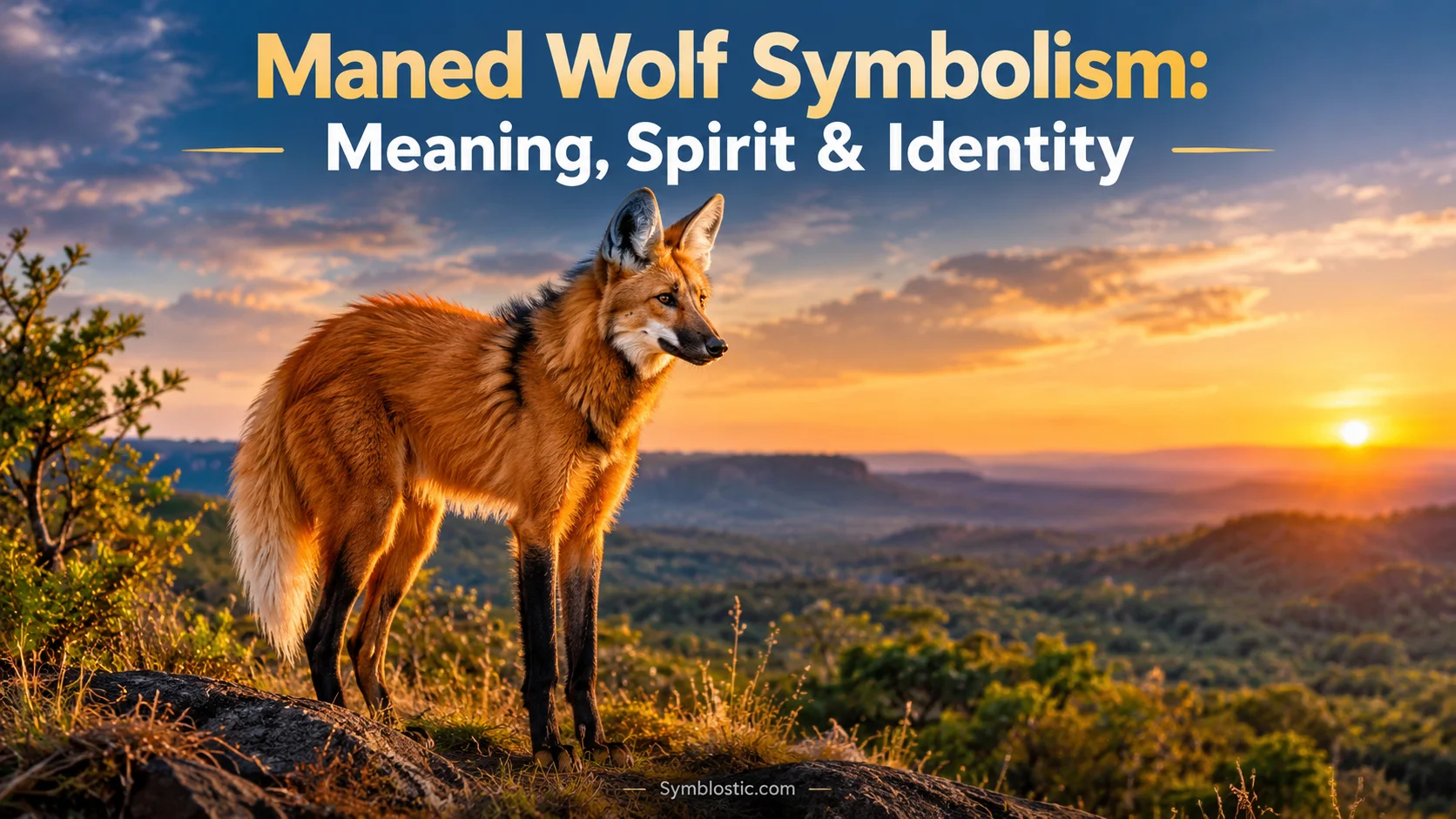
The Maned Wolf Symbolism draws much of its power from the animal’s unusual appearance and behavior. It looks partly like a wolf, partly like a fox, yet it belongs to neither group in the simple way people might expect.
In the United States, this rare South American animal often represents independence, individuality, adaptability, mystery, and respect for nature. Its long legs and solitary habits also create a strong image of standing apart from the crowd.
However, the maned wolf has deeper cultural associations beyond modern American symbolism. Across parts of South America, the animal has appeared in folklore, traditional beliefs, and conservation stories. Its meanings have changed depending on the community and historical period.
Quick Answer
Maned Wolf Symbolism commonly represents independence, uniqueness, adaptability, mystery, and resilience in modern American interpretations. Its unusual appearance also makes it a symbol of embracing individuality rather than fitting into familiar categories.
TL;DR
- The maned wolf symbolizes independence and individuality.
- Its unusual appearance represents being different without losing strength.
- In the USA, it often connects with wildlife and conservation.
- South American traditions give the animal additional cultural meanings.
- Its long legs suggest adaptability and moving through difficult environments.
- Modern tattoos often use it to express freedom and personal identity.
What Does the Maned Wolf Symbolize?
The maned wolf is especially interesting because its symbolism comes from both appearance and behavior. Unlike familiar wolves, it has a slender body, extremely long legs, a reddish coat, and a dark mane.
Independence and Individuality
The animal’s unusual body makes it difficult to compare directly with familiar canids. Therefore, it naturally represents being different without being weak.
For many American readers, this can reflect someone who follows a personal path instead of copying others.
Core Meanings at a Glance
The most common symbolic ideas include:
- Independence and self-direction
- Individuality and nonconformity
- Adaptability and survival
- Mystery and unfamiliarity
- Quiet strength and observation
- Connection with wild places
These interpretations aren’t universal spiritual rules. Instead, they’re modern symbolic readings inspired by the animal’s traits and cultural associations.
What Does the Maned Wolf Represent in America?
In the United States, the maned wolf isn’t a traditional national symbol like the bald eagle or American bison. Instead, its meaning is usually connected with wildlife, conservation, individuality, and curiosity.
A Symbol of Being Different
The maned wolf looks unlike most animals Americans associate with the word “wolf.” That difference gives it a strong modern meaning.
It can symbolize someone who doesn’t fit an expected mold. At the same time, it suggests that uniqueness can become a source of strength.
Conservation and Rare Wildlife
American zoos and conservation organizations have helped introduce the species to a wider audience. The Smithsonian’s conservation work, including breeding programs and research, has made the maned wolf a recognizable example of international wildlife conservation.
That gives the animal an additional American association: protecting something rare before it disappears.
American Symbolism at a Glance
| Context | Meaning in the USA | Common Associations | Notes |
| Wildlife | Conservation | Rare species, habitat | Connected with protecting biodiversity |
| Personal identity | Individuality | Independence, uniqueness | Often used symbolically |
| Nature imagery | Freedom | Grasslands, wilderness | Strong visual appeal |
| Tattoos | Self-direction | Strength, mystery | Meaning depends on design |
| Spiritual art | Transformation | Intuition, resilience | Usually a modern interpretation |
Maned Wolf Appearance and Symbolic Meaning
Physical characteristics strongly influence how people interpret animals symbolically. The maned wolf has several features that make its symbolism especially distinctive.
Long Legs
Its unusually long legs are one of its most recognizable traits. Symbolically, they can suggest movement, flexibility, perspective, and the ability to cross difficult ground.
The image of standing high above grass can also suggest seeing a situation from a wider perspective.
The Dark Mane
The dark mane along the neck creates a dramatic appearance. When threatened, the mane can become more noticeable.
Symbolically, this can represent boundaries, confidence, protection, and controlled power.
Reddish Coat
The reddish-orange coat can evoke warmth, vitality, earth, and energy. In symbolic artwork, these colors may also suggest courage or a connection with natural landscapes.
However, color symbolism isn’t fixed. Artists and individuals can intentionally give the same color a different meaning.
Maned Wolf Symbolism in History and South America
The maned wolf’s cultural history is closely tied to South America because the species naturally occurs there. It has never been a native North American wolf.
Indigenous and Regional Connections
The animal is known by different names across its range. One important name is aguará guazú, a Guarani term commonly translated as “large fox.”
Some regional traditions have viewed the animal as spiritually significant or unusual. In Argentina, for example, museum and cultural sources describe the maned wolf as a sacred animal in some Toba and Mocoví traditions.
However, these traditions shouldn’t be treated as one single belief system. Indigenous and local cultures have their own histories and interpretations.
Folklore and the Wolf Image
The word “wolf” in English can create assumptions that don’t necessarily belong to the maned wolf itself.
In parts of South America, the animal has also been connected with werewolf-like folklore. These stories developed through complex interactions between local traditions and European-influenced ideas.
That history shows why symbolic meanings should be understood in context rather than treated as universal facts.
Spiritual Meaning of the Maned Wolf
The maned wolf doesn’t have one universally accepted spiritual meaning. Modern spiritual interpretations often use its natural traits as metaphors.
Independence and Inner Direction
Seeing a maned wolf in symbolic or spiritual artwork may represent the idea of trusting your own direction.
Because the species is generally solitary, it can be associated with independence without necessarily implying loneliness.
Adaptation and Resilience
The animal survives in changing grassland and scrub environments. Therefore, modern spiritual interpretations sometimes connect it with adaptability and resilience.
For someone going through a major life transition, the image may represent learning to move forward without losing personal identity.
Mystery and Intuition
Its unusual appearance and elusive nature can also create associations with mystery.
In this context, the maned wolf may symbolize paying attention to things that aren’t immediately obvious.
Maned Wolf as a Spirit Animal Symbol
The phrase “spirit animal” has different meanings across cultures, so it shouldn’t be presented as a universal religious concept.
In modern American spiritual language, however, people sometimes use animal figures as personal symbols or reflective guides.
Common Personal Associations
A person drawn to the maned wolf might associate it with:
- Walking an unconventional personal path
- Protecting personal boundaries
- Adapting without abandoning core values
- Observing carefully before acting
- Finding strength in individuality
- Maintaining independence while valuing relationships
These are personal interpretations rather than established facts about what the animal “must” mean.
Maned Wolf Symbolism in Dreams
Dream symbolism is highly personal. A maned wolf appearing in a dream doesn’t have one fixed interpretation.
Seeing a Maned Wolf
A dream featuring a maned wolf may remind someone of independence or unfamiliar territory. The surrounding dream details matter greatly.
For example, a calm animal may feel different from one that appears frightened or aggressive.
A Maned Wolf Watching You
An observing maned wolf might symbolize awareness or the feeling that you need to pay closer attention.
However, the dreamer’s emotions are more useful than a generic dream dictionary. Fear, curiosity, admiration, or peace can completely change the personal meaning.
Emotional and Psychological Meaning of the Maned Wolf
Animals often become symbols because humans project familiar emotional qualities onto them. The maned wolf’s unusual form encourages several psychological associations.
Quiet Strength
The animal doesn’t have the massive body associated with stereotypical wolves. Yet its appearance remains powerful.
This creates an appealing contrast between physical delicacy and symbolic strength.
Being Different
The maned wolf is difficult to categorize at first glance. That quality can resonate with people who have felt misunderstood or different.
Its symbolism can therefore become a reminder that not fitting a familiar category isn’t automatically negative.
Solitude Without Isolation
Maned wolves generally live more independently than many people imagine when they hear the word “wolf.”
Consequently, the animal can represent healthy solitude, personal space, or self-reliance rather than rejection of others.
Read More: Hoopoe Symbolism: Meaning, History, Spirit & Wisdom
Maned Wolf Symbolism in Tattoos
Maned wolf tattoos are relatively unusual, which can make them especially personal.
Common Tattoo Meanings
A tattoo may represent:
- Independence from social expectations
- A strong connection with wildlife
- Personal transformation
- Unusual identity or individuality
- Resilience through difficult experiences
- Appreciation for South American wildlife
The design can also change the message. A realistic maned wolf may emphasize nature, while a highly stylized design may focus more strongly on personal identity.
Tattoo Design Elements
Artists may combine the animal with grasslands, moons, plants, geometric shapes, or stars.
A landscape can emphasize wilderness and conservation. Meanwhile, celestial elements may create a more mysterious or spiritual mood.
Maned Wolf Symbolism in Art, Fashion, and Decor
The animal’s striking silhouette makes it visually useful even outside wildlife settings.
Home Decor
A maned wolf image can create a feeling of wilderness and individuality. It may work particularly well in rooms designed around natural textures or wildlife themes.
Fashion and Personal Style
A maned wolf design can communicate a less conventional form of strength. Unlike common wolf imagery, it immediately suggests curiosity because many viewers don’t recognize the animal.
Social Media and Digital Identity
Animal imagery is frequently used online to express personality. A maned wolf avatar or illustration may suggest independence, mystery, unusual interests, or a strong connection with nature.
These meanings come from the user’s chosen context rather than from a universal digital symbol.
Maned Wolf Symbolism and Conservation
One of the strongest modern meanings of the maned wolf is conservation.
A Rare South American Canid
The maned wolf lives in South America, particularly in grassland and savanna environments. It is not simply a long-legged version of the familiar gray wolf.
Its distinctive biology has made it an important subject for wildlife research.
Why Conservation Matters
Habitat loss, roads, human conflict, and diseases associated with domestic dogs can threaten populations.
In the United States, conservation programs at zoos and research institutions have helped maintain managed populations and support scientific study. In 2025, the Smithsonian’s conservation campus in Virginia reported the successful birth and development of three maned wolf pups.
For modern audiences, this adds a powerful layer to the symbolism: protecting uniqueness before it is lost.
Misunderstandings and Controversies Around Maned Wolf Symbolism
Symbolism becomes complicated when folklore, popular culture, and biology overlap.
It Isn’t Really a Wolf
Despite its common name, the maned wolf isn’t closely related to the gray wolf in the way the name might suggest.
It is the only living species in its genus, Chrysocyon. Calling it simply a “South American wolf” can therefore create a misleading impression.
Folklore Isn’t the Same as Biology
Historical beliefs about magical properties or medicinal uses are part of cultural history. They shouldn’t be presented as scientifically proven effects.
Some historical traditions involved using body parts for luck or folk medicine. Today, conservation concerns make such practices especially important to discuss carefully.
Avoiding Cultural Generalizations
It’s also inaccurate to claim that all South American cultures interpret the maned wolf in the same way.
Meanings differ by country, community, tradition, and historical period. A respectful discussion keeps those differences visible.
How Maned Wolf Meaning Has Changed Over Time
The symbolic image of the maned wolf has never been completely fixed.
From Folklore to Conservation
Older accounts often focused on mystery, unusual appearance, fear, folklore, or supposed practical uses.
Modern conservation work increasingly presents the species through science, habitat protection, and biodiversity.
From Fear to Curiosity
The animal’s resemblance to familiar predators could once encourage suspicion. Today, its unusual appearance often creates fascination instead.
This shift reflects a broader change in how people understand wildlife. Scientific knowledge can replace old assumptions without erasing the cultural history that surrounded an animal.
From Rarity to Identity
Modern artists and individuals can also use the maned wolf as a symbol of uniqueness.
Its message becomes less about supernatural power and more about being comfortable with difference.
Maned Wolf Symbolism Compared With Wolf and Fox Symbolism
The maned wolf is especially interesting because people often compare it with animals it resembles.
Maned Wolf vs. Wolf
Wolves commonly symbolize strength, loyalty, teamwork, freedom, and instinct.
The maned wolf can carry some of these ideas, but its slender build and independent behavior create a more unusual symbolic profile.
Maned Wolf vs. Fox
Foxes are often associated with cleverness, adaptability, curiosity, and strategy.
The maned wolf shares some of these associations because of its behavior and appearance. However, its symbolism more strongly emphasizes uniqueness and unusual identity.
Why the Difference Matters
Using a maned wolf instead of a traditional wolf can make an artistic message more specific.
It can say, in effect, “I value independence, but I don’t need to look like everyone else.”
FAQs:
What Does a Maned Wolf Symbolize Spiritually?
It commonly symbolizes independence, adaptability, mystery, and resilience in modern spiritual interpretations. However, there isn’t one universal spiritual meaning accepted by every culture.
Is the Maned Wolf a Good Symbol?
For many people, it represents positive qualities such as individuality, survival, curiosity, and connection with nature. Its meaning ultimately depends on the context in which it is used.
What Does a Maned Wolf Represent in Dreams?
A maned wolf in a dream may be associated with independence, unfamiliar situations, observation, or personal change. The dreamer’s emotions and surrounding details are important when interpreting it.
What Does a Maned Wolf Tattoo Mean?
A maned wolf tattoo can represent individuality, freedom, resilience, wildlife appreciation, or an unconventional personal path. Additional imagery can make the intended meaning more specific.
Why Is the Maned Wolf Considered Special?
Its extremely long legs, reddish coat, dark mane, and unusual body shape make it unlike most other canids. It is also the only living species in the genus Chrysocyon.
Is the Maned Wolf a Wolf or a Fox?
It is neither a true wolf nor a true fox. The maned wolf is a distinct South American canid with its own evolutionary history.
Conclusion
The Maned Wolf Symbolism is built around an animal that refuses to fit an ordinary category. In American interpretations, it commonly represents independence, individuality, adaptability, mystery, resilience, and respect for nature.
Its cultural history adds another layer. South American traditions, folklore, scientific research, and modern conservation have all shaped how people understand this remarkable animal. Today, the maned wolf can symbolize more than wilderness. It can also represent the value of protecting what is rare and embracing what makes you different.

1 thought on “Maned Wolf Symbolism: Meaning, Spirit & Identity”