
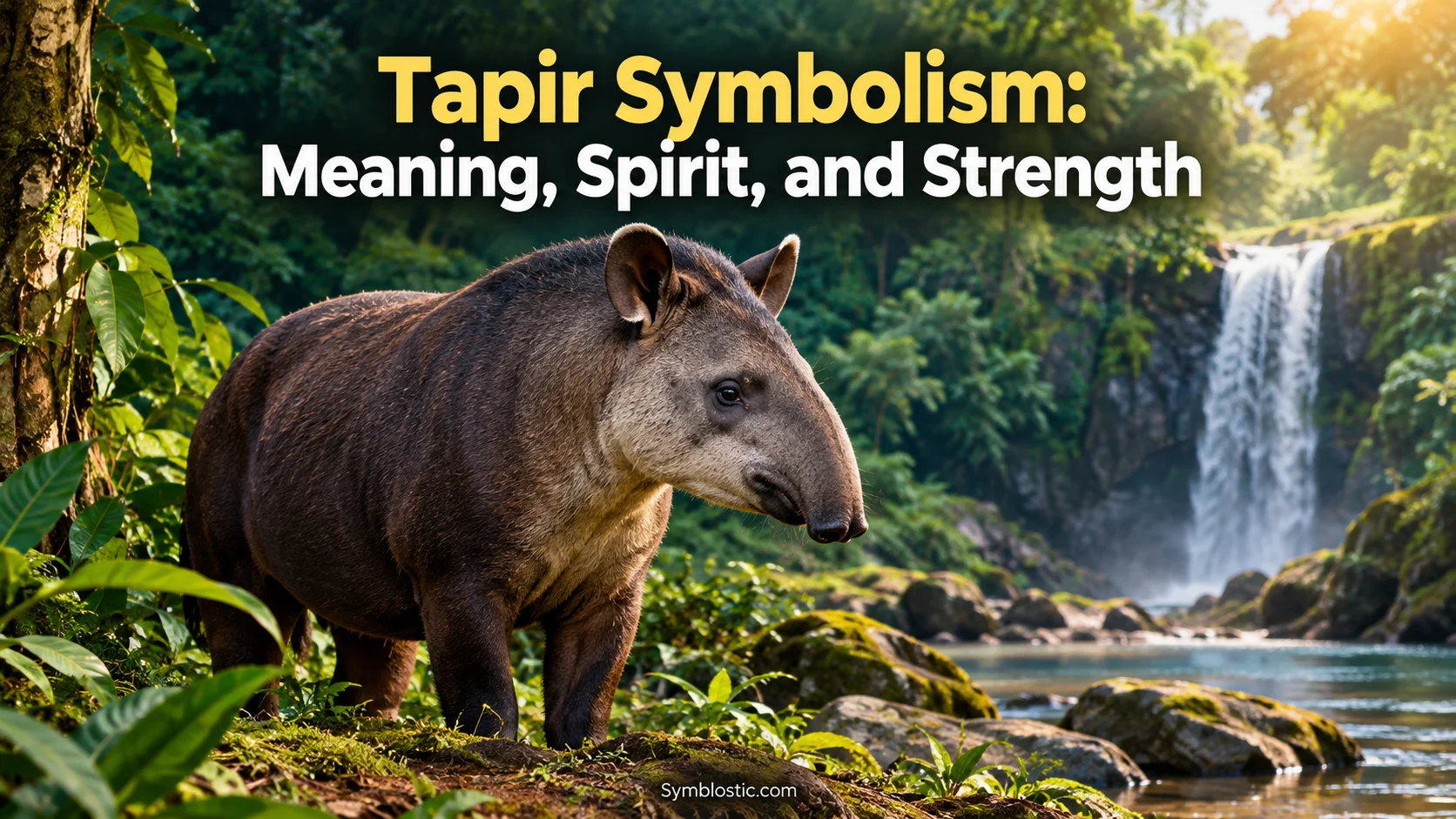
Tapir symbolism explores the qualities people associate with this unusual animal, including gentleness, resilience, patience, and a quiet connection with nature. In the United States, tapirs aren’t as widely recognized as wolves, bears, or eagles. However, their peaceful appearance and secretive behavior offer meaningful ways to think about personal growth and emotional balance.
Tapirs are large mammals with rounded bodies, short legs, and distinctive, flexible snouts. They live in forests and wetlands across Central and South America, as well as parts of Southeast Asia. Although they resemble a mixture of several familiar animals, tapirs belong to their own ancient mammal family.
Today, people may interpret the tapir as a symbol of staying grounded, protecting personal boundaries, and moving through life without seeking attention. These meanings aren’t universal cultural rules or proven spiritual messages. Instead, they’re modern interpretations inspired by the animal’s real behavior, natural habitat, and appearance.
Whether you’ve encountered a tapir in a wildlife documentary, dreamed about one, or felt drawn to its unusual shape, exploring its symbolism can offer a fresh perspective. Its quiet nature reminds us that strength doesn’t always need to be loud, and meaningful progress doesn’t always happen in public.
Quick Answer
Tapir symbolism in the United States commonly lends itself to interpretations of gentleness, resilience, groundedness, and quiet independence. Spiritually, some people connect the tapir with intuition, personal boundaries, and renewal, although these meanings are personal interpretations rather than universal beliefs.
TL;DR
- Tapirs can symbolize gentleness, patience, and understated strength.
- Their forest habitats suggest grounding, privacy, and a connection with nature.
- Their flexible snouts can represent adaptability and exploring unfamiliar paths.
- Spiritually, tapirs may inspire intuition, self-protection, and personal renewal.
- In American culture, tapirs are more often wildlife symbols than established national icons.
- Modern interpretations include nature-inspired art, tattoos, dreams, and personal reflection.
What Does a Tapir Symbolize?
The tapir’s unusual appearance and quiet lifestyle make it an interesting symbol of inner strength. For American readers, its symbolism often centers on qualities that don’t require public recognition.
Unlike animals associated with aggression or dominance, the tapir suggests a gentler approach to life’s challenges. Its meaning can change depending on the setting, personal experience, and the qualities someone admires.
Gentleness and Quiet Strength
Tapirs have sturdy bodies, yet they generally avoid unnecessary confrontation. This contrast makes them useful symbols of strength without aggression.
A tapir can represent someone who remains kind while handling difficult situations. It may also remind you that being gentle doesn’t mean being weak.
Adaptability and Groundedness
A tapir’s flexible snout helps it reach leaves, browse vegetation, and investigate its surroundings. Symbolically, this flexibility can represent finding practical ways through unfamiliar situations.
Its connection with forests and water also lends itself to groundedness. Rather than rushing toward every opportunity, the tapir encourages a steady, thoughtful approach.
Privacy and Quiet Independence
Tapirs often live solitary lives, although their social behavior varies by species and circumstance. Their preference for staying out of sight can inspire interpretations of healthy independence.
This doesn’t mean avoiding relationships or rejecting other people. Instead, the tapir can symbolize feeling comfortable with yourself without constantly seeking attention.
Tapir Symbolism in History and Ancient Cultures
The tapir has a long natural history, but its cultural history isn’t the same everywhere. Understanding that difference helps separate documented traditions from newer spiritual interpretations.
Tapirs belong to an ancient mammal lineage. Today, four living species are generally recognized: the Brazilian, Baird’s, mountain, and Malayan tapirs.
Tapirs in Ancient Mesoamerica
In parts of ancient Mesoamerica, tapirs appeared within a broader world of animal imagery, sacred landscapes, and religious ideas. Historical interpretations connect the animal with water, nighttime, fertility, and other aspects of the natural world.
Some Maya traditions associated tapirs with aquatic or underworld settings. However, Maya communities weren’t culturally identical, and the animal didn’t carry one fixed meaning across every region or period.
The Importance of Local Traditions
Tapirs also appear in Indigenous knowledge and stories from parts of Central and South America. In these traditions, animals may have roles involving food, the environment, spiritual relationships, or the balance of life.
For example, research involving Kichwa families in the Ecuadorian Amazon documents the tapir’s importance within local understandings of nature. These perspectives are more specific than broad claims that every Indigenous community considers the tapir a spirit guide.
The key lesson: Historical symbolism depends on place, language, community, and time. Modern interpretations can be meaningful, but they shouldn’t replace the original cultural context.
Tapir Symbolism in the United States
In the United States, the tapir doesn’t have the same established symbolic role as the bald eagle, bison, or bear. Most Americans encounter it through zoos, wildlife programs, educational materials, and conservation campaigns.
Even so, the animal can inspire personal meanings that fit modern American interests in nature, individuality, and environmental responsibility.
A Symbol of Wildlife Conservation
Tapirs help maintain healthy forest ecosystems by eating fruit and spreading seeds. This ecological role makes them useful symbols of biodiversity and the connections between animals and their habitats.
American wildlife education often emphasizes the importance of protecting species that receive less public attention. The tapir fits this message because it’s unusual, ecologically important, and threatened by habitat loss and hunting in parts of its range.
A Symbol of Being Different
The tapir’s shape makes it memorable. Its short legs, rounded body, and flexible snout don’t fit familiar ideas about what a large mammal should look like.
For some Americans, this unusual appearance can represent individuality and comfort with being different. It offers a reminder that something doesn’t need to look conventional to have value.
Everyday American Associations
People may connect tapirs with several ideas, depending on where they encounter them:
- Zoos and education: Curiosity, learning, and respect for wildlife.
- Nature documentaries: Discovery, wilderness, and ecological awareness.
- Conservation projects: Responsibility, habitat protection, and biodiversity.
- Personal artwork: Uniqueness, gentleness, and a preference for understated strength.
These are contemporary associations rather than official national meanings.
Tapir Spiritual Meaning and Symbolism
Spiritually, the tapir can serve as a personal reminder to slow down, listen to your instincts, and protect your peace. These interpretations come from modern symbolic practices and reflections on the animal’s behavior.
There isn’t one universal spiritual meaning of the tapir. Instead, its significance depends on your beliefs and the circumstances in which it appears.
Trusting Your Intuition
Tapirs use their flexible snouts and other senses to explore their surroundings. Symbolically, this behavior can represent paying attention to subtle information before making a decision.
If the tapir feels meaningful to you, consider whether you’re overlooking something important. The symbol can encourage careful observation rather than impulsive action.
Protection and Personal Boundaries
A tapir may also represent the value of creating a safe space. Its quiet, cautious nature offers a useful metaphor for deciding when to engage and when to step away.
This interpretation doesn’t mean you should isolate yourself. Instead, it invites you to consider which relationships and situations support your well-being.
Renewal and Personal Growth
Tapirs depend on suitable habitats, water, food, and room to move. These needs can inspire reflections about the conditions that help you grow.
In a spiritual context, the tapir might encourage you to return to basic needs, rebuild your routines, or make space for a new chapter. It doesn’t predict that change will happen; it provides a way to reflect on change.
Tapir Symbolism Across Cultures
Tapir symbolism becomes more interesting when viewed across different regions. However, similarities between traditions don’t necessarily mean they share the same origin or beliefs.
Indigenous Amazonian Perspectives
Some Indigenous Amazonian traditions place the tapir within a complex network of relationships among people, animals, forests, and spiritual beings. In certain communities, the animal has importance beyond its physical role in the ecosystem.
These meanings are tied to particular knowledge systems and local histories. They shouldn’t be reduced to a generic idea of a universal tapir spirit animal.
Maya Traditions
Historical studies of Maya culture discuss tapirs in relation to water, nighttime, fertility, and the underworld. Some historical accounts also describe connections between tapirs and rain-related imagery.
However, these interpretations require care. Maya traditions varied across communities and centuries, and surviving evidence doesn’t support a single meaning for every Maya person or period.
East Asian Dream Traditions
The tapir-like baku in Japanese folklore is known for its association with dreams. Stories describe it as a being that consumes troubling dreams, making it a symbol of protection during sleep.
The baku is a folkloric creature, not simply another name for the zoological tapir. Its familiar appearance may draw on tapir-like features alongside other animal characteristics.
The distinction matters because the dream-protection symbolism of the baku shouldn’t automatically be assigned to tapirs in every culture.
What Does a Tapir Mean Emotionally and Psychologically?
An animal symbol can become meaningful because it reflects a feeling, a personal challenge, or a quality you want to develop. From this perspective, the tapir can represent a quieter approach to emotional life.
Its symbolism is especially useful for people who value patience and stability over constant competition.
Emotional Balance
A tapir’s steady, unassuming presence can remind you not to react to every challenge immediately. Sometimes, a pause gives you more room to understand your feelings.
For example, imagine you’re dealing with a stressful change at work. The tapir might serve as a personal reminder to gather information, protect your energy, and take one manageable step at a time.
Self-Acceptance
The tapir looks different from many animals people commonly admire. Its unusual shape can therefore become a symbol of accepting traits that don’t fit conventional expectations.
This meaning may resonate with people who feel overlooked or misunderstood. You don’t need to change your personality simply to gain approval.
What Tapir Symbolism May Reflect About You
If you’re drawn to the tapir, consider whether any of these qualities feel familiar:
- You prefer meaningful progress to public recognition.
- You value calm relationships and personal space.
- You adapt quietly when circumstances change.
- You care about nature and the lives of other species.
- You want to feel comfortable with your individuality.
These are reflection prompts, not psychological tests. Admiring an animal doesn’t establish a person’s personality or emotional state.
Read More: Anhinga Symbolism: Meaning, Spiritual Signs, and Wisdom
Tapir Symbolism in Dreams
Dreams involving tapirs can feel memorable because the animal is unusual. Their meaning depends on the dream’s details, your emotions, and your personal associations.
There is no reliable universal dream dictionary that can prove what a tapir dream means. Still, exploring its imagery can help you identify feelings or concerns worth considering.
Dreaming of a Calm Tapir
A peaceful tapir might represent your desire for stability, privacy, or a less stressful pace of life. Think about whether you’ve recently needed more time to rest or reflect.
The dream may simply reflect a recent encounter with the animal, especially if you’ve watched a wildlife program or seen a picture of one.
Dreaming of a Running or Frightened Tapir
A frightened tapir could bring attention to feelings of pressure or uncertainty. Rather than treating it as a warning about the future, consider what made the animal seem threatened.
You might be feeling rushed, overwhelmed, or protective of something important. Your own emotional response offers more useful context than a fixed symbolic definition.
Dreaming of a Tapir Near Water
Water often carries personal associations with change, calm, or strong emotions. A tapir near water could prompt you to reflect on how you handle uncertainty.
However, the dream doesn’t guarantee emotional healing or a coming transformation. Its value lies in the questions it helps you explore.
Tapir Symbolism in Tattoos, Art, and Home Decor
Tapirs have a distinctive appearance that works well in visual art. In the United States, their symbolism can appeal to people who want an animal design that feels less conventional.
Because tapirs aren’t major American cultural icons, their meanings often remain personal rather than widely recognized.
Tapir Tattoos
A tapir tattoo can represent individuality, patience, environmental awareness, or quiet strength. The design’s style can help communicate the intended meaning.
- Minimalist outline: Simplicity, calm, and understated individuality.
- Forest setting: Connection with nature and respect for wildlife.
- Tapir beside water: Reflection, adaptability, or personal renewal.
- Playful illustration: Humor, curiosity, and affection for unusual animals.
These interpretations aren’t standardized. If you choose a tattoo, consider the personal story you want it to represent.
Artwork and Home Decor
Tapir illustrations can add an unusual wildlife theme to a room. Natural colors, leafy backgrounds, and forest scenes may emphasize their connection with tropical habitats.
A tapir figurine or print can also reflect curiosity about less familiar species. For some people, it becomes a conversation starter about wildlife and conservation.
Social Media and Personal Identity
Online, tapir imagery may communicate a love of nature, appreciation for quirky animals, or a preference for being different. A humorous tapir illustration can also express a relaxed, unpretentious personality.
Unlike symbols with established political or religious meanings, tapir imagery generally leaves considerable room for personal interpretation.
Tapir Symbolism in Nature and Conservation
The tapir’s ecological role provides a grounded foundation for its modern symbolism. Instead of relying entirely on spiritual claims, you can explore what the animal actually contributes to its environment.
The Forest Seed Disperser
Tapirs eat fruit and move through their habitats, helping disperse seeds. This process supports plant regeneration and contributes to the health of forest ecosystems.
Symbolically, this behavior can represent leaving something valuable behind. Small actions may have lasting effects, even when you don’t see the results immediately.
Resilience in a Changing World
Tapirs have survived across long periods of evolutionary history. However, this doesn’t mean individual species are immune to modern threats.
Habitat destruction, fragmented forests, and hunting put pressure on tapir populations. Their survival depends on suitable habitats and effective conservation efforts.
As a symbol, the tapir can represent resilience combined with vulnerability. Strength matters, but so do supportive surroundings and responsible action.
Conservation as a Personal Value
For American readers, learning about tapirs can broaden the idea of wildlife protection beyond familiar local species. It highlights how environmental health connects animals, plants, and human communities.
Supporting responsible wildlife education and habitat conservation is a practical way to honor the qualities people associate with this animal.
Tapir Symbolism: Meanings in Different Contexts
A tapir doesn’t mean the same thing in every situation. The following table summarizes common modern interpretations and distinguishes them from established cultural traditions.
| Context | Possible meaning | Important distinction |
| Personal growth | Patience and adaptability | A reflective interpretation, not a prediction |
| Spiritual practice | Intuition and protection | Depends on personal beliefs |
| American wildlife culture | Curiosity and conservation | Not an official national symbol |
| Tattoos and artwork | Individuality and quiet strength | Meaning depends on the design |
| Dreams | Privacy, stress, or renewal | Personal context matters most |
| Indigenous traditions | Relationships with nature and spiritual life | Specific meanings vary by community |
These interpretations can coexist, but they shouldn’t be treated as interchangeable. A contemporary tattoo meaning isn’t automatically an ancient belief, and a documented cultural tradition isn’t merely a personal metaphor.
Common Misunderstandings About Tapir Symbolism
Because tapirs are relatively unfamiliar to many Americans, online explanations sometimes assign them broad spiritual meanings without enough context. A careful approach makes the symbolism more useful and respectful.
Assuming Every Tapir Is a Spirit Guide
Some modern spiritual websites describe the tapir as a spirit animal or power animal. These labels reflect particular spiritual frameworks rather than a universal belief shared by every culture.
You can use the animal as a personal symbol without claiming that every tradition interprets it the same way.
Treating All Indigenous Beliefs as Identical
Indigenous peoples across the Americas have diverse languages, histories, and spiritual practices. A belief documented in one Amazonian community shouldn’t be attributed to every Indigenous nation.
When discussing cultural meanings, identify the specific community or historical setting whenever reliable information is available.
Believing Every Sighting Is a Sign
Seeing a tapir in a dream, book, or wildlife video doesn’t prove that the universe is sending you a message. The experience may still be meaningful if it prompts you to reflect on something important.
Personal significance doesn’t require a supernatural explanation.
Confusing Tapirs With Other Animals
Tapirs are sometimes mistaken for pigs, anteaters, or small elephants because of their unusual bodies and snouts. However, they are distinct mammals with their own evolutionary history.
Likewise, the Japanese baku shouldn’t be confused with a biological tapir. Similar appearances don’t establish identical symbolism.
How Tapir Symbolism Has Changed Over Time
The tapir’s meaning has shifted according to the people describing it and the settings where it appears. Historically, its significance could involve local ecology, subsistence, religious imagery, or relationships with the natural world.
In modern American culture, its role is more likely to involve wildlife education, conservation, and personal symbolism.
From Local Knowledge to Global Awareness
For communities living alongside tapirs, the animal can have direct practical and cultural importance. For many Americans, it may be an animal encountered primarily through zoos, books, or documentaries.
As international wildlife awareness has grown, tapirs have become more visible in discussions about threatened habitats and biodiversity.
From Cultural Symbol to Personal Metaphor
Online spiritual content has also encouraged people to assign animals personal meanings. In this setting, the tapir may represent resilience, independence, intuition, or renewal.
These interpretations can be useful when clearly presented as modern symbolism. However, they shouldn’t erase older cultural meanings or suggest that a newly popular interpretation is an ancient universal tradition.
What Remains Meaningful Today
The tapir’s most enduring appeal may come from its combination of strength, unusual appearance, and quiet behavior. These qualities offer a flexible symbol for people who value individuality without constant attention.
Its real ecological importance also provides a meaningful connection between personal reflection and responsibility toward the natural world.
FAQs:
What does a tapir symbolize spiritually?
A tapir may symbolize intuition, patience, protection, adaptability, and renewal in modern spiritual interpretations. However, these meanings aren’t universal, and your personal beliefs influence how you understand the animal.
Is the tapir a symbol of good luck?
Some people may interpret an encounter with a tapir as encouraging or fortunate. However, there isn’t a universal cultural tradition establishing the tapir as a general symbol of good luck.
What does it mean if a tapir appears in your dream?
A tapir dream might encourage reflection on privacy, emotional balance, or adapting to change. Consider the animal’s behavior and your feelings during the dream rather than relying on a fixed prediction.
What does a tapir symbolize in Indigenous cultures?
Tapirs have cultural and spiritual significance in some Indigenous communities, particularly in parts of Central and South America. Their meanings vary by community, so it’s important not to assume that all Indigenous traditions share one interpretation.
Is a tapir considered a spirit animal?
Some modern spiritual practices use the tapir as a personal animal symbol associated with groundedness and adaptability. However, the term doesn’t represent one universal tradition, and Indigenous spiritual concepts shouldn’t be treated as interchangeable.
What does a tapir tattoo mean?
A tapir tattoo may represent individuality, gentleness, resilience, or environmental awareness. Its specific meaning depends on the wearer’s intentions, artistic style, and personal experiences.
Conclusion:
Tapir symbolism offers a thoughtful way to explore gentleness, quiet strength, adaptability, and individuality. In the United States, the animal’s modern significance often comes from its unusual appearance, ecological importance, and appeal as a symbol of living authentically without seeking constant attention.
Across cultures, tapirs can hold deeper meanings connected with local environments and spiritual traditions. Those interpretations deserve respect and careful context rather than being reduced to one universal message.

1 thought on “Tapir Symbolism: Meaning, Spirit, and Strength”