
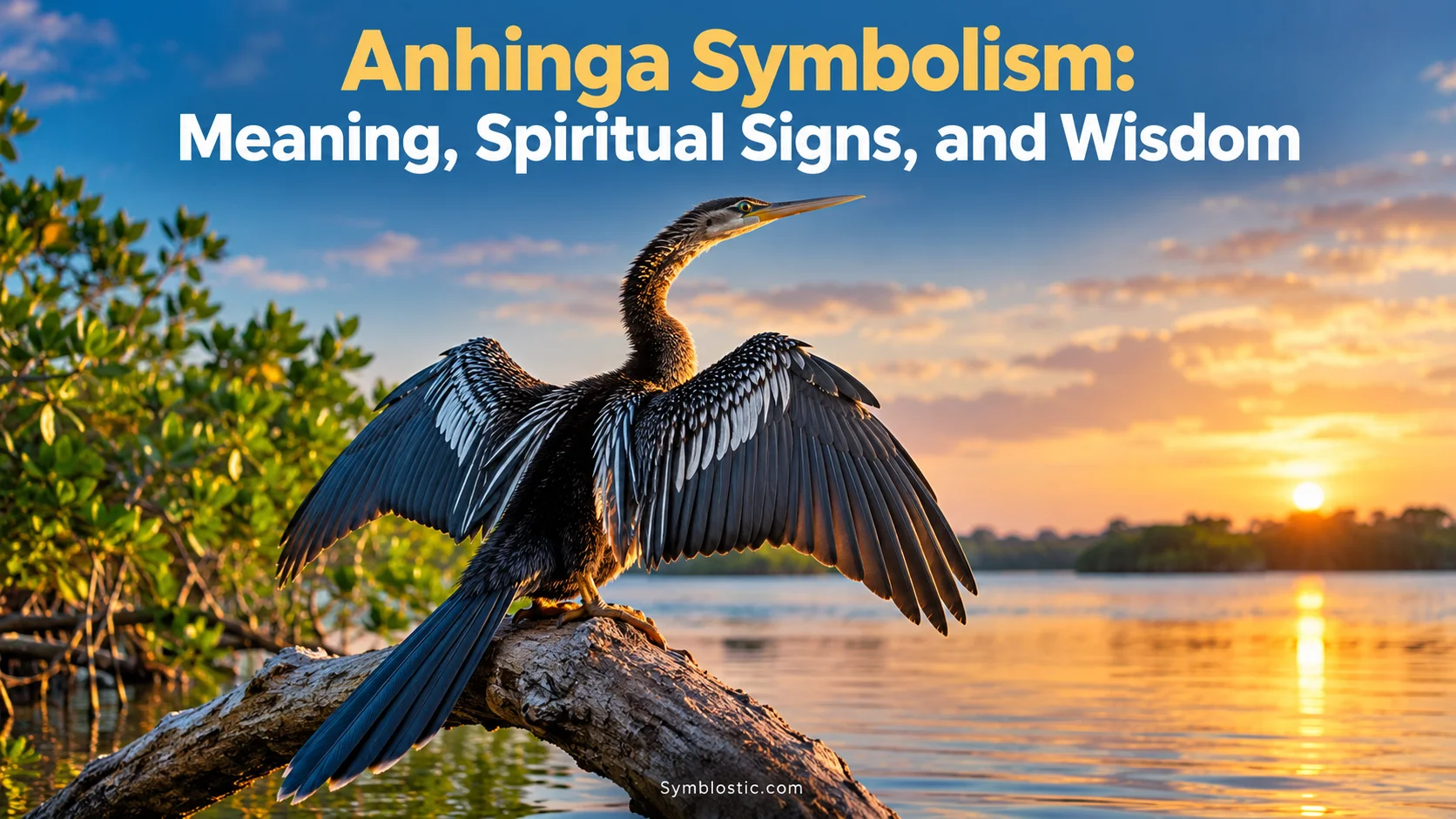
The anhinga is a striking waterbird known for its long, snake-like neck, pointed bill, and dark feathers. In American wetlands, especially across Florida and the southeastern United States, this unusual bird often appears near rivers, lakes, and marshes. Its distinctive appearance has inspired curiosity about Anhinga symbolism and the deeper meanings people might associate with its behavior.
Unlike many waterbirds, anhingas frequently swim with most of their bodies submerged. Only their heads and long necks remain visible above the water. This appearance has earned them the nickname “snakebird.” After diving for fish, they often spread their wings to dry, creating another memorable image of openness and renewal.
These natural behaviors offer useful starting points for symbolic interpretation. The anhinga can represent patience, adaptability, independence, and the ability to move between different environments. However, these meanings are modern interpretations rather than a universal spiritual code.
For American readers, the bird also connects with wetland conservation, wildlife photography, and the quiet beauty of the natural world. Understanding its symbolism begins with observing the real animal and considering what its unusual habits might mean to us.
Quick Answer
Anhinga symbolism commonly represents patience, adaptability, observation, and transformation in modern American interpretations. Spiritually, some people view the bird as a reminder to trust their timing, explore beneath the surface, and regain strength after challenging experiences.
TL;DR
- The anhinga symbolizes patience, adaptability, and quiet determination.
- Its underwater hunting suggests focus and looking beyond appearances.
- Its drying wings can represent renewal and recovery.
- In the United States, it connects strongly with southeastern wetlands.
- Spiritually, it may encourage reflection and confidence during change.
- Its natural behavior provides inspiration without proving supernatural messages.
What Does the Anhinga Symbolize?
The anhinga’s unusual body shape and hunting techniques make it a compelling subject for symbolic interpretation. For American readers, its behavior provides a natural foundation for meanings related to focus, resilience, and independence.
Unlike symbols with established meanings in religion or national history, anhinga symbolism is relatively informal. People often develop personal interpretations based on the bird’s appearance, habitat, and actions.
Patience and Focus
Anhingas hunt by diving underwater and pursuing fish with their sharp bills. Their hunting requires attention, timing, and precise movement.
Symbolically, this behavior can represent the value of patience. You don’t always need to rush toward your goals. Sometimes, careful observation and waiting for the right opportunity produce better results.
Adaptability and Independence
Anhingas move between air, land, and water with remarkable ease. They swim, dive, perch, and fly as their surroundings require.
This flexibility makes them a natural symbol of adjusting to unfamiliar circumstances. Their solitary hunting behavior may also suggest independence and confidence in your own abilities.
Transformation and Renewal
After swimming, anhingas commonly perch with their wings spread. This distinctive posture helps their feathers dry.
For someone interpreting the scene symbolically, the open wings may suggest recovery after a demanding period. The image can serve as a reminder that rest and renewal are important parts of progress.
Anhinga Spiritual Meaning
The spiritual meaning of the anhinga depends on personal beliefs and the circumstances in which someone encounters the bird. In modern spiritual reflection, its relationship with water, stillness, and flight can inspire thoughts about intuition and personal growth.
However, there is no single spiritual interpretation shared by every culture or religious tradition. The meanings below are reflective possibilities, not established facts about supernatural messages.
Trust Your Timing
An anhinga may spend considerable time hunting underwater before returning to the surface. This behavior can inspire a lesson about working quietly toward a goal.
You might be making progress even when others cannot see it. The bird can serve as a reminder to value preparation instead of measuring every achievement by immediate results.
Look Beneath the Surface
Water conceals much of an anhinga’s hunting activity. Observers often see only its head above the surface.
Spiritually, this image can represent looking beyond first impressions. A difficult situation may have hidden causes, while a person’s outward behavior may not reveal their full experience.
Allow Yourself to Recover
The anhinga’s wing-spreading posture creates a striking picture of openness. You might interpret it as permission to pause, regain your energy, and approach your responsibilities with renewed attention.
This interpretation doesn’t require a supernatural belief. It can simply offer a meaningful reminder to balance effort with recovery.
Anhinga Symbolism in American Culture
In the United States, the anhinga is most closely associated with the wetlands of Florida and other southeastern states. Its symbolism develops primarily through wildlife observation, regional nature experiences, and the bird’s memorable appearance.
Unlike the bald eagle, the anhinga isn’t a widely recognized national emblem. Its cultural importance is more local and environmental than patriotic.
Florida and the Southeastern Wetlands
Florida’s freshwater marshes, lakes, canals, and wooded waterways provide excellent habitats for anhingas. Visitors often see them perched on branches, docks, and exposed roots.
For people familiar with these environments, the bird may represent the calm, wild character of southern wetlands. Its presence can also evoke memories of fishing trips, nature walks, and family vacations.
Wildlife Photography and Outdoor Recreation
Anhingas are popular subjects for birdwatchers and photographers because their behavior creates distinctive images. Their diving, swimming, and wing-spreading offer different opportunities to observe them.
These experiences can connect the bird with curiosity, patience, and appreciation for local wildlife. The symbolism emerges through direct encounters rather than a single national tradition.
Wetland Conservation
Anhingas depend on aquatic environments that support fish and other prey. Their presence can remind people of the ecological richness of rivers, marshes, and lakes.
Although seeing an anhinga doesn’t independently establish that a wetland is healthy, the bird can inspire interest in protecting these habitats.
Anhinga Historical Background and Origins
The anhinga has a long natural history, but its symbolic history is less clearly documented. Separating those two histories helps avoid assigning ancient meanings without reliable evidence.
The species belongs to the darter family, Anhingidae. Its closest relatives include other anhingas and darters found in tropical and subtropical regions around the world.
The Origin of Its Name
The word anhinga entered English through Indigenous South American languages, commonly traced to Tupi-related terminology. The bird’s snake-like appearance helps explain why names associated with serpents became attached to it.
In English, it is also called the American darter and snakebird. These names highlight different features: its hunting behavior, geographic range, and long neck emerging from water.
Natural History Versus Symbolic History
Ancient cultures sometimes attached symbolic meanings to animals, but evidence must be specific before an interpretation can be attributed to a particular people.
There isn’t a well-established, universal ancient symbolism for the anhinga comparable to the eagle’s role in certain political traditions or the owl’s place in classical mythology.
Consequently, meanings such as patience and transformation are best described as contemporary interpretations inspired by the bird’s natural behavior.
How Modern Interpretations Developed
Photography, wildlife education, and online discussions have made unusual animals easier to appreciate. The anhinga’s dramatic shape and distinctive posture provide an appealing basis for personal symbolism.
Today, its meaning may be explored through nature writing, spiritual reflection, artwork, and conversations about wildlife. These uses can be meaningful without claiming an unbroken tradition from ancient times.
Anhinga Symbolism Across Different Cultures
Anhingas and related darters occur in several parts of the world, including the Americas, Africa, Asia, and Australia. However, similar-looking birds don’t necessarily share the same cultural meanings.
For American readers, cross-cultural comparisons can broaden understanding while respecting the distinct histories of individual communities.
South American Connections
The name anhinga reflects the bird’s linguistic history in South America. Indigenous languages and local knowledge have long influenced how people identify animals and understand their environments.
However, a name’s origin alone doesn’t establish a universal spiritual meaning. Specific cultural interpretations should be attributed only when reliable documentation supports them.
Other Darter Species Around the World
Related darters also have long necks and distinctive fishing behaviors. Their appearance may invite similar modern interpretations involving patience, focus, and adaptation.
Still, these are not automatically traditional beliefs shared across all regions. Local stories, ecological relationships, and religious traditions differ considerably.
Respecting Cultural Context
When exploring animal symbolism, it’s important to distinguish personal reflection from documented cultural teachings.
- Avoid assigning a single belief to an entire Indigenous community.
- Don’t describe modern spiritual interpretations as proven ancient traditions.
- Recognize that related bird species may have different cultural roles.
- Appreciate local knowledge without treating every tradition as interchangeable.
This approach allows the anhinga to inspire personal meaning without erasing cultural differences.
Anhinga as a Spirit Animal
The phrase spirit animal is used in contemporary American spiritual discussions, online quizzes, and personal reflection. Some people use it to describe an animal whose characteristics reflect their values or current life circumstances.
However, the phrase also has specific cultural implications. In some Indigenous traditions, relationships with animals belong to distinct spiritual systems and should not be reduced to a personality label or internet trend.
Qualities Associated With the Anhinga
If you personally identify with the anhinga, its behavior may offer several useful themes.
- Patience: You prefer careful preparation over rushed decisions.
- Independence: You can work toward goals without constant approval.
- Observation: You notice details that others may overlook.
- Adaptability: You adjust when circumstances change.
- Recovery: You understand the value of stepping back after intense effort.
These qualities are reflective associations, not proof that an animal has selected or spiritually guided you.
What the Anhinga Might Encourage
The anhinga’s behavior can inspire you to examine how you handle uncertainty. Perhaps you’re working quietly toward a goal or learning to adapt after a major life change.
Instead of treating the bird as a prediction, consider which characteristic feels relevant to your current situation. That approach keeps the interpretation personal, grounded, and flexible.
Anhinga Dream Meaning and Symbolism
Dreams involving anhingas can feel memorable because the bird has such an unusual shape and movement. Its appearance may invite reflection on patience, hidden concerns, independence, or change.
However, dream symbols don’t have universally proven meanings. Personal experiences, recent memories, and emotions often influence what appears in dreams.
Seeing an Anhinga in Water
An anhinga swimming or diving may remind you of something you’re exploring beneath the surface. You might be trying to understand a relationship, decision, or feeling that isn’t immediately clear.
The most useful interpretation depends on the dream’s emotional tone. Calm water may feel reassuring, while dark or turbulent water may reflect uncertainty.
Watching an Anhinga Spread Its Wings
A bird drying its wings may evoke recovery, readiness, or a desire for greater freedom. If the scene feels peaceful, it could connect with your need for rest after a demanding period.
However, the image doesn’t guarantee that a change or opportunity is coming. It offers a prompt for reflection rather than a reliable forecast.
An Anhinga Flying Away
A flying anhinga may bring thoughts of independence, distance, or transition. You could be considering a new direction or learning to release something that no longer fits your circumstances.
Ask yourself what you felt as the bird departed. Your emotional response often provides more personal context than a fixed dream dictionary.
Read More: Meerkat Symbolism: Curiosity, Community, and Awareness
Seeing an Anhinga: Signs and Personal Messages
Seeing an anhinga in the wild can feel significant, especially when the encounter happens during a quiet or emotionally important moment. Some people interpret unusual wildlife encounters spiritually, while others simply appreciate them as memorable experiences.
Both approaches can coexist. The key is to avoid assuming that an ordinary animal sighting predicts a specific event.
Seeing an Anhinga Repeatedly
Repeated encounters might encourage you to think about patience, attention, or your connection with nature. They may also reflect the fact that you’re visiting an area where the bird lives.
If the encounters feel meaningful, consider what has been happening in your life. Use the experience to explore your own thoughts rather than searching for a universal explanation.
Seeing an Anhinga Near Water
Water is central to the bird’s hunting and daily activity. A sighting near a lake or marsh can invite reflection on emotional depth, flexibility, and the importance of a supportive environment.
These associations are symbolic, not evidence that the bird carries a supernatural warning.
What to Ask Yourself
After a memorable encounter, consider a few questions:
- What was I thinking about when I noticed the bird?
- Did its behavior remind me of a challenge or goal?
- Which quality stood out most: patience, flexibility, or renewal?
- Can I apply that quality to something practical in my life?
These questions turn an encounter into a personal reflection without requiring a particular spiritual belief.
Anhinga Symbolism in Psychology and Emotions
Animal symbolism can help people express feelings that are difficult to describe directly. The anhinga’s distinctive behavior provides several images that may connect with emotional experiences.
These associations are interpretive rather than clinical. They don’t establish personality traits or reveal someone’s mental health.
The Need for Quiet Concentration
An anhinga’s hunting behavior involves focused movement and careful timing. This can represent the desire to concentrate without distractions.
If you feel overwhelmed by competing demands, the image may remind you to simplify your attention. You don’t have to respond to everything immediately.
Independence Without Isolation
The bird’s solitary hunting behavior can suggest self-reliance. However, independence doesn’t have to mean avoiding relationships or refusing help.
A balanced interpretation recognizes that people can work independently while still benefiting from family, friends, and community support.
Resilience After Effort
The image of an anhinga drying its wings can evoke the process of regaining strength after a difficult experience. Its posture provides a simple reminder that activity and rest both have value.
For someone navigating change, this symbolism may encourage a gentler attitude toward progress. Recovery doesn’t always need to be fast to be meaningful.
Anhinga Symbolism in Tattoos, Art, and Home Decor
The anhinga’s long neck, dark feathers, and extended wings create a distinctive visual identity. These features can translate into artwork, nature-inspired tattoos, prints, and decorative designs.
Unlike widely established symbols, an anhinga tattoo doesn’t have one fixed meaning. The interpretation depends on the wearer, the design, and the surrounding imagery.
Anhinga Tattoo Meaning
Someone might choose an anhinga tattoo to celebrate a personal connection with Florida’s wetlands or a memorable wildlife encounter. Others may appreciate its appearance or associate it with patience and adaptation.
Common design possibilities include:
- A long-necked silhouette representing quiet observation.
- An anhinga diving into water to suggest exploration.
- Spread wings symbolizing renewal and freedom.
- A wetland scene honoring a meaningful natural place.
These are creative options, not standardized tattoo meanings.
Artwork and Home Decor
Anhinga prints can suit homes inspired by coastal landscapes, wildlife, and natural materials. Their dark bodies and elegant profiles also create strong contrasts against pale water or green vegetation.
For some people, such artwork represents regional identity. For others, it simply expresses an appreciation for birds and the outdoors.
Social Media and Personal Identity
A photograph of an anhinga can communicate an interest in birdwatching, travel, photography, or nature conservation. A caption about patience or renewal adds an individual interpretation.
However, the image itself doesn’t automatically communicate a specific spiritual belief. Context matters more than assumptions about the person sharing it.
Anhinga Symbolism Compared With Other Waterbirds
The anhinga shares its habitat with herons, cormorants, egrets, and other waterbirds. Comparing their visible behaviors helps explain why people may interpret them differently.
These comparisons describe possible modern associations, not universal symbolic rules.
| Bird | Common Modern Association | Distinctive Feature |
| Anhinga | Patience and adaptability | Long neck visible above water while swimming |
| Heron | Stillness and composure | Often stands motionless while hunting |
| Cormorant | Persistence and resourcefulness | Dives underwater to pursue fish |
| Egret | Grace and elegance | Pale plumage and deliberate movements |
| Kingfisher | Precision and opportunity | Rapid dives to catch prey |
What Makes the Anhinga Different?
The anhinga’s combination of submerged swimming and exposed neck creates an unusual visual impression. Its wing-spreading posture also offers a recognizable image that many observers associate with drying and recovery.
These traits help distinguish it from other wetland birds. They also explain why patience and adaptability are useful themes when exploring its symbolism.
Why Comparisons Should Stay Flexible
People interpret wildlife through personal experience and cultural background. Someone who grew up watching herons may associate them with home, while another person may connect them with solitude.
The same flexibility applies to anhingas. No single interpretation needs to fit every observer.
Anhinga Misunderstandings, Negative Meanings, and Controversies
The anhinga’s snake-like neck and dark feathers can make it appear mysterious or intimidating. However, these features reflect its anatomy and behavior, not evidence of evil or bad luck.
Understanding the real bird helps separate natural history from unsupported claims.
Is the Anhinga a Bad Omen?
There is no broadly established American tradition that identifies an anhinga as a universal sign of misfortune. Some individuals may attach personal meanings to an unexpected encounter, but those interpretations vary.
A sighting alone doesn’t establish that something good or bad will happen. The bird is simply behaving within its natural environment.
Does Its Snake-Like Appearance Make It a Symbol of Danger?
The nickname “snakebird” refers to the way its long neck appears above the water. It doesn’t mean the bird is a snake or that it represents harmful intentions.
In modern symbolism, snake-like forms may suggest mystery, transformation, or caution. However, applying those meanings to every anhinga would overlook its actual biology.
Avoiding Unsupported Spiritual Claims
Online discussions sometimes present animal encounters as definite predictions or messages. Such claims may be meaningful to individuals, but they shouldn’t be described as established facts.
A careful interpretation distinguishes personal belief from documented tradition. It also avoids treating an unfamiliar animal as frightening simply because its appearance is unusual.
How Anhinga Symbolism Has Changed Over Time
The anhinga’s significance has developed differently from that of animals with long-standing roles in national emblems, religious art, or popular mythology. Its modern symbolism largely grows from natural observation and personal interpretation.
For American readers, this distinction helps explain why its meanings may feel less standardized than those of eagles, owls, or doves.
From Local Wildlife to Modern Symbol
Historically, people identified the anhinga through its appearance, habitat, and fishing behavior. Local names reflected the bird’s distinctive shape and relationship with water.
As photography and wildlife education expanded, more people could observe the bird without living near its habitat. This increased its visibility in nature photography, educational materials, and online wildlife communities.
The Growth of Personal Spiritual Interpretations
Contemporary spiritual discussions often use animal behavior as a starting point for reflection. The anhinga’s diving, stillness, and wing-spreading make it suitable for themes involving patience and renewal.
However, these interpretations should not be confused with a single ancient doctrine. Modern symbolism can develop organically without having one historical origin.
What Its Meaning May Become
Future interpretations may increasingly connect the anhinga with wetland conservation and awareness of local wildlife. Its recognizable shape also gives artists and photographers a distinctive subject.
Even as meanings change, the real bird remains the strongest foundation for understanding its symbolism. Observing its behavior offers a more grounded starting point than assuming every sighting contains a hidden message.
FAQs:
What does an anhinga symbolize spiritually?
An anhinga may symbolize patience, adaptability, focus, and renewal in modern spiritual interpretations. Its meaning depends on your personal beliefs and the circumstances surrounding an encounter.
Is seeing an anhinga a good sign?
Some people interpret seeing an anhinga as a reminder to remain patient and open to change. However, there is no established rule that makes the sighting a prediction of good fortune.
What does an anhinga represent in dreams?
An anhinga in a dream may inspire thoughts about independence, hidden feelings, or personal change. Your emotions during the dream and your current experiences provide useful context for interpreting it.
Why is the anhinga called a snakebird?
The anhinga is called a snakebird because its long neck often appears above water while the rest of its body remains submerged. This unusual swimming posture resembles a snake moving through the water.
What does an anhinga with its wings spread mean?
The posture usually helps the bird dry its feathers after swimming. Symbolically, people may interpret the image as renewal, recovery, openness, or readiness for a new stage.
Is the anhinga connected to Native American spirituality?
There isn’t one universal Indigenous interpretation of the anhinga that applies to all Native American communities. Specific beliefs should be attributed to particular traditions only when reliable cultural sources support them.
Conclusion:
Anhinga symbolism offers a thoughtful way to explore patience, adaptability, independence, and renewal. In the United States, the bird’s strongest associations come from southeastern wetlands, wildlife observation, and its distinctive way of moving between water and air. Its spiritual meanings are best understood as personal interpretations rather than universal promises or warnings. Whether you encounter an anhinga in Florida, photograph one beside a lake, or discover it through artwork, its behavior offers a simple lesson.

1 thought on “Anhinga Symbolism: Meaning, Spiritual Signs, and Wisdom”