
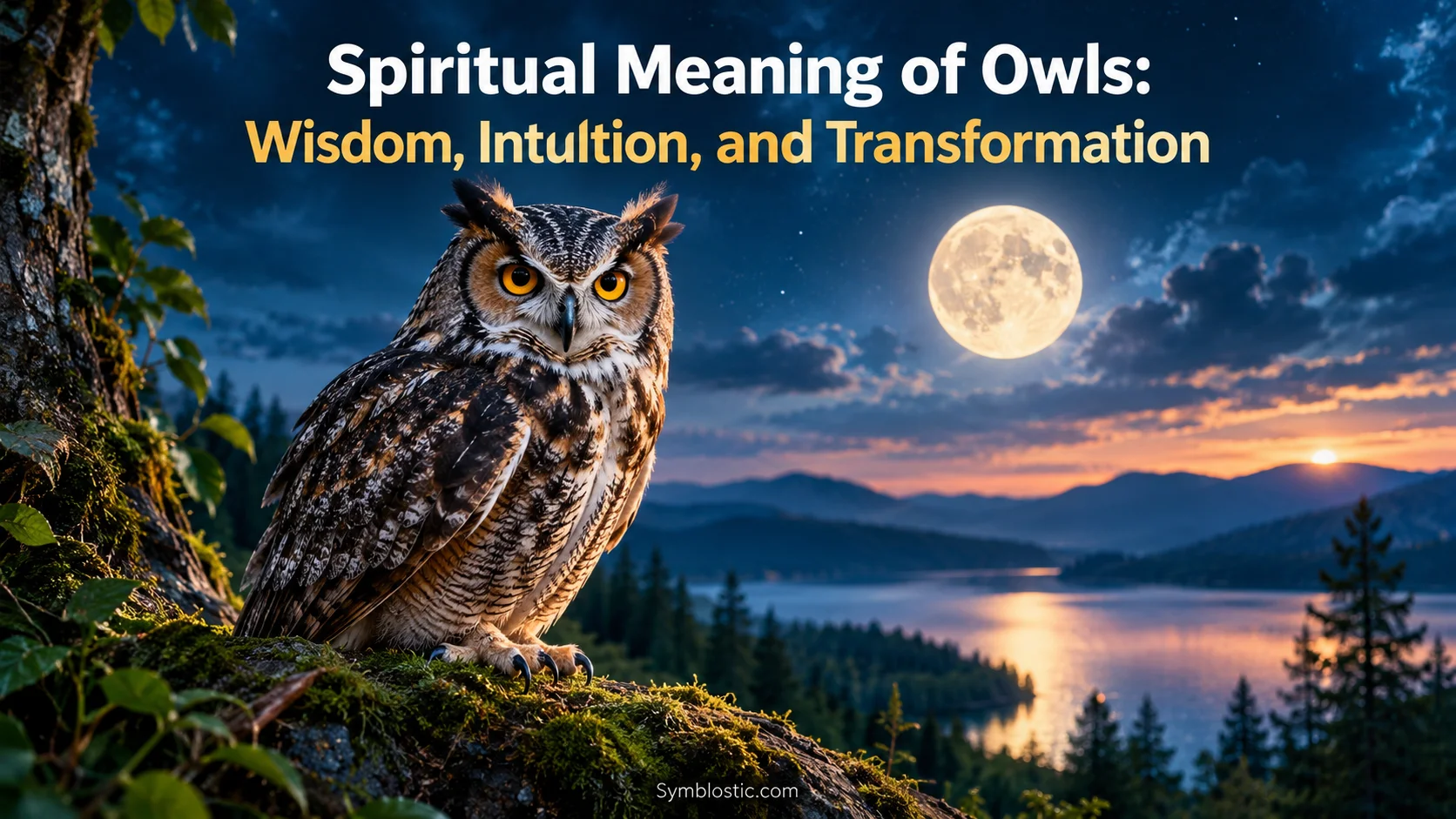
Owls have fascinated people for centuries because of their silent flight, watchful eyes, and ability to navigate the darkness. The spiritual meaning of owls often connects these mysterious birds with wisdom, intuition, hidden truths, and personal transformation. In the United States, owls appear in stories, books, art, nature photography, and spiritual discussions.
For some people, seeing an owl feels like a meaningful moment. They may associate the encounter with trusting their instincts, entering a new chapter, or paying attention to something they have overlooked. Others simply appreciate owls as remarkable nocturnal birds with unique hunting skills.
However, owl symbolism isn’t the same everywhere. Some traditions connect owls with knowledge and protection, while others associate them with death, warnings, or the unknown. Understanding these differences helps you explore their symbolism without assuming every encounter carries a supernatural message.
Quick Answer
The spiritual meaning of owls in American culture often centers on wisdom, intuition, awareness, and transformation. Spiritually, owls may represent hidden knowledge, the courage to face uncertainty, or the need to trust your inner judgment. Their meaning varies across cultures, personal beliefs, and circumstances.
TL;DR
- Owls commonly symbolize wisdom, intuition, observation, and hidden knowledge.
- In American culture, owls appear in education, literature, folklore, and popular media.
- Some spiritual traditions view owls as guides through uncertainty or change.
- Other traditions associate owls with death, warnings, or unseen dangers.
- Seeing an owl can encourage personal reflection without predicting the future.
- Owl tattoos and artwork often represent intelligence, independence, mystery, and awareness.
What Do Owls Symbolize?
Owls are distinctive birds with forward-facing eyes, rounded heads, sharp talons, and specialized feathers that support quiet flight. Their ability to hunt in low light makes them natural symbols of observation, patience, and awareness.
In the United States, owls frequently represent intelligence and learning. However, their nighttime habits also give them associations with mystery, secrets, and the parts of life people don’t fully understand.
The Core Symbolic Meanings of Owls
Several themes appear repeatedly in modern interpretations of owl symbolism.
- Wisdom: Learning from experience and looking beyond appearances.
- Intuition: Paying attention to subtle feelings and observations.
- Mystery: Exploring questions that don’t have immediate answers.
- Transformation: Moving through uncertainty toward a new understanding.
- Protection: Remaining alert and recognizing potential dangers.
- Independence: Trusting your judgment instead of following every crowd.
These meanings aren’t universal rules. Instead, they provide different ways to understand why owls hold such a powerful place in human imagination.
Why Owls Feel So Mysterious
Unlike many birds, owls are associated with darkness and quiet observation. Their large eyes, distinctive calls, and ability to remain nearly silent during flight can make an encounter feel unusual.
Consequently, people sometimes interpret an owl sighting as a reminder to slow down. The bird may inspire you to observe your surroundings carefully, question your assumptions, or become more comfortable with uncertainty.
Historical Origins of Owl Symbolism
Owl symbolism stretches back thousands of years. Ancient societies developed different interpretations based on their environments, religious beliefs, stories, and experiences with these birds.
Some cultures admired owls for their connection to knowledge. Others viewed their nighttime calls as unsettling because they associated darkness with danger or the unknown.
Owls in Ancient Greek Culture
One of the best-known historical connections is between owls and Athena, the ancient Greek goddess associated with wisdom and strategic warfare.
The little owl, Athene noctua, became closely associated with Athena and appeared on ancient Athenian coins. This association helped establish the owl as a recognizable symbol of knowledge, intelligence, and thoughtful judgment.
Over time, this image influenced broader Western ideas about owls. The bird became a familiar emblem of scholarship and intellectual ability.
Owls in Ancient Roman Beliefs
Roman writers and traditions sometimes treated owl appearances and calls as omens. In certain accounts, hearing or seeing an owl was interpreted as a warning about coming misfortune.
These beliefs reflected the broader Roman practice of interpreting unusual animal behavior as a possible sign from the gods. However, interpretations depended on the circumstances and the particular tradition.
The contrast between Greek wisdom and Roman warnings illustrates an important point: the same animal can acquire very different meanings across societies.
How Owl Symbolism Changed Over Time
During later European history, owls appeared in religious art, folklore, literature, and popular storytelling. Their nighttime activity often connected them with secrecy, loneliness, or supernatural forces.
Eventually, modern education and popular culture strengthened their association with intelligence. Today, an owl wearing glasses or holding a book is a familiar image in classrooms, libraries, and educational materials.
Owl Symbolism in American Culture
In the United States, owls carry several overlapping meanings shaped by education, literature, wildlife, folklore, and entertainment. Their image can suggest intelligence in one setting and eerie mystery in another.
American symbolism also reflects the country’s varied cultural traditions. There isn’t one single American interpretation of owls, and meanings differ between individuals and communities.
Owls as Symbols of Wisdom and Learning
The owl’s connection with knowledge is especially visible in American schools and educational settings. Owl illustrations appear on classroom posters, children’s books, academic merchandise, and learning materials.
The bird’s serious expression and alert eyes help communicate thoughtfulness. Therefore, an owl can represent a person who values education, careful reasoning, and lifelong learning.
Owls in American Folklore and Entertainment
American stories frequently use owls to establish a mysterious atmosphere. Their calls may signal that a character has entered a quiet forest or an unfamiliar nighttime setting.
Children’s stories often present owls as thoughtful advisers. Horror stories and suspenseful films, in contrast, may use their calls to create tension.
These portrayals don’t always reflect traditional beliefs. Sometimes, the owl simply serves as an effective storytelling device.
Owls and American Wildlife Appreciation
Many Americans encounter owls through birdwatching, wildlife photography, nature documentaries, and backyard sightings.
This connection adds a practical dimension to their symbolism. An owl can represent patience, environmental awareness, and respect for the natural world without carrying any supernatural meaning.
Spiritual Meaning of Seeing an Owl
Seeing an owl can feel significant, particularly when the encounter happens unexpectedly or during a meaningful period in your life. In spiritual interpretations, the experience is often connected with awareness, wisdom, and reflection.
However, seeing an owl doesn’t prove that the universe is sending a message. You can explore its symbolic meaning while recognizing that owls are wild animals following their natural behaviors.
A Reminder to Trust Your Intuition
Some spiritual interpretations associate owls with intuition, or the ability to notice patterns and impressions that aren’t immediately obvious.
If an owl appears while you’re facing a difficult decision, you might use the encounter as an opportunity to examine your feelings. Consider what you know, what you still need to learn, and whether you’re overlooking an important detail.
A Symbol of Personal Change
Owls are also associated with transformation because they move through darkness with remarkable skill.
Symbolically, this can represent navigating an uncertain period. The owl may remind you that you don’t need to understand every detail before taking a thoughtful next step.
An Invitation to Observe More Carefully
An owl’s stillness and alertness offer another useful interpretation. The encounter may encourage you to listen more carefully, notice patterns, and avoid making decisions too quickly.
This interpretation focuses on personal reflection rather than predicting future events.
What Does It Mean to Hear an Owl at Night?
Hearing an owl after dark can feel mysterious because its call may emerge from an otherwise quiet environment. Spiritually, people sometimes connect the experience with intuition, awareness, and attention to hidden concerns.
From a natural perspective, many owls call to communicate with mates, defend territories, or interact with other owls. Their vocal activity is part of ordinary wildlife behavior.
Spiritual Interpretations of an Owl’s Call
Different people attach different meanings to hearing an owl at night.
- Awareness: A reminder to pay attention to your surroundings.
- Reflection: An opportunity to examine thoughts you’ve been avoiding.
- Transition: A symbolic connection with change or uncertainty.
- Inner wisdom: Encouragement to consider your experiences carefully.
- Mystery: Recognition that some questions require patience rather than immediate answers.
None of these interpretations establishes that an owl’s call predicts an event.
Why Context Matters
Your feelings during the encounter may influence how you interpret it. Someone who feels peaceful may associate the call with comfort, while someone already anxious may find it unsettling.
The sound itself doesn’t establish whether the experience is positive or negative. Personal beliefs, cultural background, and immediate circumstances all shape its meaning.
Spiritual Meaning of Different Owl Colors
People sometimes interpret owl colors symbolically, especially in dreams, artwork, meditation, and spiritual discussions. These meanings are modern interpretive associations rather than scientifically established messages.
Actual owl coloration depends on the species, its habitat, and its natural features.
White Owl Symbolism
White owls are often associated in contemporary spiritual interpretations with clarity, renewal, mystery, and spiritual awareness.
Their pale feathers can create a striking appearance against dark surroundings. Symbolically, this contrast may suggest discovering something important during an uncertain period.
However, a white owl doesn’t universally represent purity or good fortune. Cultural traditions and individual experiences may give it different meanings.
Brown Owl Symbolism
Brown owls can symbolize stability, patience, and connection with nature in modern interpretations.
Their earthy colors may evoke forests, tree bark, and the natural environment. For someone seeking a grounded perspective, the brown owl can serve as a reminder to remain practical while exploring personal questions.
Black Owl Symbolism
Dark-colored owls may be associated with mystery, hidden knowledge, or confronting fears.
These interpretations often reflect the broader symbolic relationship between darkness and the unknown. They don’t mean that a dark owl brings bad luck or represents evil.
Gray Owl Symbolism
Gray owls may suggest balance, patience, and thoughtful judgment in contemporary symbolic readings.
Gray sits between black and white, making it an easy metaphor for uncertainty or situations that resist simple answers. An owl with gray feathers may therefore inspire reflection on the value of considering several perspectives.
Owl Symbolism Across Cultures and Spiritual Traditions
Owl symbolism differs widely across the world. Some traditions connect owls with wisdom or sacred knowledge, while others associate them with death, spiritual warnings, or powerful unseen forces.
These differences deserve respect rather than being reduced to a single universal interpretation.
Indigenous Traditions in North America
Indigenous peoples of North America have diverse languages, histories, spiritual practices, and relationships with wildlife. As a result, there is no single Indigenous meaning of the owl.
In some communities and stories, particular owl species or calls may carry associations with warnings, death, spiritual beings, or other culturally specific ideas. In other contexts, interpretations may differ significantly.
These teachings should be understood within their own communities and traditions. It would be inaccurate to assign one meaning to every Indigenous nation or present sacred knowledge as a universal spiritual rule.
Owls in Hindu Traditions
In some Hindu traditions, the owl is associated with Lakshmi, the goddess connected with prosperity and good fortune. An owl is traditionally depicted as her vahana, or vehicle, in certain representations.
Interpretations of this relationship vary. The owl may be discussed in connection with wealth, awareness, and the relationship between material prosperity and wise judgment.
Its meaning depends on the religious context and the particular interpretation being considered.
Owls in Japanese and Other East Asian Traditions
In Japan, the owl is sometimes associated with good fortune. The Japanese word fukurō can be represented using characters that allow favorable wordplay connected with protection from hardship.
Owl imagery appears in charms, decorative objects, and gifts intended to express good wishes. However, these associations are not identical across all East Asian cultures.
Elsewhere, owl symbolism may carry different meanings shaped by local stories and religious practices.
Read More: Raccoon Dog Symbolism: Adaptability, Mystery, and Survival
The Emotional and Psychological Meaning of Owls
Owls can evoke curiosity, calmness, fear, wonder, or fascination. Their symbolic impact often comes from how people respond to darkness, silence, and the unknown.
Psychological interpretations offer a way to understand these reactions without assuming that an owl has a fixed spiritual message.
Owls as Symbols of Inner Wisdom
The owl’s association with intelligence can make it a useful symbol for thoughtful decision-making.
When you identify with an owl, you may be expressing a desire to learn, observe, or act with greater care. The image can represent the value of considering evidence before forming an opinion.
Owls and the Unknown
Because many owls are active at night, they naturally fit stories about unfamiliar places and hidden things.
This association can make owls powerful symbols during periods of uncertainty. Rather than treating uncertainty as a threat, you might view it as a reason to stay curious and gather more information.
Why Some People Fear Owls
Owl calls can sound unusual, and their nighttime movements may surprise people who aren’t accustomed to seeing them.
Folklore can intensify these reactions by connecting owls with death or misfortune. However, feeling afraid during an encounter doesn’t mean the bird is dangerous or that something bad will happen.
Owl Symbolism in Dreams
Dreams involving owls can be memorable because these birds carry strong associations with wisdom, darkness, and observation. Their possible meaning depends on the dream’s details and the dreamer’s own experiences.
There is no reliable universal code that establishes what every owl dream means.
Dreaming of a Calm Owl
A calm owl may represent patience, thoughtful observation, or the desire to understand a situation more clearly.
You might reflect on whether you’re taking enough time to consider your options. The dream may also connect with a person you regard as wise or observant.
Dreaming of an Owl Watching You
An owl staring at you may symbolize self-awareness or the feeling of being observed.
Consider whether a situation in your waking life makes you feel judged, uncertain, or unusually alert. Your emotional response may reveal more about the dream’s personal significance than the owl itself.
Dreaming of a Flying or Calling Owl
A flying owl might suggest freedom, changing perspectives, or movement through uncertainty.
An owl calling in a dream could reflect something you want to acknowledge or understand. These are reflective possibilities, not predictions or proven explanations of dreams.
Owl Tattoos, Art, and Modern Symbolism
Owls remain popular subjects in tattoos, jewelry, illustrations, clothing, and home decoration. Their distinctive appearance allows artists to communicate several ideas through one recognizable image.
In contemporary American culture, owl designs can express intellectual interests, personal values, spiritual curiosity, or an appreciation for wildlife.
Popular Owl Tattoo Meanings
Owl tattoos don’t have one fixed meaning. Their interpretation often depends on the design, the person wearing it, and the other elements included.
- Owl with a book: Love of learning and intellectual curiosity.
- Owl with a moon: Mystery, nighttime, and reflection.
- Flying owl: Independence, movement, and personal change.
- Geometric owl: Order, balance, and thoughtful design.
- Owl with flowers: Growth, beauty, and a connection with nature.
- Realistic owl portrait: Respect for wildlife or a personal connection with owls.
A tattoo may also commemorate a meaningful experience or represent a private memory that others cannot see.
Owls in Home Decor and Gifts
Owl decorations appear in wall art, figurines, textiles, stationery, and seasonal displays.
An owl on a bookshelf may reinforce the theme of learning. A moonlit owl print might create a quiet, mysterious atmosphere, while a woodland illustration may celebrate nature.
These choices reflect modern design preferences rather than a single established spiritual tradition.
Owl Symbolism in Different Everyday Contexts
An owl’s meaning often changes with its surroundings. The same image can communicate education in a classroom, mystery in a film, or wildlife appreciation in a nature center.
The following table summarizes common interpretations in the United States.
| Context | Common Meaning | Important Note |
| Schools and libraries | Wisdom and learning | A familiar educational symbol |
| Nature photography | Wildlife and observation | Focuses on the natural world |
| Spiritual discussions | Intuition and transformation | Depends on personal beliefs |
| Horror and mystery stories | Darkness and suspense | Often used for atmosphere |
| Tattoos and jewelry | Intelligence and individuality | Personal meaning varies |
| Dream interpretation | Reflection and hidden concerns | No universal interpretation exists |
Understanding the context helps prevent confusion. An owl in a children’s book may simply be a wise character, while the same bird in a supernatural story may represent something unknown.
Misunderstandings About Owl Spiritual Meaning
Owl symbolism can become confusing when cultural beliefs, personal interpretations, and biological facts are treated as interchangeable. Separating these ideas makes it easier to appreciate the bird without creating unnecessary fear.
Do Owls Always Represent Bad Luck?
No. Some folklore traditions connect owls with death, misfortune, or warnings, but many other interpretations associate them with wisdom, knowledge, and good fortune.
A negative association in one cultural setting doesn’t establish a universal meaning. Nor does an owl sighting provide reliable evidence that an unfortunate event is coming.
Are Owls Always Spiritual Messengers?
Some people interpret animal encounters spiritually, while others understand them through nature and personal experience.
There is no scientific evidence that seeing an owl automatically delivers a supernatural message. You can still use the experience as a meaningful prompt for reflection if that approach fits your beliefs.
Does an Owl’s Call Predict Death?
An owl calling at night is not reliable evidence that someone will die.
This belief appears in some cultural stories and folklore, but owls vocalize for ordinary biological reasons. Their calls can be explained through communication, territorial behavior, mating, and other natural activities.
Respecting Cultural Differences
It’s important not to label an entire culture’s beliefs as foolish or treat one tradition as the definitive interpretation.
Owl symbolism developed through many different histories. Learning about these traditions respectfully means recognizing their context and avoiding unsupported claims about what every community believes.
How Owl Symbolism Has Changed Over Time
Owl symbolism has shifted as societies changed their relationships with religion, nature, education, and popular entertainment. Meanings once associated primarily with omens now coexist with modern associations involving intelligence and personal growth.
From Omens to Knowledge
In some ancient traditions, owls were treated as signs of future events. Their unusual nighttime calls and sudden appearances made them compelling subjects for stories about fortune and danger.
Meanwhile, the association between owls and Athena strengthened the connection with wisdom in Western culture. Over time, educational imagery helped make this positive interpretation especially familiar in the United States.
From Folklore to Popular Culture
Books, films, television, and illustrations have expanded the owl’s symbolic range.
Today, owls may appear as wise mentors, mysterious creatures, comic characters, or powerful wildlife subjects. These portrayals can reinforce older meanings while also creating new associations.
From Fixed Meanings to Personal Interpretation
Modern spiritual discussions often encourage people to connect animal symbolism with individual experiences.
Consequently, an owl might represent independence to one person and a period of personal change to another. This flexibility allows symbolism to remain meaningful without requiring everyone to accept the same interpretation.
FAQs:
Is Seeing an Owl a Good Sign?
Many contemporary spiritual interpretations view seeing an owl positively, associating it with wisdom, awareness, and intuition. However, some traditions connect owls with warnings or difficult changes, so the meaning depends on the cultural and personal context.
What Does It Mean When an Owl Visits Your House?
An owl near your house may simply be hunting, resting, nesting, or passing through its territory. Spiritually, some people interpret the encounter as a reminder to pay attention to their surroundings or trust their judgment, but it doesn’t establish that a supernatural event is coming.
What Does Hearing an Owl at Night Mean Spiritually?
Hearing an owl at night is sometimes interpreted as a symbol of intuition, reflection, or awareness. In nature, owls call to communicate with other owls, defend territories, and support mating behavior.
What Does a White Owl Mean Spiritually?
In modern spiritual interpretations, a white owl may symbolize clarity, renewal, mystery, or awareness. These meanings aren’t universal, and the bird’s appearance doesn’t prove that a particular spiritual message has been delivered.
What Does an Owl Symbolize in Christianity?
Owls appear in some biblical passages associated with desolation, wilderness, or deserted places, depending on the translation and the bird identification involved. Christian interpretations vary, so the owl shouldn’t automatically be treated as a universal symbol of evil or spiritual danger.
Are Owls Considered Good Luck in American Culture?
Owls are often associated with wisdom and learning in American culture, while other stories connect them with mystery or misfortune. There is no single American belief about owl luck, and an owl’s presence doesn’t reliably predict future events.
Conclusion:
The spiritual meaning of owls brings together several powerful themes, including wisdom, intuition, mystery, awareness, and transformation. In the United States, owls are widely recognized as symbols of learning, but their presence in folklore and spiritual traditions adds more complex interpretations. Across cultures, owls can represent good fortune, hidden knowledge, warnings, or connections with the unseen world. These differences show why it’s important to consider cultural context instead of assuming every owl carries the same message.

1 thought on “Spiritual Meaning of Owls: Wisdom, Intuition, and Transformation”