
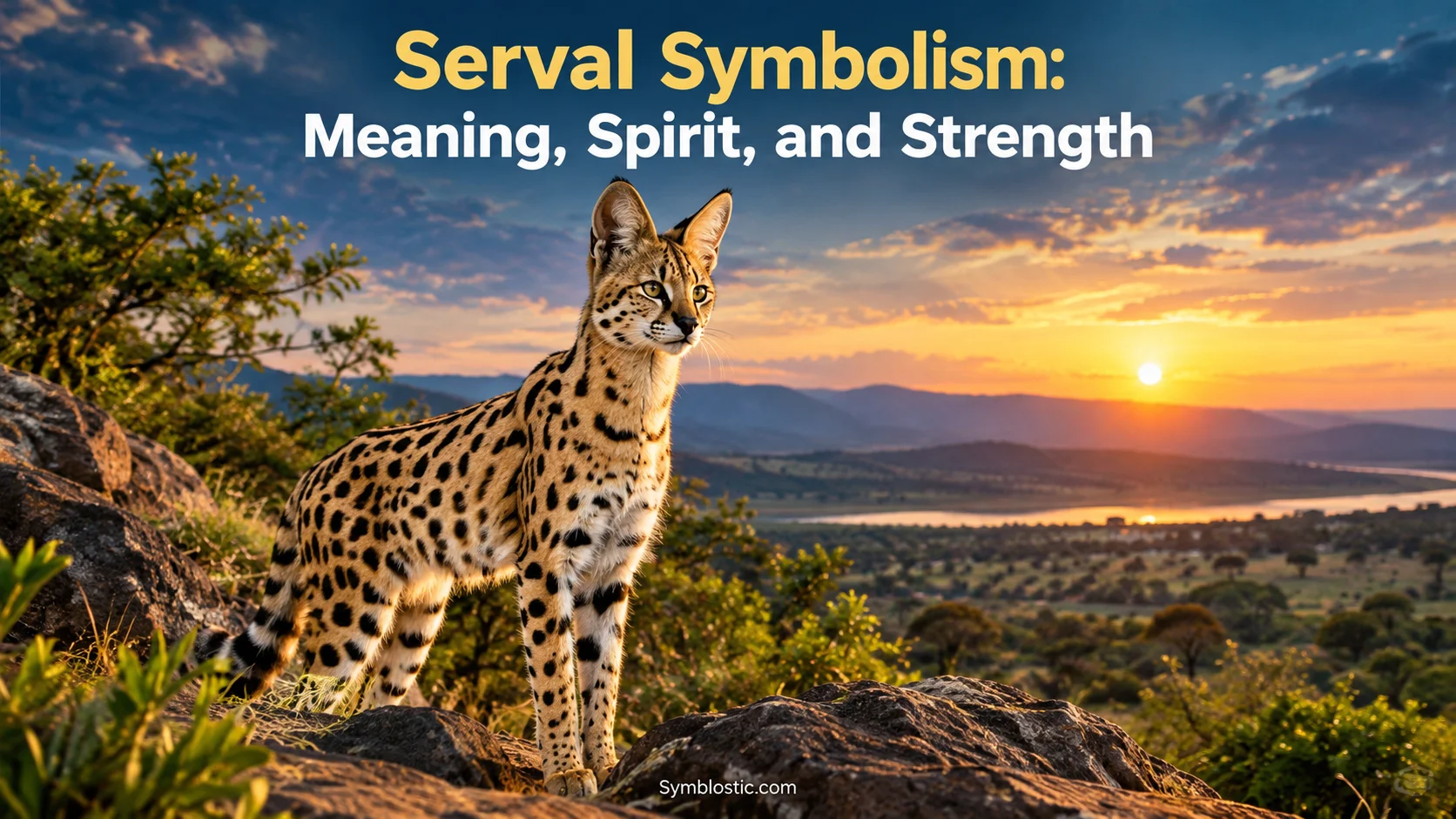
The Serval Symbolism often begins with the animal itself: a slender African wild cat with unusually long legs, huge ears, and a spotted golden coat. Those features naturally invite ideas of awareness, agility, patience, and independence.
For many people in the United States, the serval feels mysterious because it isn’t a familiar wild animal like a deer, wolf, or bobcat. Yet its unusual appearance and remarkable hunting skills make it a powerful modern symbol of paying attention, trusting your instincts, and acting at the right moment.
The serval also carries a deeper lesson. It doesn’t need the physical power of a lion to survive. Instead, it relies on hearing, patience, precision, and flexibility. That makes its symbolism especially relevant when you’re facing a situation where quiet strength matters more than force.
Quick Answer
Serval Symbolism commonly represents awareness, independence, patience, adaptability, intuition, and graceful strength. In a modern American context, it can symbolize knowing when to observe, when to stay independent, and when to make a precise move.
TL;DR
- Servals symbolize awareness, patience, independence, and adaptability.
- Their large ears suggest listening and heightened perception.
- Their long legs represent agility and graceful movement.
- Their hunting style connects them with patience and precision.
- In America, servals often represent exotic beauty and wild freedom.
- Modern symbolism commonly appears in art, tattoos, wildlife imagery, and identity.
What Does a Serval Symbolize?
The serval has a distinctive appearance that makes its symbolism easy to understand. Its huge ears, long legs, spotted coat, and alert posture each suggest a different quality.
However, symbolism isn’t a scientific fact. These meanings come from the way people interpret an animal’s behavior, appearance, habitat, and cultural associations.
The Main Symbolic Meanings
Common modern interpretations include:
- Awareness: noticing details others may overlook.
- Independence: following your own direction instead of copying others.
- Patience: waiting carefully before taking action.
- Adaptability: changing your approach when circumstances shift.
- Intuition: trusting information gathered through observation and instinct.
- Grace: remaining controlled and composed under pressure.
- Precision: using timing and focus rather than unnecessary force.
The serval’s symbolism becomes strongest when these qualities are considered together. It represents quiet power rather than loud dominance.
Serval Appearance and Symbolic Meaning
A serval’s physical design strongly influences how people interpret it. Unlike lions or tigers, it doesn’t immediately communicate brute strength.
Instead, almost everything about its body suggests sensory awareness and movement.
Large Ears and Awareness
The serval has exceptionally large ears relative to its body. Its hearing helps it detect prey hidden in vegetation.
Symbolically, those ears can represent listening before reacting. They suggest paying attention to subtle information rather than waiting for something obvious to happen.
For a modern reader, this can represent emotional awareness, careful observation, or simply becoming more present.
Long Legs and Agility
The serval’s long legs give it a striking appearance. They also help it move through grasses and wet habitats.
As a symbol, long legs can suggest mobility, flexibility, and the ability to rise above obstacles. The idea isn’t about physical height alone. It’s about having room to move when circumstances become difficult.
Spotted Coat and Adaptation
Its tawny coat with dark markings helps it blend into its surroundings.
Therefore, the spots are often interpreted symbolically as adaptation and camouflage. They can represent knowing when to stand out and when to become less visible.
Historical Background of Serval Symbolism
The serval’s relationship with humans goes back much further than its popularity in modern wildlife photography. Evidence connects servals with human culture in ancient northeastern Africa.
However, it’s important not to treat every ancient feline image as a serval. Ancient artists often depicted several wild and domestic cat species, and identifying an exact species can be difficult.
Servals in Ancient Egypt
Historical evidence indicates that servals were known in ancient Egypt and could appear as animals associated with Nubia. Their presence reflects the movement of animals and goods between regions.
Ancient Egyptian culture also gave enormous importance to cats and feline imagery. Yet this doesn’t mean the serval itself held the same sacred status as domestic cats or particular feline deities.
That distinction matters. Modern articles sometimes combine all ancient Egyptian feline symbolism and label it specifically as serval symbolism.
From Wild Animal to Symbol
Over time, people have interpreted wild cats through qualities such as stealth, hunting ability, independence, and mystery.
The serval fits those themes particularly well. Its unusual body and nocturnal habits make it especially easy to associate with the unseen and the carefully observed.
Serval Symbolism in the USA
In the United States, serval symbolism is shaped less by traditional national mythology and more by wildlife culture, animal photography, conservation, exotic-animal interest, and modern spiritual interpretation.
The serval isn’t a native American wild cat. As a result, Americans often encounter it through zoos, documentaries, photography, educational material, social media, and exotic-cat discussions.
What the Serval Represents to Americans
Today, the serval can symbolize:
- Wild freedom in contrast with domesticated life.
- Individuality because its appearance is instantly recognizable.
- Alertness because of its remarkable ears and hunting behavior.
- Grace under pressure because it combines delicacy with predatory skill.
- Connection with nature through African wildlife imagery.
- Curiosity because the animal remains unfamiliar to many Americans.
For some people, the serval represents a desire to maintain independence while remaining observant and adaptable.
Wildlife and Conservation
The American view of the serval is also influenced by conservation awareness. Habitat loss, especially the degradation of wetlands and grasslands, can threaten the species and its prey.
That gives the animal another modern meaning: fragile wild beauty that deserves protection.
In this context, serval imagery can represent respect for ecosystems rather than simply exotic appearance.
Spiritual Meaning of the Serval
Modern spiritual interpretations commonly connect the serval with intuition, observation, independence, and inner confidence.
These interpretations should be understood as personal or spiritual frameworks rather than universal religious teachings.
Serval as a Spiritual Guide
In contemporary animal-symbolism traditions, the serval may represent learning to trust your senses.
Its message can be understood as:
- Listen carefully before making important decisions.
- Observe behavior instead of relying only on words.
- Protect your independence without isolating yourself.
- Wait for the right opportunity instead of rushing.
- Adapt when your original plan stops working.
- Move confidently when the moment finally arrives.
The overall spiritual theme is awareness followed by deliberate action.
Serval and the Night
Because servals are primarily active around dusk and night, modern spiritual interpretations sometimes connect them with mystery and hidden knowledge.
That doesn’t mean the animal has a universal supernatural meaning. Instead, nighttime creates a natural metaphor for situations that aren’t fully understood.
The serval can therefore represent staying calm when you can’t yet see the entire path.
Serval Symbolism Across Cultures
Serval symbolism shouldn’t be presented as one unified African belief. Africa contains thousands of cultures, languages, histories, and traditions.
There are documented connections between servals and human culture, but broad claims about what “Africans believe” can easily become misleading.
African Contexts
The serval has long existed within African landscapes and has appeared in cultural and artistic contexts.
In some modern interpretations, its stealth, alertness, and distinctive appearance are connected with intelligence and survival. However, specific traditional meanings should be tied to particular communities rather than assigned to the entire continent.
This approach gives the animal more cultural respect.
Ancient Egyptian Connections
Ancient Egypt provides one of the clearest historical contexts for feline symbolism. Cats were important in Egyptian art, religion, and daily life.
Still, the strongest Egyptian feline symbolism generally belongs to cats and feline deities broadly, rather than specifically to the serval.
Therefore, it’s more accurate to say that the serval existed within a wider world of important African feline imagery.
Read more: Ladybug Symbolism: Meaning, Spirit, History & More
Emotional and Psychological Meaning of a Serval
People often connect with animal symbols because an animal expresses something they feel or want to become.
The serval works particularly well as a psychological symbol because it combines vulnerability with capability.
What the Serval Can Represent Emotionally
A serval may symbolize:
- Quiet confidence without a need for attention.
- Curiosity about unfamiliar experiences.
- Independence without complete isolation.
- Patience during uncertain periods.
- Alertness when something feels emotionally wrong.
- Confidence in personal instincts.
- Grace when dealing with pressure.
Its symbolism can appeal to people who dislike aggressive ideas of strength.
Instead, the serval suggests that strength can be quiet, observant, and selective.
The Psychology of Waiting
One of the most useful serval metaphors is patience.
The animal doesn’t need to attack every movement it notices. It observes, evaluates, and then acts.
For people, that can represent a healthier response to uncertainty. Sometimes the strongest decision is to gather more information before making a move.
Serval Symbolism in Dreams
Dream interpretation is personal, so a serval doesn’t have one fixed meaning for everyone.
However, its characteristics can provide useful symbolic possibilities.
Seeing a Serval in a Dream
A serval might represent heightened awareness if you’re currently dealing with uncertainty.
If the animal is watching you, the dream may symbolically reflect your own attention toward something unresolved. If it is running freely, the image may connect with independence or a desire for greater freedom.
The emotional tone matters most.
A frightening serval can suggest vulnerability or feeling watched. A calm serval may suggest confidence, curiosity, or self-trust.
Serval Symbolism in Tattoos and Art
Serval tattoos are less common than lion, tiger, leopard, or domestic-cat tattoos. That rarity can actually strengthen their symbolic appeal.
A serval tattoo may communicate individuality because the animal isn’t an obvious mainstream choice.
Common Tattoo Ideas
A serval design can emphasize:
- Large ears for heightened awareness.
- Long legs for agility and movement.
- Spotted fur for adaptability.
- A crouching pose for patience.
- A walking pose for independence.
- A focused face for intuition.
- Tall grass for connection with nature.
A realistic serval can communicate wildlife appreciation, while a stylized design can emphasize personal symbolism.
Art and Home Decor
In American homes, serval imagery can fit nature-inspired, safari-inspired, or contemporary spaces.
It may also appeal to people who prefer less familiar wildlife symbols. Instead of representing dominance, it can create an atmosphere of quiet mystery and natural elegance.
Serval Symbolism in Modern Culture
Today, the serval exists at the intersection of wildlife education, social media, photography, conservation, and exotic-animal culture.
Its appearance makes it especially popular in visual media.
Social Media and Identity
Online, animal imagery often becomes a form of self-expression.
Someone might use a serval image because they identify with being observant, independent, unusual, or quietly confident.
However, a picture alone doesn’t establish one universal meaning. The caption, context, and person using it determine the intended message.
Exotic Pet Culture
Servals have also appeared in discussions about exotic pets. Their striking appearance can make them seem like unusual domestic cats, but they remain wild animals with specialized needs.
Hybrid cats such as Savannah cats have further connected servals with American pet culture.
This creates an important distinction between admiring a symbol and treating a wild animal like an ordinary household pet.
Serval Symbolism by Context
The same serval image can communicate different ideas depending on where it appears. Context often matters more than the animal itself.
| Context | Meaning in the USA | Common Association | Notes |
| Tattoo | Independence and individuality | Quiet strength | Often chosen for uncommon symbolism |
| Wildlife art | Natural beauty | African wilderness | Can emphasize conservation |
| Spiritual artwork | Intuition and awareness | Inner guidance | Personal rather than universal |
| Home decor | Elegance and mystery | Exotic nature | Often visually driven |
| Social media | Uniqueness and confidence | Wild identity | Meaning depends on the user |
| Conservation imagery | Environmental responsibility | Protecting wildlife | Focus shifts toward habitat |
Misunderstandings and Controversies
Serval symbolism has relatively few major controversies compared with symbols connected to religion, politics, or national identity.
However, several misunderstandings deserve attention.
Not Every Spiritual Claim Is Traditional
Online symbolism pages sometimes present modern spiritual interpretations as ancient African beliefs.
That can blur the difference between contemporary spiritual writing and documented cultural tradition.
A respectful approach is to describe modern interpretations as modern interpretations unless there is strong evidence for a specific historical tradition.
The Serval Is Not a Domestic Cat
Another common misunderstanding comes from its appearance.
A serval may resemble an unusually tall domestic cat, but it is a wild species. Symbolic admiration shouldn’t erase its natural behavior or welfare needs.
Fur and Cultural Dress
Serval skins have historically been used in some ceremonial contexts in southern Africa. Conservation efforts have also encouraged alternatives, including synthetic materials, in some settings.
This history shows that animal symbolism can change. Cultural meaning and modern conservation concerns sometimes need to be balanced carefully.
How Serval Symbolism Has Changed Over Time
The serval’s symbolic story has shifted as human relationships with wildlife have changed.
In older contexts, wild animals could be connected with trade, hunting, ceremony, survival, and regional identity. Today, Americans are more likely to encounter servals through photography, conservation, zoos, documentaries, and digital media.
From Wild Resource to Conservation Symbol
One major shift is the growing emphasis on protecting wild habitats.
The serval can now symbolize not only independence and mystery but also the vulnerability of wildlife in changing landscapes.
This gives its symbolism a more modern environmental dimension.
From Mystery to Self-Expression
The serval has also become useful as a personal symbol.
Modern readers may choose it because they want to express qualities such as independence, alertness, unusual beauty, or quiet confidence.
In that sense, the serval has moved from being simply an unfamiliar African predator to becoming a flexible symbol for modern identity.
What Can the Serval Teach You?
Animal symbolism becomes most useful when it creates a practical reflection rather than a rigid rule.
The serval offers several simple ideas that can apply to everyday life.
Listen Before You Act
The serval’s extraordinary hearing creates an obvious metaphor.
You don’t always need more action. Sometimes you need more information.
Stay Flexible
The world rarely follows one perfect plan.
The serval represents the ability to adjust without losing your direction. Adaptability doesn’t mean giving up your identity.
Use Quiet Strength
The serval isn’t symbolically powerful because it dominates everything around it.
Instead, it demonstrates how patience, awareness, and timing can produce strength without constant confrontation.
Protect Your Independence
Independence doesn’t require cutting yourself off from other people.
Instead, it can mean knowing your values well enough to make your own decisions.
FAQs:
What does a serval symbolize spiritually?
A serval can symbolize intuition, awareness, independence, patience, and adaptability in modern spiritual interpretations. Its large ears and careful hunting style often inspire themes of listening and observation.
What does seeing a serval symbolize?
Seeing a serval can be interpreted as a reminder to pay attention and trust your observations. The personal meaning depends on the situation and your emotional response to the animal.
Is a serval a symbol of good luck?
There is no universal tradition that makes the serval a standard symbol of good luck. However, modern animal symbolism may connect it with favorable qualities such as awareness, opportunity, adaptability, and confidence.
What does a serval represent in dreams?
A serval in a dream may represent independence, alertness, instinct, or something that requires closer attention. The animal’s behavior and your feelings during the dream can change the interpretation.
What does a serval tattoo symbolize?
A serval tattoo can represent individuality, quiet strength, intuition, agility, and independence. Because serval tattoos are less common, they can also communicate a preference for unusual or distinctive symbolism.
Are servals connected with ancient Egyptian symbolism?
Servals were known in ancient Egypt and were associated with the wider movement of animals from Nubia into Egyptian culture. However, it’s more accurate to distinguish specific serval references from the broader religious importance of Egyptian feline imagery.
Conclusion:
Serval Symbolism centers on awareness, patience, independence, adaptability, and quiet strength. Its remarkable ears, long legs, spotted coat, and careful hunting behavior naturally create metaphors for listening closely, moving gracefully, and acting with purpose.
In the United States, the serval has become an intriguing symbol of individuality and wild beauty, while conservation gives it another layer of meaning. Whether you encounter the serval in a tattoo, dream, artwork, photograph, or spiritual reflection, its strongest lesson is simple: pay attention, trust your instincts, stay flexible, and choose your moment wisely.

1 thought on “Serval Symbolism: Meaning, Spirit, and Strength”