
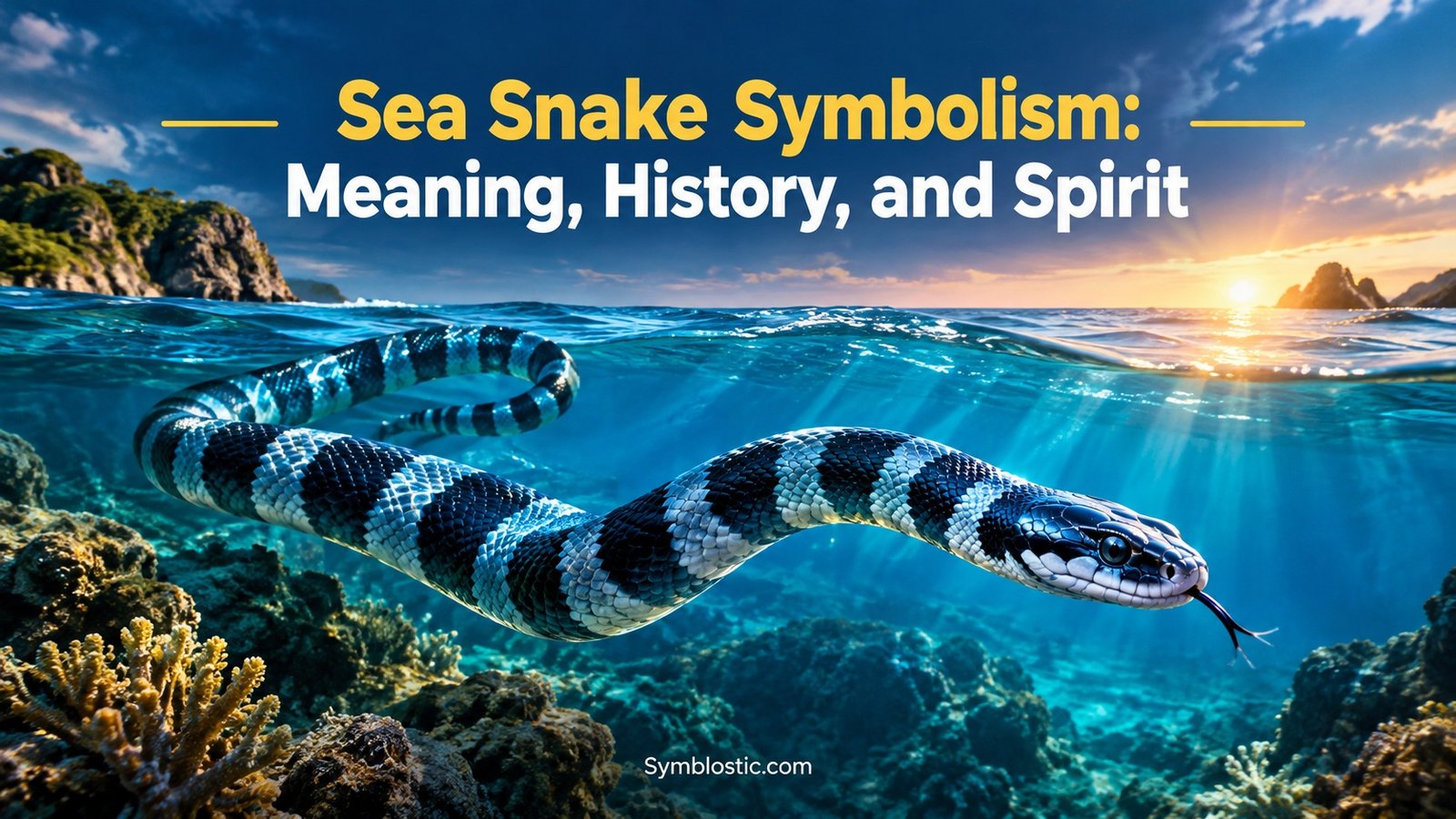
Sea snakes are real marine reptiles, but their long bodies, unusual movements, venom, and life beneath the waves have also made them powerful symbolic creatures. Sea Snake Symbolism often combines the traditional meanings of snakes with the deeper associations of the ocean.
In the United States, sea snakes don’t have one fixed cultural meaning. Instead, Americans may connect them with mystery, danger, survival, transformation, nature, and the unexplored depths of the sea. Their meaning can also change depending on whether they appear in art, tattoos, dreams, stories, or spiritual discussions.
Across other cultures, serpent and sea-serpent imagery has carried many meanings. Some traditions connect water serpents with wisdom or supernatural power, while others portray them as dangerous forces. Understanding those differences helps prevent one simple interpretation from being applied everywhere.
Quick Answer
Sea Snake Symbolism in the USA commonly represents adaptability, hidden strength, mystery, transformation, and respect for dangerous natural forces. In broader spiritual traditions, snake imagery can also represent renewal, wisdom, protection, or the movement between visible and hidden worlds.
TL;DR
- Sea snakes symbolize adaptability because they thrive in challenging ocean environments.
- Their venom creates associations with danger, power, and self-protection.
- Ocean symbolism adds mystery, emotional depth, and the unknown.
- Snake symbolism often connects with transformation and renewal.
- In America, sea snakes are more natural symbols than national ones.
- Modern tattoos often emphasize mystery, strength, change, or individuality.
What Does a Sea Snake Symbolize?
A sea snake combines two powerful symbolic ideas: the snake and the ocean. The snake contributes meanings such as transformation, danger, instinct, and hidden power, while the ocean adds mystery, depth, emotion, and the unknown.
For American readers, this combination makes the sea snake especially interesting. It represents something that can move through an environment humans cannot easily control or fully explore.
Core Meanings of the Sea Snake
Common symbolic associations include:
- Adaptability — surviving and moving effectively in a difficult environment.
- Hidden strength — possessing power without constantly displaying it.
- Transformation — changing, adapting, and leaving old patterns behind.
- Mystery — representing things that remain beneath the surface.
- Protection — warning others to respect personal boundaries.
- Danger — reminding people that beauty and threat can coexist.
However, symbolism depends heavily on context. A peaceful sea snake in artwork can suggest graceful adaptation, while an aggressive snake may communicate warning or fear.
Sea Snake Description and Symbolic Appearance
A real sea snake has several features that naturally inspire symbolic interpretations. Most true sea snakes have streamlined bodies, flattened tails, and adaptations that help them live in marine environments.
Their appearance can seem almost otherworldly to people who are more familiar with land snakes. That difference contributes to their association with mystery.
Colors and Patterns
Many sea snakes display striking patterns or contrasting colors. Black, yellow, brown, gray, and banded patterns can make them visually memorable.
Symbolically, contrasting colors may suggest duality. The creature appears beautiful and dangerous at the same time.
Movement Through Water
The sea snake’s movement is another important symbolic feature. Instead of moving across solid ground, it glides through a constantly changing environment.
This makes it a useful metaphor for flexibility. It suggests moving with circumstances instead of fighting every change directly.
Read More: Stink Bug Symbolism: Meaning, Spiritual Signs, and More
Historical Roots of Sea Snake Symbolism
Snake symbolism is far older than modern American culture. Serpents appear in myths, religious stories, artwork, folklore, and oral traditions across many parts of the world.
However, it’s important to distinguish real sea snakes from mythical sea serpents. Historical stories about enormous sea monsters often describe legendary creatures rather than the relatively small marine reptiles known to modern biology.
Ancient Serpent Traditions
Ancient cultures frequently associated serpents with water, fertility, danger, wisdom, or supernatural power. Water itself was often treated as a boundary between familiar life and an unknown world.
Some traditions imagined enormous serpent-like beings living in oceans, rivers, or other bodies of water. These stories helped establish the broader idea of the serpent as a creature connected with hidden forces.
The World Serpent Pattern
One famous example comes from Norse mythology. Jörmungandr, the Midgard Serpent, was described as a gigantic serpent living in the ocean and surrounding the world.
This isn’t a biological sea snake. Instead, it demonstrates how the combination of serpent + ocean became a powerful mythological image.
The same basic pattern appears in other traditions, although the meanings differ significantly.
Sea Snake Symbolism in the United States
Sea snakes don’t hold the same established national symbolism in America as the bald eagle, American bison, or rattlesnake. Their symbolic role is therefore more subtle.
Still, American culture has a long history of giving snakes powerful meanings. During the Revolutionary era, the rattlesnake became associated with independence, warning, resistance, and self-defense.
From the Rattlesnake to the Sea Snake
The famous American snake symbols usually involve native land snakes rather than sea snakes. The sea snake therefore doesn’t automatically inherit every meaning associated with the American rattlesnake.
However, American audiences may still recognize broader snake themes such as:
- Independence and personal strength.
- Warning against crossing boundaries.
- Survival in difficult environments.
- Respect for dangerous wildlife.
- Resistance and self-protection.
Today, sea snake imagery is more likely to appear in nature education, marine art, tattoos, fantasy, and conservation-related material.
American Symbolism at a Glance
| Context | Meaning in the USA | Common Association | Important Note |
| Nature | Adaptation and survival | Marine wildlife | Based on real animal behavior |
| Tattoo art | Transformation and strength | Personal identity | Meaning depends on design |
| Ocean imagery | Mystery and depth | Unknown places | Often metaphorical |
| Fantasy art | Power and danger | Sea monsters | May depict mythical creatures |
| Spiritual content | Renewal and inner change | Symbolic snake | Interpretations vary widely |
What Does a Sea Snake Mean Spiritually?
Spiritual interpretations often combine the traditional symbolism of snakes with the symbolic meaning of water. Water is commonly associated with emotions, intuition, depth, cleansing, and change.
Therefore, a sea snake may represent transformation happening beneath the surface.
Inner Transformation
A sea snake can symbolize personal changes that other people cannot immediately see. You may be changing your beliefs, priorities, relationships, or understanding of yourself.
The ocean reinforces this idea because much of its world remains hidden from human view.
Hidden Wisdom
Some modern spiritual interpretations treat snakes as symbols of knowledge or awareness. The sea adds another layer by suggesting wisdom found through emotional depth and introspection.
This doesn’t mean every spiritual tradition interprets sea snakes this way. Instead, it reflects a modern symbolic reading influenced by broader serpent traditions.
Sea Snake Meanings Across Cultures
Sea-serpent and water-serpent traditions appear in many cultures, but they shouldn’t be treated as one universal belief system.
Some traditions describe serpent-like water beings as protectors. Others present them as dangerous, chaotic, mysterious, or supernatural forces.
Japan and the Yellow-Bellied Sea Snake
A particularly interesting example comes from Japan. At Izumo, the yellow-bellied sea snake has been associated with Ryujashin, a dragon-serpent divine messenger in local tradition.
The snakes’ seasonal arrival along the coast became connected with beliefs about divine visitors arriving from across the sea. This illustrates how an actual marine animal can become part of a larger sacred cultural story.
South Asian Traditions
South Asian traditions contain extensive serpent symbolism, including the Nāga tradition. Nāgas can be associated with water, protection, fertility, power, and supernatural beings.
However, Nāgas aren’t simply equivalent to biological sea snakes. They belong to a much broader religious and mythological tradition.
Indigenous and Pacific Traditions
Various Indigenous and Pacific cultures have their own relationships with snakes, ocean creatures, and water beings. These traditions are diverse and should not be reduced to one general “native meaning.”
For this reason, it’s better to describe specific traditions carefully rather than claiming that all Indigenous cultures view sea snakes in the same way.
Sea Snake Symbolism and the Ocean
The ocean dramatically changes how people interpret a snake. A land snake can suggest secrecy or danger, but a sea snake adds ideas of depth, isolation, movement, and the unknown.
For many Americans, the ocean is also linked with exploration. It represents a world that humans can visit but cannot completely dominate.
The Ocean as Mystery
The surface of the ocean hides most of what exists beneath it. A sea snake disappearing into dark water can therefore become a strong visual metaphor for hidden knowledge.
It may suggest:
- Something important exists beneath the obvious surface.
- Not everything valuable can be immediately understood.
- Unknown environments can contain both beauty and danger.
- Exploration often requires courage and patience.
- Hidden experiences can shape visible behavior.
The Ocean as Emotional Depth
Water frequently appears in symbolic language about feelings. Deep water can represent emotions that are difficult to express or understand.
A sea snake moving through that water can symbolize navigating complicated feelings without becoming overwhelmed by them.
Emotional and Psychological Meaning of a Sea Snake
People don’t always choose symbols because they have one historical meaning. Sometimes they choose them because the image matches something they feel.
The sea snake can communicate several emotional qualities at once. It can look graceful, threatening, mysterious, and resilient.
Strength Without Noise
A sea snake doesn’t need to appear enormous to seem powerful. Its venom and specialized adaptations create a different kind of strength.
For some people, that makes it a symbol of quiet confidence. The message is less about showing power and more about knowing when power is necessary.
Facing the Unknown
The ocean also gives the image a psychological connection with uncertainty. A sea snake can represent someone who has learned to move through situations they can’t completely predict.
That makes the symbol especially relevant during major life changes.
It can suggest:
- Learning to tolerate uncertainty.
- Trusting your ability to adapt.
- Recognizing hidden emotional patterns.
- Protecting yourself without becoming aggressive.
- Accepting change instead of resisting everything new.
Sea Snake Symbolism in Dreams
Dream symbolism is personal rather than universal. A sea snake doesn’t automatically have one fixed dream meaning for everyone.
However, the surrounding details can provide clues. The water, the snake’s behavior, your emotional response, and what happens afterward may all influence the interpretation.
Seeing a Sea Snake
Seeing a calm sea snake might represent something mysterious that you’re beginning to understand. It could also reflect curiosity about a situation that feels unfamiliar.
If the snake creates fear, the dream may instead reflect concerns about hidden threats or uncertainty.
Being Chased by a Sea Snake
A threatening sea snake may symbolize something you’re trying to avoid. The ocean can intensify this meaning by suggesting that the issue feels emotionally deep.
Rather than treating the dream as a prediction, consider it a reflection of your current thoughts and feelings.
Swimming With a Sea Snake
Swimming alongside a sea snake can suggest acceptance of uncertainty. It may represent learning to coexist with something powerful instead of trying to eliminate it.
The meaning changes if the snake attacks, disappears, or protects you.
Sea Snake Tattoos and Modern Identity
Sea snake tattoos can carry highly personal meanings. Unlike common snake designs, they also introduce a strong ocean element.
This combination allows people to communicate ideas about transformation, resilience, mystery, or connection with the sea.
Popular Symbolic Interpretations
A person might choose a sea snake tattoo to represent:
- Personal transformation after a difficult period.
- Strength developed through challenging experiences.
- A fascination with marine life and the ocean.
- Respect for nature’s dangerous side.
- Independence and a willingness to follow one’s own path.
- Emotional depth that isn’t immediately visible.
The design itself also matters. A coiled snake can feel defensive or powerful, while a swimming snake may appear more fluid and peaceful.
Color and Style
A realistic design may emphasize the animal itself. A darker artistic style can make the image mysterious, while bright colors may highlight its unusual beauty.
However, tattoo symbolism isn’t a fixed dictionary. The strongest meaning usually comes from the person’s own story.
Sea Snakes in Art, Decor, and Social Media
Modern visual culture often uses animals to communicate personality quickly. Sea snakes work particularly well because they combine recognizable snake imagery with unusual marine elements.
In home decor, they can fit ocean-themed rooms, natural-history collections, coastal artwork, or darker fantasy aesthetics.
Digital and Pop Culture Uses
On social media, snake imagery often communicates independence, mystery, confidence, transformation, or danger.
Sea snake images can also appear in:
- Marine-life photography.
- Wildlife education.
- Fantasy illustrations.
- Ocean-themed artwork.
- Conservation discussions.
- Personal tattoo posts.
- Mythology and folklore content.
The meaning can shift quickly online. A serious cultural symbol may become an aesthetic design without its original context.
Sea Snake Symbolism, Fear, and Controversy
Snakes often trigger strong reactions. For some people, they represent beauty and transformation. For others, they immediately suggest danger.
Sea snakes intensify this tension because many species are venomous.
Beauty Versus Danger
A major symbolic theme is the coexistence of attraction and threat. The animal can look elegant while possessing a powerful defense mechanism.
This duality makes the sea snake useful in art. It communicates the idea that appearances don’t always reveal the whole story.
Myth Versus Reality
Another source of confusion is the mixing of real sea snakes with legendary sea serpents.
A biological sea snake is generally far smaller than the giant creatures described in maritime legends. Historical sea-serpent stories may have involved misidentified animals, unusual ocean conditions, floating objects, or exaggerated observations.
Keeping these categories separate makes the symbolism more accurate.
FAQs:
What does a sea snake symbolize spiritually?
A sea snake can symbolize transformation, adaptability, hidden strength, and emotional depth. Some modern spiritual interpretations also connect it with intuition and personal renewal.
Is a sea snake a symbol of good luck?
There is no universal tradition that makes the sea snake a general symbol of good luck. Its meaning varies by culture and context, ranging from protection and wisdom to danger and mystery.
What does seeing a sea snake mean?
Symbolically, seeing a sea snake may suggest that you’re encountering something unfamiliar or hidden. In dreams, the meaning depends heavily on your emotions and the snake’s behavior.
What does a sea snake tattoo symbolize?
A sea snake tattoo can represent transformation, resilience, independence, mystery, or respect for the ocean. The colors, posture, and surrounding imagery can change the message.
Are sea snakes associated with transformation?
Yes, modern symbolic interpretations often connect them with transformation. This association comes partly from broader snake symbolism and the idea of adapting to changing environments.
Are sea snakes considered sacred?
Some specific cultural traditions have treated serpent-like marine creatures as divine messengers or spiritually significant beings. However, sea snakes aren’t universally considered sacred across cultures.
Conclusion:
Sea Snake Symbolism brings together the traditional mystery of the snake with the emotional and unknown qualities of the ocean. In the United States, it most naturally suggests adaptability, hidden strength, danger, transformation, and respect for nature.
Its meaning becomes even richer when you consider the contrast between beauty and threat. A sea snake can move gracefully through an environment that seems mysterious to humans, making it a strong metaphor for navigating uncertainty.

1 thought on “Sea Snake Symbolism: Meaning, History, and Spirit”