
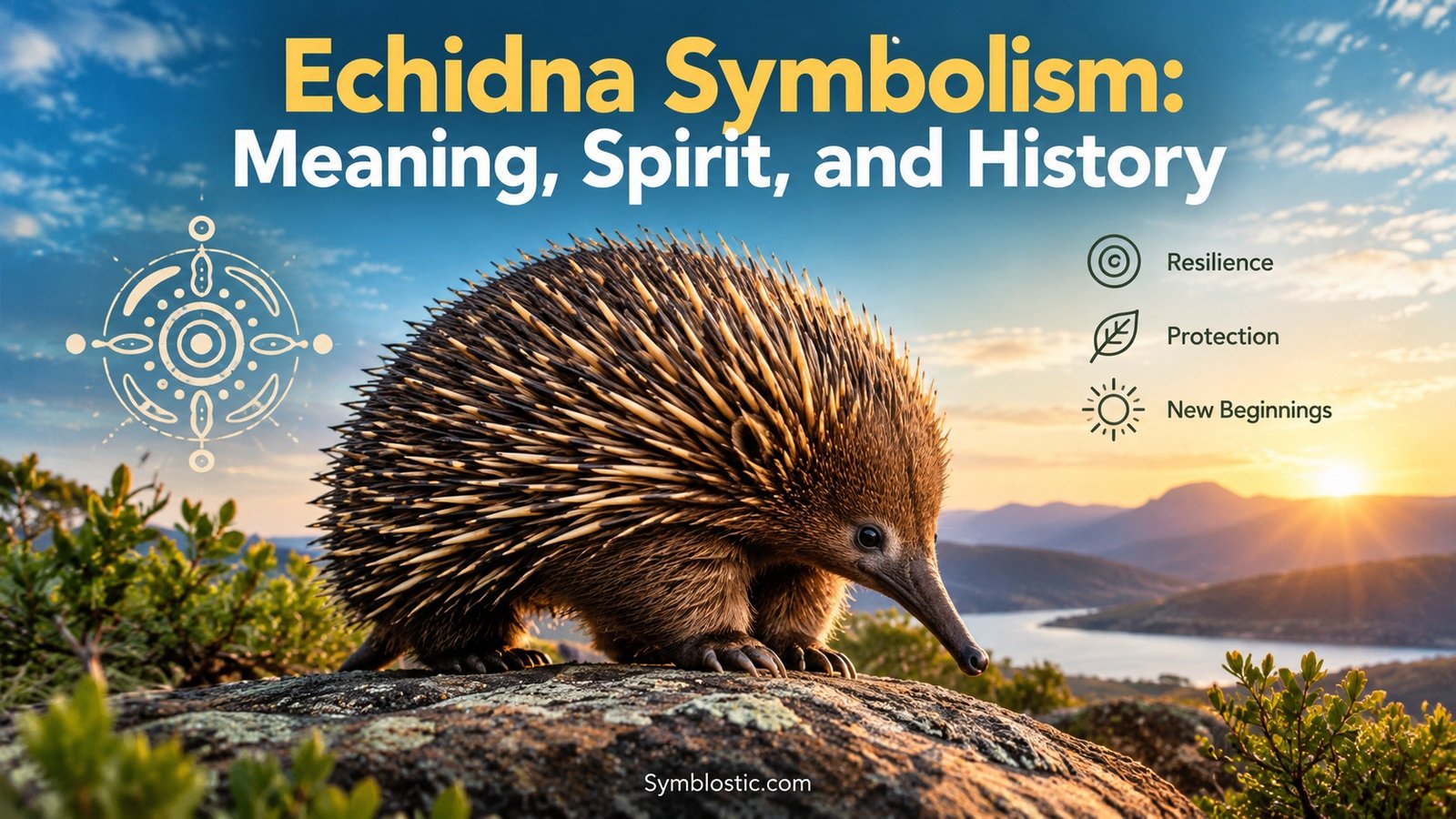
Meta Description: Discover echidna symbolism, from protection and resilience to Australian Indigenous traditions, Greek mythology, spiritual meanings, and modern identity.
Echidna symbolism centers on protection, resilience, patience, independence, and adaptability. The echidna is one of the world’s strangest mammals, with a spiny back, long snout, powerful claws, and an unusual ability to lay eggs.
For Americans, the echidna may seem unfamiliar compared with symbols such as the eagle, bear, wolf, or deer. However, its unusual appearance and survival skills give it strong symbolic appeal. Today, people may connect the animal with personal boundaries, quiet strength, individuality, and the ability to survive without seeking attention.
The echidna also carries important cultural associations in Australia, where Indigenous communities have included the animal in stories, art, knowledge systems, and relationships with Country. At the same time, the word “Echidna” has a completely different ancient meaning in Greek mythology.
Quick Answer
Echidna Symbolism often represents protection, resilience, patience, self-reliance, and quiet strength. In the United States, it can symbolize individuality and the ability to protect your vulnerable side while remaining adaptable; in Australian Indigenous traditions, its meaning is connected to particular cultural stories and relationships with land and community.
TL;DR
- Echidnas commonly symbolize protection, resilience, patience, and independence.
- Their spines suggest boundaries and defense without constant aggression.
- Their digging behavior connects them with persistence and discovery.
- Australian Indigenous traditions contain distinct echidna stories and cultural meanings.
- Greek mythology has a separate Echidna, a half-woman, half-serpent monster.
- Modern Americans may use echidna imagery for individuality and quiet strength.
What Does An Echidna Symbolize?
The echidna has several symbolic qualities that come directly from its unusual behavior and appearance. It doesn’t dominate its surroundings like a large predator. Instead, it survives through patience, strong defenses, and clever adaptation.
Protection Without Aggression
The animal’s spines are perhaps its clearest symbolic feature. They suggest the idea of having boundaries without constantly seeking conflict.
When threatened, an echidna can curl up or dig into the ground. Its defense therefore suggests retreat, protection, and patience rather than unnecessary confrontation.
Patience and Persistence
Echidnas spend much of their time searching carefully for food. Their claws allow them to dig into soil, logs, and termite mounds.
Symbolically, this can represent someone willing to keep working beneath the surface until they find what they need.
Independence and Adaptability
Echidnas are generally quiet and solitary animals. They don’t depend on dramatic displays of power to survive.
For modern readers, this makes the animal an appealing symbol of self-reliance, individuality, and adapting to difficult circumstances.
Common symbolic associations include:
- Protection: Defending yourself and your personal boundaries.
- Resilience: Continuing despite difficult circumstances.
- Patience: Allowing progress to happen at its own pace.
- Resourcefulness: Using unusual abilities to solve problems.
- Individuality: Being comfortable with what makes you different.
- Adaptability: Adjusting without losing your identity.
Echidna Physical Features and Their Symbolism
The echidna’s appearance helps explain why people attach such unusual meanings to it. Nearly every part of the animal offers a symbolic connection.
Spines and Defensive Strength
The spines create an obvious association with protection. They show that something small or quiet can still have powerful defenses.
However, the spines don’t necessarily symbolize hostility. A better interpretation is controlled strength.
Digging Claws and the Earth
Echidnas have strong claws designed for digging. This behavior can symbolize grounding, persistence, and uncovering things hidden beneath the surface.
For a person, the image can suggest looking deeper instead of accepting appearances.
Long Snout and Careful Searching
The echidna uses its specialized snout while searching for insects. Symbolically, this can represent curiosity and careful investigation.
It suggests that answers aren’t always obvious. Sometimes you need patience to discover them.
Egg-Laying and Uniqueness
Echidnas belong to the monotremes, a rare group of mammals that lay eggs. Their biology makes them unusual even within the animal world.
That uniqueness strengthens their modern symbolic connection with being different without being inferior.
Echidna Symbolism in Australian Culture
For an American audience, understanding the Australian context is essential. The echidna is native to Australia and New Guinea, so its cultural history differs greatly from that of animals native to North America.
Indigenous Stories and Traditions
Echidnas appear in stories associated with different Aboriginal Australian communities. These traditions are not one single belief system, so their meanings should not be treated as universal.
Some stories connect echidnas with transformation, consequences, protection, survival, or relationships between people and the natural world.
One widely documented story tells of an old man who was punished with spears and eventually became associated with the spiny animal. Other traditions contain different versions and meanings.
Connection With Country
In some Australian Indigenous knowledge systems, animals are connected with particular places, ancestors, stories, responsibilities, and ways of understanding Country.
Therefore, calling an echidna simply a “spirit animal” can miss important cultural context. Its meaning may be much more specific within a particular community or tradition.
Why This Matters in America
American readers often encounter Australian animal symbolism online without its original context. Understanding the cultural background helps prevent a single modern interpretation from being presented as an ancient universal truth.
Echidna Spiritual Meaning
Modern spiritual writing often treats the echidna as a symbol of quiet endurance. These interpretations are contemporary and shouldn’t be confused with every Indigenous tradition involving the animal.
Protection and Personal Boundaries
An echidna can represent the ability to protect yourself while avoiding unnecessary confrontation.
Its message can be expressed simply: you don’t have to become aggressive to become stronger.
Patience During Difficult Times
Because echidnas move and forage deliberately, they can symbolize patience. Their imagery may appeal to someone going through a period that requires steady effort.
Rather than promising instant change, the symbol emphasizes persistence.
Staying Grounded
The echidna spends considerable time close to the ground. Its digging behavior creates a natural connection with earth, stability, and grounding.
For modern spiritual audiences, this can represent slowing down and reconnecting with what feels stable.
Modern Spiritual Associations
Contemporary interpretations commonly connect echidnas with:
- Quiet resilience during challenging periods.
- Protection of emotional and personal boundaries.
- Patient progress instead of rushed decisions.
- Trust in unusual personal strengths.
- Independence balanced with awareness of others.
- Looking beneath surface appearances for deeper answers.
Echidna Symbolism in the United States
The echidna isn’t a traditional national symbol of the United States. Still, American audiences can attach modern meanings to it based on its appearance, behavior, and growing exposure through wildlife education and digital culture.
A Symbol of Individuality
Americans often use animal imagery to express identity. An unusual animal can communicate a desire to stand apart from more common choices.
An echidna tattoo, illustration, or decoration can therefore suggest, “I’m comfortable being different.”
Quiet Strength
American popular culture often celebrates bold animals such as eagles, bears, and wolves. The echidna offers a different model of strength.
It represents someone who doesn’t need to appear powerful to possess real defenses.
Protection and Boundaries
The spiny body can also fit modern conversations about personal space and boundaries. Someone may choose the image because it represents knowing when to protect themselves.
This interpretation is especially common in modern symbolic discussions, rather than being an established American tradition.
Everyday Associations
| Context | Meaning in the USA | Common Association | Important Note |
| Tattoo | Individuality and resilience | Quiet strength | Personal interpretation varies |
| Home decor | Uniqueness and nature | Curiosity | Often decorative rather than spiritual |
| Art | Adaptability and mystery | Unusual beauty | Cultural context matters |
| Personal symbolism | Boundaries and independence | Self-protection | Modern interpretation |
| Wildlife education | Scientific wonder | Uniqueness | Based on real biology |
Echidna in Aboriginal Australian Symbolism
There isn’t one universal Aboriginal interpretation of the echidna. Australia contains many distinct Aboriginal peoples, languages, communities, and traditions.
Stories Vary by Community
Some documented stories portray the echidna as a transformed person or ancestral figure. In these accounts, the animal may carry lessons involving behavior, consequences, survival, or relationships within a community.
Other traditions place greater emphasis on the animal’s relationship with land and the natural environment.
Art and Storytelling
Echidnas appear in Australian Indigenous art and storytelling. Their distinctive shape makes them recognizable, while their cultural meaning can depend heavily on the community and story behind the artwork.
For this reason, modern readers should avoid treating every echidna image as interchangeable with a generic “spiritual animal.”
Respectful Modern Interpretation
A respectful approach is to recognize the original cultural setting before borrowing an interpretation.
The echidna can inspire modern personal symbolism, but that doesn’t make a personal interpretation equivalent to an Indigenous cultural tradition.
Read More: Sea Snake Symbolism: Meaning, History, and Spirit
Echidna and Greek Mythology
One of the most confusing aspects of echidna symbolism is the name itself. The Australian animal and the creature called Echidna in Greek mythology are not the same being.
The Mythological Echidna
In ancient Greek mythology, Echidna was a monstrous female figure described as part woman and part serpent.
Ancient sources connect her with several famous monsters, including Cerberus, the Chimera, and the Sphinx in later genealogical traditions.
This mythological figure represents a very different symbolic world involving monsters, danger, hidden places, and the frightening side of nature.
Why Does the Animal Have This Name?
The modern animal received the name because early observers associated its unusual combination of characteristics with the mythological creature.
The connection is interesting because the real echidna also looks like a combination of traits from different animal groups. It has mammalian features, lays eggs, and has a spiny body.
Therefore, the name creates a historical connection between two very different meanings.
Echidna Symbolism and Psychological Meaning
Animal symbols often work because people recognize themselves in certain behaviors. The echidna offers a particularly strong image for people who value quietness and self-protection.
The Need for Boundaries
The spines can represent emotional boundaries. They suggest that being kind doesn’t mean allowing everyone unlimited access to you.
This doesn’t mean withdrawing from people completely. Instead, the symbol can represent knowing when to create distance.
Introversion and Solitude
Because echidnas are generally solitary, people may associate them with introversion.
However, solitude isn’t automatically loneliness. The symbolic lesson can be about finding comfort in your own company while maintaining meaningful connections.
Resilience
The echidna’s unusual biology makes it an appealing image of survival. It isn’t the fastest or most intimidating animal, yet it has developed specialized ways to live successfully.
That creates a useful psychological metaphor: strength doesn’t have to look conventional.
Echidna Symbolism in Dreams
Dream interpretations involving echidnas are largely modern and personal. There isn’t one scientifically established meaning for dreaming about this animal.
Seeing an Echidna
Seeing an echidna in a dream may personally suggest curiosity, independence, or a need for protection.
The surrounding dream matters more than the animal alone.
An Echidna Hiding
A hiding echidna may remind you of withdrawal or self-protection. It could reflect a situation where you feel safer keeping your distance.
However, dream symbolism shouldn’t be treated as a prediction of future events.
An Echidna Digging
A digging echidna can create a strong metaphor for searching beneath the surface.
It may represent curiosity about an unresolved issue or a desire to understand something more deeply.
An Echidna With Raised Spines
An echidna displaying defensive behavior can symbolize alertness and boundaries.
The interpretation becomes more meaningful when you consider how you felt during the dream.
Echidna Tattoos, Art, and Modern Identity
Echidna imagery works well in modern visual culture because the animal has a distinctive silhouette. Its spines and unusual face make it recognizable without requiring elaborate decoration.
Echidna Tattoo Meaning
Someone might choose an echidna tattoo to represent:
- Resilience after surviving a difficult experience.
- Individuality and comfort with being unusual.
- Protection of personal boundaries.
- Patience through a long personal journey.
- Connection with Australia or Australian wildlife.
- Curiosity about unusual animals and natural history.
Home Decor and Artwork
Echidna artwork can bring a playful or natural feeling into a room. Some people may also choose it because they prefer uncommon animals over traditional wildlife imagery.
In this setting, the meaning may be aesthetic rather than spiritual.
Social Media and Personal Expression
Animal imagery on social platforms often functions as a shorthand for personality. An echidna can communicate humor, independence, awkward charm, curiosity, or toughness.
Because online meanings change quickly, these associations shouldn’t be treated as permanent definitions.
Echidna Symbolism in Nature and Conservation
The animal’s real ecological role adds another layer to its symbolism. Echidnas are specialized insect-eating mammals that interact closely with soil while searching for food.
A Symbol of Adaptation
The echidna’s unusual biology demonstrates how evolution can produce highly specialized solutions.
Its symbolism therefore works particularly well for adaptation. It shows that survival doesn’t require looking or behaving like other animals.
Respect for Wildlife
Using an echidna as a symbol can also represent appreciation for biodiversity.
For American audiences, it offers a reminder that meaningful wildlife symbolism doesn’t have to come from familiar North American species.
The Value of Unusual Animals
The echidna’s strangeness is part of its appeal. It reminds us that nature doesn’t follow human expectations about what a mammal “should” look like.
That makes it a natural symbol for curiosity and acceptance of difference.
Misunderstandings and Controversies
Echidna symbolism is generally not controversial in the United States. However, several misunderstandings can arise when modern spiritual interpretations mix with Indigenous traditions.
“All Aboriginal People Believe the Same Thing”
This is inaccurate. Aboriginal Australia contains many distinct cultural groups and traditions.
A story associated with one community shouldn’t automatically be presented as the belief of every Aboriginal Australian.
Confusing the Two Echidnas
The Australian mammal and Greek mythological Echidna have different origins and meanings.
The shared name creates an interesting historical link, but it doesn’t make their symbolism identical.
Calling Every Interpretation Ancient
Many online interpretations involving “spirit animals,” personal energy, or dream messages are modern.
They can be meaningful to individuals, but they shouldn’t automatically be presented as ancient beliefs.
Turning Cultural Stories Into Generic Quotes
Traditional stories can lose important meaning when removed from their original cultural setting.
A respectful approach preserves the distinction between documented cultural traditions and modern personal symbolism.
FAQs:
What does an echidna symbolize?
An echidna commonly symbolizes protection, resilience, patience, independence, and adaptability. Modern interpretations often focus on quiet strength and personal boundaries.
Is the echidna a spiritual animal?
Some modern spiritual traditions treat the echidna as a symbolic or spiritual animal. However, those interpretations are not universal and shouldn’t be confused with the distinct cultural traditions of Aboriginal Australian communities.
What does an echidna symbolize in Aboriginal culture?
There is no single Aboriginal meaning for the echidna. Different communities have distinct stories and cultural relationships involving the animal, so its meaning should always be considered within its specific tradition.
What does an echidna tattoo symbolize?
An echidna tattoo may represent resilience, individuality, protection, patience, or connection with Australian wildlife. The exact meaning depends on the person wearing it.
Is Echidna from Greek mythology the same as the animal?
No. Greek mythology’s Echidna is a half-woman, half-serpent monster. The Australian mammal was later given the same name, creating an interesting connection between the two.
What does an echidna mean in a dream?
A dream about an echidna may personally suggest protection, solitude, curiosity, or resilience. Dream meanings aren’t fixed, so the animal’s behavior and your feelings in the dream matter.
Conclusion:
Echidna symbolism offers a powerful image of quiet strength. Its spines suggest protection, its digging suggests persistence, and its unusual biology represents adaptability and individuality.
For American readers, the echidna can serve as a modern symbol of boundaries, resilience, and being comfortable with what makes you different. At the same time, its Australian cultural history deserves careful treatment because Indigenous traditions are diverse and cannot be reduced to one universal interpretation.
