
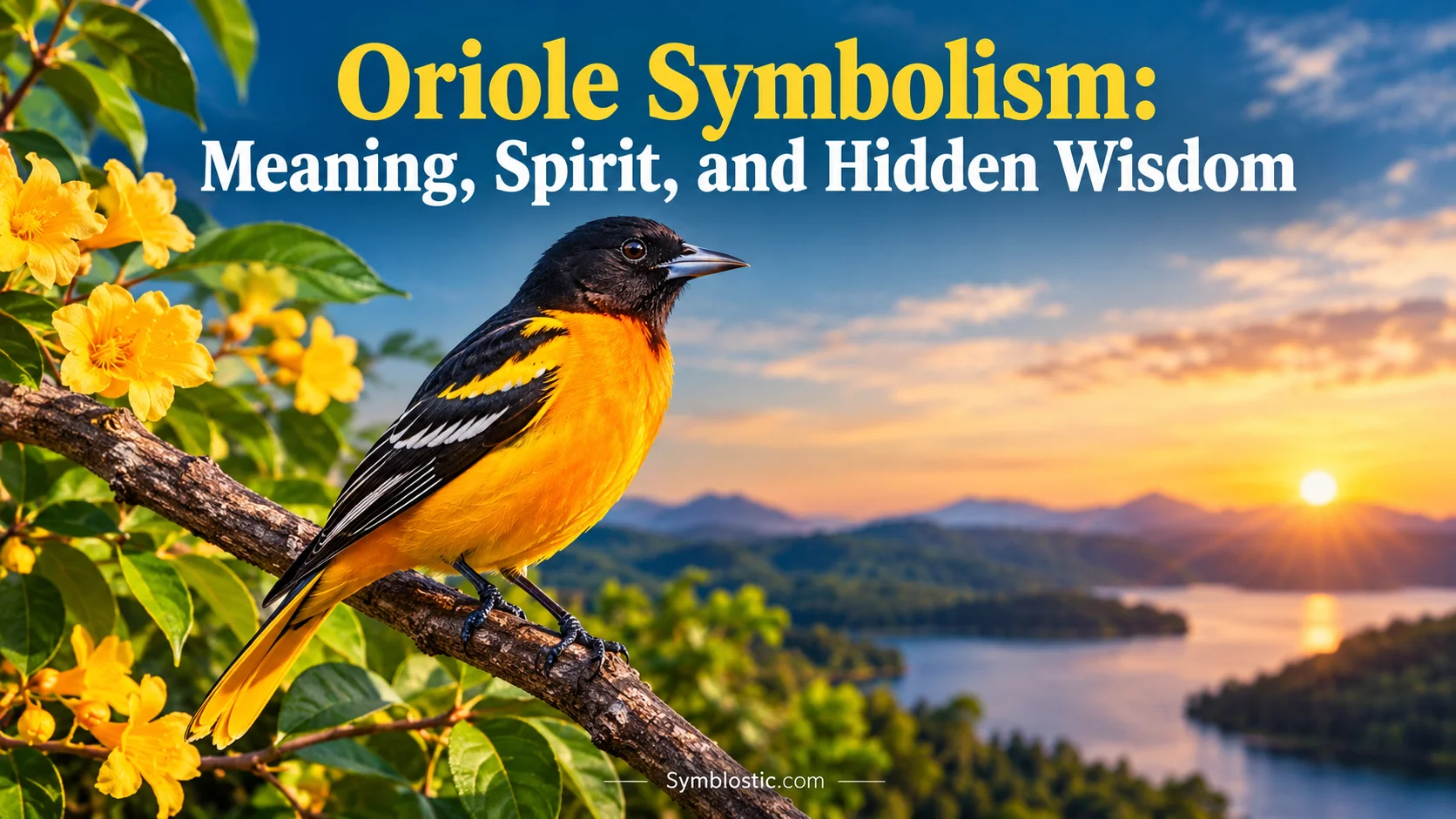
An oriole is a striking songbird known for its bright colors, clear calls, and graceful movements among trees. In the United States, the Baltimore oriole is especially familiar, with its vivid orange-and-black plumage making it a memorable sight in gardens and wooded neighborhoods. These features have helped people associate orioles with happiness, beauty, and the arrival of warmer days.
Oriole symbolism explores what this colorful bird can represent in nature, personal reflection, and spiritual traditions. For some people, seeing an oriole feels like a reminder to welcome change, express creativity, or appreciate life’s smaller pleasures. Others connect its song with emotional healing, hope, or the comfort of being present.
However, an oriole doesn’t carry one universal meaning. Its significance depends on personal experience, cultural background, and the circumstances in which someone encounters it. A bird visiting your backyard may remind you of childhood summers, while an oriole appearing during a difficult period may inspire thoughts of resilience and new beginnings.
Understanding this symbolism means looking beyond the bird’s beautiful appearance. Its natural behavior, place in American culture, and role in modern spiritual interpretation all help explain why this songbird continues to capture people’s imagination.
Quick Answer
Oriole symbolism in the United States commonly centers on joy, creativity, hope, and renewal. Its bright plumage and melodic song also inspire spiritual interpretations involving optimism, emotional growth, and appreciation for life’s beauty.
TL;DR
- Joy: Bright orange feathers often suggest happiness and positive energy.
- Creativity: The oriole’s colorful appearance inspires artistic expression and individuality.
- Renewal: Its seasonal presence can represent fresh starts and changing circumstances.
- Hope: Its cheerful song may offer comfort during uncertain times.
- Spiritual reflection: Some people interpret an oriole sighting as a personal reminder to stay hopeful.
- American identity: The Baltimore oriole has a lasting connection with Maryland and Baltimore baseball.
What Does an Oriole Symbolize?
An oriole’s symbolism begins with its bright appearance, lively song, and ability to thrive in changing environments. In American culture, these qualities often inspire ideas about joy, confidence, beauty, and personal growth.
However, the bird’s meaning isn’t limited to happiness. Its habits and natural features offer several ways to understand its symbolic importance.
The Main Symbolic Meanings
- Joy and happiness: Its vivid colors suggest warmth, enthusiasm, and a positive outlook.
- Creativity and expression: Its distinctive appearance encourages people to celebrate their unique qualities.
- Hope and renewal: Its seasonal return can remind people that difficult periods eventually change.
- Resilience: Its long migrations suggest endurance through demanding transitions.
- Family and care: Its carefully woven nest represents protection, patience, and nurturing.
- Freedom and independence: Its flight can represent the desire to explore new possibilities.
These meanings are interpretations rather than fixed rules. Your own experiences with nature may give the oriole a more personal significance.
Why Its Appearance Matters
The male Baltimore oriole has brilliant orange plumage contrasted with black feathers. This striking combination naturally attracts attention, while its whistled song adds a sense of liveliness.
Female and immature orioles often display softer yellow-orange shades. Consequently, oriole symbolism doesn’t depend on one exact appearance. The broader image of a colorful, active songbird carries much of its modern symbolic appeal.
Historical Background of Oriole Symbolism
The history of oriole symbolism is closely connected to how people have understood birds, colors, and seasonal changes. Unlike certain mythological creatures, the oriole doesn’t have one universally recognized ancient symbolic tradition.
Instead, its modern meanings draw from natural observation, local bird traditions, and the human tendency to connect beautiful wildlife with emotional experiences.
Early Connections With Nature
For generations, people have watched birds as signs of seasonal change. Migratory birds can signal the return of warmer weather, the availability of food, and changes in the surrounding landscape.
In eastern North America, Baltimore orioles arrive during spring migration. Their appearance and songs can therefore feel like a celebration of winter’s end.
This seasonal pattern supports several common interpretations:
- Spring represents new opportunities after a difficult period.
- Bright feathers suggest life, warmth, and natural abundance.
- Birdsong creates associations with peace, celebration, and connection.
- Migration reflects movement, adaptation, and changing circumstances.
These interpretations emerge from the bird’s behavior rather than a single ancient legend.
How the Meaning Developed
Over time, birdwatching, garden culture, regional identity, and wildlife photography helped make orioles familiar symbols of natural beauty.
Today, people may encounter oriole imagery in artwork, decorative objects, bird guides, and personal reflections. Its meaning has expanded through individual experiences rather than one established religious or historical doctrine.
It’s important to distinguish this modern symbolism from documented history. An interpretation can be meaningful without being an ancient belief shared by an entire culture.
Oriole Symbolism in American Culture
In the United States, the oriole has especially strong associations with regional pride, baseball, spring, and backyard birdwatching. The Baltimore oriole is one of the most recognizable examples because of its orange-and-black coloring and its connection with Maryland.
These associations make the bird more than a decorative image. For many Americans, it represents a familiar part of home, community, and seasonal life.
Maryland and Baltimore Connections
The Baltimore oriole is Maryland’s state bird. Its name and colors also connect it to Baltimore’s history and the city’s well-known sports identity.
The bird’s orange-and-black plumage resembles the colors associated with the historic Baltimore family whose name became attached to the city. Baltimore’s professional baseball team, the Orioles, carries that connection into modern American sports culture.
For local residents and baseball fans, the oriole may symbolize:
- Pride in Baltimore and Maryland.
- Loyalty to a hometown sports team.
- Shared memories of games and family traditions.
- A connection between wildlife and regional identity.
These meanings are particularly strong in the Baltimore area, although the bird’s wider appeal extends far beyond Maryland.
The American Backyard Experience
Orioles also have a place in everyday American life. Birdwatchers may attract them with oranges, suitable nectar feeders, and fruit-bearing plants.
Their seasonal visits can become a familiar backyard tradition. People may look forward to seeing the first oriole of spring just as they anticipate flowering trees or warmer evenings.
In this setting, the bird often represents a simple but meaningful idea: happiness can come from paying attention to the world around you.
The Spiritual Meaning of an Oriole
The spiritual meaning of an oriole usually centers on optimism, personal expression, hope, and awareness. Some people interpret seeing this bird as a reminder to reconnect with their values or welcome a new chapter in life.
However, these interpretations vary between individuals. There is no established spiritual rule that an oriole must appear for a particular reason.
A Reminder to Welcome Joy
An oriole’s bright feathers can inspire people to reconsider what brings happiness into their lives. Its presence may encourage someone to spend more time with loved ones, explore a creative interest, or notice small moments of beauty.
This interpretation doesn’t require you to believe in supernatural messages. You can use the encounter as a meaningful prompt for personal reflection.
A Symbol of Inner Growth
The oriole can also represent the willingness to grow without losing your identity. Its bold colors provide a useful image for someone learning to express themselves more openly.
You might connect this meaning with starting a new project, leaving behind an unhelpful habit, or becoming more comfortable with your own personality.
For spiritual reflection, consider these questions:
- What part of my life needs more joy?
- Am I allowing myself to express my true feelings?
- Which changes am I ready to welcome?
- What small experience deserves more of my attention?
The value of these questions lies in the reflection they encourage, not in a guaranteed supernatural message.
Oriole Color Symbolism: Orange, Black, and Yellow
Color plays an important role in the oriole’s visual appeal. Because the Baltimore oriole combines bright orange with black, people often connect it with warmth, confidence, contrast, and individuality.
These associations come from broader color symbolism. They aren’t special meanings that every oriole must carry.
Orange: Joy and Creative Energy
Orange is commonly associated with warmth, enthusiasm, and sociability in modern American color symbolism. It can evoke sunsets, autumn leaves, ripe fruit, and glowing firelight.
When people interpret an oriole’s orange feathers symbolically, they may associate them with:
- Confidence and a willingness to be noticed.
- Creativity and imaginative thinking.
- Enthusiasm for new experiences.
- Warmth in relationships and social life.
Orange can also suggest caution or strong visual impact in certain settings. Context matters when interpreting any color.
Black: Strength and Mystery
The black feathers of a male Baltimore oriole create a dramatic contrast with its orange body. In symbolic art, black can suggest strength, elegance, mystery, or protection.
However, black isn’t automatically negative. Its meaning changes depending on the artwork, cultural setting, and personal associations involved.
Yellow: Optimism and Light
Some orioles, especially females and immature birds, display yellow or yellow-orange feathers. Yellow often evokes sunshine, alertness, hope, and mental energy.
Together, these colors create a symbol that feels lively and distinctive. That’s one reason oriole imagery works well in art and personal designs.
Oriole Symbolism in Different Spiritual and Cultural Traditions
Oriole symbolism should be understood with cultural care. American orioles and Old World orioles belong to different bird families, even though their similar appearances inspired their shared English name.
As a result, beliefs about one kind of oriole shouldn’t automatically be applied to another.
Broader Bird Symbolism
Across different societies, birds have appeared in stories, religious imagery, poetry, and folklore. Depending on the tradition, they may represent freedom, communication, the soul, protection, or a connection between earthly and spiritual life.
These are broad bird-related themes, not proof of a universal oriole tradition.
Color and Song Across Cultures
Brightly colored birds often attract attention in art and storytelling. Their feathers can become associated with beauty, vitality, or status, while birdsong may suggest celebration, longing, or the arrival of a new season.
However, individual traditions assign different meanings to different species. A belief about a golden bird, for example, doesn’t necessarily describe the Baltimore oriole.
A Respectful Way to Interpret the Bird
If you encounter an oriole while exploring a particular spiritual tradition, look for evidence within that tradition rather than assuming a meaning.
You can still develop a personal interpretation based on hope, beauty, or renewal. Just distinguish your own reflection from a documented cultural or religious belief.
The Psychological Meaning of Seeing an Oriole
An oriole encounter can influence how someone feels because vivid colors, birdsong, and outdoor experiences often attract our attention. A moment in nature may feel especially meaningful when it happens during a period of stress or change.
Psychologically, this experience can be understood without assuming that the bird predicts the future.
Why a Brief Encounter Can Feel Important
People often notice experiences that connect with their current emotions. Someone who needs encouragement may find an oriole especially memorable because its bright colors fit their desire for hope.
This doesn’t make the experience false or unimportant. It means that personal meaning often develops through the relationship between an event and the observer’s circumstances.
Emotional Associations
| Experience | Possible symbolic meaning | Personal reflection |
| Seeing an oriole after a difficult week | Hope and relief | What has recently improved? |
| Hearing its song in the morning | Fresh beginnings | How can I approach today differently? |
| Watching it build a nest | Patience and care | What relationship or project needs attention? |
| Seeing one during a major change | Adaptation and courage | What can I learn from this transition? |
| Photographing an oriole in the garden | Beauty and mindfulness | What have I been overlooking? |
These connections are personal possibilities, not psychological diagnoses or universal responses.
The Value of Paying Attention
Nature can provide a pause from busy routines. Watching an oriole move between branches encourages observation and may help you feel more connected to your surroundings.
Sometimes, the most useful interpretation is simply that you stopped long enough to notice something beautiful.
Oriole Symbolism in Dreams
Dreaming about an oriole can suggest joy, self-expression, freedom, or a desire for change, depending on the dreamer’s experiences. Dream meanings aren’t scientifically fixed, so the emotions and circumstances surrounding the dream matter more than any universal symbol dictionary.
Common Oriole Dream Interpretations
- A singing oriole: You may be thinking about communication, happiness, or expressing yourself.
- A flying oriole: The image may connect with independence or a desire for greater freedom.
- A nesting oriole: You might be reflecting on family, home, or a project that needs patience.
- A brightly colored oriole: The dream may highlight creativity, confidence, or something that has caught your attention.
- An oriole leaving: You could be processing change, distance, or the end of a familiar period.
These are reflective possibilities rather than predictions.
How to Understand Your Dream
Start by remembering your emotional response. Did you feel peaceful, excited, worried, or disappointed?
Next, consider what was happening in your life when you had the dream. A bird near your childhood home may connect with family memories, while one flying through an unfamiliar landscape might reflect curiosity about the future.
The meaning becomes more personal when you consider the dream’s setting and your own associations with birds.
Read More: Sparrow Symbolism: Meaning, Spirit & Hidden Wisdom
Oriole Symbolism in Tattoos, Art, and Home Decor
Oriole imagery offers a combination of color, movement, and natural detail that suits many creative styles. In the United States, it can express a love of birds, regional identity, personal resilience, or appreciation for nature.
Its meaning depends on how the image is used and what the owner wants it to represent.
Oriole Tattoos
An oriole tattoo can combine a beautiful bird with a personal story. Some people choose it because they love birdwatching, while others appreciate its bright colors and associations with renewal.
Popular design ideas include:
- An oriole perched on a flowering branch to represent growth.
- A flying oriole to suggest independence and change.
- An orange-and-black bird to celebrate Maryland or Baltimore.
- An oriole beside flowers to express beauty and connection with nature.
- A small songbird silhouette to symbolize a personal memory.
These are possible design interpretations, not standardized tattoo meanings.
Art and Interior Design
Oriole illustrations can add color to a living room, study, garden room, or creative workspace. Their natural appearance pairs well with botanical prints, wood textures, and other wildlife artwork.
A framed oriole image might remind someone of a favorite place or a family member who enjoyed birdwatching.
Social Media and Personal Identity
On social media, an oriole photograph can communicate a love of nature, a memorable wildlife encounter, or pride in a local community.
People may also use the bird as a personal symbol of a fresh start. However, its meaning isn’t universally understood, so a short caption can help explain the story behind the image.
Oriole Symbolism, Migration, and Renewal
Migration is one of the strongest natural foundations for oriole symbolism. Baltimore orioles travel between their North American breeding grounds and warmer wintering regions, making their seasonal movements a useful image of change and adaptation.
Their return can feel like a promise that familiar pleasures will come again. For many observers, this is where the connection between orioles and renewal becomes especially meaningful.
The Meaning of Returning
When a familiar bird returns to a garden each spring, people may experience a sense of continuity. The landscape has changed, but something recognizable has come back.
This experience can symbolize:
- Reconnecting with a forgotten passion.
- Returning to a meaningful place or relationship.
- Recovering a sense of direction after uncertainty.
- Recognizing progress that wasn’t obvious at first.
These meanings work because seasonal change is part of everyday life.
The Meaning of Moving Forward
Migration also involves leaving one environment and entering another. As a symbol, this movement can encourage people to accept transitions without treating every ending as a failure.
A new job, a move, or a change in personal priorities may involve uncertainty. The oriole offers a natural image for adapting while continuing toward a new destination.
Still, migration is a biological process, not proof that a person should make a particular life decision. Its symbolic value comes from the comparison people draw between the bird’s journey and their own experiences.
Oriole Symbolism and Common Misunderstandings
Oriole symbolism can be useful for personal reflection, but several misunderstandings arise when symbolic interpretations are presented as universal facts.
The clearest approach is to separate what we know about the bird from what people choose to associate with it.
Is an Oriole Always a Sign of Good Luck?
No established rule says that seeing an oriole guarantees good luck. Some people may interpret the encounter positively because they associate the bird with joy, spring, or a meaningful personal memory.
Others may simply enjoy observing wildlife. Both responses are valid.
Does an Oriole Visit Predict a Major Life Change?
Not in any scientifically established sense. Its arrival may coincide with an important moment, but coincidence doesn’t prove that the bird predicted what happened.
You can still use the encounter as a reminder to reflect on your goals or welcome new opportunities.
Does Every Culture Share the Same Meaning?
No. Bird symbolism varies across cultures, historical periods, and individual traditions.
It’s misleading to claim that all spiritual traditions regard orioles as messengers, signs of prosperity, or symbols of divine protection without reliable evidence.
Are Orioles Symbols of Only Positive Things?
Not necessarily. Bright colors can suggest excitement and confidence, but some people may associate an oriole with loss, longing, or a difficult memory.
Symbolism is shaped by context. A meaningful personal interpretation doesn’t need to be positive to be worthwhile.
The main concern is not that people interpret nature symbolically. Problems arise when personal beliefs are presented as proven facts or attributed to cultures without evidence.
How Oriole Symbolism Is Changing Today
Oriole symbolism continues to develop as people engage with nature through photography, digital communities, environmental awareness, and personal creative expression.
Older associations with seasonal change and regional pride remain relevant. Meanwhile, newer interpretations often focus on mindfulness, individuality, and finding hope during uncertain periods.
From Backyard Bird to Personal Symbol
In the past, many people encountered orioles through local wildlife, family gardens, and regional traditions. Today, a photograph or video can introduce the bird to someone who has never seen one in person.
This wider exposure allows people to connect with the bird through art and personal reflection. It also means that some modern meanings may emerge online without a long historical tradition behind them.
Environmental Awareness
Orioles depend on suitable habitat, food sources, and safe places to nest. Their migration also exposes them to threats such as habitat loss and collisions with buildings.
These realities can add another layer to the bird’s modern significance. For some people, the oriole represents a reason to protect local wildlife and preserve natural spaces.
What Has Stayed the Same?
Several themes remain closely connected to the bird’s appearance and behavior:
- Bright colors continue to inspire associations with joy and vitality.
- Seasonal migration supports ideas about renewal and transition.
- Song and movement encourage attention to beauty and self-expression.
- Nest-building provides a natural example of patience and care.
These connections may evolve, but they remain grounded in recognizable features of the bird.
FAQs:
1. What Does It Mean When You See an Oriole?
Seeing an oriole may remind you of joy, hope, creativity, or a fresh start. In the United States, its seasonal return also connects with spring and the enjoyment of backyard wildlife.
The personal meaning depends on your experiences and feelings during the encounter.
2. Is Seeing an Oriole Considered Good Luck?
Some people regard an oriole sighting as a positive experience because of its bright colors and cheerful song. However, there is no reliable evidence that seeing one guarantees luck or predicts a specific event.
You can appreciate the encounter without treating it as a promise about the future.
3. What Does an Oriole Mean Spiritually?
Spiritually, an oriole may represent optimism, self-expression, renewal, or awareness. Some people use the sighting as a prompt to reflect on their priorities and reconnect with what matters to them.
These meanings are personal interpretations rather than universal religious teachings.
4. What Does an Oriole Tattoo Symbolize?
An oriole tattoo may represent creativity, happiness, resilience, or a connection with nature. It can also honor Maryland, Baltimore, or a personal memory involving birds.
The chosen design and the wearer’s story help determine its meaning.
5. What Does an Oriole Symbolize in a Dream?
An oriole in a dream may bring to mind freedom, communication, growth, or change. Its meaning depends on the dream’s emotional tone and your personal associations with the bird.
Dream interpretations aren’t fixed predictions, so consider what the image means to you.
Conclusion:
Oriole symbolism brings together joy, creativity, hope, resilience, and renewal. In the United States, the Baltimore oriole adds another layer of meaning through its connection with Maryland, Baltimore baseball, and the return of spring. Its colorful feathers and distinctive song make it a memorable reminder of nature’s beauty.
Whether you encounter an oriole in your garden, see one in a dream, or choose it for a tattoo, its meaning can reflect your own experiences. Rather than searching for one fixed message, consider what the bird brings to mind and how that feeling connects with your life. Sometimes, noticing a small moment of beauty is enough to inspire a fresh perspective.

1 thought on “Oriole Symbolism: Meaning, Spirit, and Hidden Wisdom”