
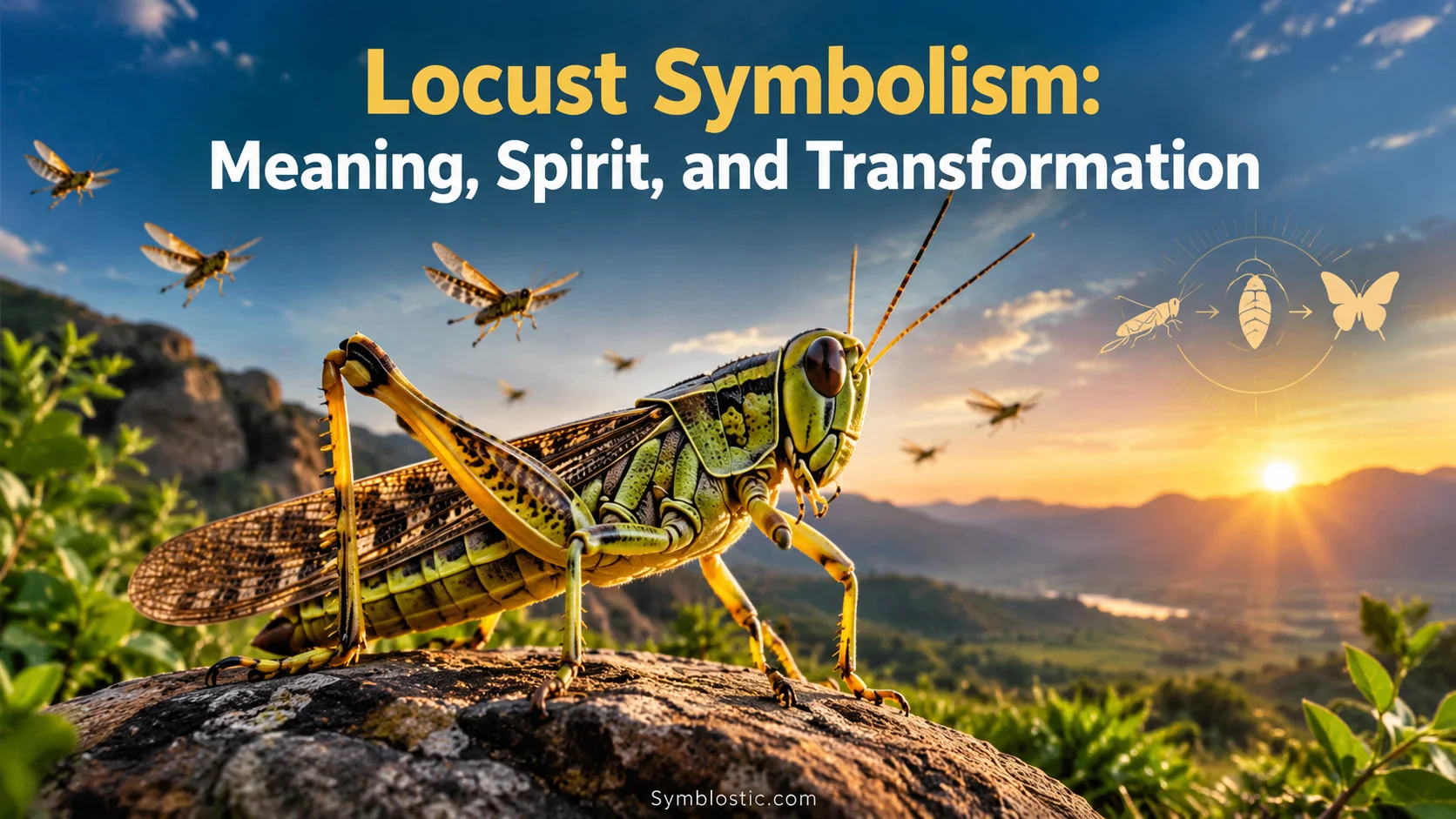
Locust symbolism explores the deeper meanings people attach to one of nature’s most fascinating and feared insects. In the United States, locusts often represent sudden change, overwhelming challenges, destruction, and the possibility of starting again. Their appearance can also inspire thoughts about patience, adaptability, and the delicate balance between individual needs and collective behavior.
Unlike ordinary grasshoppers, locusts can undergo dramatic changes in behavior and form conditions that allow them to gather in enormous swarms. These swarms can transform green landscapes into damaged fields within a short time. Consequently, locusts have become powerful images of abundance that turns into excess and natural strength that becomes difficult to control.
However, their meaning isn’t entirely negative. Locusts also invite reflection on resilience, preparation, and the cycles that shape life. Religious stories, ancient farming communities, modern environmental concerns, and personal spiritual beliefs all contribute to how people interpret them today.
Understanding this symbolism means looking beyond fear. A locust can represent a warning, a period of transformation, or a reminder that even overwhelming changes can lead to new beginnings.
Quick Answer
Locust symbolism in the United States most commonly represents destruction, overwhelming change, survival, and transformation. Spiritually, locusts may symbolize warnings against excess, the need to prepare for difficult times, or the opportunity to rebuild after loss.
TL;DR
- Locusts often symbolize destruction, sudden change, and overwhelming challenges.
- Biblical traditions associate locusts with judgment, hardship, and calls for reflection.
- Their survival abilities can represent resilience, adaptability, and persistence.
- Swarms highlight the tension between collective power and individual consequences.
- Modern interpretations connect locusts with environmental change and human responsibility.
- Personal spiritual meanings depend on context, beliefs, and emotional responses.
What Does a Locust Symbolize?
Locusts have several symbolic meanings, depending on their behavior and the situation in which they appear. For American readers, the strongest associations often come from biblical stories, agricultural history, and the image of a swarm consuming everything in its path.
However, the insect’s biology also offers meaningful ways to understand its symbolism.
Core Symbolic Meanings
- Destruction: Locust swarms can represent sudden losses or damage that changes everyday life.
- Transformation: Their changing behavior reflects how circumstances can reshape individuals and communities.
- Overwhelming change: A swarm symbolizes forces that feel too large to control alone.
- Survival: Locusts endure difficult conditions, suggesting persistence during challenging periods.
- Collective power: Their swarming behavior highlights the strength and risks of acting together.
- Warning: Locusts can symbolize the need to recognize problems before they grow.
These meanings aren’t universal rules. Someone who has experienced agricultural loss may associate locusts with fear, while another person may admire their adaptability.
Why the Locust Is a Powerful Symbol
A single locust is relatively small and easy to overlook. A swarm, however, can transform an entire landscape.
This contrast makes the insect a compelling symbol of how small problems can accumulate. It also illustrates how individual actions can produce enormous consequences when repeated across a group.
Historical Origins of Locust Symbolism
Locust symbolism reaches back thousands of years. Ancient communities depended on crops for food, trade, and survival, making destructive swarms a serious threat.
Consequently, locusts entered religious traditions, historical records, art, and stories about human vulnerability.
Locusts in the Ancient World
Historical records from the ancient Near East describe people’s efforts to understand and control locust invasions. Communities prayed for protection, guarded agricultural land, and developed methods to drive insects away.
Ancient Egyptian art also included locust imagery. In agricultural societies, the insect represented a threat that could overwhelm human planning and labor.
The symbolic association between locusts and devastation developed from these real experiences. When an entire harvest disappeared, people faced hunger, financial hardship, and uncertainty about the future.
How Their Meaning Developed
Over time, locust symbolism expanded beyond agriculture.
- Ancient farming communities associated swarms with crop destruction and hunger.
- Religious writers used locusts to illustrate judgment and the consequences of human actions.
- Later literature portrayed swarms as images of invading armies and uncontrollable forces.
- Modern environmental discussions use locusts to explore ecological balance and food security.
The essential theme remained consistent: something small could produce consequences far greater than its individual size suggested.
However, historical accounts don’t establish one universal spiritual interpretation. Different societies developed meanings shaped by their experiences and beliefs.
Locust Symbolism in American Culture
In the United States, locust symbolism draws heavily on biblical traditions, farming history, and the language of disaster. The insect also appears in discussions about nature, environmental change, and the limits of human control.
American interpretations often emphasize practical consequences rather than an exclusively spiritual message.
Agricultural History and the American West
Locusts became particularly memorable in American agricultural history during the nineteenth century. The Rocky Mountain locust caused devastating outbreaks across parts of the Great Plains.
During the 1870s, enormous swarms damaged crops and threatened the livelihoods of farming families. These events became part of the historical memory of settlement and agricultural hardship in the American West.
The Rocky Mountain locust later disappeared as a recognized living species. Its history remains a powerful example of how a natural event can shape communities and public memory.
For many Americans, this history gives locusts a meaning connected to vulnerability, endurance, and rebuilding after disaster.
Modern American Associations
Today, locust imagery can communicate several ideas within American culture.
- Economic hardship: A destructive swarm can represent losses that threaten a family’s stability.
- Environmental uncertainty: Locusts remind people that natural systems can change unexpectedly.
- Community resilience: Shared hardship can reveal the importance of cooperation and mutual support.
- Excess and waste: The image of a swarm consuming everything suggests unchecked growth or overconsumption.
Locusts don’t have an official national meaning in the United States. Their significance comes from history, religion, personal experience, and popular language.
Locusts in Everyday American Language
People sometimes use the word locusts metaphorically to describe rapid consumption or destructive behavior. For example, a writer might compare an excessively wasteful crowd to a swarm of locusts.
However, this language can become unfair when applied to groups of people. Comparing human beings to pests can encourage dehumanization, particularly when used against migrants or other vulnerable communities.
Understanding the historical context helps preserve the metaphor’s meaning without turning it into an attack on human dignity.
Biblical Meaning of Locusts
Biblical symbolism is one of the most influential sources of modern locust interpretations in the United States. In Scripture, locusts appear in stories of judgment, hardship, repentance, and restoration.
Their meaning depends on the passage rather than on the insect alone.
Locusts as a Sign of Judgment
In Exodus 10, locusts form the eighth plague sent upon Egypt. They consume vegetation that survived the earlier hail, demonstrating the severity of the disaster.
The story connects locusts with judgment and the consequences of resisting divine commands. For many Christian readers, this passage explains why locust imagery often carries a serious spiritual tone.
The Book of Joel also describes devastating locust invasions. These passages use agricultural destruction to communicate a broader religious warning.
Locusts and Restoration
Biblical symbolism isn’t limited to punishment.
In Joel 2:25, God promises to restore the years consumed by locusts. This passage has become especially meaningful to readers seeking hope after loss.
The image suggests that devastation doesn’t necessarily define the rest of a person’s life. Although the original context concerns a community’s suffering and restoration, modern readers may also find personal comfort in its themes.
Locusts in Revelation
Revelation 9 describes extraordinary, frightening locust-like creatures. These aren’t simply ordinary insects in the narrative; they belong to the book’s vivid apocalyptic imagery.
Interpretations differ among Christian traditions. Some readers understand these images symbolically, while others connect them with future events.
It’s important not to treat every ordinary locust sighting as a prediction of disaster. Biblical imagery belongs to its literary and religious context.
Spiritual Meaning of Locusts
Outside specific religious teachings, some people interpret locust encounters through personal spirituality. They may see the insect as a reminder to examine their habits, recognize change, or prepare for difficult circumstances.
These interpretations are personal reflections rather than established facts about supernatural messages.
A Warning to Reconsider Your Choices
A locust may symbolize the need to notice what is consuming your time, attention, or energy.
For example, you might reflect on whether an unhealthy routine has gradually taken over your day. The insect becomes a metaphor for something that grows more damaging when left unchecked.
This interpretation encourages awareness instead of fear.
A Symbol of Transformation
Locusts can change from solitary behavior to group behavior under particular environmental conditions. Their transformation makes them a useful symbol of changing circumstances.
Spiritually, some people connect this process with periods of personal growth, new responsibilities, or changes in identity.
The lesson isn’t that change will always be comfortable. Instead, it suggests that adapting to new conditions may require a different approach.
A Reminder to Rebuild
Locusts can also represent the period after a major loss.
- Recognize what has changed instead of denying it.
- Protect the resources and relationships that remain.
- Ask for support when a challenge exceeds your individual capacity.
- Focus on rebuilding gradually rather than demanding immediate recovery.
These reflections can be useful without assuming that an insect has appeared for a supernatural reason.
Locust Meanings Across Cultures and Traditions
Locusts appear in many cultural traditions because agricultural communities across the world have experienced their destructive power. Nevertheless, their meanings vary according to local history, religion, food practices, and relationships with nature.
American interpretations are only one part of this broader picture.
Middle Eastern and Ancient Near Eastern Traditions
In ancient Near Eastern societies, locusts were associated with crop loss, hunger, and threats to community survival. Their appearance in religious texts reflected the practical importance of agriculture.
Jewish and Christian traditions preserve several prominent examples of locust imagery. These include warnings about devastation as well as accounts of recovery and restored abundance.
Islamic Contexts
Locusts appear in Islamic discussions of food, religious law, and natural life. Interpretations depend on the particular text and scholarly tradition.
Some Muslim legal traditions permit locusts as food under specified religious teachings. This provides an important contrast to the assumption that locusts must always represent something evil or spiritually threatening.
Other Cultural Perspectives
In regions where locusts have long been used as food, they may also be understood through nourishment, resourcefulness, and survival.
Elsewhere, their arrival has been associated primarily with disaster and fear. These differences show how the same animal can acquire contrasting meanings.
It’s best to avoid assigning one spiritual interpretation to an entire culture. Local traditions, individual beliefs, and historical experiences can differ considerably.
Emotional and Psychological Meaning of Locusts
Locusts can provoke strong emotional reactions because they combine a small physical form with the possibility of enormous destruction. A swarm may feel overwhelming even when someone understands the biological process behind it.
Consequently, locust imagery often connects with anxiety, loss of control, resilience, and the need to prepare.
Feeling Overwhelmed
A swarm can symbolize responsibilities or problems that appear to arrive all at once.
You might associate locusts with mounting bills, competing demands, family pressures, or an exhausting workload. In these situations, the symbol reflects the feeling of being surrounded by problems.
However, it doesn’t prove that disaster is approaching. It can simply provide an image for emotions that are difficult to describe.
Fear of Losing What Matters
Because locusts can destroy crops, they may represent fear of losing something valuable.
That could mean a relationship, a long-term goal, personal stability, or a sense of security. The emotional connection comes from the idea that something carefully developed can be damaged quickly.
Strength and Adaptability
Locust symbolism can also emphasize the ability to endure change.
A person may interpret the insect as a reminder to stay flexible when circumstances shift. Instead of viewing adaptability as weakness, this interpretation treats it as a practical form of strength.
The most useful psychological interpretation depends on the feelings the insect brings up for you. Fear, curiosity, and admiration can lead to very different personal meanings.
Read More: Oriole Symbolism: Meaning, Spirit, and Hidden Wisdom
What Does It Mean to Dream About Locusts?
Dreams involving locusts can feel especially intense because swarms often evoke loss of control. However, no single dream interpretation applies to everyone, and dreams aren’t reliable predictions of future events.
Your emotions, experiences, and the dream’s details may help you understand why the image stood out.
Dreaming of a Locust Swarm
A swarm may reflect a sense of pressure or too many demands arriving together.
Consider whether you’ve recently felt overwhelmed by work, family responsibilities, or unexpected changes. The dream may provide a starting point for reflection rather than a supernatural warning.
Dreaming of a Single Locust
A single locust may draw attention to a small concern that has caught your interest.
Its meaning could relate to persistence, curiosity, discomfort, or a problem you haven’t addressed. The insect’s behavior and your emotional reaction may matter more than its presence alone.
Dreaming of Locusts Destroying Crops
This image may connect with fears about losing progress or having your efforts wasted.
If you’re working toward an important goal, consider whether uncertainty has been making you feel vulnerable. The dream doesn’t mean your plans will fail.
Dreaming of Killing or Escaping Locusts
Escaping a swarm may represent a desire for relief from overwhelming circumstances. Killing locusts might reflect an attempt to regain control or establish boundaries.
However, dreams don’t have fixed symbolic dictionaries. Personal context matters more than a universal list of meanings.
Locust Symbolism in Tattoos, Art, and Modern Life
Locust imagery can communicate complex ideas through a relatively simple design. In contemporary American culture, its meaning depends on the artist’s intention, the visual style, and the context in which the image appears.
Unlike more widely recognized positive symbols, a locust often invites curiosity because its associations are complicated.
Locust Tattoos
Someone might choose a locust tattoo to express survival, transformation, or an interest in biblical imagery.
Common design approaches include:
- A realistic locust representing nature and biological fascination.
- A solitary insect suggesting independence or adaptability.
- A swarm representing overwhelming change or collective strength.
- A locust beside a plant symbolizing the tension between destruction and renewal.
- A biblical-style illustration expressing religious reflection or personal faith.
These are possible interpretations, not standardized meanings. A tattoo may have a deeply personal story that outsiders cannot determine from its appearance.
Locusts in Art and Decor
Locust illustrations may appeal to people interested in insects, natural history, vintage scientific drawings, or unusual botanical art.
Their angular legs, veined wings, and earthy colors can create striking visual patterns. However, locusts aren’t as commonly associated with traditional home decoration as butterflies, birds, or flowers.
When used in artwork, the insect may suggest either fascination with nature or a darker theme involving scarcity and change.
Social Media and Storytelling
Locust imagery can appear in posts about environmental events, personal upheaval, or rapid consumption.
A swarm may become a visual metaphor for something spreading quickly or consuming attention. Still, the meaning depends on the accompanying words and the creator’s intent.
There isn’t a widely established locust emoji with a universal symbolic meaning. People generally communicate the idea through photographs, illustrations, or combinations of other symbols.
Negative Associations, Misuse, and Controversies
Locust symbolism carries difficult associations because real swarms can threaten food supplies and livelihoods. Nevertheless, a symbol’s negative meaning should be understood within its historical and social context.
Problems arise when metaphors about insects are applied carelessly to human beings.
Why Locusts Represent Destruction
The association isn’t arbitrary. Locusts can gather in large numbers and consume substantial amounts of vegetation.
For farmers, this can mean damaged crops, lost income, and uncertainty about the next harvest. The destructive meaning therefore reflects genuine experiences rather than simply an invented superstition.
When the Metaphor Becomes Harmful
Calling a group of people “locusts” can portray them as mindless, destructive, or less than human. Historically, similar pest comparisons have been used in rhetoric about outsiders and migrant populations.
Such language can encourage hostility by suggesting that people are an infestation instead of individuals with different circumstances and needs.
The context matters. Describing an actual insect swarm is not the same as using that swarm to dehumanize a community.
Avoiding Unfounded Spiritual Fear
Another misunderstanding occurs when locusts are automatically treated as evidence of a curse, punishment, or coming catastrophe.
Religious texts contain powerful locust imagery, but an insect’s appearance doesn’t establish a divine message. Natural causes, including environmental conditions, can explain locust behavior.
A balanced interpretation respects religious belief while distinguishing spiritual reflection from claims that cannot be verified.
How Locust Symbolism Has Changed Over Time
Locust symbolism has evolved as societies have changed their relationships with farming, religion, science, and the natural world. Although destruction remains a major theme, other meanings have become more visible.
From Agricultural Threat to Religious Image
For ancient farming communities, locusts represented an immediate danger to food supplies. Religious traditions later used this familiar threat to express judgment, hardship, and the need for reflection.
The symbol became more than a description of an insect. It offered a way to communicate fear, vulnerability, and moral responsibility.
From Religious Stories to Modern Metaphors
In later literature and public language, locusts became shorthand for invading forces, rapid consumption, and overwhelming numbers.
However, these comparisons sometimes carried harmful implications when directed at human populations. Modern readers increasingly need to consider not only what a metaphor communicates but also whom it describes.
A Broader Environmental Perspective
Today, scientific understanding helps explain how locusts behave and why swarms develop. Environmental discussions can therefore consider both the damage locusts cause and the ecological processes behind their behavior.
This doesn’t erase traditional symbolism. Instead, it adds another layer of meaning.
Locusts can represent destruction, but they can also encourage questions about adaptation, environmental balance, and the relationship between human communities and the natural world.
Locust Symbolism at a Glance
The meaning of a locust depends on where it appears and how people interpret it. The following table summarizes common associations for readers in the United States.
| Context | Symbolic Meaning | Common Association |
| Biblical stories | Judgment and restoration | Faith, repentance, hope |
| Personal spirituality | Change and awareness | Reflection, preparation |
| American agricultural history | Destruction and hardship | Crop loss, resilience |
| Dreams | Feeling overwhelmed | Stress, uncertainty |
| Tattoos and artwork | Transformation or survival | Identity, personal meaning |
| Environmental discussions | Ecological change | Adaptation, responsibility |
These meanings overlap, but they aren’t interchangeable. For example, a locust in a biblical illustration may carry a specific religious meaning, while a locust tattoo may express an individual’s personal experience.
How to Interpret a Locust Encounter
If seeing a locust has prompted you to consider its meaning, begin with the situation itself.
- Notice whether the insect appeared alone or among many others.
- Consider your immediate emotional reaction.
- Think about any changes or challenges currently occupying your attention.
- Explore relevant religious or cultural meanings without assuming they must apply.
- Remember that a natural encounter doesn’t automatically predict a future event.
This approach allows symbolism to support reflection without creating unnecessary fear.
FAQs:
What does a locust symbolize spiritually?
A locust may symbolize change, destruction, endurance, or a warning to reconsider your choices. Some people also associate it with rebuilding after hardship. These meanings depend on personal beliefs and cultural context rather than a universal spiritual rule.
What does a locust mean in the Bible?
In the Bible, locusts often represent judgment, devastation, and hardship. However, Joel 2:25 also uses the image of locust damage in a promise of restoration. The meaning therefore depends on the specific passage.
Is seeing a locust a good or bad omen?
A locust isn’t universally considered either a good or bad omen. Some people interpret it as a reminder to prepare for change, while others connect it with resilience. There is no reliable basis for treating an ordinary locust sighting as a prediction of future events.
What does it mean to dream about locusts?
Dreaming about locusts may reflect feelings of pressure, uncertainty, or fear of losing something important. A swarm might represent several demands competing for your attention. However, dream meanings are personal and shouldn’t be treated as certain predictions.
What does a locust tattoo symbolize?
A locust tattoo may represent transformation, survival, collective power, or biblical faith. Its meaning depends on the design and the wearer’s intentions. A realistic insect illustration, for example, may express an interest in nature rather than a spiritual belief.
Are locusts always symbols of destruction?
No. Destruction is one of their strongest historical associations, but locusts can also symbolize persistence, adaptation, and recovery. Their use as food in some traditions further demonstrates that their cultural meanings aren’t always negative.
Conclusion:
Locust symbolism brings together destruction, transformation, survival, and the power of collective behavior. In the United States, these meanings are shaped by biblical stories, agricultural history, environmental concerns, and modern personal interpretations. Although locusts can represent overwhelming loss, they can also inspire reflection about resilience and rebuilding.
The most meaningful interpretation depends on the context. A locust in a religious passage may carry a different message from one in a dream, a tattoo, or a field. Rather than assuming every encounter predicts something, consider what the insect represents to you and what its symbolism reveals about change, responsibility, and the ability to begin again.

1 thought on “Locust Symbolism: Meaning, Spirit, and Transformation”