
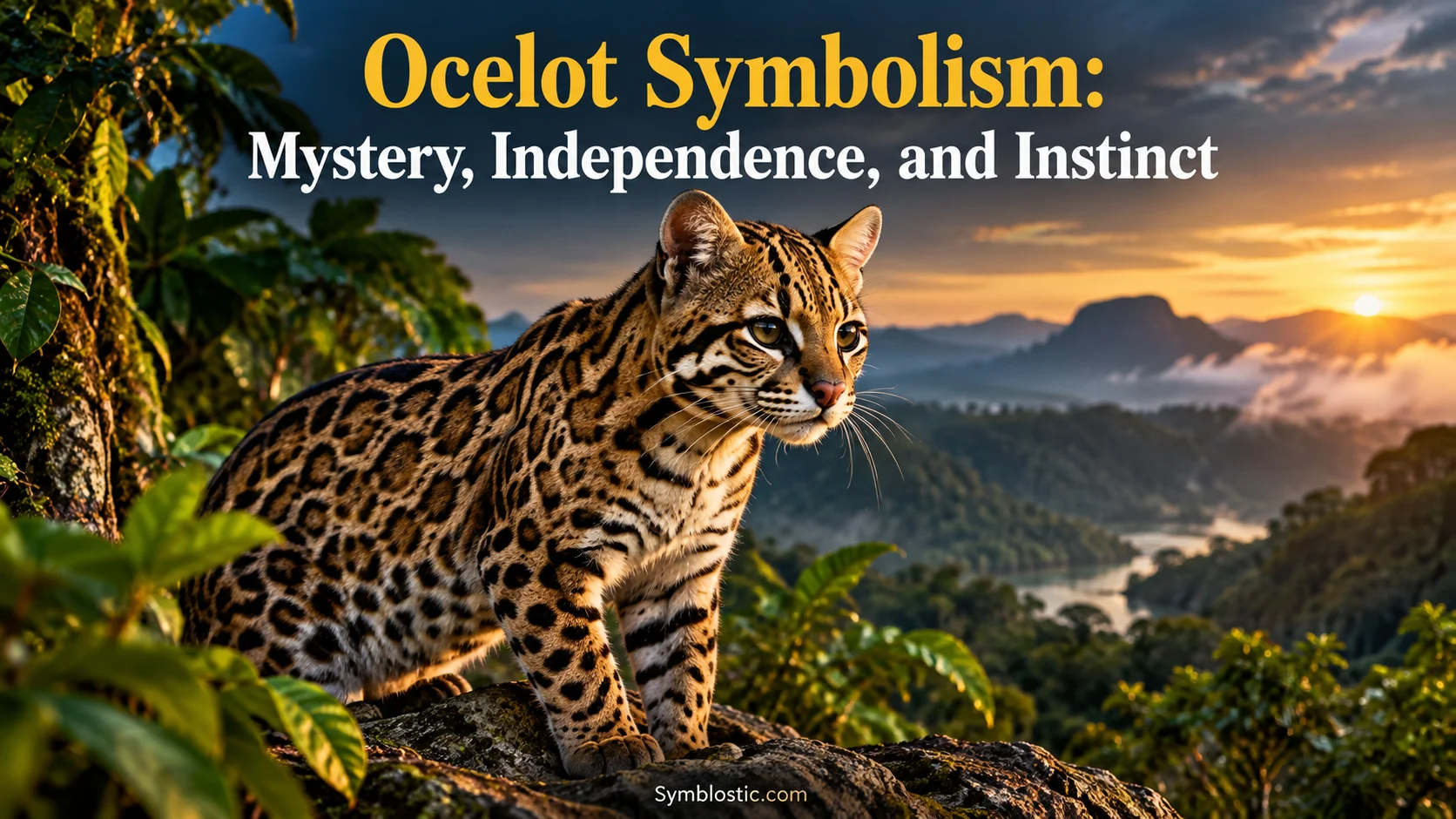
The ocelot symbolism often centers on mystery, independence, patience, and the power of instinct. This beautiful wild cat, known for its golden coat and dark markings, moves quietly through forests and grasslands. Its appearance creates a sense of elegance, while its secretive behavior suggests a deeper connection with observation and self-reliance.
In the United States, ocelots are associated with wilderness, endangered wildlife, and the untamed beauty of the natural world. They’re also intriguing symbols for people who value privacy, confidence, and the freedom to follow their own path. Although ocelots aren’t as familiar in American culture as lions, wolves, or bald eagles, their distinctive appearance makes them memorable.
People may encounter ocelots in wildlife photography, conservation stories, spiritual animal interpretations, or tattoo designs. Each setting can give the animal a slightly different meaning. However, it’s important to distinguish documented cultural traditions from modern spiritual interpretations. An ocelot doesn’t carry one universal message, and its symbolism often depends on the observer’s experiences and beliefs.
Quick Answer
Ocelot symbolism in the United States commonly represents independence, mystery, keen observation, and instinct. In modern spiritual interpretations, the ocelot may also symbolize personal transformation, quiet confidence, and the courage to trust yourself.
TL;DR
- Independence: The ocelot represents self-reliance and personal freedom.
- Mystery: Its secretive, nocturnal behavior suggests hidden knowledge and unanswered questions.
- Instinct: Its sharp senses symbolize awareness and trust in personal judgment.
- Patience: Its hunting behavior reflects careful observation and well-timed action.
- Transformation: Its changing surroundings can inspire personal growth and adaptability.
- Conservation: In the United States, it also represents rare wildlife and habitat protection.
What Is Ocelot Symbolism?
Ocelot symbolism comes from the animal’s appearance, behavior, habitat, and the meanings people attach to wild cats. Understanding these natural characteristics helps explain why the ocelot can represent both quiet strength and hidden potential.
The Ocelot’s Appearance and Natural Behavior
The ocelot is a small wild cat native to the Americas, including parts of South Texas.
Ocelots have short, golden or tawny coats covered with dark spots, stripes, and irregular markings. Their large eyes, rounded ears, and muscular bodies give them a distinctive appearance.
They usually hunt alone and rely on stealth to approach their prey. Their ability to move quietly through dense vegetation makes them natural symbols of patience and careful observation.
The animal’s main symbolic associations include:
- Spotted coat: Individuality, complexity, and the beauty of difference.
- Quiet movements: Discretion, patience, and thoughtful action.
- Alert eyes: Awareness, curiosity, and attention to detail.
- Solitary behavior: Independence, self-reliance, and personal boundaries.
- Adaptability: The ability to respond to changing environments.
These meanings are interpretations inspired by the animal’s real characteristics. They aren’t scientific claims about spiritual energy or supernatural powers.
Why People Find the Ocelot Symbolically Appealing
Unlike larger predators that symbolize dominance through size, the ocelot suggests a quieter kind of strength. It doesn’t need to attract attention to survive.
For many people, this creates a useful metaphor for confidence without arrogance. The ocelot can represent someone who watches carefully, chooses their moments, and doesn’t reveal everything about themselves.
Ocelot Spiritual Meaning
The ocelot’s spiritual meaning is often connected with intuition, independence, personal awareness, and the courage to explore the unknown. These interpretations are especially common in contemporary animal symbolism, where people use wildlife as a source of personal reflection.
However, spiritual meanings vary by individual and tradition. There isn’t one universally accepted spiritual interpretation of the ocelot.
Intuition and Inner Awareness
An ocelot depends on its senses to navigate its environment and locate prey. Symbolically, this behavior can encourage people to pay attention to subtle details and recognize patterns they might otherwise overlook.
Seeing an ocelot in a dream, image, or meaningful personal encounter might prompt you to reflect on your own instincts. It doesn’t prove that a supernatural message has been sent.
Independence and Personal Freedom
Because ocelots generally live and hunt alone, they can represent the freedom to make independent choices. This interpretation may resonate when you’re reconsidering a relationship, changing direction, or learning to trust your judgment.
The lesson isn’t that you should avoid other people. Instead, the ocelot can remind you that independence and healthy relationships can exist together.
Exploring the Unknown
The ocelot’s secretive nature makes it a natural symbol for curiosity about hidden aspects of life. It can encourage you to approach uncertainty with patience rather than fear.
For some people, this meaning connects with spiritual exploration. For others, it simply represents the willingness to ask questions and discover something new.
Ocelot Symbolism in American Culture
In the United States, the ocelot is most meaningfully connected with wildlife, wilderness, biodiversity, and conservation. Unlike animals such as the bald eagle or American bison, it doesn’t have a widely established national symbolic role.
Nevertheless, its presence in southern Texas and its striking appearance give it cultural significance in particular settings.
The Ocelot and the American Wilderness
The ocelot lives in parts of the Americas, and the United States has a small population in southern Texas. Its presence connects the animal with the country’s remaining native wild habitats.
American wildlife imagery often celebrates animals that represent independence and survival. The ocelot fits this broader pattern, even though it isn’t a major national emblem.
Its symbolic associations in the United States include:
- Wild freedom: Life beyond human control and domestication.
- Natural beauty: The visual richness of native wildlife.
- Ecological balance: The importance of predators within healthy ecosystems.
- Wildlife protection: The need to preserve habitats for threatened species.
- Regional identity: The distinctive wildlife of southern Texas and the borderlands.
Conservation and Endangered Wildlife
The ocelot has particular importance in American conservation because its remaining Texas population is small and faces habitat-related challenges.
Habitat loss, fragmentation, and road mortality can threaten these animals. As a result, the ocelot can symbolize the fragile relationship between human development and the natural world.
For American readers, this creates a meaning beyond personal strength. The animal can also represent responsibility, environmental awareness, and the importance of protecting wildlife before it disappears from local landscapes.
Historical Background of Ocelot Symbolism
The ocelot’s symbolic history is closely connected with the cultures and environments of the Americas. However, its historical meanings should not be confused with the much broader symbolism of jaguars, which have a more prominent place in several ancient American traditions.
Ocelots in the Ancient Americas
Wild cats appeared in the art and belief systems of various ancient American societies. In some traditions, large felines, especially jaguars, were associated with power, rulers, the natural world, and spiritual forces.
Ocelots also belong to the region’s long history of human relationships with wild animals. However, evidence for specific, widespread ocelot symbolism is less clear than it is for jaguar symbolism.
It’s therefore inaccurate to claim that every ancient American culture viewed the ocelot as a sacred guardian or spiritual messenger. Different communities had distinct beliefs, and not every feline image represents the same species.
From Wild Animal to Modern Symbol
Over time, artistic representations of wild cats appeared in decorative objects, illustrations, wildlife publications, and popular media. As photography became more accessible, people could observe ocelots without encountering them in their natural habitats.
In contemporary culture, their symbolism increasingly draws on recognizable animal traits. Their patterned coats suggest individuality, while their elusive behavior suggests secrecy and independence.
Today, many spiritual interpretations are modern personal readings rather than documented continuations of ancient traditions. Recognizing this difference helps preserve the historical meaning of actual cultural practices.
Ocelot Symbolism Across Cultures and Spiritual Traditions
The ocelot belongs to a wider family of wild-cat imagery that appears in many cultures. However, similar-looking animals can carry very different meanings, so their symbolism shouldn’t be treated as interchangeable.
Feline Symbolism in the Americas
Across the ancient Americas, large cats held important places in several artistic and religious traditions. Jaguars, in particular, appear in archaeological evidence associated with rulership, power, and relationships between humans and the natural world.
The ocelot shares the feline qualities that may inspire modern interpretations, such as stealth and alertness. However, a specific meaning associated with a jaguar cannot automatically be attributed to an ocelot.
Broader Spiritual Interpretations
In contemporary spiritual writing, wild cats are sometimes associated with:
- Intuition: Recognizing subtle signs and trusting careful judgment.
- Protection: Maintaining personal boundaries and remaining alert.
- Independence: Making choices without constant outside approval.
- Mystery: Accepting that not everything is immediately understood.
- Confidence: Acting with quiet assurance instead of seeking attention.
These are broad symbolic interpretations rather than beliefs shared by every religious or cultural tradition.
If you encounter an ocelot in a story from a specific Indigenous community, the community’s own teachings are the best guide to its meaning. Respectful interpretation avoids combining distinct traditions into one generalized spiritual message.
The Psychological Meaning of the Ocelot
From a psychological perspective, the ocelot can serve as a symbol of traits people admire or want to develop. Its image may encourage reflection on independence, attention, privacy, and the balance between caution and action.
This doesn’t mean that liking ocelots reveals a fixed personality type. Instead, the animal can provide a useful way to explore personal values.
Independence Without Isolation
An ocelot’s solitary habits can appeal to people who enjoy spending time alone. Solitude may provide space for creativity, rest, and thoughtful decisions.
However, independence doesn’t require emotional distance from others. The ocelot can symbolize the ability to maintain personal boundaries while still building supportive relationships.
Patience and Self-Control
The animal’s hunting style offers another psychological metaphor. Rather than chasing every opportunity, it waits, observes, and responds when conditions are favorable.
This interpretation may resonate when you’re facing a difficult decision. It suggests that careful preparation can sometimes be more useful than immediate action.
The Appeal of Mystery
People are often drawn to animals that appear difficult to understand. The ocelot’s elusive behavior can represent the desire to preserve privacy or explore parts of yourself that aren’t yet clear.
For some, this symbolism reflects confidence in being different. For others, it provides a reminder that personal growth doesn’t always need to happen publicly.
Ocelot Symbolism in Dreams
Dreaming about an ocelot can invite reflection on independence, awareness, fear, or curiosity. However, dreams don’t have universally fixed meanings, and a single animal image can’t reliably predict future events.
Your emotions during the dream and the details surrounding the animal may offer more useful clues than a generic interpretation.
Seeing a Calm Ocelot
A calm ocelot might bring to mind quiet confidence, self-control, or the comfort of being alone. Consider whether you’re learning to trust yourself or protect your time and attention.
If the animal appears relaxed, you might also reflect on whether you feel secure in your current surroundings.
Seeing an Aggressive or Chasing Ocelot
An aggressive ocelot could reflect feelings of pressure, uncertainty, or vulnerability. The dream might provide an opportunity to think about a situation that feels difficult to control.
However, it doesn’t mean that danger is coming. Dreams can incorporate everyday stress, recent experiences, memories, and imagination.
Seeing an Ocelot Watching You
An ocelot that watches from a distance may bring attention to observation and awareness. You might be noticing something you’ve previously overlooked or feeling that you need more information before acting.
Rather than treating the dream as a prediction, ask what the image reminds you of in your waking life.
Read More: Grackle Symbolism: Intelligence, Adaptability, and Mystery
Ocelot as a Spirit Animal or Personal Guide
Some contemporary spiritual approaches use animal guides as symbols of personal qualities. Within that framework, an ocelot may represent intuition, discretion, independence, and the ability to move through uncertainty.
Not everyone follows this approach, and the phrase spirit animal has cultural associations that deserve consideration.
What the Ocelot Guide May Represent
If the ocelot feels personally meaningful to you, its symbolic qualities can serve as prompts for reflection:
- Trust your judgment while remaining open to new evidence.
- Protect your privacy without shutting out supportive people.
- Observe a situation carefully before committing to a decision.
- Accept your individuality without needing constant recognition.
- Adapt to changing circumstances while keeping your core values.
These ideas can be useful whether you approach the animal spiritually or simply admire its behavior.
Using the Symbol Respectfully
The phrase spirit animal is often used casually online to describe a favorite animal or a personality match. However, related concepts have specific meanings in some Indigenous traditions.
If you’re drawn to the ocelot, you can describe it as a personal symbol, an animal you admire, or a source of inspiration. This approach allows you to explore its meaning without claiming a cultural role or spiritual practice that isn’t yours.
Ocelot Symbolism in Tattoos, Art, and Home Decor
Ocelot imagery can communicate individuality and a connection with the natural world. Its patterned coat also makes it visually distinctive, giving artists several ways to express the animal’s symbolic qualities.
Ocelot Tattoos
An ocelot tattoo may represent personal independence, quiet strength, or a love of wildlife. Its meaning depends on the design and the person’s reasons for choosing it.
Common artistic approaches include:
- Realistic portrait: Respect for wildlife and appreciation of natural beauty.
- Eyes in shadow: Mystery, observation, and alertness.
- Full-body design: Freedom, movement, and self-reliance.
- Floral composition: A connection between wildlife and natural environments.
- Geometric interpretation: Individuality expressed through a modern visual style.
These associations aren’t universal tattoo meanings. A person’s own story often matters more than a general symbolism guide.
Art and Interior Design
In home decor, ocelot imagery can bring a sense of wilderness and visual texture to a room. Wildlife prints, nature photography, and patterned artwork can also express an interest in conservation.
However, ocelot imagery shouldn’t be confused with generic leopard-print fashion. Although their coats can look similar at a glance, ocelots are a distinct species with their own markings and natural history.
Social Media and Personal Identity
On social platforms, someone might use an ocelot photograph as a profile image or share artwork to express a preference for independent, observant, or unconventional animals.
In these settings, the symbolism is usually personal rather than traditional. The image communicates a mood or identity without requiring a fixed spiritual explanation.
Ocelot Symbolism Compared With Other Wild Cats
Ocelots share several symbolic associations with other wild cats, but differences in appearance, size, and behavior can shape how people interpret them. In American culture, comparisons are especially useful because lions, tigers, jaguars, leopards, and ocelots have different levels of cultural recognition.
| Animal | Common symbolic associations | Distinctive emphasis |
| Ocelot | Mystery, instinct, independence | Quiet awareness and individuality |
| Jaguar | Power, authority, wilderness | Strength and prominent ancient American symbolism |
| Leopard | Adaptability, stealth, elegance | Agility and versatility |
| Tiger | Courage, intensity, determination | Boldness and personal power |
| Lion | Leadership, bravery, pride | Public authority and protection |
These are broad modern interpretations, not universal meanings shared by all cultures.
What Makes the Ocelot Different?
The ocelot combines the visual appeal of a spotted wild cat with a less familiar place in mainstream American symbolism. Its meaning tends to feel more personal and understated than the leadership or dominance often associated with lions.
For someone choosing an animal symbol, this distinction can be helpful. The ocelot may appeal to people who value awareness and individuality more than public recognition or displays of power.
Misunderstandings and Controversies About Ocelot Symbolism
Animal symbolism can be meaningful, but it can also become misleading when personal interpretations are presented as established history. The ocelot’s relatively limited place in widely documented symbolic traditions makes careful language especially important.
Confusing Ocelots With Leopards or Jaguars
Ocelots, leopards, and jaguars are different species. Their coats may all feature dark markings, but their natural ranges, physical features, and cultural histories differ.
A symbolic interpretation of a jaguar from an ancient American tradition shouldn’t automatically be labeled ocelot symbolism. Accurate identification helps avoid confusing distinct animals and traditions.
Treating Spiritual Interpretations as Facts
Some websites describe an ocelot encounter as proof of a spiritual awakening, a warning, or a guaranteed change in fortune. These claims go beyond what can be established.
It’s reasonable to find personal meaning in an encounter with wildlife. However, a symbolic reading is a matter of interpretation, not evidence that an event has supernatural significance.
Overlooking Real Conservation Concerns
The ocelot is more than a decorative image. Its limited presence in the United States makes habitat conservation an important part of its real-world story.
When ocelot imagery inspires interest, learning about its natural history can deepen that interest. Supporting responsible wildlife education and habitat protection offers a practical way to connect symbolism with the animal’s actual needs.
How Ocelot Symbolism Has Changed Over Time
Ocelot symbolism hasn’t followed one clear path from ancient religious beliefs to modern personal meanings. Instead, its interpretation reflects changing relationships with wildlife, expanding access to nature photography, and the popularity of contemporary animal symbolism.
From Regional Wildlife to Global Imagery
Historically, the ocelot was part of the natural environments and human experiences of the Americas. Its meaning depended on the people, places, and circumstances surrounding it.
Today, photographs and digital media allow people far from its habitat to encounter the animal. As a result, its image can represent anything from conservation to personal independence.
The Rise of Personal Spiritual Interpretation
Modern online discussions often connect individual animals with emotional growth, intuition, and life changes. The ocelot fits naturally into this trend because of its secretive behavior and striking appearance.
However, modern popularity shouldn’t be mistaken for evidence of an ancient, universal belief. Some interpretations have documented cultural roots, while others are contemporary reflections inspired by nature.
What Its Modern Meaning Emphasizes
Today, ocelot symbolism is best understood as a combination of natural observation, personal association, and broader wild-cat imagery.
Its strongest modern themes remain independence, mystery, awareness, and quiet confidence. In American conservation contexts, it also highlights the importance of protecting rare wildlife and preserving natural habitats.
FAQs:
What Does an Ocelot Symbolize Spiritually?
An ocelot may symbolize intuition, independence, patience, and awareness in contemporary spiritual interpretations. Its meaning depends on your beliefs and experiences rather than a single universal spiritual rule.
Is Seeing an Ocelot a Good Sign?
Some people interpret an ocelot sighting as a reminder to trust their instincts or embrace independence. However, seeing one doesn’t guarantee good fortune or predict a specific event.
What Does an Ocelot Represent in a Dream?
An ocelot in a dream may bring to mind privacy, alertness, uncertainty, or personal strength. Consider your feelings during the dream and any connections to your waking life instead of relying on a fixed prediction.
What Does an Ocelot Tattoo Mean?
An ocelot tattoo can represent individuality, quiet confidence, freedom, or a connection with wildlife. Its meaning may also reflect a personal experience or an appreciation of the animal’s distinctive appearance.
Is the Ocelot a Symbol of Protection?
Some modern symbolic interpretations associate wild cats with alertness and personal boundaries. However, there isn’t one universally established tradition that makes the ocelot a symbol of protection across all cultures.
How Is Ocelot Symbolism Different From Jaguar Symbolism?
Ocelot symbolism commonly emphasizes subtle strength, individuality, and quiet awareness in modern interpretations. Jaguar symbolism has more prominent documented associations with power and authority in several ancient American traditions, although meanings vary across cultures.
Conclusion:
Ocelot symbolism offers a meaningful way to explore independence, mystery, intuition, and quiet confidence. In the United States, the animal also represents the beauty of native wildlife and the need to protect vulnerable habitats. Its secretive behavior and distinctive coat make it an appealing symbol for people who value individuality without seeking constant attention.
Whether you encounter the ocelot in a dream, choose it for a tattoo, or admire it through wildlife photography, its meaning can begin with simple observation. Consider which of its qualities speaks to you, and let that connection inspire a deeper appreciation of both your own individuality and the natural world.

1 thought on “Ocelot Symbolism: Mystery, Independence, and Instinct”