
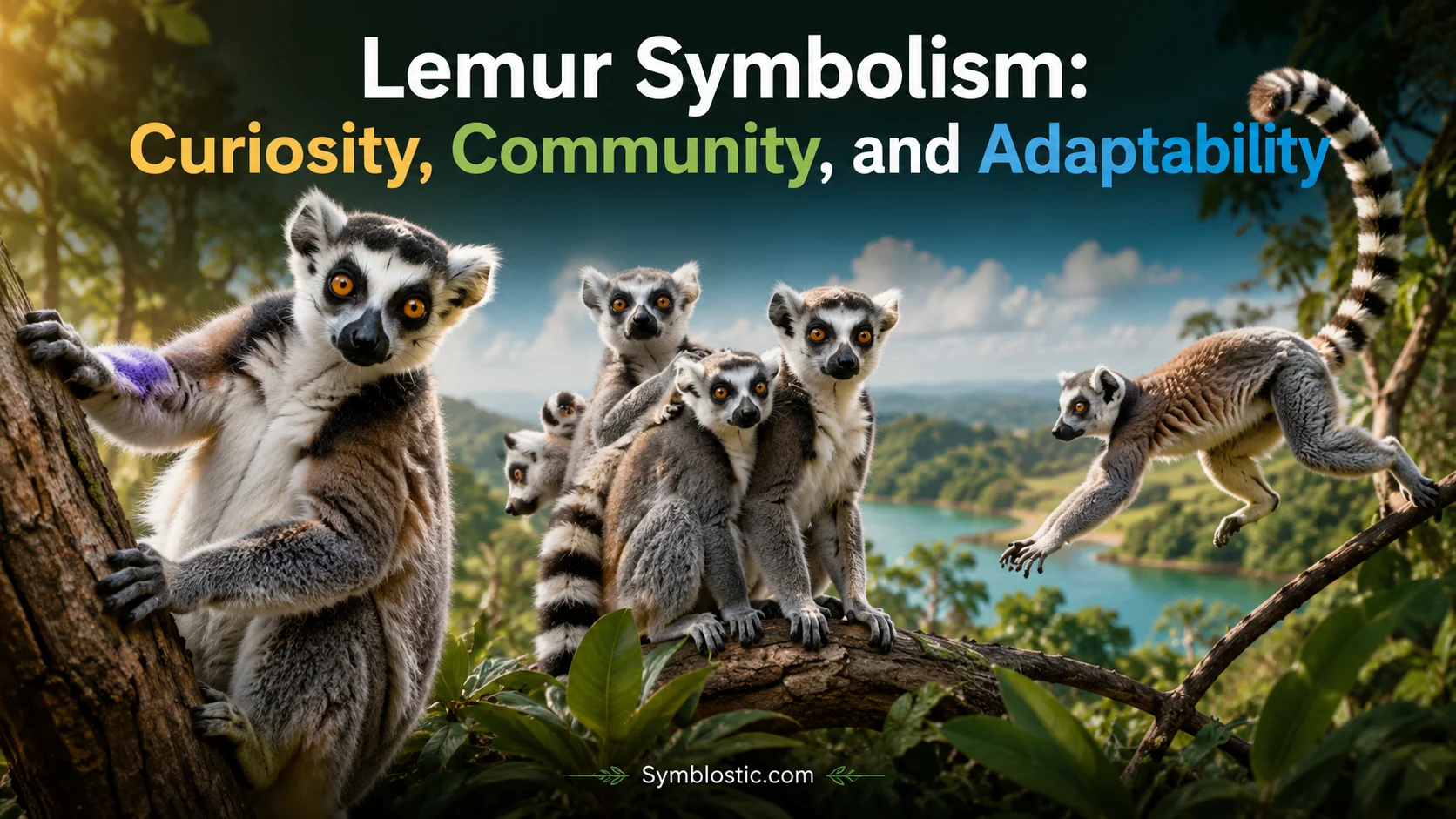
Lemur symbolism explores the meanings people attach to these unusual primates, from curiosity and social connection to adaptability and awareness. Native to Madagascar, lemurs have distinctive eyes, expressive faces, and varied behaviors that make them fascinating symbols in wildlife stories, spiritual interpretations, and modern art. Their natural habits also offer meaningful connections to everyday human experiences.
In the United States, lemurs often represent playfulness, intelligence, individuality, and the importance of protecting wildlife. Their appearance in documentaries, animated films, zoos, and conservation campaigns has helped make them recognizable to American audiences. However, their symbolic meaning goes beyond their appearance or entertainment value.
Lemurs live in complex environments and display different social behaviors depending on the species. Some rely heavily on group relationships, while others spend more time alone. These differences make lemurs useful symbols of both independence and belonging.
Whether you encountered a lemur in a dream, saw one in a wildlife documentary, or feel drawn to its unusual appearance, exploring its symbolism can reveal interesting ideas about your own values and experiences.
Quick Answer: What Does Lemur Symbolism Mean?
Lemur symbolism commonly represents curiosity, community, adaptability, and awareness in modern American culture. Spiritually, some people interpret lemurs as reminders to stay playful, trust their observations, embrace change, and maintain meaningful connections with others.
TL;DR: Lemur Symbolism at a Glance
- Curiosity: Encourages exploration, learning, and discovering unfamiliar possibilities.
- Community: Reflects cooperation, social bonds, and mutual support.
- Adaptability: Represents adjusting to changing environments and circumstances.
- Playfulness: Reminds people to balance responsibility with joy.
- Awareness: Symbolizes observation, alertness, and attention to surroundings.
- Individuality: Celebrates unusual qualities and different ways of living.
What Is the Core Symbolism of a Lemur?
Lemurs can symbolize several qualities that people recognize in themselves and their relationships. Their expressive faces, varied social habits, and unusual movements contribute to these associations. However, no single interpretation applies to every lemur or every cultural setting.
Curiosity and Exploration
Lemurs often explore their surroundings while searching for food, investigating objects, or moving through trees. This behavior can inspire people to approach life with an open mind.
Symbolically, a lemur may represent the willingness to ask questions rather than accept everything at face value. It can also encourage someone to explore a new hobby, meet unfamiliar people, or reconsider an old assumption.
Community and Connection
Many lemur species live in social groups. Their relationships provide a natural starting point for symbolism involving family, cooperation, and belonging.
For American readers, this meaning can connect with close friendships, supportive families, and communities that help people through difficult times. A lemur may serve as a reminder that independence and connection can exist together.
Adaptability and Awareness
Lemurs have evolved to survive in Madagascar’s varied habitats, including forests and other changing environments. Their different adaptations reflect the diversity of life.
As a symbol, a lemur can represent resourcefulness and the ability to respond to unfamiliar circumstances. Its alert posture and wide, attentive eyes can also suggest noticing opportunities before they pass.
Lemur Symbolism in History and Nature
Lemurs have a distinctive evolutionary history that sets them apart from many other primates. Understanding their natural background helps separate established facts from symbolic interpretations that developed later.
Ancient Origins and Evolution
Lemurs belong to a group of primates whose evolutionary history extends back millions of years. Their ancestors reached Madagascar long ago, and isolation allowed lemurs to develop into a remarkable range of species.
Madagascar became home to many forms of lemur adapted to different ecological niches. Today, these animals represent an important part of the island’s unique biodiversity.
However, there is no universal ancient tradition assigning one spiritual meaning to all lemurs. Many symbolic interpretations found today are modern reflections inspired by their behavior and appearance.
How Their Natural Behavior Inspires Meaning
Lemurs offer several observable characteristics that people can interpret symbolically.
- Their alert eyes suggest attentiveness and careful observation.
- Their social interactions can represent cooperation and belonging.
- Their movements through trees evoke flexibility and exploration.
- Their varied calls suggest communication and awareness of others.
- Their distinctive appearances can symbolize individuality and unconventional thinking.
These connections are interpretations rather than scientific claims about hidden messages. Still, they explain why lemurs can feel meaningful to people who appreciate wildlife.
What Does a Lemur Mean in American Culture?
In the United States, lemurs are commonly associated with wildlife education, conservation, entertainment, and the appeal of unusual animals. Their meaning often develops through direct experiences with nature or exposure to popular media.
Wildlife Education and Conservation
American zoos, nature programs, and conservation organizations introduce audiences to lemurs and their habitats. These encounters can encourage curiosity about ecosystems beyond the United States.
Lemurs also help illustrate the importance of protecting endangered species. Habitat loss, hunting, and other human pressures threaten many lemur populations.
Consequently, lemur imagery can represent environmental responsibility, biodiversity, and the need to protect vulnerable wildlife. This association is especially meaningful in educational settings and conservation campaigns.
Individuality and Unconventional Charm
Lemurs look different from many animals familiar to American audiences. Their large eyes, facial markings, and long tails make them instantly recognizable.
Because of this distinctive appearance, a lemur can symbolize the beauty of being different. People may connect with this idea when they feel unusual, misunderstood, or proud of their personal identity.
In a culture that often celebrates individuality, the lemur offers a playful reminder that being different does not mean being less valuable.
American Media and Entertainment
Animated films, children’s programs, and wildlife documentaries have helped popularize lemurs in the United States. Their energetic movements and expressive faces make them appealing characters.
Entertainment can also shape public understanding. For example, a fictional lemur might appear unusually talkative, mischievous, or humanlike.
These portrayals can strengthen associations with humor and confidence. However, fictional behavior should not be mistaken for the natural behavior of every lemur species.
The Spiritual Meaning of a Lemur
Some people interpret animal encounters through personal spirituality. Within this approach, a lemur can become a symbol of awareness, flexibility, social connection, or a renewed sense of wonder.
These interpretations are personal rather than universally established spiritual teachings. There is no single spiritual meaning that everyone must accept.
A Reminder to Stay Curious
A lemur may symbolize a willingness to look beyond familiar routines. Seeing one could prompt you to consider what you have stopped noticing in your everyday life.
Perhaps you have become comfortable with an unchanging routine. Alternatively, you might be avoiding an opportunity because it feels unfamiliar.
A spiritual interpretation could encourage you to approach such situations with curiosity instead of fear.
A Call to Balance Independence and Belonging
Lemurs display different social patterns, depending on their species. This diversity offers a useful metaphor for balancing personal freedom with relationships.
If you connect with lemur symbolism, consider whether you need more time alone or more support from others. Sometimes, personal growth requires space. At other times, it depends on allowing trusted people to help.
Finding Joy in Ordinary Moments
The playful appearance of certain lemurs can inspire a lighter approach to daily life. Their symbolism may remind you that responsibility doesn’t have to eliminate enjoyment.
This interpretation does not mean ignoring serious problems. Instead, it suggests making room for humor, relaxation, and small experiences that restore your energy.
Lemur Symbolism Across Cultures
Lemur symbolism varies according to individual beliefs, local traditions, and the context in which people encounter these animals. Because lemurs are native to Madagascar, Malagasy cultural perspectives deserve particular care.
Lemurs in Madagascar
Lemurs are part of Madagascar’s natural heritage, but local traditions and beliefs are not uniform. Different communities may understand particular animals through different stories, customs, and historical experiences.
Some Malagasy communities have traditions and taboos involving certain lemur species. One well-known example concerns the aye-aye, a nocturnal lemur whose unusual appearance has contributed to various local beliefs.
However, beliefs about the aye-aye should not be applied to every lemur. Nor should one community’s traditions be presented as the beliefs of all Malagasy people.
Broader Spiritual Interpretations
Outside Madagascar, people may interpret lemurs through general ideas about animal symbolism. These meanings often reflect the observer’s personal experiences rather than a shared ancient tradition.
Common modern interpretations include:
- Curiosity as a path toward learning and discovery.
- Social behavior as a reminder of family and friendship.
- Adaptability as encouragement during periods of change.
- Unusual appearance as a celebration of individuality.
- Alertness as a prompt to notice one’s surroundings.
These interpretations can be personally meaningful without being attributed to a particular religion or culture.
Lemur Symbolism in Dreams
Dreams involving lemurs can feel memorable because these animals are visually distinctive. Some people use dream symbolism to reflect on their emotions, relationships, or current challenges.
However, dreams do not have universally accepted meanings. Your personal associations with lemurs matter more than any fixed symbolic dictionary.
Seeing a Lemur in a Dream
A lemur exploring its surroundings might represent curiosity or a desire for new experiences. If you are considering a change, the dream could offer an opportunity to reflect on your readiness.
A calm lemur might remind you of the value of observation before action. An energetic one could bring attention to playfulness, excitement, or a need for variety.
These are possible interpretations, not predictions of future events.
Dreaming of a Group of Lemurs
A group of lemurs may bring relationships and belonging to mind. Consider whether you feel supported by the people around you.
If the animals appear peaceful, you might associate the dream with cooperation. If they seem distant or agitated, it could prompt reflection on communication or social tension.
The emotional tone of the dream is often more useful than the animal alone.
Dreaming of a Lemur Watching You
A lemur looking directly at you might symbolize self-awareness or the feeling that something deserves your attention. You could use the dream as a prompt to examine an issue you have been overlooking.
Still, the dream does not prove that an external force is sending you a message. Personal memories, recent experiences, and ordinary dream activity can also shape its content.
The Psychological Meaning of Lemurs
Animal symbolism often works because people recognize aspects of themselves in the natural world. Lemurs offer several traits that can become useful metaphors for emotional and psychological experiences.
Curiosity and Openness
Curiosity involves a willingness to learn, ask questions, and explore unfamiliar ideas. A lemur can represent this mindset through its association with investigation and alertness.
For someone facing a major decision, this symbol might encourage gathering information before reaching a conclusion. It can also remind a person that changing their mind is sometimes a sign of learning.
Social Needs and Emotional Connection
Many lemurs depend on social relationships, although their group structures vary. This behavior can inspire reflection on human connection.
People need different amounts of social contact. Some feel energized by groups, while others prefer smaller circles or more solitude.
Therefore, lemur symbolism doesn’t need to mean constant togetherness. Instead, it can represent understanding which relationships help you feel secure, respected, and connected.
Playfulness During Stressful Times
Lemurs are often portrayed as lively and entertaining. Symbolically, this can represent the value of play during difficult periods.
Humor, hobbies, and enjoyable activities may help people create a healthier balance in their routines. However, playfulness shouldn’t become an excuse to avoid responsibilities or dismiss someone else’s feelings.
The deeper message is balance: take challenges seriously without allowing them to consume every part of life.
Lemur Colors, Eyes, and Physical Features
A lemur’s appearance can influence how people interpret its symbolism. Different species have different coats, facial markings, body shapes, and behaviors, so visual meanings depend on the animal being represented.
The Ring-Tailed Lemur
The ring-tailed lemur is among the most recognizable species. Its long tail features alternating black and white bands, while its face has pale fur and dark markings around the eyes.
Symbolically, the striped tail may suggest contrast, balance, or the coexistence of different qualities. Its distinctive face can represent awareness and individuality.
These associations are creative interpretations, not meanings established by lemur biology.
Read More: Ocelot Symbolism: Mystery, Independence, and Instinct
The Black-and-White Ruffed Lemur
The black-and-white ruffed lemur has a striking coat that makes it visually distinctive. Its appearance can inspire ideas about contrast, complexity, and the coexistence of different perspectives.
In personal artwork, this animal might represent learning to accept conflicting feelings. Someone can be confident while uncertain, independent while caring, or serious while playful.
The Aye-Aye
The aye-aye has large eyes, prominent ears, and a specialized middle finger used to locate and extract food. Its unusual appearance has also contributed to folklore and misunderstandings.
In modern symbolic art, the aye-aye may represent unconventional intelligence, hidden details, or the courage to be different. However, its appearance should not be treated as evidence of danger or bad luck.
Common Visual Associations
| Lemur feature | Possible symbolic meaning | Modern association |
| Ringed tail | Balance and contrast | Individuality and visual identity |
| Large eyes | Awareness and curiosity | Observation and discovery |
| Distinctive markings | Uniqueness | Self-expression and creativity |
| Agile movements | Flexibility | Adaptability and exploration |
| Social behavior | Connection | Friendship and cooperation |
Lemur Tattoos, Art, and Home Decor
Lemur imagery can communicate personality and values through tattoos, illustrations, clothing, and decorative objects. In the United States, its meaning often depends on the design and the person’s connection to the animal.
Lemur Tattoo Meaning
A lemur tattoo can express affection for wildlife or a personal interest in Madagascar’s biodiversity. It may also represent curiosity, independence, or a playful outlook.
Design choices can add another layer of meaning:
- A ring-tailed lemur may emphasize individuality and balance.
- A lemur resting on a branch may suggest patience and reflection.
- A playful lemur may communicate humor and lightheartedness.
- A lemur surrounded by leaves may express a connection with nature.
- A group of lemurs may represent family or close friendships.
The most meaningful tattoo is usually one connected to the wearer’s own experiences rather than a supposedly universal interpretation.
Art and Clothing
Lemur illustrations often suit playful prints, nature-inspired clothing, and wildlife-themed accessories. Their expressive faces make them appealing subjects for both realistic and stylized artwork.
For some people, wearing lemur imagery signals an interest in conservation. For others, it simply reflects affection for unusual animals.
Neither meaning is automatically more authentic than the other.
Home Decor and Personal Spaces
Lemur artwork can add a sense of curiosity and personality to a room. Children’s bedrooms, reading spaces, and nature-themed interiors are natural settings for such designs.
A realistic illustration might celebrate wildlife, while a cartoon version could create a more playful atmosphere. In either case, the decoration’s meaning comes from the person who chooses it.
Lemur Symbolism in Social Media and Popular Culture
Social media has made animal imagery an easy way to express moods, interests, and personality. Lemurs fit this environment because their faces and movements are memorable.
Humor and Online Identity
Lemur photographs and videos can communicate curiosity, surprise, mischief, or excitement. People may share them simply because the animals are entertaining.
A lemur image can also serve as a playful representation of someone who feels unconventional or energetic. In this context, symbolism develops through the caption, image, and surrounding conversation.
Wildlife Awareness
Lemur content can introduce viewers to conservation issues that might otherwise receive little attention. A short video may encourage someone to learn about Madagascar’s forests or threatened species.
However, popularity doesn’t always produce accurate understanding. Captions and edited clips can leave out important information about natural behavior.
Responsible wildlife content should avoid encouraging unsafe contact, inappropriate feeding, or the purchase of wild animals as pets.
The Difference Between Fiction and Reality
Popular entertainment often gives animal characters human personalities. This approach makes stories engaging, but it can create unrealistic expectations.
Real lemurs have species-specific needs and behaviors. They are wild animals, not naturally suitable household companions simply because they appear friendly on screen.
Recognizing this difference allows people to enjoy lemur imagery while respecting the animals themselves.
Misunderstandings and Controversies About Lemur Meaning
Lemurs have a generally playful image in modern American culture, but several misunderstandings can affect how people interpret them. Separating symbolism from fact helps keep these interpretations respectful and accurate.
Assuming Every Lemur Has the Same Meaning
Lemurs include many species with different physical traits and social habits. A ring-tailed lemur and an aye-aye can inspire different reactions because they look and behave differently.
Therefore, avoid assigning one fixed meaning to every species. The surrounding context and the person’s interpretation matter.
Treating Spiritual Interpretations as Facts
Some websites and personal belief systems describe animals as spiritual messengers. Such interpretations may be meaningful to individuals, but they aren’t scientifically established messages.
Seeing a lemur in a dream or encountering one in a photograph doesn’t prove that a supernatural event is occurring. People can explore symbolic meaning while remaining open to ordinary explanations.
Repeating Cultural Stereotypes
Traditional beliefs about certain lemurs, especially the aye-aye, are sometimes simplified into claims that entire communities fear or dislike these animals. Such descriptions can erase local differences and historical complexity.
A more respectful approach recognizes that beliefs vary between communities and individuals. Cultural traditions should be discussed with context rather than reduced to sensational stories.
Confusing Conservation With Ownership
A strong emotional connection to lemurs may inspire someone to want closer contact with them. However, admiring an animal doesn’t mean keeping it as a pet is appropriate.
Lemurs have specialized needs and are affected by wildlife trafficking and habitat loss. Supporting responsible conservation efforts is a more constructive way to turn admiration into action.
How Lemur Symbolism Has Changed Over Time
The meaning of lemurs has developed through changing relationships between people, wildlife, and popular media. Their modern image reflects both their natural history and the ways audiences encounter them.
From Local Traditions to Global Recognition
For generations, lemurs have existed within Madagascar’s ecological and cultural landscapes. Their significance has varied across communities, species, and local traditions.
As scientific study and international wildlife education expanded, lemurs became more familiar to people outside Madagascar. Their unusual appearance and evolutionary history attracted attention from researchers and nature enthusiasts.
The Influence of Entertainment
Animated characters and viral animal videos helped bring lemurs into mainstream American awareness. These portrayals often emphasized humor, energy, and expressive behavior.
As a result, many modern audiences associate lemurs with playful individuality rather than specific historical or religious meanings. This shift reflects popular culture, not a universal transformation in traditional beliefs.
Conservation and Environmental Awareness
Today, lemurs also represent the importance of protecting threatened wildlife. Habitat destruction and other pressures have made conservation central to their public image.
This association adds a more serious dimension to their symbolism. A lemur can represent curiosity and playfulness while also reminding people that natural habitats need protection.
Ultimately, its meaning continues to evolve with education, personal experience, and changing cultural attitudes.
FAQs:
What Does a Lemur Symbolize Spiritually?
A lemur may symbolize curiosity, adaptability, awareness, and connection in modern spiritual interpretations. These meanings are personal reflections rather than a single established spiritual tradition.
Is Seeing a Lemur Considered Good Luck?
Some people may interpret a lemur encounter as a positive reminder to explore new possibilities. However, there is no universal tradition establishing lemurs as signs of good luck or predicting future events.
What Does a Lemur Represent in a Dream?
A lemur in a dream may prompt reflection on curiosity, social relationships, or personal freedom. Consider your emotions during the dream and any experiences that might have influenced it.
What Does a Ring-Tailed Lemur Symbolize?
A ring-tailed lemur can represent individuality, adaptability, and balance in personal interpretations. Its distinctive striped tail also makes it a recognizable symbol in wildlife art and nature-themed designs.
What Does a Lemur Tattoo Mean?
A lemur tattoo may express a love of wildlife, a playful personality, or an appreciation for individuality. Its exact meaning depends on the design and the wearer’s personal story.
Are Lemurs Considered Sacred in Madagascar?
There isn’t one belief shared by all Malagasy communities about every lemur species. Some communities have specific traditions and taboos involving particular lemurs, so these beliefs should be understood in their individual cultural contexts.
Conclusion:
Lemur symbolism brings together curiosity, community, adaptability, individuality, and awareness. In the United States, these animals often inspire playful self-expression, interest in wildlife, and appreciation for the natural world. Their distinctive features also make them memorable symbols in tattoos, artwork, dreams, and popular culture.
At the same time, lemurs carry real ecological importance beyond their symbolic appeal. Their evolutionary history, varied behaviors, and conservation challenges offer reasons to appreciate them with both imagination and respect.

1 thought on “Lemur Symbolism: Curiosity, Community, and Adaptability”