
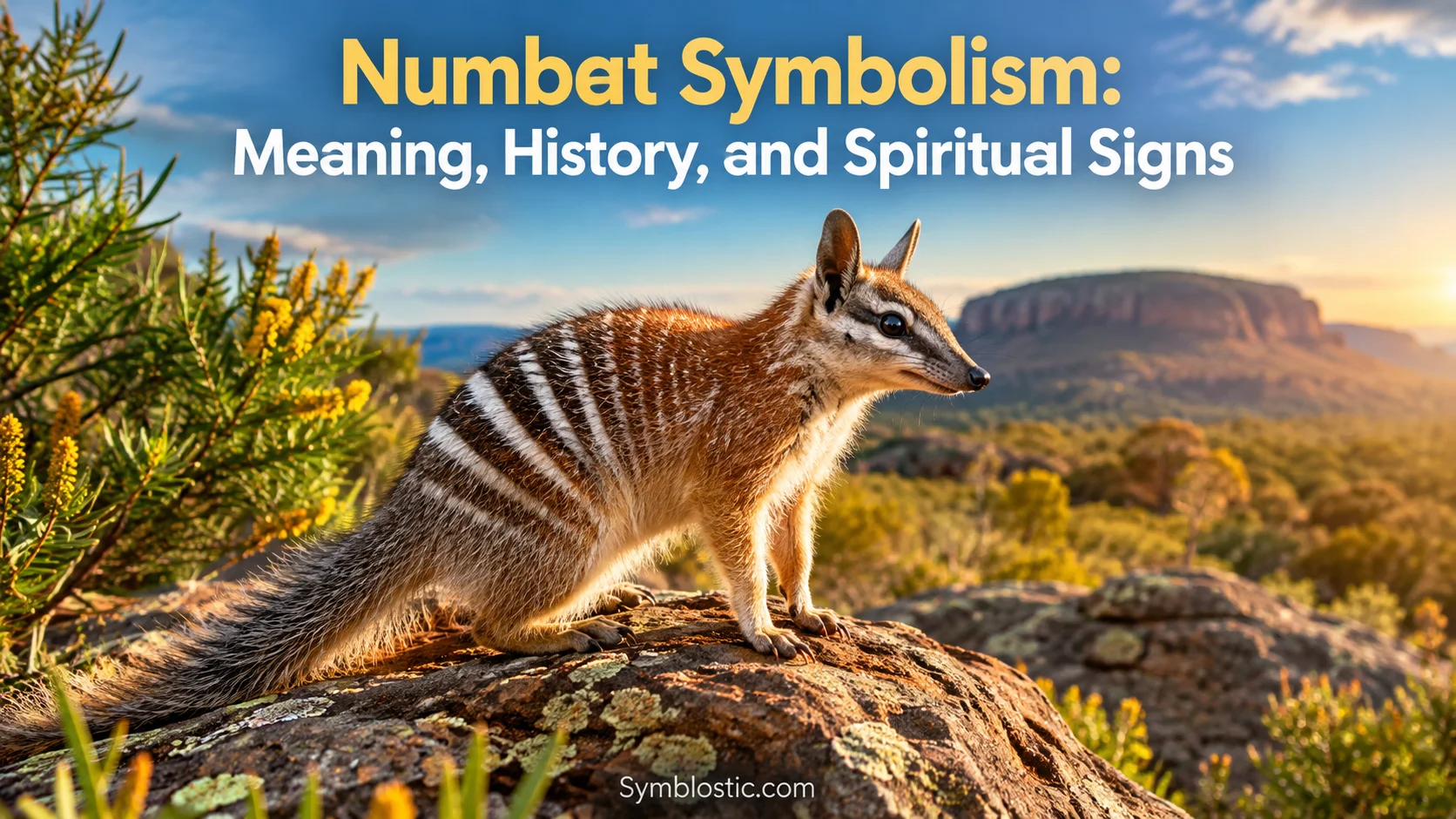
The Numbat Symbolism can be understood through the animal’s unusual appearance, focused behavior, cultural history, and remarkable survival story. This small Australian marsupial has a striped body, long tongue, sharp claws, and a highly specialized diet of termites. Those traits have inspired modern symbolic ideas about focus, persistence, awareness, and quiet strength.
For readers in the United States, the numbat may be less familiar than animals such as the eagle, wolf, bear, or butterfly. However, its rarity gives it a special symbolic quality. It represents something small and distinctive that can survive despite serious challenges.
The numbat also carries important cultural meaning in Australia. Several Aboriginal peoples have long-standing knowledge and names for the animal. Therefore, modern spiritual interpretations should be separated from specific Indigenous traditions rather than treated as interchangeable.
Today, the numbat can symbolize conservation, individuality, patience, and the value of protecting vulnerable wildlife. Its story also shows how an animal can move from being relatively unknown to becoming an important regional emblem.
Quick Answer
Numbat Symbolism commonly represents focus, resilience, individuality, awareness, and protection of nature. In a broader spiritual sense, people may interpret the numbat as a reminder to stay patient, notice what others overlook, and use quiet strength during difficult periods.
TL;DR
- The numbat often symbolizes focus, persistence, and quiet strength.
- Its stripes can represent individuality and distinctive identity.
- Western Australia adopted the numbat as its animal emblem in 1973.
- Indigenous Australian communities have longstanding cultural knowledge of the species.
- Modern symbolism often connects the numbat with conservation and survival.
- Dream interpretations commonly focus on attention, vulnerability, and hidden opportunities.
What Does a Numbat Symbolize?
The numbat has no single universal symbolic meaning. Instead, its symbolism comes from its behavior, appearance, history, and relationship with its environment.
For American readers, these meanings can be understood as modern symbolic associations rather than fixed spiritual rules. A person may connect with the numbat for completely different reasons.
Core symbolic meanings
The most common modern associations include:
- Focus: The numbat specializes in finding and eating termites.
- Persistence: It survives despite being small and vulnerable.
- Individuality: Its striped appearance makes it instantly distinctive.
- Awareness: It depends heavily on its senses and surroundings.
- Quiet strength: It survives through specialized skills rather than physical dominance.
- Conservation: Its recovery story highlights the importance of protecting vulnerable species.
The combination is important. The numbat isn’t powerful because of size or aggression. Instead, its strength comes from specialization, awareness, and adaptation.
Numbat Symbolism in the United States
Although the numbat is native to Australia, American audiences can still connect with its symbolism. In the United States, unusual wildlife often becomes a symbol of environmental responsibility, individuality, or appreciation for biodiversity.
The numbat’s conservation story makes this connection especially strong. Its survival demonstrates how habitat protection and predator management can influence the future of a species.
Why Americans may connect with the numbat
The animal can represent several values that are familiar in modern American culture:
- Protecting endangered or threatened wildlife
- Respecting unusual forms of beauty
- Valuing individuality over conformity
- Supporting environmental responsibility
- Finding strength without aggression
- Appreciating small creatures with important ecological roles
The numbat can therefore work as a symbol of quiet determination.
It doesn’t need to dominate its environment to survive. Instead, it depends on knowing its surroundings and using its natural abilities effectively.
A modern American interpretation
For someone choosing the numbat as a personal symbol, it might represent the idea:
You don’t have to be the biggest presence in the room to have value.
That interpretation isn’t an ancient universal teaching. It’s a modern symbolic reading based on the animal’s characteristics.
Numbat Symbolism in Australia
Australia is the most important cultural setting for understanding the numbat. The animal is native to the country and has a particularly strong connection with Western Australia.
Western Australia proclaimed the numbat its animal emblem on July 25, 1973. It therefore has an official civic role rather than being simply a popular wildlife species.
A symbol of Western Australia
The numbat represents a distinctive part of Western Australia’s natural heritage. Its survival is closely connected with the state’s woodland ecosystems.
Its official status also helped make the animal more visible to the public. Over time, conservation programs turned the numbat into an example of wildlife recovery and environmental stewardship.
What the emblem represents
| Context | Meaning in the USA | Common Association | Important Note |
| Wildlife | Uniqueness and biodiversity | Rare Australian animal | Native to Australia |
| Conservation | Protecting vulnerable life | Environmental responsibility | Connected to recovery efforts |
| Personal symbolism | Focus and persistence | Quiet determination | Modern interpretation |
| Cultural history | Respect for Indigenous knowledge | Connection to Country | Traditions vary by community |
| Western Australia | Regional identity | Native heritage | Official animal emblem |
The numbat’s official status makes its symbolism more concrete than many modern animal-spirit interpretations.
Historical Background of the Numbat
The numbat’s history stretches far beyond modern conservation campaigns. Before European settlement, its range was much larger than it is today.
Historical evidence indicates that numbats once lived across large parts of southern Australia. Their range later contracted dramatically because of habitat changes and introduced predators.
From widespread animal to rare survivor
European settlement brought major changes to Australian ecosystems. Land clearing reduced suitable habitat, while introduced foxes and cats created additional pressure.
By the 1970s, only a few hundred numbats were believed to remain. Conservation programs later helped establish additional populations.
This history gives the numbat an especially powerful modern association with survival after decline.
The meaning of survival
Symbolically, the numbat’s story can suggest:
- Recovery after hardship
- The importance of protecting vulnerable things
- Hope after severe decline
- Strength through adaptation
- The value of collective conservation
- Respect for natural ecosystems
These meanings are particularly relevant today because conservation has become part of the numbat’s public identity.
Ancient and Indigenous Roots of Numbat Meaning
The numbat has Indigenous names and cultural connections that existed long before its adoption as a Western Australian emblem.
The animal is known as noombat in Noongar contexts, while walpurti is used by several desert language groups. Different Indigenous peoples have their own languages, stories, knowledge systems, and relationships with the animal.
Why cultural distinctions matter
It would be misleading to describe all Aboriginal Australian beliefs about the numbat as one tradition. Australia contains many distinct Indigenous nations and language groups.
Some communities hold specific stories involving the animal. For example, accounts associated with Pitjantjatjara traditions describe a story involving the walpurti and the perentie, in which the animals exchange distinctive markings.
These stories should be understood within their particular cultural contexts. They aren’t simply generic examples of “animal spirituality.”
Connection with Country
The numbat also reflects detailed ecological knowledge.
Indigenous communities developed extensive knowledge about where the animal lived, what it ate, and where it sheltered. This demonstrates that cultural meaning and practical environmental knowledge can exist together.
Spiritual Meaning of a Numbat
Modern spiritual writing often associates the numbat with focus, resilience, awareness, and individuality. These interpretations are contemporary symbolic readings rather than universal religious teachings.
For someone who feels drawn to the animal, the numbat may represent a period of careful attention and personal persistence.
Focus and purpose
A numbat spends much of its active time searching for termites. Its highly specialized feeding behavior makes focused effort an obvious symbolic association.
Spiritually, some people may interpret this as a reminder to concentrate on what genuinely matters instead of chasing every possibility.
Quiet strength
The numbat doesn’t resemble traditional symbols of power.
It is small and vulnerable, yet it has survived through specialized behavior. Therefore, it can represent strength that doesn’t need to be loud or aggressive.
Awareness
The animal relies on smell, movement, and environmental clues while searching for food.
As a modern spiritual metaphor, that can represent paying closer attention to subtle changes around you.
Numbat Symbolism and Personality
People sometimes use animals as mirrors for personality traits. The numbat can fit a personality that values independence, observation, and specialized interests.
However, these associations shouldn’t be treated as scientific personality tests. They are symbolic descriptions rather than psychological diagnoses.
Traits associated with the numbat
A person who identifies with the numbat might see themselves as:
- Quiet but determined
- Curious about details
- Comfortable working independently
- Protective of vulnerable things
- Highly focused on specific interests
- Sensitive to changes in their environment
- Proud of being different
The solitary nature of the numbat can also appeal to people who enjoy independence.
However, solitude isn’t automatically the same as loneliness. The symbolic meaning depends heavily on the person and context.
Psychological Meaning of the Numbat
Animal symbols can influence emotions because people naturally connect physical traits with ideas and feelings.
The numbat’s small size may create a sense of gentleness. Its unusual stripes can create curiosity, while its survival history can produce admiration.
What the numbat may emotionally represent
The animal can evoke:
- Curiosity about unfamiliar things
- Admiration for resilience
- Comfort from gentle wildlife
- Respect for environmental protection
- Inspiration to remain persistent
- Appreciation for individuality
Its story also challenges the idea that strength must look intimidating.
The numbat survives through specialization and awareness. That makes it a useful symbol for people who prefer patience over confrontation.
Read More: Jerboa Symbolism: Meaning, History, and Spiritual Signs
Numbat Symbolism in Dreams
Dream symbolism is highly personal. A numbat appearing in a dream doesn’t have one proven meaning for everyone.
Still, modern symbolic interpretations often connect the animal with focus, hidden discoveries, vulnerability, and persistence.
Seeing a numbat in a dream
A dream about a healthy numbat may be interpreted as a symbol of:
- Concentrating on one important goal
- Discovering something previously overlooked
- Protecting something vulnerable
- Becoming more observant
- Remaining patient during uncertainty
The surrounding dream matters as much as the animal.
A frightened numbat may suggest vulnerability in a symbolic reading. A calm numbat might instead represent confidence, independence, or peaceful observation.
A numbat searching for food
A numbat digging or searching can symbolize investigation.
You may associate the scene with looking beneath the surface for information, answers, or opportunities. Again, this is a personal interpretation rather than a fixed spiritual rule.
Numbat Symbolism in Tattoos and Art
Animal tattoos often communicate personality, values, memories, or appreciation for nature. A numbat tattoo can therefore carry several layers of meaning.
Because the animal is unusual, the tattoo may also communicate individuality.
Common tattoo meanings
A numbat tattoo might represent:
- Resilience after hardship
- Connection with Australian wildlife
- Environmental awareness
- Individuality
- Focus and determination
- Appreciation for unusual animals
The striped back provides strong visual appeal for tattoo designs.
Some people may choose a realistic numbat, while others may use a simplified silhouette or natural woodland scene.
Respectful cultural use
A numbat tattoo inspired by a specific Indigenous tradition deserves additional care.
Indigenous Australian designs can have cultural meaning that goes beyond decoration. Therefore, copying a culturally specific artwork or story without understanding its context can be inappropriate.
A general wildlife tattoo and a culturally specific Indigenous design aren’t automatically the same thing.
Numbat Symbolism in Social Media, Fashion, and Decor
The numbat is well suited to modern visual culture because its appearance is distinctive.
Its stripes, long tail, pointed face, and unusual body shape make it recognizable in illustrations, educational material, wildlife photography, and nature-themed designs.
Modern uses
You may encounter numbat imagery in:
- Wildlife education
- Conservation campaigns
- Nature photography
- Children’s books
- Australian-themed artwork
- Environmental merchandise
- Wildlife organization materials
- Educational mascots
The animal’s friendly appearance also makes it suitable for mascots.
For example, educational projects can use the numbat to communicate curiosity and investigation. That connection reflects its real behavior rather than an invented personality.
Why the Numbat Represents Conservation
Few aspects of modern numbat symbolism are stronger than conservation.
The species experienced a major population decline after habitat loss and the introduction of predators. Recovery programs later demonstrated that long-term protection can produce meaningful results.
From vulnerability to recovery
In July 2026, reporting based on the International Union for Conservation of Nature’s updated assessment said the numbat’s global status had improved to Near Threatened.
That development is important symbolically. The story is no longer only about disappearance.
It is also about what sustained conservation work can accomplish.
A symbol of ecological responsibility
For modern readers, the numbat can therefore represent:
- Recovery rather than surrender
- Protection of threatened ecosystems
- Cooperation between conservation groups
- The importance of habitat
- Long-term environmental responsibility
- Hope based on measurable progress
However, recovery doesn’t mean the species is free from risk. Its remaining range is still a small fraction of its historical distribution.
Numbat Symbolism and Individuality
The numbat’s appearance makes it a natural symbol of being different.
Its striped body isn’t merely decorative. The markings help it blend into woodland surroundings when it moves, creating a useful connection between uniqueness and adaptation.
Being different as a strength
Modern American culture often uses animal symbolism to express identity.
A numbat can communicate a quieter version of individuality:
I don’t need to resemble everyone else to have a place here.
That message can work particularly well for artwork, personal collections, or nature-themed tattoos.
The balance between individuality and belonging
The numbat is distinctive, but it is still part of a larger ecosystem.
That creates an interesting symbolic balance. You can be unique while remaining connected to your environment and community.
Misunderstandings and Misuse of Numbat Symbolism
Because numbat spirituality is mostly a modern interpretive field, readers should be careful with claims presented as universal facts.
There is no single ancient doctrine that gives the numbat one fixed symbolic meaning for everyone.
Common misunderstandings
One common mistake is treating all Indigenous Australian traditions as one belief system. Another is presenting modern “spirit animal” interpretations as if they were traditional teachings from every Aboriginal community.
A more accurate approach is to separate:
- Documented Indigenous cultural knowledge
- Western Australian civic symbolism
- Modern conservation symbolism
- Personal spiritual interpretation
- Contemporary animal symbolism
This distinction makes the discussion more respectful and historically accurate.
The “anteater” misunderstanding
The numbat is sometimes called the banded anteater, but it isn’t simply another version of an American anteater.
It is an Australian marsupial with its own evolutionary history. Calling it an anteater can help explain its diet, but the comparison can also hide what makes the animal unique.
How Numbat Meaning Has Changed Over Time
The symbolic identity of the numbat has changed along with its public history.
Earlier Indigenous relationships with the animal were rooted in Country, language, ecological knowledge, and cultural traditions. Later, the animal became part of European-Australian scientific and conservation discussions.
Its adoption as Western Australia’s animal emblem in 1973 added another layer.
From wildlife to emblem
The numbat gradually came to represent Western Australian identity and native wildlife.
Then, as its conservation situation became more serious, it increasingly represented environmental protection.
Today, the animal can carry several meanings simultaneously:
- Indigenous cultural significance
- Western Australian identity
- Wildlife conservation
- Ecological resilience
- Individuality
- Modern spiritual symbolism
These meanings don’t all have the same historical origin. Keeping those origins separate helps avoid oversimplification.
FAQs:
What does a numbat symbolize spiritually?
Modern spiritual interpretations often connect the numbat with focus, resilience, awareness, individuality, and quiet strength. These are contemporary interpretations, not universal religious beliefs.
What does seeing a numbat mean?
Symbolically, seeing a numbat may be interpreted as a reminder to pay attention, stay focused, or value your individuality. The meaning depends on the personal and cultural context surrounding the encounter.
What does a numbat represent in Australia?
The numbat represents native wildlife and Western Australian identity. It has been the animal emblem of Western Australia since July 25, 1973.
What does a numbat symbolize in a dream?
A numbat dream may be associated with focus, careful observation, vulnerability, or searching for something hidden. Dream meanings aren’t fixed, so the dream’s emotions and circumstances matter.
Is the numbat an Indigenous Australian symbol?
The numbat has important cultural connections with several Indigenous Australian peoples, including communities with names such as noombat and walpurti. Specific meanings and stories differ among cultural and language groups.
Why is the numbat associated with resilience?
The numbat became rare across much of its historical range because of habitat loss and introduced predators. Its subsequent conservation recovery has made resilience and survival strong modern associations.
Conclusion:
The Numbat Symbolism story is unusual because the animal itself is unusual. Its stripes, specialized diet, alert behavior, and survival history naturally support modern associations with focus, individuality, awareness, resilience, and conservation.
For American readers, the numbat can be especially meaningful as a symbol of quiet strength. It shows that something small and distinctive can have an important place within a much larger ecosystem.

1 thought on “Numbat Symbolism: Meaning, History, and Spiritual Signs”