
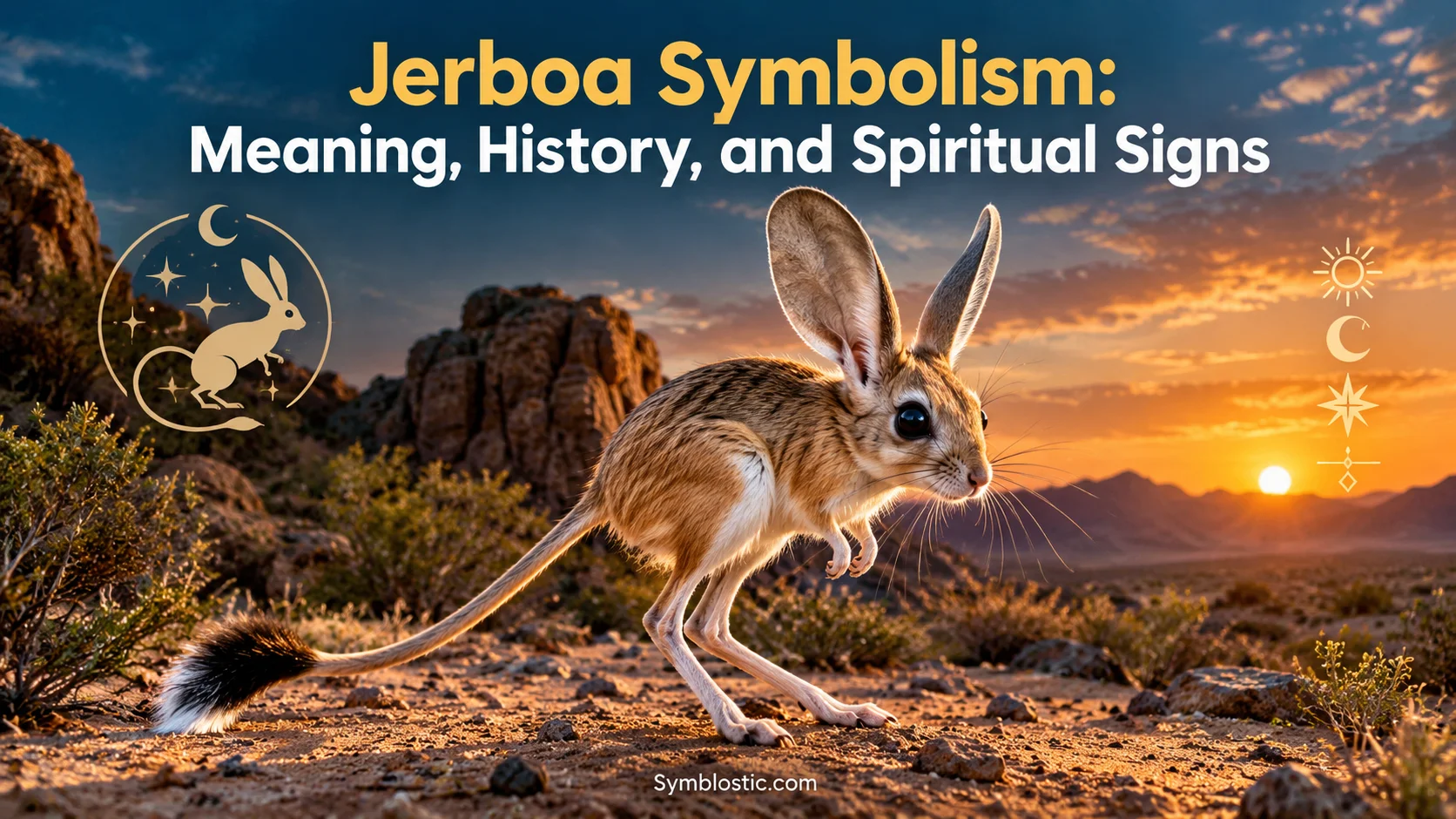
A jerboa is a small desert rodent known for its huge hind legs, long tail, and powerful jumping ability. Jerboa Symbolism often centers on adaptability, quick movement, independence, and surviving difficult conditions.
For American readers, the jerboa isn’t a common cultural symbol like an eagle, bear, or wolf. However, its unusual body and desert lifestyle give it a strong symbolic appeal. People may connect it with overcoming obstacles, staying alert, or moving forward when circumstances change.
The animal also has a fascinating place in folklore and modern spiritual interpretation. These meanings aren’t universal facts. Instead, they reflect cultural traditions, personal beliefs, and the qualities people notice in the animal.
Quick Answer
Jerboa Symbolism commonly represents adaptability, agility, independence, resilience, and the ability to navigate difficult environments. In spiritual interpretations, its powerful jumps can also symbolize taking a leap, trusting your instincts, and moving beyond limitations.
TL;DR
- Jerboas commonly symbolize agility, adaptation, independence, and resilience.
- Their jumping ability represents movement beyond obstacles.
- Their desert habitat connects them with endurance and resourcefulness.
- In the USA, jerboas have limited traditional symbolism but strong nature-based appeal.
- Spiritual interpretations often focus on instinct, freedom, and transformation.
- Jerboa imagery can represent curiosity and unconventional individuality today.
What Does a Jerboa Symbolize?
The jerboa’s appearance explains much of its symbolic meaning. Its tiny body, oversized hind legs, long tail, and large ears make it instantly recognizable.
More importantly, its body is built for survival in harsh desert environments. It can move quickly, conserve energy, and respond to danger with sudden leaps.
Core Symbolic Meanings
People who interpret the jerboa symbolically often associate it with:
• Adaptability when conditions change unexpectedly
• Agility when obstacles require fast reactions
• Independence and self-reliance
• Resilience during challenging circumstances
• Freedom from limitations or restrictive situations
• Instinct and awareness of the surrounding environment
The strongest theme is adaptation. The jerboa doesn’t survive by overpowering its surroundings. Instead, it survives through specialized abilities.
That distinction makes the animal an interesting symbol for people who value flexibility over force.
Jerboa Symbolism in the United States
The jerboa doesn’t have a major established symbolic role in mainstream American history. Still, its characteristics fit several themes that Americans commonly associate with desert wildlife.
The American Southwest, in particular, has a strong cultural connection with desert landscapes and survival imagery. Although jerboas aren’t native to the United States, their appearance can remind people of desert ecosystems and animals adapted to extreme environments.
Desert Survival and Resilience
American culture frequently uses desert landscapes as symbols of endurance. Deserts can represent isolation, difficulty, heat, uncertainty, and the challenge of finding limited resources.
A jerboa fits naturally into that broader symbolic idea.
It survives in an environment that appears empty or hostile to outsiders. Therefore, it can symbolize the ability to find opportunities where others see only hardship.
Independence and Self-Reliance
The jerboa’s solitary and highly mobile lifestyle can also support ideas of independence.
For an American audience, this can connect with the familiar cultural value of self-reliance. The symbolism isn’t about refusing help. Instead, it can represent confidence in your own ability to handle changing circumstances.
Jerboa Symbolism in Desert Landscapes
The desert is central to understanding why the jerboa carries such strong symbolic possibilities. Its environment shapes nearly every noticeable behavior.
Jerboas are adapted to arid regions of North Africa and Asia. Different species occupy different habitats, but many live in sandy or dry environments.
Why the Desert Matters
A desert offers little room for waste. Water, food, shelter, and energy all matter.
Because of this, the jerboa can symbolize resourcefulness. It demonstrates how survival can depend on using the abilities you already possess.
The desert also creates a powerful contrast between vulnerability and strength. A tiny animal can thrive in an environment that seems overwhelmingly harsh.
That contrast gives jerboa imagery a deeper message: small doesn’t necessarily mean powerless.
Historical Roots of Jerboa Meaning
Jerboas belong to a group of jumping rodents found across parts of Africa and Asia. They have existed within human awareness for centuries because of their unusual appearance and desert habitats.
However, it’s important not to invent a single ancient symbolic meaning for all jerboas. Historical records don’t support one universal interpretation shared across every culture.
Ancient and Traditional Context
In regions where jerboas live, people have encountered these animals as part of local desert ecosystems. Their strange appearance naturally made them noticeable.
Traditional animal symbolism often develops from observation. People watch an animal’s behavior and connect it with qualities such as speed, caution, strength, or cleverness.
The jerboa’s remarkable jumping ability makes it especially easy to associate with movement and escape.
From Observation to Symbolism
Over time, modern spiritual writing has expanded these natural qualities into symbolic themes.
For example, jumping can become a metaphor for:
• Leaving an old situation behind
• Taking a bold opportunity
• Escaping restrictive circumstances
• Moving quickly toward a new goal
• Trusting natural instincts during uncertainty
These interpretations are modern symbolic readings rather than proven ancient beliefs.
Spiritual Meaning of a Jerboa
In spiritual contexts, the jerboa can represent movement, adaptability, instinct, and personal freedom.
However, spiritual symbolism varies greatly between individuals and traditions. There isn’t one universally accepted spiritual meaning assigned to the animal.
A Leap Into the Unknown
The jerboa’s most distinctive behavior is its ability to leap across the ground.
Symbolically, that movement can represent a transition. You may be leaving one stage of life and entering another.
The image of a leap also suggests courage. You can’t always see exactly where the next step will lead.
Trusting Instinct
Jerboas depend heavily on their senses and quick reactions.
Because of this, spiritual interpretations may connect the animal with listening to your instincts. The message isn’t necessarily supernatural.
Instead, it can serve as a metaphor for paying attention to subtle signals and responding thoughtfully.
Freedom and Movement
A jerboa rarely looks like an animal designed for stillness. Its body communicates movement.
As a result, it can symbolize the desire to escape stagnation and regain personal freedom.
What Does a Jerboa Mean in a Dream?
Dream symbolism is personal, so a jerboa doesn’t have one fixed meaning in every dream.
Your emotions, the animal’s behavior, and the surrounding setting can change the interpretation. A frightening dream may suggest something very different from a peaceful encounter.
Common Symbolic Interpretations
A jerboa appearing in a dream might be associated with:
• Adapting to an unfamiliar situation
• Feeling ready to make a major change
• Needing greater independence
• Reacting quickly to unexpected problems
• Searching for freedom from limitations
For example, seeing a jerboa successfully escaping danger could reflect your perception of your own ability to handle pressure.
On the other hand, a trapped jerboa might symbolize feeling restricted or unable to move forward.
These interpretations are reflective tools, not predictions of future events.
Jerboa Symbolism and Psychology
Animal symbols can work as psychological metaphors because people naturally connect visible traits with personal qualities.
The jerboa is particularly interesting because its physical proportions seem almost exaggerated. Its large hind legs immediately suggest energy and movement.
The Psychology of Adaptation
People often admire animals that survive difficult environments. Such animals can become symbols of personal resilience.
A jerboa can therefore represent someone who doesn’t need ideal circumstances to keep going.
Instead, the symbolism emphasizes adjustment. When the environment changes, the individual changes their approach.
The Psychology of Movement
Movement can also symbolize emotional progress.
A person who feels stuck may find the image of a jumping animal meaningful. It offers a simple visual idea: you don’t always have to move forward in a straight line.
Sometimes progress involves changing direction.
Read More: Bird-of-Paradise Symbolism: Meaning, History & Beauty
Jerboa Symbolism in Modern Life
Today, animal symbolism appears across tattoos, artwork, social media, clothing, home decoration, and personal identity.
The jerboa is less common than wolves, snakes, butterflies, or lions. That rarity can actually make it more appealing to people who want something unusual.
Tattoos
A jerboa tattoo might represent independence, resilience, or a personal connection with desert life.
Some people may choose the animal simply because they appreciate its unusual appearance. Others may focus on the idea of overcoming obstacles.
A jumping jerboa can create a particularly clear visual message about freedom and forward movement.
Art and Decor
Jerboa artwork can bring a playful desert theme into a room.
Its distinctive silhouette also works well in minimalist drawings, natural-history artwork, and desert-inspired designs.
Because the animal isn’t heavily commercialized as a symbol, it can feel more personal than familiar wildlife imagery.
Social Media and Identity
Online, unusual animals often become shorthand for personality traits.
A jerboa might represent someone who sees themselves as:
• Independent rather than conventional
• Curious about unusual subjects
• Quick-thinking under pressure
• Comfortable adapting to change
• Drawn toward desert or wildlife themes
These meanings depend on the individual using the image.
Jerboa Symbolism Across Cultures
Jerboas occur across regions of Africa and Asia, so people in different areas have encountered them in different cultural settings.
Still, there isn’t a single worldwide tradition that gives every jerboa the same symbolic meaning.
North African and Middle Eastern Contexts
In regions where jerboas live, they are part of desert and semi-desert wildlife.
Local knowledge may focus more on their behavior, habitat, and ecological role than on symbolic interpretation. Modern spiritual sources sometimes assign broader meanings such as agility or survival.
Those modern interpretations shouldn’t automatically be presented as ancient religious traditions.
Asian Contexts
Jerboa species also occur in parts of Central and East Asia.
Again, symbolic associations can vary by community. The animal’s unusual movement and nighttime activity may influence how people perceive it.
However, broad claims about one universal “Asian jerboa meaning” would oversimplify many different cultures.
Jerboa Symbolism in Nature and Wildlife
Beyond spiritual ideas, the jerboa has real ecological qualities that make its symbolism meaningful.
Many jerboas are nocturnal. They spend much of their active time moving through environments where daytime temperatures can become extreme.
Nocturnal Adaptation
Night activity can symbolically suggest mystery, awareness, and navigating uncertainty.
It also shows how animals don’t have to follow human patterns to thrive. What seems difficult during the day may become manageable at night.
Efficient Movement
The jerboa’s powerful hind legs allow it to move through open terrain with remarkable leaps.
That makes it a useful natural metaphor for efficiency. Instead of relying on constant effort, the animal uses specialized movement.
This can symbolize working smarter and adapting your approach when circumstances demand it.
Jerboa Colors, Appearance, and Symbolic Meaning
Jerboas generally have sandy, brown, gray, or pale coloring that helps them blend into their surroundings.
Their appearance supports several additional symbolic themes.
Sandy Colors
Earthy colors can suggest grounding, simplicity, and connection with nature.
Camouflage adds another layer. A jerboa doesn’t always need to stand out to survive.
That can symbolize knowing when to be visible and when to remain unnoticed.
Large Ears and Long Tail
Its large ears can represent awareness and careful listening in symbolic artwork.
Its long tail helps with balance and movement. Symbolically, balance can suggest staying steady while navigating rapid change.
Together, these features create a picture of alertness combined with adaptability.
Jerboa Meaning in Tattoos, Art, and Personal Identity
Choosing a jerboa for personal artwork can communicate individuality.
Unlike more familiar animal symbols, the jerboa isn’t immediately associated with one dominant cultural message. That gives the person more freedom to define its meaning.
Symbolic Design Ideas
A jerboa image may emphasize different qualities through its pose.
A standing jerboa can suggest awareness. A jumping jerboa can emphasize freedom, movement, or change.
A desert landscape can strengthen themes of endurance and survival.
A minimalist outline may instead focus on individuality and curiosity.
| Context | Meaning in the USA | Common Association | Symbolic Focus |
| Tattoo | Individuality and resilience | Personal growth | Moving beyond obstacles |
| Artwork | Nature and curiosity | Desert wildlife | Adaptation |
| Home decor | Unusual natural beauty | Desert themes | Simplicity and survival |
| Personal symbol | Independence | Nonconformity | Self-direction |
| Spiritual imagery | Transformation | Instinct and movement | Taking a new path |
Misunderstandings and Misuse of Jerboa Symbolism
Because jerboa symbolism isn’t standardized, misinformation can spread easily.
One website may claim the animal has an ancient sacred meaning. Another may describe it as a universal spiritual messenger. Such statements require caution.
Symbolism Isn’t Scientific Fact
There is no scientific evidence that seeing a jerboa delivers a supernatural message.
Likewise, dreams involving jerboas don’t have scientifically established meanings.
Symbolism can still be personally meaningful. The important distinction is between personal interpretation and documented cultural tradition.
Avoiding Cultural Overreach
It’s also important not to assign one meaning to every culture where jerboas exist.
Africa and Asia contain many distinct communities and traditions. A symbolic interpretation from one modern spiritual source shouldn’t be presented as the belief of an entire region.
How Jerboa Symbolism Has Changed Over Time
The meaning of unusual animals often changes as people encounter them through new forms of media.
Historically, people mainly knew animals through direct observation and local storytelling. Today, photographs, documentaries, social platforms, tattoos, and spiritual websites introduce wildlife to audiences worldwide.
From Survival Animal to Personal Symbol
The jerboa can now be interpreted through modern ideas about personal growth.
Its natural traits become metaphors for adapting, moving, and surviving change.
However, this doesn’t mean older interpretations disappeared. Instead, modern symbolism often adds new layers to familiar observations.
Why Unusual Animals Matter Today
People increasingly use less familiar animals to express individuality.
A jerboa can communicate something subtle: you don’t need to look powerful to be capable.
That idea gives this small desert animal a surprisingly strong symbolic presence.
FAQs:
What does a jerboa symbolize spiritually?
A jerboa can symbolize adaptability, instinct, freedom, resilience, and movement. Spiritual interpretations vary, so these meanings should be understood as symbolic rather than universal religious teachings.
What does seeing a jerboa mean?
Seeing a jerboa can simply mean you’ve encountered an unusual desert animal. Symbolically, some people interpret the encounter as a reminder to adapt, stay alert, or move beyond obstacles.
What does a jerboa represent in dreams?
A jerboa in a dream may represent movement, independence, quick reactions, or adapting to change. Your feelings and the dream’s setting are important when considering a personal interpretation.
Is the jerboa a symbol of good luck?
There isn’t a universal tradition that identifies the jerboa as a good-luck symbol. Some modern interpretations connect it with positive qualities such as resilience and successful adaptation.
What does a jerboa tattoo symbolize?
A jerboa tattoo can represent independence, agility, resilience, freedom, or overcoming difficult circumstances. The meaning can also be completely personal to the person wearing it.
Why is the jerboa associated with adaptability?
Jerboas have specialized bodies and behaviors that help them survive in dry environments. Their ability to move efficiently and respond quickly makes adaptability a natural symbolic association.
Conclusion:
Jerboa Symbolism centers on qualities that are easy to recognize in this remarkable desert animal: adaptability, agility, independence, resilience, and freedom. Its powerful jumps offer a natural metaphor for overcoming obstacles without relying on brute strength.
For American readers, the jerboa has no single established national meaning. Instead, its symbolism comes largely from its unusual biology, desert environment, and the personal meanings people attach to animals.

1 thought on “Jerboa Symbolism: Meaning, History, and Spiritual Signs”