
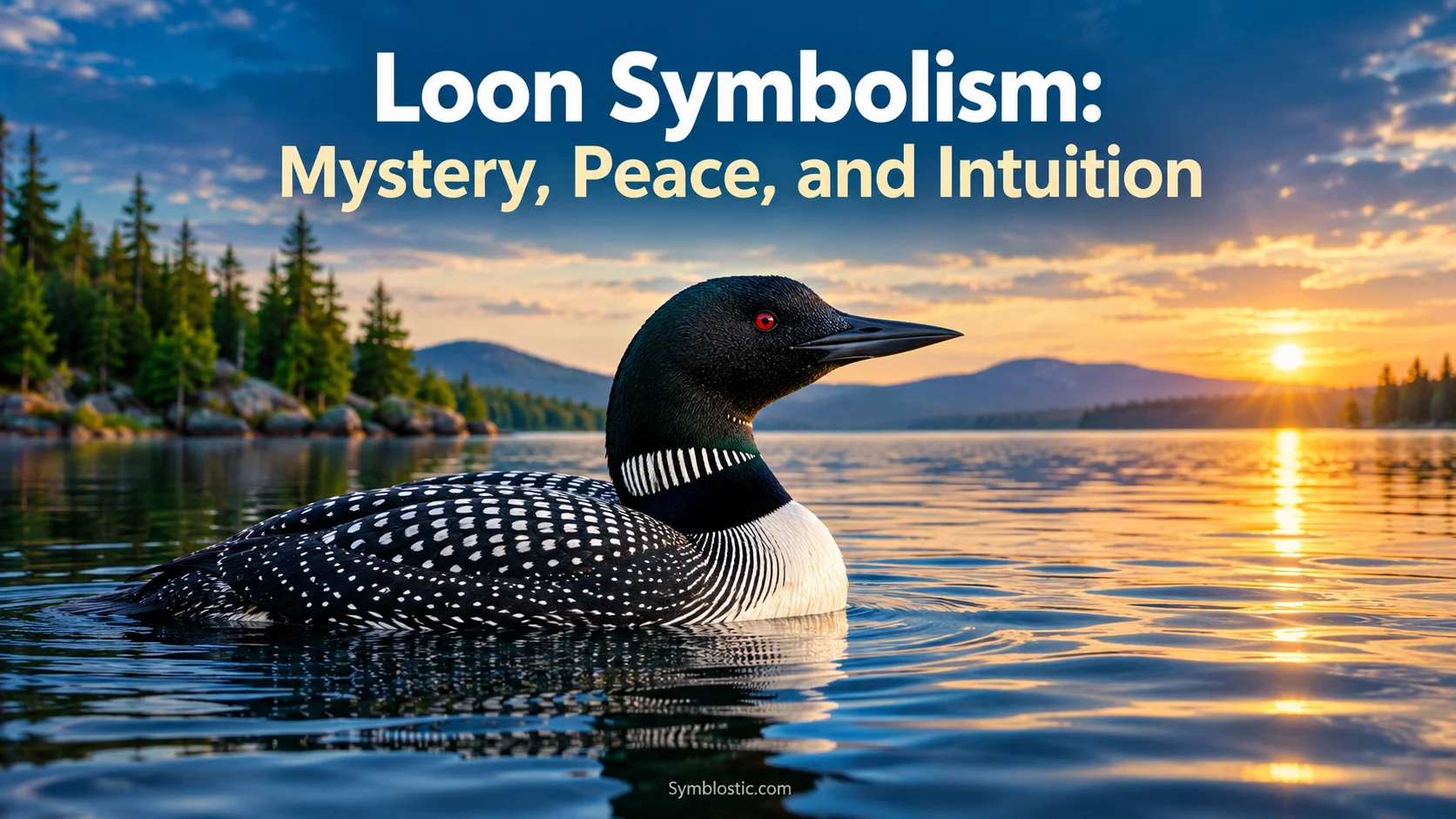
The haunting call of a loon can make a quiet lake feel mysterious and alive. Loon symbolism often centers on peace, intuition, emotional depth, and a strong connection with nature. In the United States, especially across the northern states and lake regions, loons are familiar symbols of wilderness and solitude. Their striking black-and-white feathers and haunting nighttime calls give them an unforgettable presence.
For many Americans, loons bring to mind peaceful summers, misty mornings, and quiet evenings beside the water. However, their meaning goes beyond beautiful scenery. Their ability to dive beneath the surface and disappear into dark water can inspire thoughts about hidden emotions, self-discovery, and the parts of ourselves we rarely share.
Loons also have cultural and spiritual associations that deserve thoughtful consideration. Some Indigenous traditions connect loon stories with community, creation, or relationships with the natural world, although meanings vary between nations. Meanwhile, modern art, jewelry, tattoos, and lakeside decorations often use the loon to express freedom, loyalty, and a love of wild places.
Understanding loon symbolism doesn’t require you to believe in supernatural messages. Instead, you can explore the bird’s natural behavior, cultural history, and emotional impact to discover why it continues to fascinate people.
Quick Answer
In the United States, loon symbolism commonly represents peace, intuition, emotional depth, loyalty, and a deep connection with nature. Spiritually, the loon may also symbolize inner exploration, transformation, and the courage to trust your instincts, although interpretations depend on personal beliefs and cultural traditions.
TL;DR
- Peace: Loons evoke quiet lakes, solitude, and a slower pace of life.
- Intuition: Their underwater dives suggest exploring feelings hidden beneath the surface.
- Loyalty: Their breeding behavior can inspire ideas about commitment and partnership.
- Freedom: Their wild habitats represent independence and an untamed spirit.
- Transformation: Moving between air, land, and water suggests adapting to change.
- American identity: Loons are strongly associated with northern lakes and wilderness traditions.
What Does a Loon Symbolize?
The loon combines a striking appearance with unusual behavior, making it a powerful symbol in nature-inspired interpretations. For American readers, its strongest associations usually involve peaceful surroundings, emotional awareness, and life near lakes.
The Meaning Behind Its Appearance
The common loon has a distinctive black head, a sharp bill, and a patterned black-and-white back during breeding season. In winter, its plumage becomes more subdued, showing gray above and white below.
These seasonal changes offer several possible symbolic associations:
- Black and white suggest contrast, balance, and the coexistence of opposing feelings.
- Water represents emotion, reflection, and the unknown.
- The loon’s streamlined body suggests grace, focus, and movement through difficult situations.
- Its bright red eyes during breeding season can evoke alertness and intensity.
These are interpretive associations, not fixed meanings shared by everyone. Still, they help explain why the loon works so well as a symbol in art and personal reflection.
Three Core Symbolic Themes
Peace and solitude: The loon often appears alone on a quiet lake. This image can represent the value of spending time away from noise and outside pressure.
Emotional depth: Because loons dive beneath the surface to find food, they can symbolize looking beyond appearances. Their behavior provides a natural metaphor for examining feelings and uncovering hidden truths.
Loyalty and connection: Loons form breeding pairs, defend territories, and often raise their chicks together. These behaviors can inspire ideas about partnership, shared responsibility, and devotion.
The History of Loon Symbolism
The loon’s symbolic history comes from its place in northern landscapes, Indigenous cultural traditions, and later American appreciation of wildlife. Understanding these influences helps separate documented history from newer spiritual interpretations.
Indigenous Stories and Cultural Traditions
Loons appear in stories and cultural traditions among some Indigenous peoples of North America. However, Indigenous nations have distinct languages, histories, and spiritual beliefs, so there isn’t one universal Native American meaning for the bird.
In some traditions, loon stories connect with the origins of the world, relationships between animals and humans, or lessons about community. Other stories may emphasize particular behaviors, relationships, or the bird’s distinctive voice.
It’s important not to assign a meaning to every Indigenous nation without specific evidence. A story belonging to one community shouldn’t automatically be treated as a belief shared across all Native American cultures.
From Regional Wildlife to a Cultural Symbol
As European American settlements expanded across northern lake regions, loons became familiar features of outdoor life. Their calls, diving skills, and seasonal movements helped establish them as memorable symbols of remote lakes and relatively undisturbed wilderness.
By the modern era, loons had become closely associated with lake vacations, wildlife observation, and conservation. Their image also found a place in regional art, souvenirs, and outdoor-themed decorations.
Today, the loon can connect people with both natural history and personal memories. For someone who spent childhood summers at a Minnesota lake, the bird might represent family traditions as much as wilderness.
Loon Symbolism in the United States
In the United States, the loon is especially meaningful in the northern lake country. Its image connects regional identity, outdoor recreation, environmental awareness, and memories of time spent near the water.
Minnesota and the Northern Lakes
Minnesota is famously associated with the common loon, which is the state’s official state bird. The loon also has strong cultural associations with Wisconsin, Maine, Michigan, and other northern states where suitable lakes provide breeding habitat.
For residents and visitors, the bird often represents:
- Minnesota pride: A recognizable symbol of the state’s lakes and wildlife.
- Lake traditions: Family cabins, fishing trips, canoeing, and summer vacations.
- Wilderness protection: The importance of maintaining clean water and healthy habitats.
- Regional belonging: A shared appreciation for northern landscapes and outdoor life.
These associations are especially strong in communities where loons are regularly heard during the breeding season.
The Loon and the American Outdoors
The loon fits naturally into an American tradition of celebrating wilderness. Its presence on a remote lake can suggest that a place remains relatively quiet and connected to nature.
However, the bird is more than a decorative image. Common loons depend on suitable lakes for breeding and can be affected by pollution, shoreline development, and disturbances from boats. As a result, loon imagery can also encourage people to think about environmental responsibility.
Why Its Call Feels So Meaningful
The loon’s calls include wails, tremolos, and yodels. Some sound eerie or mournful, especially when heard across water after dark.
For many listeners, these sounds create a powerful emotional connection. They may bring back memories of childhood summers, remind someone of a distant loved one, or inspire a sense of wonder.
That emotional response is real, even when the listener doesn’t interpret the call as a supernatural sign.
Loon Spiritual Meaning and Symbolism
Spiritually, the loon can represent inner wisdom, emotional awareness, and a closer relationship with the natural world. These meanings are modern interpretations rather than universal spiritual rules, so you can approach them in a way that fits your own beliefs.
The Loon as a Symbol of Inner Wisdom
A loon can disappear beneath the water and return moments later. Symbolically, this movement can represent turning inward before making an important decision.
You might connect the loon with intuition when you’re facing uncertainty. Its image can remind you to examine your feelings, gather information, and avoid reacting too quickly.
However, intuition doesn’t mean every feeling predicts the future. Sometimes, it simply reflects experiences and details you’ve noticed without consciously examining them.
Transformation and Spiritual Growth
Water often represents change, emotion, and renewal in spiritual imagery. Since the loon moves between the water’s surface, the depths, and the open sky, it offers a useful metaphor for personal growth.
Its symbolism may resonate when you’re:
- Leaving behind an old routine or relationship.
- Learning to understand complicated emotions.
- Adjusting to a new home, role, or stage of life.
- Making space for reflection before moving forward.
The loon doesn’t promise that change will be easy. Instead, it can serve as a reminder that growth sometimes requires patience and a willingness to explore unfamiliar feelings.
Connection With the Natural World
Some people interpret encounters with wild animals as spiritually meaningful. Seeing a loon might inspire gratitude, calm, or a stronger sense of belonging in the world.
You don’t need to treat the encounter as a message from the universe. Its meaning can come from the attention you give the moment and the feelings it brings forward.
Loon Symbolism in Indigenous and Other Cultural Traditions
Loons have a long relationship with Indigenous peoples of North America, particularly in regions where the birds live. Their cultural significance varies, so understanding specific traditions is more meaningful than assigning one spiritual definition to every community.
Ojibwe Associations
In some Ojibwe traditions, the loon, known as maang in Ojibwe, appears in traditional stories and artwork. Historical accounts describe the bird in connection with bravery and creation stories.
These associations belong to particular cultural contexts. They shouldn’t be reduced to a simple claim that all Indigenous peoples view the loon in the same way.
For readers interested in Indigenous symbolism, community-authored stories and cultural resources offer a better starting point than generalized spiritual lists.
Broader Cultural Interpretations
Across different societies, birds have often represented freedom, communication, or a connection between the earthly and spiritual worlds. However, these broad themes don’t establish a specific traditional meaning for the loon in every culture.
In contemporary spiritual writing, the loon may be associated with:
- Solitude: Finding wisdom through quiet observation.
- Communication: Listening carefully and expressing feelings honestly.
- Adaptability: Moving through different emotional experiences.
- Renewal: Recognizing that difficult periods can lead to new perspectives.
These interpretations should be understood as reflective possibilities, not as a single ancient tradition shared worldwide.
The Psychological Meaning of the Loon
The loon can evoke strong emotions because its appearance, behavior, and calls create a memorable sensory experience. Psychologically, its symbolism often reflects how people respond to solitude, mystery, and the feeling of being connected to something larger than themselves.
Why Loons Feel Mysterious
A loon can seem almost unreal when it glides across a still lake. Then, without much warning, it dives and disappears.
This sudden change can capture the imagination. It also creates an easy metaphor for the difference between what people show publicly and what they experience privately.
The loon may therefore represent:
- A thoughtful personality that values privacy.
- A desire to understand feelings beneath the surface.
- Comfort with uncertainty and unanswered questions.
- A need to balance social activity with quiet time.
These meanings depend on personal associations. Someone who grew up around loons may experience familiarity and happiness rather than mystery.
Solitude Versus Loneliness
The loon often appears alone, which can make it a symbol of independence. However, being alone and feeling lonely are different experiences.
Solitude can provide rest, creativity, and room to think. Loneliness usually describes an unwanted lack of connection.
The loon can help illustrate this distinction. A person might choose quiet time to recover their energy while still maintaining close friendships and family relationships.
Its symbolism doesn’t suggest that independence requires emotional distance. Instead, it can represent the ability to enjoy your own company without rejecting meaningful relationships.
Loon Symbolism in Dreams
Dreams involving loons can feel especially vivid because the bird’s calls and movements are distinctive. Although dream interpretations aren’t scientifically established predictions, the setting and emotions of a dream can help you explore its personal significance.
Dreaming of a Loon on Calm Water
A loon floating on peaceful water might remind you of a desire for balance. If the dream feels comforting, it may reflect a period when you feel secure or want a quieter routine.
However, the same image might feel lonely if the lake is empty and the atmosphere is cold. Your emotional response matters more than a fixed symbol dictionary.
Dreaming of a Diving Loon
A loon diving beneath the surface can suggest a desire to understand something hidden. You might be thinking about a difficult decision, an unspoken feeling, or an experience you haven’t fully processed.
Consider what happened immediately before the dive in your dream. Did you feel curious, afraid, relieved, or surprised? Those details can offer more personal insight than assuming the bird predicts a future event.
Hearing a Loon in a Dream
A loon’s call may symbolize communication, memory, or an emotion seeking your attention. If the sound reminds you of a person or place, that association may help explain the dream.
There is no reliable evidence that a loon appearing in a dream guarantees good luck, warns of danger, or carries one universal spiritual message.
What Does Hearing a Loon Call Mean?
A loon’s call can sound haunting, joyful, or even unsettling. In symbolism, people often associate it with emotional expression, connection across distance, and the mystery of the natural world.
The Wail: Connection and Longing
The loon’s wail travels across lakes and helps birds locate one another. Because the sound can seem mournful to human listeners, it often inspires associations with longing, remembrance, and emotional connection.
If you hear a wail while sitting beside a lake, you might think of someone you miss or remember a meaningful time in your life. That response is a personal association, not proof that someone is contacting you spiritually.
The Tremolo: Alertness and Release
The tremolo is a wavering call that people sometimes describe as laughter. In the right setting, it can sound playful, eerie, or urgent.
Symbolically, it may bring to mind emotional release, heightened awareness, or the need to pay attention. In nature, however, the tremolo serves a real communication purpose and can occur when a loon is disturbed.
Hearing a Loon at Night
Hearing a loon after dark can make a familiar landscape feel mysterious. Some people connect nighttime sounds with intuition, reflection, or an awareness of things they can’t immediately see.
There is also a natural explanation. Loons vocalize at different times, including at night during the breeding season. Their calls communicate with other loons rather than automatically signaling a spiritual event.
If the sound feels meaningful to you, take a moment to notice what it brings to mind. You can appreciate the experience without assuming that it predicts something specific.
Loon Symbolism in Love, Loyalty, and Relationships
Loons can symbolize commitment because breeding pairs cooperate in nesting and raising their young. For many people, these behaviors make the bird a natural emblem of loyalty, shared responsibility, and lasting connection.
The Loon as a Symbol of Love
A pair of loons moving across a lake can represent two people who share a meaningful bond. The image may appeal to couples who value trust, independence, and time spent together.
However, loons don’t mate for life in every case. They can change partners when a mate dies or another loon takes over a territory.
Their symbolism is therefore stronger when it focuses on commitment and cooperation rather than an absolute promise of lifelong pairing.
What a Loon Pair Can Represent
- Partnership: Working together toward shared goals.
- Trust: Building a relationship through consistent actions.
- Independence: Maintaining personal identity within a close bond.
- Family: Protecting and caring for those who depend on you.
- Resilience: Adapting when relationships or circumstances change.
A loon can also be meaningful to someone who has experienced a breakup or a new beginning. In that context, it may represent the ability to love deeply without believing that every relationship must remain unchanged.
Loon Symbolism in Tattoos, Jewelry, and Home Decor
Modern loon imagery is popular among people who appreciate wildlife, lake culture, and understated nature-inspired designs. Its meaning often depends on the setting, style, and personal experiences associated with the bird.
Loon Tattoos and Personal Identity
A loon tattoo can express a connection to a particular place or a personal value. For someone raised near Minnesota’s lakes, it might honor family memories or a childhood home.
Common design ideas include:
- A black-and-white loon resting on calm water.
- A loon diving beneath stylized waves.
- Two loons representing partnership or family.
- A loon silhouette against a moonlit lake.
- A loon with pine trees representing northern wilderness.
The design can also symbolize a preference for quiet reflection or an appreciation for wildlife conservation. Adding a date, landscape, or meaningful location can make the tattoo more personal.
Jewelry and Wearable Symbols
Loon pendants, earrings, pins, and other accessories can serve as reminders of a beloved place. They may also represent independence, outdoor adventure, or a connection with the natural world.
Some people choose loon jewelry as a keepsake from a lake vacation. Others wear it to express regional pride without using words or slogans.
Loon Decor in American Homes
Loon imagery fits naturally into cabins, lake houses, and homes with rustic or nature-inspired interiors. It appears in wall art, pottery, textiles, lamps, and seasonal decorations.
Its appeal comes partly from its association with a peaceful outdoor setting. A loon painting can remind someone of summer mornings, quiet evenings, or time spent with family beside the water.
Read More: Narwhal Symbolism: Mystery, Uniqueness, and Strength
The Symbolism of Loon Colors and Natural Features
The loon’s physical features help explain why it carries such a distinctive visual meaning. Black-and-white patterns, red eyes, and graceful movement across water all offer different symbolic possibilities.
Black and White: Contrast and Balance
During the breeding season, the common loon displays bold black-and-white markings. These contrasting colors can represent two sides of an experience, such as confidence and uncertainty or independence and connection.
Some people also associate black with mystery and white with clarity. Together, they can suggest the effort to understand complicated feelings without ignoring their differences.
These are artistic interpretations rather than established meanings in every spiritual or cultural tradition.
Red Eyes: Focus and Awareness
The adult common loon has striking red eyes during its breeding season. In symbolic artwork, this feature may suggest alertness, intensity, or the ability to notice details.
For a tattoo or illustration, the red eye can create a vivid contrast against the bird’s dark head. It may emphasize determination or a watchful presence without implying aggression.
Water and Movement
Water is central to the loon’s identity. The bird swims, dives, and returns to the surface with remarkable control.
This movement can suggest emotional depth, flexibility, and the ability to approach challenges from different angles. Meanwhile, a loon resting on smooth water can represent calmness and a willingness to pause.
Loon Symbolism in Art, Literature, and Popular Culture
The loon has become a recognizable image in North American nature writing and regional art. Its distinctive voice and association with northern lakes make it especially useful for expressing solitude, wilderness, and memory.
A Soundtrack for the Wilderness
Writers and artists often use the loon’s call to establish a remote or mysterious setting. A single wail across a lake can suggest distance, quiet, or a world beyond the human characters.
This association is particularly strong in stories about cabins, wilderness trips, and life near northern lakes. The sound helps create an atmosphere without requiring a detailed description of the landscape.
A Symbol of Place and Belonging
In the United States, loon artwork often appears in regional souvenirs and outdoor-themed designs. For residents of northern lake communities, the bird can represent a sense of home.
It can also connect people who have moved away from their childhood surroundings. A loon image may bring back memories of family gatherings, fishing trips, or summer evenings.
Nature Appreciation and Conservation
Loons are also symbols of the value of wild places. Their need for suitable breeding lakes makes them relevant to conversations about habitat protection and responsible recreation.
In this setting, the bird represents more than personal peace. It can remind people that quiet natural spaces require care and that human activity can affect wildlife.
Common Misunderstandings About Loon Symbolism
Loon symbolism can be meaningful, but popular interpretations sometimes confuse personal beliefs with established facts. Understanding the difference helps you appreciate the bird without spreading inaccurate claims.
Myth: Loons Always Represent Lifelong Love
Loons form breeding partnerships and often return to familiar territories. However, they don’t always remain with the same mate for life.
Their behavior can inspire ideas about commitment, but it doesn’t prove that the bird guarantees permanent romantic relationships.
Myth: Every Loon Call Is a Spiritual Warning
A loon calling at night may sound mysterious. However, its vocalizations have natural purposes, including locating other birds, defending territory, and signaling alarm.
A listener can find personal meaning in the sound without interpreting every call as a warning or prediction.
Myth: All Indigenous Traditions Share One Loon Meaning
Indigenous communities have distinct cultural histories and teachings. A meaning documented in one Ojibwe story, for example, shouldn’t be assigned automatically to every Indigenous nation.
Responsible interpretation respects those differences and avoids presenting living cultures as a single set of beliefs.
Myth: The Loon Has One Fixed Spiritual Meaning
No single interpretation applies to every person or situation. A loon may represent peace to one person, family memories to another, and mystery to someone else.
Context matters. The location, the bird’s behavior, and your personal associations all influence what the encounter means to you.
How Loon Symbolism Has Changed Over Time
The loon’s meaning has developed through changing relationships between people and the natural world. Its symbolism now combines regional identity, wildlife conservation, personal spirituality, and modern design.
From Traditional Stories to Regional Identity
For Indigenous communities, the loon has long appeared in particular stories and cultural traditions. These meanings continue to belong to their specific communities and should not be treated as relics of the past.
Later, the bird became a familiar symbol of northern North American landscapes. In Minnesota, its official designation as the state bird in 1961 strengthened its place in public identity.
From Wilderness Image to Conservation Symbol
As outdoor recreation and environmental awareness grew, loons became associated with the preservation of clean lakes and natural habitats.
Their sensitivity to human disturbance gives this symbolism practical meaning. Protecting nesting areas and keeping fishing line and harmful tackle out of the environment can help support loon populations.
Modern Spiritual and Personal Interpretations
Today, online discussions often connect the loon with intuition, emotional healing, independence, and transformation. These themes can be useful for reflection, although they aren’t all documented as ancient traditions.
Modern interpretations allow people to connect the bird with their own experiences. The most meaningful reading may be the one that encourages greater awareness, appreciation, or care for the natural world.
Loon Symbolism Across Different Contexts
The same loon can communicate different ideas depending on how people encounter it. The following table summarizes common modern interpretations, especially in the United States.
| Context | Common Symbolic Meaning | Typical Association |
| Northern lakes | Home and regional pride | Minnesota and lake-country traditions |
| Spiritual reflection | Intuition and inner awareness | Personal growth and self-discovery |
| Relationships | Commitment and cooperation | Partnership and family |
| Tattoos and jewelry | Identity and independence | Personal values and meaningful places |
| Wildlife conservation | Respect for nature | Clean water and healthy habitats |
These meanings aren’t universal rules. They provide starting points for understanding how people use loon imagery today.
FAQs:
What Does a Loon Symbolize Spiritually?
A loon can symbolize intuition, emotional depth, transformation, and connection with nature. These are common contemporary interpretations, not universal spiritual teachings or guaranteed messages.
Is Seeing a Loon Considered Good Luck?
Some people may interpret seeing a loon as an encouraging or fortunate experience. However, there is no universal tradition establishing that every loon sighting brings good luck.
What Does a Loon Represent in Native American Culture?
The loon appears in the stories and traditions of some Indigenous communities, including the Ojibwe. Its significance varies by nation and story, so it’s important to avoid assigning one meaning to all Indigenous cultures.
What Does a Loon Tattoo Mean?
A loon tattoo can represent freedom, peacefulness, emotional depth, or a connection with northern lakes. It may also honor a hometown, a family memory, or a personal relationship.
What Does Hearing a Loon at Night Mean Spiritually?
Some people interpret a nighttime loon call as a reminder to listen to their intuition or reflect on their emotions. Naturally, loons also call at night to communicate with other birds, so the sound doesn’t necessarily indicate a spiritual message.
Do Loons Symbolize Loyalty and Love?
Loons can symbolize loyalty because breeding pairs cooperate in raising their young and defending their territories. However, they don’t always remain with the same partner throughout their lives, so their symbolism shouldn’t be treated as a promise of permanent love.
Conclusion:
Loon symbolism brings together peace, intuition, loyalty, emotional depth, and a deep appreciation for the natural world. In the United States, the bird has a particularly strong connection with northern lakes, Minnesota’s regional identity, and the memories people associate with outdoor life. Its haunting calls and graceful movements also make it a compelling symbol of reflection and mystery.
Across spiritual interpretations, personal artwork, and cultural traditions, the loon can mean different things to different people. The most useful approach is to respect its natural behavior and cultural history while allowing your own experiences to shape its personal significance.

1 thought on “Loon Symbolism: Mystery, Peace, and Intuition”