
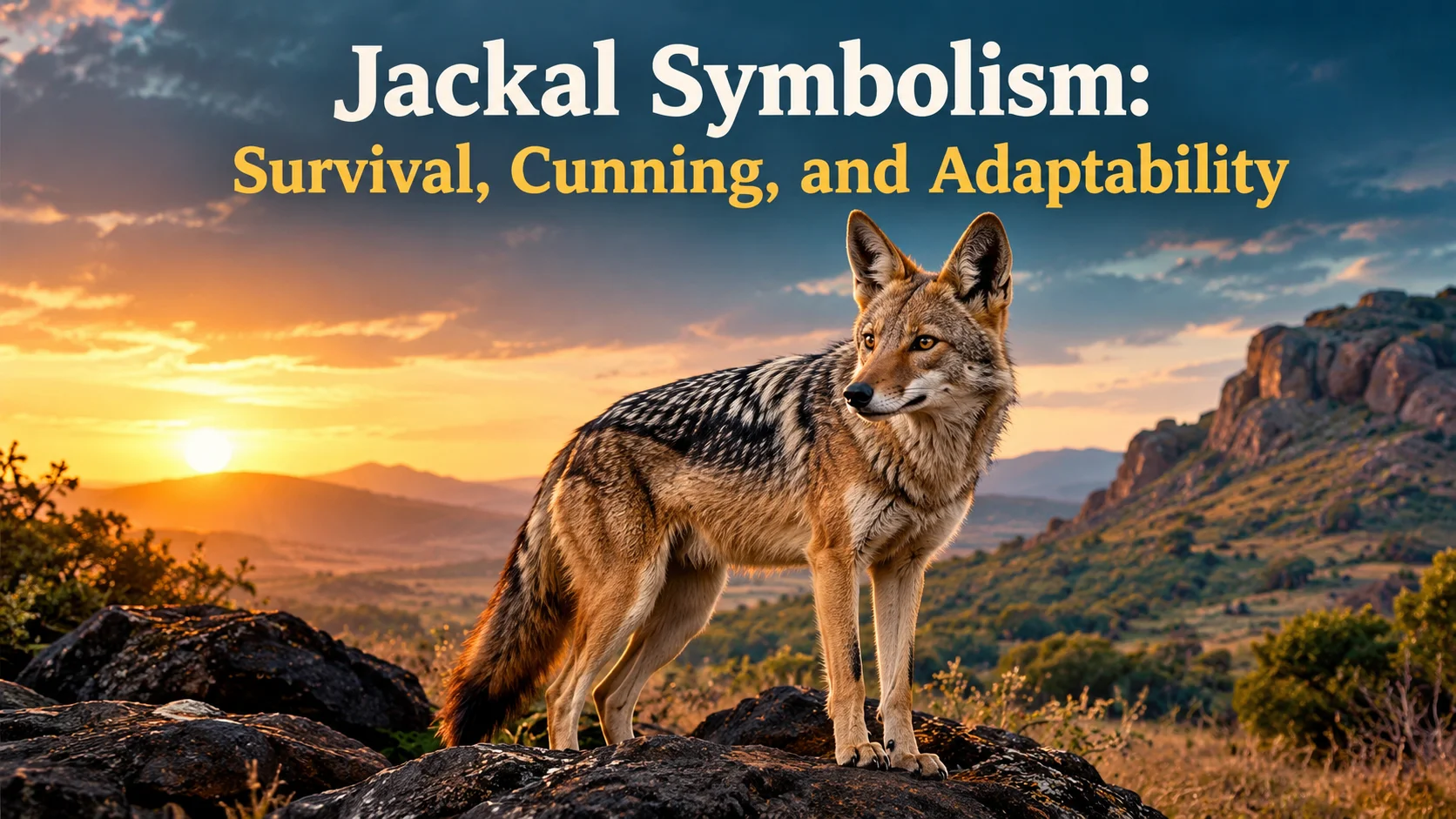
The jackal is a clever, adaptable animal that survives in challenging environments. In jackal symbolism, people often associate this wild canid with intelligence, resourcefulness, independence, and the ability to find opportunities in unexpected places. Its behavior offers a powerful way to think about survival, personal growth, and making wise choices.
In the United States, jackals are less familiar than wolves, foxes, and coyotes. However, their symbolic meanings connect with themes Americans often recognize, including self-reliance, strategic thinking, and resilience during difficult times. A jackal appearing in a dream, story, piece of artwork, or spiritual reflection may inspire questions about how you handle change and uncertainty.
Jackals also have a rich history in ancient mythology, particularly in Egypt, where a jackal-like animal became closely associated with Anubis, a deity connected with funerary rites and the afterlife. Other traditions have portrayed jackals as clever tricksters, scavengers, or survivors. These different images show how one animal can represent both admirable intelligence and less flattering forms of cunning.
However, a jackal doesn’t have one universal spiritual meaning. Its interpretation depends on cultural background, personal experience, and the situation in which the animal appears. Understanding these differences helps you appreciate the jackal without treating every symbolic interpretation as an established fact.
Quick Answer
Jackal symbolism in the United States commonly represents survival, intelligence, adaptability, and resourcefulness. In broader spiritual and cultural traditions, jackals can symbolize transformation, guardianship, trickery, and a connection with death or the afterlife.
TL;DR
- Survival: Jackals represent finding ways forward in difficult circumstances.
- Intelligence: Their symbolism highlights observation, strategy, and quick thinking.
- Adaptability: They suggest adjusting to change instead of resisting it.
- Ancient Egypt: Jackal-like imagery connects with Anubis and funerary traditions.
- Trickster energy: Some folktales portray jackals as clever, deceptive characters.
- Modern meaning: Jackal imagery can express independence, resilience, and unconventional thinking.
What Does a Jackal Look Like, and Why Does It Matter Symbolically?
A jackal is a wild canid related to dogs, wolves, and coyotes. Its appearance and behavior help explain why people connect it with alertness, cleverness, and survival.
Physical Features and Symbolic Associations
Jackals generally have pointed ears, narrow muzzles, long legs, and bushy tails. Their coats vary by species, ranging from golden or reddish shades to gray and black patterns.
These features inspire several symbolic interpretations:
- Pointed ears: Awareness, careful listening, and attention to surroundings.
- Sharp eyes: Observation, intuition, and the ability to notice opportunities.
- Lean body: Efficiency, endurance, and making use of limited resources.
- Bushy tail: Balance, movement, and adaptability in changing environments.
These meanings are symbolic interpretations, not fixed messages found in nature. Nevertheless, they give artists and storytellers useful ways to express the jackal’s character.
What the Jackal’s Behavior Represents
Jackals use different survival strategies, depending on their species and environment. They may hunt small animals, eat insects and fruit, or scavenge available food.
Consequently, the jackal can represent practical intelligence rather than brute strength. Its symbolism reminds people that success sometimes comes from patience, awareness, and choosing the right moment.
Historical Origins of Jackal Symbolism
The jackal has a particularly important place in ancient Egyptian religious history. Its connection with burial grounds helped shape its association with death, protection, and the journey beyond earthly life.
Jackals in Ancient Egypt
Ancient Egyptians observed wild canids around desert cemeteries. Their presence may have helped inspire religious imagery involving animal-shaped guardians of the dead.
By Egypt’s early historical period, jackal-like deities already appeared in religious traditions. These figures remained important across many centuries of Egyptian history. Anubis became the best-known example.
Anubis was associated with embalming, protection of the deceased, and the rituals surrounding burial. He was often depicted with a human body and a black jackal-like head.
Why Death Became Part of the Symbolism
The connection between jackals and death wasn’t necessarily a symbol of evil. Instead, it reflected the practical and spiritual concerns of a society that placed great importance on protecting the dead.
Anubis helped guide the deceased through the afterlife and played a role in the judgment of the dead. His imagery therefore connected the jackal with guardianship, sacred duty, and transition.
This history offers an important lesson: an animal associated with death can also symbolize care, protection, and hope.
Jackal Symbolism in the United States
In the United States, the jackal doesn’t have the same established national symbolism as the bald eagle or the American bison. Its meaning is shaped more by wildlife knowledge, popular storytelling, mythology, and individual interpretation.
Survival and Self-Reliance
American culture often celebrates the ability to overcome challenges through determination and resourcefulness. The jackal fits this theme because it can survive in demanding environments without relying on size or strength alone.
For an American audience, jackal imagery may suggest someone who knows how to work with limited resources. It can represent a person who studies a situation carefully before acting.
The Jackal Compared With Familiar American Animals
Jackals are sometimes compared symbolically with coyotes, foxes, and wolves. However, these animals have different biological characteristics and cultural associations.
| Animal | Common American association | Connection with jackal symbolism |
| Jackal | Resourcefulness and survival | Strategic thinking and adaptability |
| Coyote | Cleverness and wilderness | Improvisation and unconventional solutions |
| Fox | Cunning and intelligence | Observation and quick decisions |
| Wolf | Loyalty, instinct, and the wild | Group cooperation and endurance |
These are broad cultural associations, not universal definitions. For example, a wolf may symbolize family loyalty to one person and independence to another.
Jackals in American Media and Everyday Life
American audiences may encounter jackals through wildlife documentaries, fantasy stories, ancient Egyptian exhibits, video games, or historical films. These portrayals can make the animal appear mysterious, dangerous, intelligent, or supernatural.
However, the jackal remains less familiar than many other wild canids in the United States. As a result, its symbolic meaning often depends on the particular story or personal interest that brings it to someone’s attention.
Spiritual Meaning of the Jackal
In modern spiritual interpretations, the jackal often represents awareness, transformation, survival, and the ability to move through uncertain situations. These ideas draw partly on the animal’s behavior and partly on historical mythology.
A Symbol of Personal Transformation
A jackal may serve as a personal symbol during a period of change. Its association with ancient funerary traditions also gives it a connection with endings and transitions.
However, an ending doesn’t always mean something negative. Leaving an old habit, changing direction, or accepting a new stage of life can create room for growth.
Some people interpret jackal imagery as a reminder to release what no longer serves them. This is a personal spiritual interpretation rather than a universal religious teaching.
Intuition and Awareness
Because jackals are alert animals, people may use them to represent attentiveness and practical intuition.
This symbolism encourages reflection on questions such as:
- Am I noticing important details before making decisions?
- Am I adapting to my circumstances or resisting necessary change?
- Am I using intelligence responsibly?
- Am I recognizing opportunities without taking advantage of others?
These questions make the jackal a useful symbol for self-reflection without requiring belief in supernatural messages.
Is Seeing a Jackal a Sign?
Some spiritual traditions encourage people to reflect on meaningful animal encounters. Others understand such encounters through ordinary observation and the natural world.
If you encounter a jackal in a dream, artwork, or story, you can explore what it means to you. However, there is no reliable evidence that seeing one predicts a particular event or guarantees a spiritual message.
Jackal Symbolism in Different Cultures
Jackal imagery has appeared in different cultural settings, although its meaning varies considerably. Understanding these differences prevents one tradition’s interpretation from being incorrectly applied to everyone.
Ancient Egyptian Traditions
Ancient Egyptian religion provides the clearest historical example of positive jackal-related religious symbolism. Anubis represented protection, embalming, and guidance for the dead.
Another deity, Wepwawet, whose name is commonly translated as “Opener of the Ways,” was associated with opening paths and guiding movement. He was also depicted as a jackal-like or wolf-like canid.
These roles connect jackal imagery with protection and passage, rather than simply with death or danger.
Jackals in Folktales
In various South Asian and African storytelling traditions, jackals appear as clever, opportunistic, or deceptive characters. The details differ across languages, communities, and individual tales.
In some stories, the jackal succeeds because it thinks quickly. In others, its pride or dishonesty causes trouble.
These contrasting portrayals make the jackal a flexible character. It can represent useful intelligence or warn against using cleverness without honesty.
Religious and Cultural Differences
No single interpretation represents every culture that has encountered jackals. Even within a tradition, stories may assign different qualities to the same animal.
Therefore, it’s best to identify the specific story or religious setting before interpreting its symbolism. Broad claims that all cultures consider jackals evil, sacred, or lucky overlook important differences.
Psychological Meaning of the Jackal
The jackal’s symbolic appeal also comes from recognizable human qualities. People may connect with its image when they’re learning to handle uncertainty, protect their interests, or think more carefully.
Intelligence and Strategic Thinking
The jackal can represent a thoughtful approach to difficult situations. Instead of reacting immediately, a person may observe the circumstances, consider available options, and choose a practical response.
This doesn’t mean that every intelligent person is secretive or calculating. Rather, the symbol highlights the value of thinking before acting.
Independence and Emotional Resilience
A jackal may appeal to someone who values independence or has learned to adapt after a difficult experience. Its image can represent finding another route when the original plan no longer works.
However, independence doesn’t mean refusing all help. Healthy resilience also involves recognizing when cooperation, advice, or support can improve the outcome.
The Shadow Side of Cunning
The jackal’s reputation for opportunism can also represent suspicion, manipulation, or selfish behavior. In this interpretation, the animal asks whether intelligence is being used fairly.
A useful distinction is between resourcefulness and exploitation. Finding a creative solution can benefit everyone involved, while manipulating another person for personal gain can damage trust.
Jackal Symbolism in Dreams
Dreams involving jackals can feel mysterious because the animal carries associations with wilderness, cleverness, and ancient mythology. However, dream interpretations are subjective, and no single explanation applies to everyone.
Seeing a Jackal in a Dream
A jackal might reflect a situation in which you feel you need to be more observant or resourceful. It could also bring to mind a person you consider clever, unpredictable, or difficult to understand.
Your personal associations matter more than a fixed dream dictionary. Consider what has been happening in your life and how you felt during the dream.
Read More: Mockingbird Symbolism: Freedom, Voice, and Innocence
Different Jackal Dream Scenarios
| Dream scenario | Possible personal interpretation | Question to consider |
| A calm jackal | Awareness and thoughtful observation | Where would patience help me? |
| A running jackal | Change or the need to act | Am I avoiding an important decision? |
| An aggressive jackal | Conflict or perceived threat | What situation feels difficult to manage? |
| A group of jackals | Cooperation or social tension | How do my relationships affect my choices? |
| A jackal watching you | Self-awareness or suspicion | Am I paying attention to a concern? |
These interpretations are reflective possibilities, not proven psychological rules. A dream may also incorporate memories, recent experiences, or images encountered during the day.
Should You Worry About a Jackal Dream?
No. Dreaming about a jackal doesn’t establish that something bad will happen.
Instead, consider the emotions you experienced. Fear, curiosity, confidence, and calmness may offer more useful clues about your personal associations than the animal alone.
Jackal as a Spirit Animal or Personal Symbol
Some modern spiritual practices use animals as personal symbols, guides, or representations of qualities people wish to develop. Within these settings, the jackal may stand for adaptability, awareness, and practical intelligence.
Qualities Associated With a Jackal Guide
People who identify with jackal imagery may appreciate its association with:
- Observing situations before making a move.
- Finding solutions when resources are limited.
- Remaining flexible when circumstances change.
- Recognizing the difference between confidence and recklessness.
- Using intelligence without abandoning personal values.
These qualities can be meaningful whether someone approaches the jackal spiritually or simply admires it as a wild animal.
A Respectful Approach to Animal Symbolism
The phrase “spirit animal” has specific significance in some Indigenous traditions and shouldn’t be treated as a universal label for every form of animal symbolism.
If you want a personal emblem, you can describe the jackal as an animal symbol, a source of inspiration, or a reminder of resilience. This allows you to explore its meaning without assuming that every spiritual tradition uses the same concepts.
Jackal Tattoos, Art, and Modern Design
Jackal imagery can be used in tattoos, illustrations, jewelry, and decorative artwork. Its pointed ears, narrow face, and distinctive silhouette make it recognizable in both detailed and minimalist designs.
What Does a Jackal Tattoo Mean?
A jackal tattoo can express different ideas depending on the design and the person wearing it.
- Realistic jackal: A connection with wildlife, survival, or nature.
- Jackal in motion: Adaptability, independence, or moving through change.
- Jackal with geometric patterns: Structure, observation, or strategic thinking.
- Anubis-inspired imagery: An interest in ancient Egyptian history, funerary beliefs, or transformation.
A tattoo doesn’t have one mandatory meaning. Its personal significance may come from an important experience, a favorite story, or a quality the wearer wants to remember.
Jackal Imagery in Home Decor and Fashion
Jackal motifs may appeal to people who enjoy desert landscapes, wildlife art, mythology, or darker fantasy aesthetics. Sculptures, framed prints, and clothing designs can emphasize the animal’s alert expression and distinctive shape.
In the United States, Anubis-inspired artwork is also recognizable in some fantasy and gaming communities. However, it’s worth distinguishing historical Egyptian religious imagery from modern fictional interpretations.
Jackal Symbolism in Folklore, Stories, and Popular Culture
Stories often turn animal behavior into a way of discussing human choices. The jackal’s association with cunning makes it especially useful in tales about cleverness, pride, deception, and survival.
The Clever Trickster
In a trickster role, the jackal succeeds through intelligence rather than physical strength. It may escape a powerful opponent by recognizing a weakness or inventing an unexpected solution.
However, trickster characters aren’t always heroes. Some use their intelligence to deceive others, creating a lesson about the consequences of selfish behavior.
The Outsider and Survivor
The jackal can also represent a character who survives outside established systems. This interpretation may appeal to people who see themselves as independent thinkers or outsiders.
Still, being unconventional doesn’t automatically make someone wise or morally superior. The strongest version of this symbolism combines adaptability with responsibility.
From Ancient Myth to Modern Fiction
Ancient Egyptian images of jackal-like deities continue to influence contemporary depictions of Anubis. Modern stories may present him as a guardian, supernatural judge, mysterious ruler, or fantasy character.
These adaptations can introduce people to ancient imagery. However, entertainment often simplifies religious traditions, so a fictional portrayal shouldn’t be mistaken for a complete account of historical beliefs.
Negative Jackal Symbolism and Common Misunderstandings
The jackal’s symbolic meaning isn’t always positive. Its association with scavenging and opportunism has sometimes made it a figure of suspicion or contempt.
Why Jackals Can Represent Deception
Some folktales portray jackals as liars or manipulators. In everyday speech, animal comparisons can also be used to insult people viewed as dishonest or self-serving.
However, these judgments reflect human storytelling and language rather than a moral quality inherent in the animal. Scavenging is a natural feeding strategy, not evidence of bad character.
Death Doesn’t Always Mean Evil
The connection between jackals and death is especially easy to misunderstand. Ancient Egyptian funerary symbolism associated jackal-like deities with protecting the deceased and helping them navigate the afterlife.
Therefore, describing every jackal image as a symbol of misfortune ignores its protective and sacred associations.
Avoiding Cultural Misuse
When using jackal imagery, consider whether the design draws from a specific religious or historical tradition. For example, an image of Anubis has a more specific cultural background than a general jackal silhouette.
Respectful interpretation doesn’t require avoiding ancient symbols altogether. It means understanding their context and being careful not to present modern inventions as authentic historical beliefs.
How Jackal Symbolism Has Changed Over Time
The jackal’s symbolic history shows how the same animal can represent different ideas in different periods. Its meanings have shifted with religious practices, storytelling traditions, and modern popular culture.
From Burial Grounds to Sacred Protection
In ancient Egypt, the presence of wild canids near cemeteries may have contributed to their association with funerary deities. Religious art transformed this real-world connection into a more complex image of guardianship and passage.
Over time, Anubis became one of the most recognizable figures in ancient Egyptian religious imagery. His continued appearance in museums, books, films, and games keeps that association alive.
From Folk Trickster to Modern Survivor
In various folktales, the jackal’s intelligence became a way to explore deception and practical wisdom. Modern personal interpretations may place more emphasis on resilience, adaptability, and independent thought.
Neither interpretation completely replaces the others. A jackal can represent cleverness in one setting and dishonesty in another.
The Meaning Today
Today, the jackal has no single accepted symbolic definition across the United States. Its meaning depends on whether it appears in mythology, wildlife art, a dream, a tattoo, or a personal spiritual practice.
This flexibility is part of its appeal. Rather than treating one meaning as universally correct, readers can consider the historical background alongside their own experiences.
FAQs:
What does a jackal symbolize spiritually?
A jackal may symbolize survival, awareness, adaptability, and transformation in modern spiritual interpretations. Its meaning depends on the person’s beliefs and the context in which the animal appears.
Is seeing a jackal a good or bad omen?
There is no reliable evidence that seeing a jackal predicts good or bad events. Some people interpret an encounter as a reminder to stay alert, while others simply appreciate it as a wildlife sighting.
What does a jackal symbolize in ancient Egypt?
Jackal-like imagery was associated with Egyptian funerary deities, especially Anubis. These deities played roles in protecting the dead, overseeing burial rites, and guiding the deceased through the afterlife.
What does a jackal tattoo represent?
A jackal tattoo may represent intelligence, independence, survival, or personal transformation. An Anubis-inspired tattoo can also reflect an interest in ancient Egyptian religion and mythology.
What does a jackal mean in a dream?
A jackal in a dream may bring up themes of caution, resourcefulness, conflict, or adaptability. However, dreams don’t have universal meanings, so your emotions and personal experiences are important to consider.
Conclusion:
Jackal symbolism brings together survival, intelligence, adaptability, and the complicated relationship between cleverness and deception. In the United States, these meanings often connect with self-reliance and the ability to handle difficult circumstances, while ancient Egyptian traditions offer a deeper history of protection and spiritual transition.
The jackal’s meaning changes with its setting. A jackal in a folktale may represent cunning, an Anubis-inspired image may reflect ancient religious history, and a personal tattoo may celebrate resilience or independence.

1 thought on “Jackal Symbolism: Survival, Cunning, and Adaptability”