
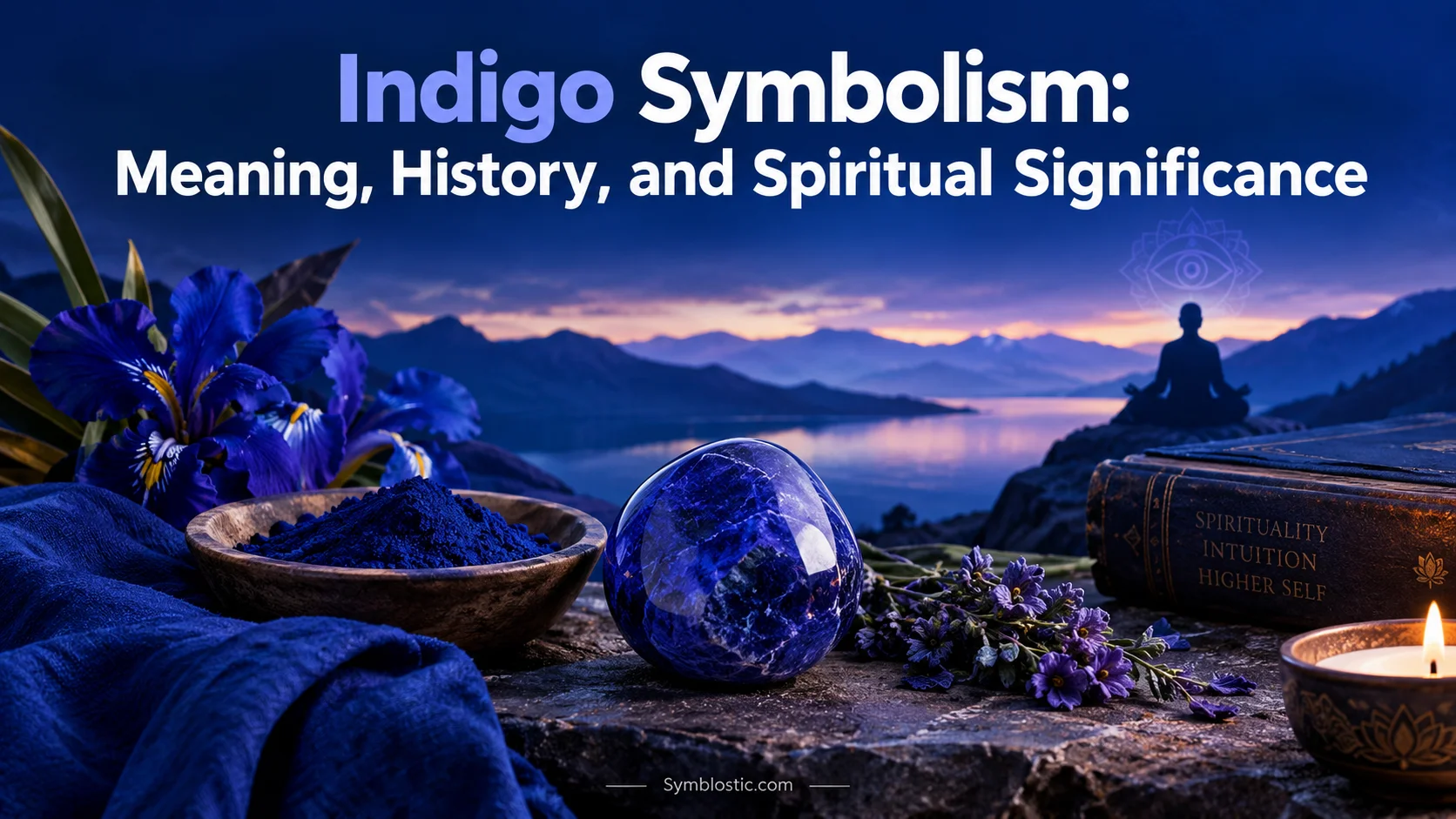
Indigo is a deep, rich color that sits between blue and violet on the visible color spectrum. It often reminds people of the night sky, distant horizons, and the quiet moments when the world begins to slow down. Indigo symbolism connects this distinctive color with intuition, wisdom, mystery, spirituality, and deep reflection. However, its meaning can change depending on the culture, setting, and personal experience behind it.
In the United States, indigo appears in clothing, home decor, art, meditation spaces, and traditional textiles. Its association with denim also makes it familiar in everyday American life. At the same time, its darker tones can suggest elegance, secrecy, or the unknown.
People often choose indigo when they want to express calm confidence without losing a sense of depth. Others connect it with spiritual awareness or the search for inner truth. Although these associations can feel meaningful, they aren’t universal rules. Understanding indigo requires looking at its history, cultural uses, emotional effects, and modern interpretations.
Quick Answer
In the United States, indigo symbolism commonly represents intuition, wisdom, calmness, and quiet strength. Spiritually, it may suggest inner awareness and deeper understanding, while culturally, it connects with craftsmanship, tradition, creativity, and the mysterious beauty of the night sky.
TL;DR
- Indigo represents intuition, wisdom, mystery, and thoughtful reflection.
- American culture connects indigo strongly with denim, workwear, and everyday identity.
- Historically, indigo dye symbolized craftsmanship, trade, and valuable textile traditions.
- Spiritual interpretations associate indigo with awareness, insight, and inner exploration.
- Indigo decor can create a peaceful, elegant, and grounded atmosphere.
- Its meaning depends on personal experience, cultural background, and context.
What Does Indigo Symbolize?
Indigo carries several related meanings because it combines qualities people often associate with blue and violet. Blue commonly suggests trust and calmness, while violet can evoke imagination and mystery. Together, these associations give indigo a distinctive emotional character.
Wisdom and Intuition
Indigo often represents the desire to understand something beyond its surface appearance. People may associate it with thoughtful decisions, careful observation, and the ability to recognize patterns.
However, intuition doesn’t mean knowing everything without evidence. In everyday life, it can describe the quiet judgment that develops through experience, reflection, and attention.
Mystery and Inner Depth
Indigo’s darkness gives it a sense of distance and secrecy. It can suggest hidden knowledge, unanswered questions, or parts of life that remain difficult to explain.
For example, an indigo painting of a star-filled sky may encourage viewers to think about existence, time, and the universe.
Calm Strength
Unlike bright colors that demand immediate attention, indigo often feels restrained. It can express confidence, seriousness, and stability without appearing overly forceful.
This makes it useful for people who prefer a thoughtful, understated style.
The History of Indigo and Its Symbolic Roots
Indigo’s history begins long before modern color psychology. For thousands of years, people have extracted indigo dye from plants and used it to color fabrics. As a result, its meaning developed through trade, labor, artistic traditions, and everyday clothing.
Ancient Indigo Dye
Natural indigo dye comes from certain plants, including species in the Indigofera genus. Communities in different regions developed methods for producing the deep blue pigment.
Indigo-dyed textiles appeared in parts of Asia, Africa, and other regions long before synthetic dyes became widely available. The color’s practical value helped establish its place in clothing, decorative arts, and cultural traditions.
Indigo in Global Trade
During the early modern period, indigo became an important commodity in international trade. European merchants sought the dye because it produced rich, lasting blue shades on cloth.
However, this trade was also connected with colonial expansion, forced labor, and exploitation in some regions. The history of indigo therefore includes both artistic achievement and painful human experiences.
The Rise of Synthetic Indigo
In 1897, German chemist Adolf von Baeyer and the company BASF helped bring synthetic indigo into commercial production. Synthetic dye reduced dependence on plant-based production and changed the economics of textile manufacturing.
Today, synthetic indigo is widely used in denim production. Although its manufacturing methods have changed, the color still carries associations with heritage, craftsmanship, and familiar clothing.
Indigo Symbolism in American Culture
In the United States, indigo is especially familiar because of its connection with blue jeans. However, its cultural meaning extends beyond clothing to include personal expression, creative work, and traditional design.
Denim and American Identity
Blue jeans have become a recognizable part of American everyday dress. Indigo-dyed denim is associated with workwear, practicality, youth culture, and casual freedom.
During the twentieth century, jeans moved from work clothing into mainstream fashion. They became popular among many different groups, including young people who used casual dress to express individuality.
Consequently, indigo can symbolize independence, resilience, and an informal approach to life. Yet these meanings aren’t exclusive to Americans, and denim has become a global fashion staple.
Art and Personal Expression
American artists and designers use indigo to communicate different moods. A light, faded shade may suggest nostalgia, while a nearly black indigo can feel dramatic and serious.
The color also works well in modern interiors because it can feel both traditional and contemporary. Its versatility allows it to appear in minimalist rooms, rustic homes, and bold artistic designs.
Everyday American Associations
Indigo’s familiar uses give it several possible meanings in American life:
- Denim clothing can represent practicality, independence, and everyday comfort.
- Dark indigo interiors may suggest elegance, depth, and quiet confidence.
- Indigo artwork can express imagination, mystery, or emotional complexity.
- Hand-dyed fabrics may highlight craftsmanship and respect for traditional techniques.
- Night-sky imagery can connect indigo with wonder and contemplation.
Indigo Spiritual Meaning
Indigo has become associated with spirituality in several modern belief systems. People may use it to represent intuition, inner awareness, meditation, and the search for deeper understanding. These interpretations are personal or tradition-specific rather than scientifically established properties of the color.
Intuition and Inner Awareness
Some spiritual interpretations treat indigo as a symbol of looking inward. The color’s association with darkness and stillness can encourage people to pause, examine their feelings, and reflect on difficult questions.
For example, someone may choose an indigo journal or meditation space as a reminder to listen carefully to their thoughts.
However, the color itself doesn’t guarantee insight or spiritual growth. Its importance comes from the meaning a person gives it.
The Third Eye Chakra
In some modern yoga and chakra systems, indigo is associated with the third eye chakra, traditionally located between the eyebrows. This chakra is commonly linked with intuition, perception, and inner wisdom.
Color associations can vary between contemporary teachers and traditions. Chakra systems also have complex histories, so indigo should not be treated as a universal religious symbol shared by every Hindu or Buddhist community.
Meditation and Reflection
Indigo can serve as a visual reminder to slow down and concentrate. Its deep tone may feel less stimulating than bright yellow or orange, especially in a softly lit room.
Some people use indigo candles, fabrics, or artwork during personal reflection. These objects function as reminders of their intentions rather than as objects with proven supernatural powers.
Indigo Symbolism Across Different Cultures
Indigo has appeared in many cultural traditions, but it doesn’t carry one universal meaning. Its interpretation often depends on local history, textile practices, religious beliefs, and the ways communities use color.
South Asian Traditions
Indigo has a long history in South Asia, where natural dye production became an important part of textile making and commerce. Indigo-dyed cotton fabrics were traded across regions and developed distinctive local styles.
Its historical significance includes technical skill, artistic expression, and economic importance. Colonial-era indigo production also involved coercive systems and resistance by cultivators, particularly in parts of India.
Therefore, indigo can evoke both cultural craftsmanship and the difficult history of colonial exploitation. Neither interpretation should erase the other.
African Textile Traditions
Indigo dyeing has deep roots in several African societies. In parts of West Africa, artisans developed distinctive methods of resist dyeing, weaving, and decorating indigo textiles.
These fabrics may carry meanings connected with identity, community, status, or artistic heritage. However, specific meanings vary by region, people, garment, and occasion.
It’s important not to treat all African textile traditions as one unified system. Each community has its own history and design practices.
East Asian Art and Craft
Indigo dyeing has also played an important role in Japanese textile traditions. Techniques such as aizome, or indigo dyeing, became closely connected with clothing, workwear, and decorative fabrics.
Different shades and patterns can reflect the material, dyeing method, and purpose of the textile. Today, indigo craftsmanship continues to inspire designers who value durability, natural variation, and traditional skill.
The Emotional and Psychological Meaning of Indigo
Colors can influence how people interpret an environment, although their effects depend on personal experience and context. Indigo often feels quieter and deeper than brighter shades of blue. As a result, people may associate it with introspection, stability, and emotional seriousness.
Calmness and Focus
Dark blue shades can remind people of evening skies, deep water, and quiet spaces. These associations may make indigo feel suitable for environments designed for reading, reflection, or concentration.
However, no color produces the same response in everyone. Lighting, surrounding colors, cultural experience, and individual preferences all affect perception.
Mystery and Emotional Depth
Indigo can suggest emotions that aren’t immediately visible. It may represent thoughtful silence, hidden feelings, or the process of understanding oneself.
In art, a dark indigo background can create contrast and make brighter elements seem more vivid. This visual effect can also give an image a feeling of distance or emotional intensity.
Confidence Without Display
Some people prefer indigo because it looks strong without being flashy. In clothing and design, it can communicate seriousness while remaining more approachable than pure black.
Its symbolism may therefore fit someone who values privacy, independence, and quiet confidence. Still, wearing indigo doesn’t automatically reveal a person’s character.
Indigo Symbolism in Dreams
Dream interpretations often connect indigo with intuition, uncertainty, reflection, and the unknown. However, dreams don’t have fixed meanings that apply equally to everyone. Personal experiences and emotions are more useful starting points than universal color dictionaries.
Seeing Indigo in a Dream
An indigo sky, room, or object might remind you of a question you’ve been considering. It could also reflect memories of nighttime, a favorite garment, or a recent visual experience.
Rather than assuming the dream predicts an event, consider how the color felt in the moment.
Bright Indigo Versus Dark Indigo
The shade may influence your personal interpretation. Bright, vivid indigo might feel imaginative or energizing, while very dark indigo may seem serious, distant, or mysterious.
Ask yourself what was happening in the dream and whether the color felt comforting or unsettling. These details can help you explore its personal significance without treating the dream as a definite prophecy.
Indigo in Tattoos, Fashion, and Home Decor
Indigo’s versatility makes it useful in personal style and visual design. In the United States, its connection with denim gives it a familiar quality, while its darker tones add elegance and depth.
Indigo Tattoos
An indigo tattoo may express a personal connection with intuition, creativity, reflection, or the night sky. Some designs use the color in celestial imagery, waves, flowers, or abstract patterns.
People may also choose indigo simply because they like its appearance. A tattoo’s meaning ultimately comes from the person wearing it, the design, and its cultural context.
Fashion and Personal Identity
Indigo clothing can communicate a range of styles, from practical and relaxed to refined and formal. Denim remains one of its most recognizable forms, but indigo also appears in dresses, jackets, scarves, and accessories.
Because the color pairs well with white, gray, tan, and other blues, it’s easy to incorporate into everyday outfits. It can also serve as a subtle alternative to black.
Read More: Cricket Symbolism: Meaning, Spirit, and Hidden Wisdom
Home Decor and Interior Design
In a home, indigo can create contrast and visual depth. Its effect depends on how much of the color appears and how the room is lit.
| Context | Common Symbolic Meaning | Typical Use |
| Living room | Stability and quiet confidence | Accent walls, cushions, and rugs |
| Bedroom | Reflection and calm | Bedding, curtains, and artwork |
| Workspace | Focus and seriousness | Desk accessories and wall art |
| Creative studio | Imagination and depth | Painted surfaces and decorative objects |
| Clothing | Independence and practicality | Denim, jackets, and accessories |
A small indigo accent can add depth without making a room feel dark. However, large areas of deep indigo may feel heavy in rooms with limited natural light.
Indigo and Its Connection With Nature
Indigo is closely associated with natural scenes, even though the color’s appearance in nature can differ from its appearance in dyed materials. People often connect it with the transition between daylight and darkness, deep water, and distant horizons.
The Evening Sky
Indigo frequently appears in artistic depictions of twilight and nighttime. The gradual shift from blue to darker shades can suggest transition, rest, and the boundary between what is visible and what remains unknown.
For this reason, indigo is often used in images of stars, moons, and distant landscapes. These scenes can encourage reflection on time, change, and the vastness of the universe.
Water and Deep Spaces
Deep blue-purple tones can also evoke ocean water or shadowed landscapes. In these settings, indigo may suggest depth, mystery, and the limits of human knowledge.
However, actual water doesn’t have one fixed indigo color. The appearance of water depends on light, depth, particles, and surrounding conditions.
Plants and Natural Dye
Indigo’s connection with plants provides another symbolic layer. Natural dye production requires knowledge of growing, processing, fermentation, and careful application.
This process can inspire associations with patience, skilled labor, and the relationship between people and the natural world. It also reminds us that a familiar color may carry centuries of practical knowledge.
Indigo in Art, Design, and Popular Culture
Artists and designers use indigo because it can create strong visual effects without relying on bright colors. It works well in photography, illustrations, clothing, packaging, and digital design. Its meaning changes according to the subject and the other colors around it.
Visual Storytelling
In films and illustrations, indigo lighting may establish a nighttime setting or create an atmosphere of uncertainty. It can also provide contrast against warm colors such as gold, amber, and orange.
For example, an indigo background behind a warm light can make the scene feel intimate or dramatic. The effect comes from the overall composition, not from an unchanging symbolic rule.
Branding and Graphic Design
Designers may choose indigo when they want a visual identity to appear thoughtful, dependable, creative, or refined. Its darker shades can feel formal, while brighter versions appear more energetic.
Still, indigo isn’t automatically a sign of trustworthiness or intelligence. A brand’s message also depends on its words, reputation, imagery, and behavior.
Social Media and Digital Aesthetics
Online, indigo often appears in celestial artwork, fantasy imagery, inspirational graphics, and calming visual themes. It can help create a consistent look for accounts focused on art, personal reflection, or design.
Unlike a standardized symbol, the color has no single universal meaning across social platforms. Trends change, and users may select indigo for its visual appeal rather than any deeper message.
Common Misunderstandings and Controversies About Indigo
Indigo is generally a versatile color, but its symbolism can be misunderstood when people assume every culture uses it in the same way. Its history also includes questions about labor, trade, and the treatment of traditional knowledge.
Indigo Doesn’t Have One Universal Meaning
Some modern interpretations present indigo as a guaranteed sign of spiritual awakening or special intuition. These are beliefs or personal interpretations, not established facts about everyone who encounters the color.
Likewise, a person wearing indigo clothing isn’t necessarily trying to express a particular spiritual identity. Context matters more than a simple color label.
The Difference Between Symbolism and Science
Color symbolism is a way of interpreting cultural and personal meaning. Color psychology studies how people respond to colors, but those responses can vary significantly.
Therefore, indigo shouldn’t be treated as a proven tool for revealing personality, predicting the future, or diagnosing emotional states. It can still be meaningful without making those claims.
Respecting Textile Heritage
Indigo textiles reflect the knowledge and labor of artisans across many regions. Modern designers can appreciate these traditions while recognizing their origins and avoiding misleading claims about cultural ownership.
Historical indigo production also involved exploitation in some colonial economies. Celebrating the beauty of indigo shouldn’t require overlooking the people whose labor shaped its history.
How Indigo Symbolism Has Changed Over Time
Indigo’s meaning has developed through changes in technology, trade, clothing, art, and spiritual interpretation. What once required specialized dye-making knowledge is now widely available through modern textile production. Yet the color continues to carry traces of its past.
From Valuable Dye to Everyday Clothing
In earlier periods, producing indigo dye required specialized processes and considerable labor. Its commercial value helped it travel across trade networks and become important to textile economies.
Later, synthetic production made indigo more accessible to manufacturers. Its widespread use in denim then connected the color with everyday clothing rather than only specialized textiles.
From Craftsmanship to Personal Style
Traditional indigo dyeing remains important to artisans and textile enthusiasts. At the same time, modern fashion has made indigo a flexible choice for people with different tastes and identities.
Its symbolism has broadened accordingly. Today, indigo may represent heritage, casual independence, craftsmanship, or simply a preferred color.
The Growth of Spiritual Interpretations
Modern spiritual communities have increasingly used indigo to represent intuition and inner awareness. These associations appear in some contemporary discussions of chakras, meditation, and personal development.
However, spiritual meanings should be understood within their specific traditions. Indigo’s history as a dye is much older and broader than any one modern spiritual interpretation.
FAQs:
What Does Indigo Symbolize Spiritually?
Indigo often symbolizes intuition, inner awareness, wisdom, and reflection in contemporary spiritual interpretations. Its meaning varies between belief systems and personal experiences.
Is Indigo a Positive or Negative Color?
Indigo is neither inherently positive nor negative. People may associate it with wisdom and calmness, but its darkness can also suggest secrecy, sadness, or uncertainty.
What Does Wearing Indigo Say About You?
Wearing indigo may communicate a preference for classic style, understated confidence, or rich, dark colors. However, clothing alone can’t reliably reveal a person’s personality or beliefs.
What Does Indigo Mean in Dreams?
Indigo in a dream may remind you of reflection, mystery, nighttime, or an unresolved question. Consider your emotions and personal associations rather than assuming the dream predicts something.
Why Is Indigo Associated With the Third Eye Chakra?
Some modern chakra systems associate indigo with the third eye chakra, which represents intuition and perception. This color association isn’t identical across all spiritual traditions.
Why Is Indigo Important in American Culture?
Indigo is especially familiar in the United States through blue jeans and denim clothing. It can also represent practicality, individuality, creative expression, and the history of textile production.
Conclusion:
Indigo is a color rich in history, cultural meaning, and personal associations. Its symbolism often includes intuition, wisdom, mystery, calmness, and quiet strength. In the United States, its connection with denim adds another layer of meaning through everyday identity, independence, and practical style.
Across the world, indigo also reflects centuries of textile craftsmanship and trade. Its spiritual interpretations offer another way to explore reflection and inner awareness, although these meanings aren’t universal or scientifically guaranteed.

1 thought on “Indigo Symbolism: Meaning, History, and Spiritual Significance”