
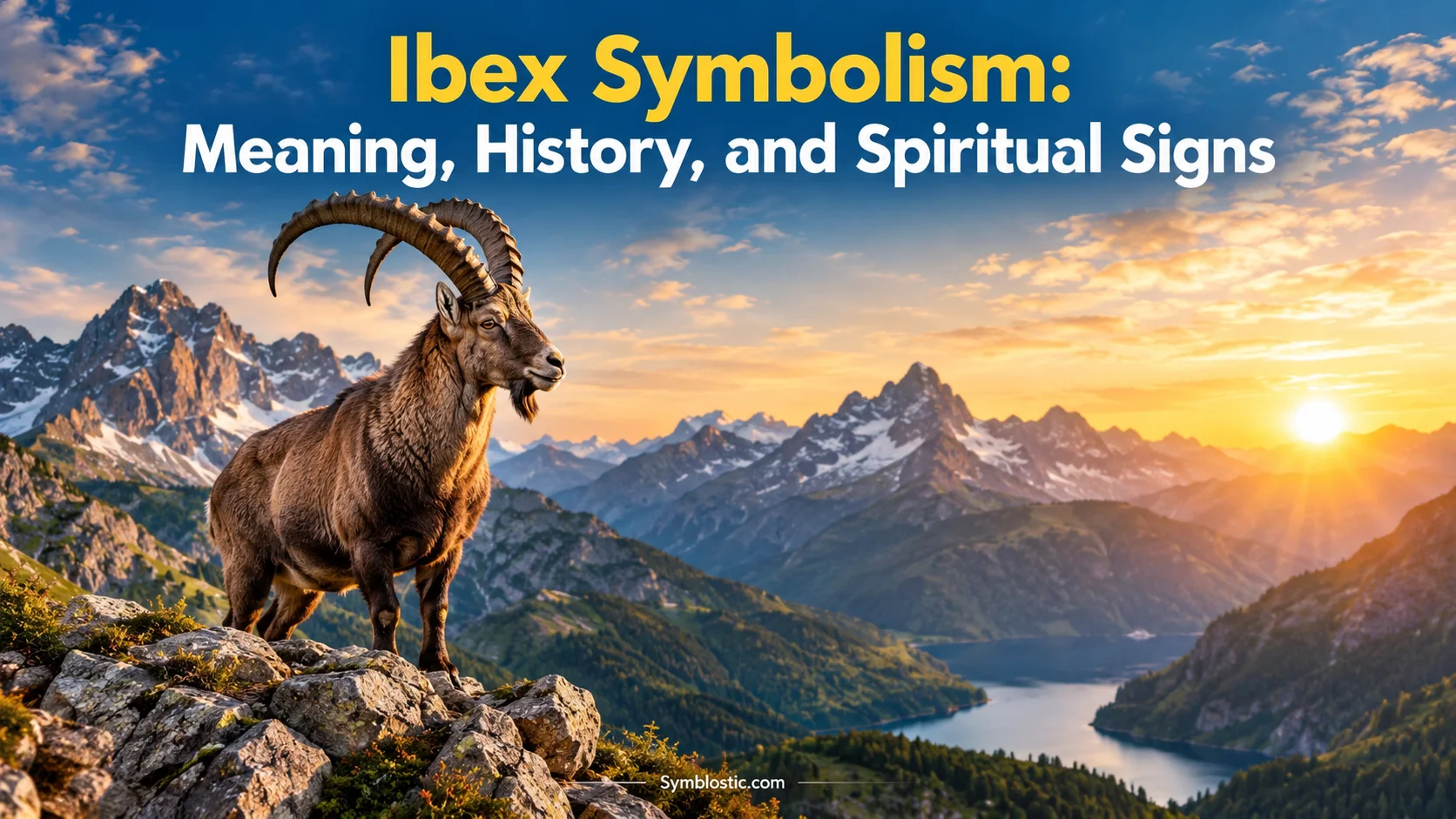
The Ibex Symbolism tradition begins with a remarkable animal. An ibex is a wild goat that lives across rugged mountain regions of Europe, Asia, and Africa. Its curved horns, strong body, and ability to cross steep cliffs have made it a striking symbol for thousands of years.
In the United States, the ibex isn’t a major national symbol in the way the bald eagle or bison is. However, its image still carries powerful modern associations with strength, endurance, adventure, independence, and overcoming difficult terrain. These ideas often appear in outdoor culture, tattoos, artwork, and personal symbolism.
The animal also has a much older symbolic history. Archaeological evidence shows ibex images appearing across ancient Iran and the broader Near East for thousands of years. Yet historians caution that the exact meaning wasn’t always the same. Context, time period, and culture matter.
Quick Answer
Ibex symbolism commonly represents resilience, sure-footedness, independence, determination, and the ability to overcome difficult challenges. In older Near Eastern traditions, ibex imagery could also connect with fertility, rain, water, seasonal cycles, hunting, and celestial ideas.
TL;DR
- Ibex symbolism often represents strength and resilience.
- Its climbing ability suggests balance and careful progress.
- Long horns can symbolize power, protection, or maturity.
- Ancient ibex imagery had several religious and cultural meanings.
- Modern Americans often connect ibex imagery with mountains and adventure.
- Ibex tattoos commonly express endurance, independence, or personal growth.
What Does the Ibex Symbolize?
The ibex has several layers of meaning. Most modern interpretations begin with its physical behavior rather than a single ancient legend.
An ibex can cross terrain that appears almost impossible to navigate. Therefore, people naturally connect it with persistence, balance, and confidence.
Strength and Resilience
An ibex survives in harsh mountain environments where food, weather, and terrain can all create challenges. This makes resilience one of its clearest modern associations.
The symbolism isn’t simply about physical strength. Instead, the animal suggests knowing how to use limited resources effectively.
Balance and Sure-Footedness
An ibex doesn’t need a broad road to move forward. It can find stability on narrow rocky surfaces.
As a symbol, this can represent staying steady when circumstances become uncertain.
Independence and Determination
The wild nature of the ibex also supports ideas of independence. It belongs to remote landscapes rather than controlled domestic settings.
For many modern readers, that makes the animal a fitting symbol of personal freedom and self-reliance.
Ibex Symbolism in Ancient History
The historical record gives ibex symbolism unusual depth. Ibex figures appear in prehistoric rock art, pottery, metalwork, seals, and other objects across parts of Europe and Western Asia.
However, it’s important not to assign one meaning to every ancient ibex image. Archaeological researchers continue to debate the purpose of many individual representations.
Ancient Iran and the Near East
Ibex images were especially common in ancient Iranian art. Archaeological evidence places these motifs across long periods, from prehistoric communities through later Iranian cultures.
Some interpretations connect ibex imagery with fertility, water, rain, seasonal change, and renewal. Other interpretations emphasize hunting, animals, landscape, or celestial symbolism.
Recent archaeological research published in 2025 again highlighted the long symbolic presence of ibex motifs in ancient Iranian culture.
The Ibex and the Tree of Life
One famous ancient motif shows animals positioned around a sacred tree.
In some Near Eastern examples, ibex-like animals appear beside a central plant or tree. Researchers have connected versions of this composition with ideas involving life, fertility, nature, and sacred space.
Still, these interpretations shouldn’t be treated as one universal explanation. Ancient symbols often changed meaning depending on location and period.
Hunting and Sacred Power
Ibex were also hunted, making them part of everyday survival as well as ritual life.
The Metropolitan Museum of Art notes that ritual ibex hunts were important in ancient southwestern Arabian kingdoms. Successful hunts could be associated with securing divine favor.
This creates an interesting contrast. The ibex could represent both wild power and a valuable hunted animal.
What Do Ibex Horns Symbolize?
The horns are one of the most recognizable features of an ibex. Their size and shape have naturally attracted symbolic attention.
Across different settings, horns can suggest strength, protection, maturity, authority, or vitality. However, these meanings aren’t universal.
Power and Protection
Large horns can make the ibex appear physically formidable. Consequently, modern artwork often uses the horns to emphasize strength and defensive power.
A horned ibex facing forward can therefore create a much more forceful impression than a peaceful side profile.
Experience and Maturity
Animal horns can also become visual records of growth. In symbolic artwork, this makes them useful for representing experience gained over time.
The meaning becomes especially strong when an ibex is shown as an older, large-horned animal.
The Shape Matters
A curved horn has a different visual effect from a straight horn. The sweeping shape can create associations with movement, cycles, nature, and the mountain landscape.
Therefore, the design itself can influence the meaning of an ibex symbol.
Ibex Symbolism in the United States
The ibex doesn’t have the same deep national identity in the United States as native animals such as the bison, bald eagle, or American alligator.
There’s also an important zoological distinction. The North American mountain goat is not the same animal as an Old World ibex. The National Park Service notes that mountain goats are native to northern North America and are closely related to Eurasian serows and chamois rather than domestic goats.
That distinction matters because American mountain imagery can sometimes blend the two animals together.
What Americans May Associate With Ibex Imagery
| Context | Meaning in the USA | Common Association | Important Note |
| Mountain artwork | Endurance | Wilderness and difficult terrain | Often a modern interpretation |
| Tattoo | Personal strength | Overcoming hardship | Meaning depends on the wearer |
| Outdoor design | Adventure | Climbing and exploration | May resemble mountain-goat imagery |
| Horned portrait | Power | Confidence and determination | Horn symbolism varies culturally |
| Spiritual artwork | Growth | Rising above challenges | Personal rather than universal |
Mountains and Adventure
American outdoor culture often values rugged landscapes and physical challenges. As a result, an ibex image can fit naturally into hiking, climbing, wilderness, and adventure themes.
The symbolism becomes stronger when the animal appears high above a valley or standing on a narrow cliff.
Personal Achievement
An ibex can also represent a difficult goal.
Someone might use its image after completing a demanding journey, surviving a difficult period, or reaching a personal milestone. In this sense, the mountain becomes a metaphor for the challenge itself.
Spiritual Meaning of the Ibex
Spiritual interpretations of the ibex vary widely. There isn’t one universally accepted spiritual message associated with seeing or dreaming about the animal.
Modern spiritual writing commonly connects the ibex with courage, resilience, independence, grounding, and personal growth.
Climbing Toward Growth
The upward movement of an ibex can easily become a metaphor for growth.
A person might interpret the animal as representing movement toward a difficult goal. However, that is a personal spiritual interpretation rather than a scientifically established message.
Staying Grounded
There is also an interesting contrast between height and stability.
The ibex may stand on a high cliff, yet its survival depends on maintaining contact with the ground. Symbolically, this can suggest pursuing ambitious goals without losing stability.
Spiritual Renewal
Ancient Near Eastern research has linked some ibex imagery with fertility, water, rain, and renewal.
These historical associations are different from modern “spirit animal” interpretations. Keeping those traditions separate prevents ancient beliefs from being simplified into modern spiritual language.
Ibex Symbolism in Mythology and Religion
Ibex imagery appears in several ancient religious and mythological settings. Yet the animal shouldn’t be assigned one single religious meaning.
Ancient Iranian Traditions
In ancient Iranian material, ibex imagery appears frequently in visual art.
Encyclopaedia Iranica notes that the ibex was represented across many periods and artistic forms. It also records an important Avestan connection in which the victory deity Vərəthragna appears in animal forms, including a male ibex.
This illustrates how an animal could become connected with divine power without having one fixed meaning everywhere.
Mesopotamian Connections
Ancient Mesopotamian art also contains wild-goat imagery.
Some scholarly interpretations connect ibex figures with fertility, rain, water, and seasonal cycles. Other interpretations remain more cautious because archaeological context doesn’t always reveal the exact belief behind an image.
Ancient Arabia
Ibex imagery had a particularly strong presence in southwestern Arabian art.
The animal appears in sculptures and other works, while ritual hunting formed part of religious practice. This gives the ibex a meaning connected not only with nature but also with ritual and divine favor.
Emotional and Psychological Meaning of the Ibex
Symbols often work because they turn physical characteristics into emotional ideas.
The ibex’s environment makes it especially useful for expressing determination. A person looking at an ibex standing on a cliff may immediately think about overcoming something difficult.
Common Emotional Associations
• Courage when facing an uncertain path
• Confidence developed through difficult experiences
• Patience while working toward a distant goal
• Independence without completely rejecting support
• Stability during periods of personal change
• Freedom from ordinary or restrictive surroundings
The Shadow Side
Symbols can have less comfortable interpretations too.
An ibex may represent stubbornness when determination becomes excessive. Independence can also become isolation if someone refuses every form of help.
Likewise, constantly choosing the hardest path isn’t necessarily a sign of strength. Sometimes the wiser choice is finding a safer route.
Read More: Eland Symbolism: Meaning, History, and Spiritual Signs
Ibex Tattoos and Their Meanings
An ibex tattoo can communicate several different ideas. The intended meaning usually depends more on the wearer than on a fixed symbolic dictionary.
Common Ibex Tattoo Meanings
• Surviving a difficult chapter in life
• Reaching a major personal goal
• Love of mountains and wilderness
• Independence and self-reliance
• Courage during difficult circumstances
• Personal growth through adversity
• Connection with ancestral or historical imagery
A detailed ibex head can emphasize the horns. Meanwhile, a full-body design on a cliff can emphasize climbing, endurance, and adventure.
Some people may also choose the animal because of its connection with a particular region, mountain culture, or outdoor activity.
Ibex Symbolism in Dreams
Dream symbolism is highly personal. An ibex appearing in a dream doesn’t have one scientifically proven interpretation.
Still, people often interpret animals through their behavior, appearance, and emotional reaction.
Seeing an Ibex
Seeing an ibex in a dream may personally suggest independence, challenge, or persistence.
The surrounding dream matters. A calm animal on a mountain may create a very different feeling from an ibex being chased or trapped.
Climbing With an Ibex
If the ibex is climbing beside you, the image may feel connected with your own journey.
It could reflect ambition, difficult progress, or the feeling that you need to remain careful while moving forward.
An Ibex Falling
A falling ibex may create associations with losing balance or fearing failure.
However, dreams don’t provide universal messages. Your own experiences and emotions are more important than any symbolic dictionary.
Ibex Symbolism in Art, Fashion, and Decor
The ibex works well visually because its silhouette is immediately recognizable.
The long horns create a strong shape, while the mountain setting adds drama. Consequently, artists can use the animal without needing many additional elements.
Modern Design Uses
• Mountain landscape paintings featuring a solitary ibex
• Minimalist horn and animal silhouettes
• Rustic wall art inspired by mountain wildlife
• Outdoor clothing and adventure-themed graphics
• Nature photography and wildlife collections
• Personal artwork representing endurance or freedom
In home decor, an ibex can create a rugged alpine feeling. However, the same image can also feel elegant when reduced to a simple line drawing.
Ibex, Goat, Ram, and Mountain Goat: What’s the Difference?
These animals are often confused because they share similar body shapes and horns.
An ibex is a wild goat belonging to the genus Capra. A ram is an adult male sheep, while the North American mountain goat belongs to a different genus.
Why This Matters Symbolically
Different animals have different histories.
A ram can carry associations with leadership, force, sacrifice, or masculine power. A domestic goat has a much broader history involving farming, fertility, food, and religious imagery.
The North American mountain goat has a stronger connection with American alpine wilderness. Therefore, an American design described as an “ibex” may actually be depicting a mountain goat.
Ibex and Capricorn
Capricorn adds another common source of confusion.
In Western astrology, Capricorn is represented by a sea-goat, a mythical creature combining goat and fish features. It isn’t simply an ibex.
The two may share themes such as ambition or climbing toward a goal. However, their histories are different and shouldn’t be treated as identical.
Misunderstandings and Controversies Around Ibex Symbolism
Ibex symbolism doesn’t have a major modern controversy in the United States. Most concerns involve inaccurate cultural claims or mixing separate traditions together.
Ancient Meaning Isn’t Always Certain
A common mistake is treating every ancient ibex image as proof of fertility symbolism.
Archaeologists have proposed connections involving fertility, water, rain, celestial imagery, hunting, and ritual. Yet some interpretations remain uncertain.
That uncertainty is important. Good historical interpretation distinguishes evidence from later speculation.
Don’t Confuse Ibex With Every Goat Symbol
Goat symbolism is much broader than ibex symbolism.
Ancient stories involving domestic goats, satyrs, rams, or other horned animals shouldn’t automatically be applied to ibex. Similar physical features don’t guarantee identical cultural meanings.
Modern Spiritual Claims
Some websites present ibex symbolism as if it has one universal spiritual message.
A more careful approach recognizes that spiritual meanings are often personal or tradition-specific. Historical symbolism and modern spiritual interpretation can coexist without being treated as the same thing.
How Ibex Symbolism Has Changed Over Time
The meaning of the ibex has never been completely fixed.
In prehistoric and ancient societies, the animal was part of real life. People hunted it, observed it, and incorporated its image into objects and artwork.
Later, ibex imagery entered religious, artistic, heraldic, and decorative traditions. In some places, its horns became especially important symbols of strength and status.
Today, modern audiences often focus on the animal’s ability to survive difficult terrain. This makes resilience and determination especially common interpretations.
From Survival to Self-Development
Older symbolism often connected the ibex with nature, ritual, fertility, hunting, or divine forces.
Modern personal symbolism tends to turn those physical qualities inward. The mountain becomes a personal challenge, while climbing becomes a metaphor for self-improvement.
From Sacred Image to Personal Symbol
An ancient ibex image could have belonged to a shared religious or cultural system.
A modern tattoo, however, usually belongs to one person. Its meaning may be completely personal, even when its visual roots are ancient.
FAQs:
What does an ibex symbolize spiritually?
An ibex can symbolize resilience, independence, balance, courage, and progress in modern spiritual interpretations. However, these meanings aren’t universal religious rules.
What does an ibex symbolize in dreams?
An ibex in a dream may personally represent a difficult goal, independence, balance, or persistence. The emotional context of the dream matters more than a fixed interpretation.
What does an ibex tattoo mean?
An ibex tattoo can represent endurance, overcoming hardship, mountain life, freedom, or personal achievement. Some people choose it simply because they admire the animal.
Are ibex and mountain goats the same?
No. Ibex are wild goats of the genus Capra, while the North American mountain goat belongs to a different genus. Their symbolic meanings can overlap, but their natural histories differ.
What did the ibex symbolize in ancient cultures?
Ancient ibex imagery had several proposed meanings, including fertility, water, rain, hunting, renewal, and celestial themes. The meaning varied according to the culture and period.
Is the ibex a symbol of strength?
Yes, strength is one common modern interpretation. Its powerful body, large horns, and ability to survive steep mountain environments naturally support that association.
Conclusion:
Ibex symbolism brings together ideas of resilience, balance, independence, determination, and survival. Its modern meaning often comes from the animal’s remarkable ability to move through steep and dangerous terrain.
However, its history reaches much further back. Ancient ibex images appeared across parts of Europe, Iran, the Near East, and Arabia, where they could carry meanings involving nature, fertility, water, ritual, hunting, and renewal.

1 thought on “Ibex Symbolism: Meaning, History, and Spiritual Signs”