
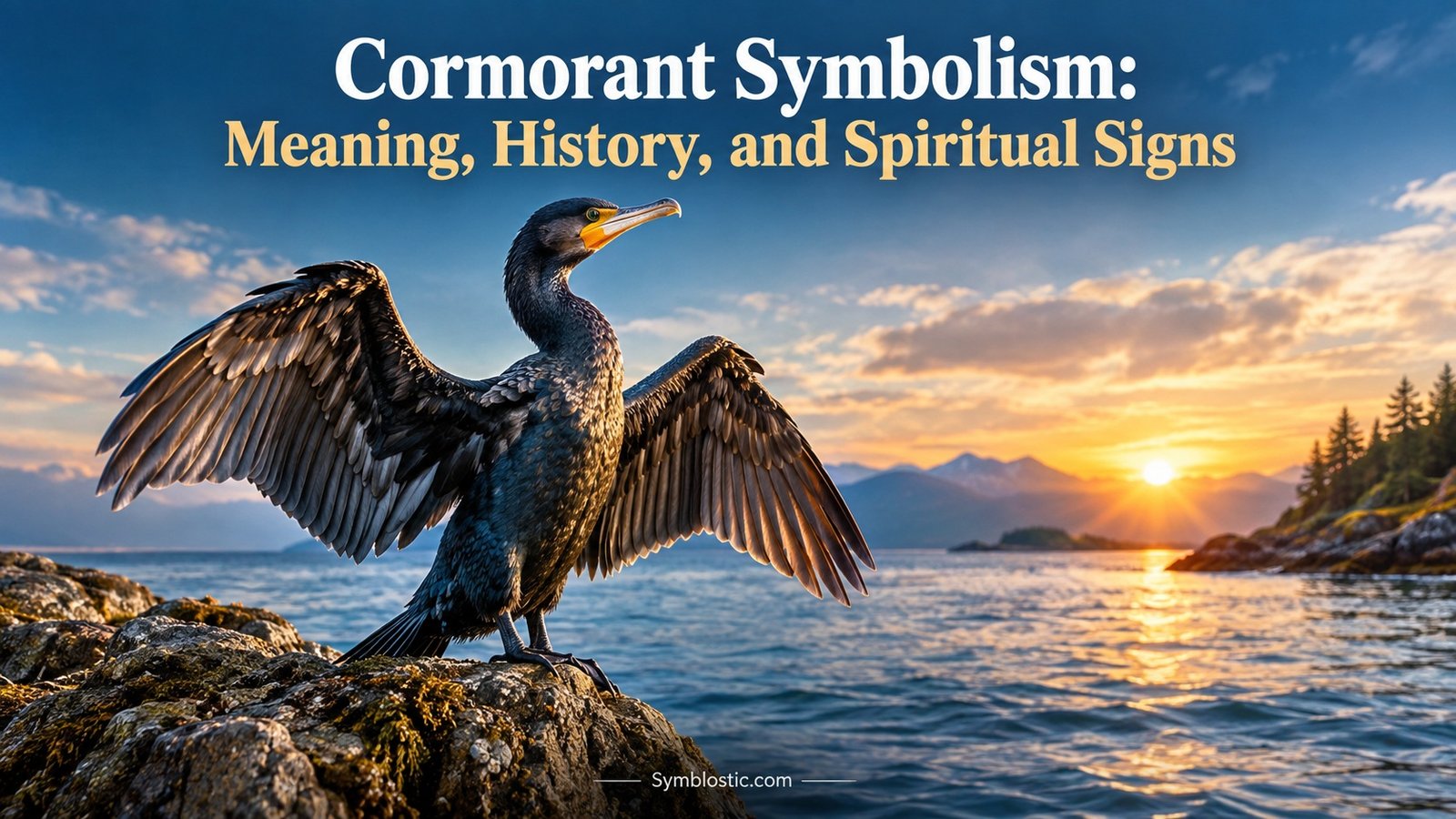
Cormorants are dark waterbirds known for diving beneath the surface to catch fish. Their unusual appearance and behavior have made them powerful symbols of survival, patience, mystery, and sometimes greed. Cormorant Symbolism has changed greatly across cultures and centuries.
In the United States, the cormorant carries several meanings at once. It can represent adaptability and persistence, especially because the bird moves comfortably between air, land, and water. However, American discussions also connect cormorants with fishing, wildlife conservation, and conflicts over fish populations.
The bird’s meaning becomes even more interesting when you look at its history. Ancient stories, European literature, Asian fishing traditions, Indigenous traditions, and modern environmental debates have all shaped how people understand this remarkable bird.
Quick Answer
What Does Cormorant Symbolism Mean?
Cormorant symbolism in the United States most often represents resilience, adaptability, patience, independence, and emotional depth. Its ability to dive into deep water can suggest exploring hidden feelings, while its wing-spreading posture can symbolize recovery and renewal.
TL;DR
- Cormorants often symbolize resilience, patience, and adaptability.
- Diving can represent emotional depth and hidden knowledge.
- Wing spreading can suggest recovery after difficult experiences.
- American meanings include wildlife, fishing, independence, and environmental conflict.
- Older European traditions sometimes connected cormorants with greed or darkness.
- Asian traditions highlight fishing skill, teamwork, and cultural continuity.
What Does a Cormorant Represent?
A Bird Built for Difficult Environments
A cormorant is not a bird that depends on one environment. It can swim, dive, fly, perch, and hunt with impressive efficiency.
That makes adaptability one of its strongest symbolic meanings. The bird reminds people that survival sometimes depends on changing your approach rather than fighting every change.
Its dark feathers also affect its visual symbolism. Against bright water or sky, the cormorant can look mysterious and almost shadow-like.
The Meaning of Its Diving Behavior
Cormorants spend important parts of their lives below the surface. They disappear from view, search beneath the water, and then return.
Symbolically, this can represent:
- Looking beneath appearances to find deeper truths
- Exploring emotions that remain hidden from others
- Searching patiently for something valuable
- Entering uncertainty without losing direction
- Returning to everyday life after inner exploration
The diving image is especially powerful because water often represents emotion, memory, and the unknown.
What Does a Cormorant Symbolize in America?
Resilience and Survival
In the United States, cormorants are familiar around coastlines, rivers, reservoirs, wetlands, and the Great Lakes. Their ability to survive across different environments makes them natural symbols of endurance.
The double-crested cormorant is especially familiar to many Americans. Its population recovered dramatically after serious environmental pressures in the twentieth century.
That history gives the bird an additional meaning: survival after hardship.
Independence Without Isolation
A cormorant standing alone on a branch can look completely self-contained. Yet cormorants also live and nest in groups.
Because of this contrast, the bird can symbolize independence without suggesting complete isolation. It can represent someone who knows how to stand alone while still belonging to a larger community.
American Associations at a Glance
| Context | Meaning in the USA | Common Association | Notes |
| Lakes and rivers | Adaptability | Wildlife and nature | Especially familiar around freshwater |
| Coastal areas | Endurance | Ocean and fishing | Connected with working waterfronts |
| Wing-spreading pose | Recovery | Rest and renewal | A striking visual image |
| Diving | Depth | Reflection and discovery | Often interpreted psychologically |
| Fishing conflicts | Competition | Environmental debate | Meaning can become negative |
| Tattoos and art | Independence | Personal resilience | Usually highly individual |
Cormorant Symbolism in History
Ancient and Classical Connections
Cormorants have been known to people for thousands of years because they are distinctive birds around water. Their diving ability made them especially noticeable to fishing communities.
In ancient Mediterranean literature, diving seabirds could appear in stories involving the sea, transformation, rescue, and divine intervention. One famous tradition associated a diving seabird with the sea goddess Ino, who helped Odysseus after his shipwreck.
These stories show an important early pattern. The bird could represent danger and protection at the same time.
Medieval and European Meanings
European symbolism became more complicated during the Middle Ages and early modern period. The cormorant’s dark appearance, unusual neck, and feeding habits contributed to darker interpretations.
Some writers connected it with death, misfortune, excessive appetite, or greed. However, those meanings weren’t universal.
In heraldry and artwork, the bird could also appear as a powerful creature connected with water, strength, and noble imagery.
The Cormorant in Literature
Literature played a major role in shaping the bird’s negative reputation.
In Paradise Lost, John Milton used a cormorant as the form taken by Satan when entering Eden. The bird therefore became linked with deception, temptation, and greed in one of the most influential English poems.
Shakespeare also used the cormorant as an image of excessive hunger.
As a result, some modern references to cormorants still carry an old literary association with insatiable appetite.
Spiritual Meaning of a Cormorant
Water, Depth, and Inner Discovery
Spiritually, the cormorant is often interpreted through its relationship with water.
Water can represent emotions, intuition, memory, and the unconscious. A bird that willingly disappears beneath that surface can therefore become a symbol of exploring what isn’t immediately visible.
This doesn’t mean every cormorant encounter has a supernatural message. Instead, the symbolism can provide a personal framework for reflection.
The Wing-Spreading Symbol
The cormorant’s famous wing-spreading pose adds another layer.
Unlike many birds, cormorants often spread their wings after diving. Their feathers aren’t as naturally waterproof as those of many other waterbirds, so the behavior helps them dry.
Symbolically, people may see this practical behavior as a picture of recovery:
- Resting after an intense experience
- Allowing yourself time to recover
- Becoming comfortable with vulnerability
- Preparing for another stage of life
- Finding balance between action and stillness
The symbolism comes from observing nature, not from a universal spiritual rule.
Cormorant Symbolism in Native and Indigenous Traditions
Why Generalizations Should Be Avoided
Indigenous traditions in North America are extremely diverse. There isn’t one universal Indigenous interpretation of the cormorant.
Some Indigenous communities have meaningful relationships with the bird, while specific traditions and stories vary by nation and region. Therefore, it isn’t accurate to assign one spiritual meaning to every Indigenous culture.
The Cormorant as a Water-Connected Figure
Some Indigenous traditions connect cormorants with water, prayer, creation stories, or spiritual communication.
For example, accounts connected with Indigenous communities in the San Antonio region describe the cormorant as a sacred water bird. In those traditions, it can appear in ceremonial objects and stories involving sacred waters and communication with the Creator.
These meanings should be understood within their particular cultural settings rather than turned into a universal “spirit animal” definition.
Cormorant Symbolism in China and Japan
The Tradition of Cormorant Fishing
One of the strongest cultural associations with cormorants comes from East Asia.
For centuries, fishermen in China and Japan trained cormorants to catch fish. The practice required close cooperation between humans and birds.
In Japan, the tradition is known as ukai, or cormorant fishing. Some locations have preserved the practice for more than a thousand years.
Read More: Nautilus Symbolism: Meaning, History, and Spiritual Signs
Skill, Partnership, and Tradition
Because of this history, cormorants can symbolize cooperation and specialized skill.
The bird isn’t simply viewed as a wild creature. In traditional fishing culture, it became part of a complex relationship between people, rivers, boats, and seasonal life.
That creates meanings that differ sharply from the old European association with greed.
In this context, the cormorant can represent:
- Skilled work developed through experience
- Cooperation between humans and animals
- Traditional knowledge passed through generations
- Patience and precision near water
- Respect for an old fishing heritage
Modern cormorant fishing is also connected with cultural tourism and heritage preservation.
Cormorant Symbolism in European Folklore
Darkness and Ominous Meanings
Some European traditions viewed cormorants with suspicion. Their dark bodies, strange silhouettes, and underwater hunting habits could make them seem mysterious.
In parts of northern Europe, however, the bird could have more positive meanings. Norwegian traditions have connected cormorants with people lost at sea and with visits from the dead.
That interpretation reflects the importance of the ocean in coastal communities. A bird arriving from the sea could naturally become associated with people who never returned from it.
Good Luck and Bad Luck
Cormorant folklore isn’t consistent.
In some places, seeing the bird could be considered fortunate, particularly for people connected with fishing. Elsewhere, a cormorant in an unusual location could be interpreted as a warning.
This contradiction is important. Symbols aren’t dictionaries with one permanent definition. Their meanings depend on history, place, occupation, religion, and personal experience.
What Does a Cormorant Mean Emotionally?
Emotional Depth
The cormorant’s relationship with water makes it a natural metaphor for emotional depth.
Someone who chooses a cormorant as a personal symbol may identify with the idea of having a rich inner life that isn’t always visible to others.
The bird can represent a person who appears calm externally while processing much more beneath the surface.
Strength Without Showmanship
Cormorants don’t have the visual grandeur of an eagle or the softness associated with a dove. Their symbolic power is more understated.
That can appeal to people who value quiet strength.
A cormorant may communicate:
- Persistence without seeking attention
- Confidence without excessive display
- Emotional depth beneath a calm exterior
- Independence shaped by experience
- Strength developed through difficult circumstances
What Does It Mean to See a Cormorant?
A Symbolic Interpretation
Seeing a cormorant can feel meaningful when the encounter happens during an important moment. However, there isn’t one objective spiritual message attached to every sighting.
A useful interpretation depends on what the bird was doing and what you were experiencing.
For example, a cormorant diving might remind you to investigate something more deeply. One standing with open wings could suggest that you’re in a period of recovery.
Consider the Context
Instead of asking only, “What does this bird mean?” consider asking:
- What was happening in my life when I noticed it?
- Was the bird diving, flying, resting, or hunting?
- What emotion did I feel when I saw it?
- Does water have personal meaning for me?
- Does the bird remind me of a person, place, or experience?
These questions create a more personal interpretation without treating symbolism as a fixed prediction.
Cormorant Symbolism in Dreams
Diving Cormorant Dreams
A diving cormorant in a dream may symbolize exploration beneath the surface.
It could reflect curiosity about something you’ve avoided or a desire to understand your own emotions more deeply. However, dream meanings aren’t universal formulas.
Your personal experiences matter more than any symbolic dictionary.
A Cormorant Spreading Its Wings
A cormorant with open wings can represent a pause between effort and action.
It may suggest recovery, patience, or preparation. In some cases, the image could also represent vulnerability because the bird is temporarily exposed while resting.
The strongest meaning usually comes from the dream’s emotional atmosphere.
Cormorant Tattoos and Modern Symbolism
Why People Choose Cormorant Tattoos
Cormorant tattoos can work well for people who want an unusual symbol of resilience.
The bird’s recognizable silhouette also makes it visually effective. A tattoo can show the cormorant flying, diving, perched on a branch, or standing with its wings spread.
Common personal meanings include:
- Surviving a difficult period
- Connection with oceans, rivers, or lakes
- Personal independence
- Emotional transformation
- Love of wildlife and nature
- Respect for fishing heritage
Tattoo Style Changes the Meaning
A realistic cormorant can emphasize nature and wildlife. A minimalist silhouette can focus more strongly on independence and movement.
Meanwhile, a bird combined with waves can emphasize emotional depth or a connection with water.
Because tattoo symbolism is personal, the same image can mean completely different things to two people.
Cormorants in American Culture and Environmental Debate
A Complicated Reputation
The double-crested cormorant has become part of major environmental debates in the United States.
The species suffered serious population losses during the twentieth century because of contaminants and human pressures. Later, populations recovered strongly.
That recovery created a new conflict in some areas. Fishers, fish farmers, wildlife managers, conservationists, and other groups have sometimes disagreed about the bird’s impact on fish populations and habitats.
From Threatened Bird to Controversial Wildlife
This history creates a powerful shift in symbolism.
To some people, the cormorant represents successful wildlife recovery. To others, large colonies can represent competition for fish or concerns about damaged vegetation and habitat.
Neither interpretation should automatically be treated as the complete story.
The bird’s modern American symbolism therefore includes an important idea: nature can be both celebrated and contested when wildlife returns successfully.
Is Cormorant Symbolism Positive or Negative?
Positive Meanings
Modern interpretations often emphasize the bird’s practical strengths.
These include resilience, adaptability, focus, patience, independence, and the ability to move through difficult environments.
For many people, these meanings are more relevant than older literary associations.
Negative Meanings
Negative interpretations have historical roots too.
European literature sometimes used the cormorant to symbolize greed, excessive appetite, darkness, or deception. Modern environmental conflicts can also produce negative attitudes toward the bird.
However, calling cormorants “bad” because of these associations oversimplifies their cultural history.
Why the Symbol Has Two Sides
The same behavior can create opposite interpretations.
A bird that catches many fish can represent impressive survival skills. Yet the same behavior can be described as excessive appetite.
That tension is part of what makes the cormorant such an interesting symbol.
How Cormorant Meaning Has Changed Over Time
From Omen to Wildlife Symbol
Older societies often interpreted unusual animals through religion, folklore, and superstition.
Today, Americans are more likely to encounter cormorants through birdwatching, photography, environmental education, fishing, travel, or social media.
The bird hasn’t completely lost its older meanings. Instead, newer interpretations have been added.
A Symbol of Adaptation
The biggest modern shift is toward resilience.
A cormorant can now represent an ability to adapt after hardship. It dives into difficult conditions, finds what it needs, returns to the surface, and rests before continuing.
That pattern fits modern ideas about personal growth without requiring a supernatural explanation.
FAQs:
What does a cormorant symbolize spiritually?
A cormorant can symbolize emotional depth, resilience, patience, and exploration of hidden experiences. Spiritual interpretations vary widely by culture and personal belief.
Is seeing a cormorant a good omen?
There is no universal answer. Some traditions associate cormorants with good fortune or protection, while others connect them with warnings or death.
What does a cormorant symbolize in Native American culture?
There isn’t one universal Native American meaning. Specific Indigenous nations and communities may have their own relationships, stories, and ceremonial meanings involving the bird.
What does a cormorant symbolize in Japan?
In Japan, the cormorant is strongly associated with traditional fishing, especially ukai. This can connect the bird with fishing skill, teamwork, heritage, and long-standing cultural traditions.
What does a cormorant tattoo mean?
A cormorant tattoo can represent resilience, independence, emotional depth, transformation, or a personal connection with water. The exact meaning depends on the person and tattoo design.
Why are cormorants associated with greed?
European literature helped establish this association because writers used the bird’s strong appetite as a metaphor for excessive desire. John Milton’s Paradise Lost is one especially influential example.
What does a cormorant mean in a dream?
A cormorant dream may suggest emotional exploration, patience, independence, or recovery. The bird’s behavior and the dreamer’s feelings are more useful than any single fixed interpretation.
Conclusion:
Cormorant symbolism brings together several seemingly different ideas: resilience, patience, emotional depth, adaptability, independence, fishing, and mystery. In the United States, the bird also carries a modern environmental meaning because its population recovery has placed it at the center of debates about wildlife and fisheries.
Across cultures, the cormorant has been viewed as a skilled fishing companion, a mysterious creature of the sea, a spiritual figure, and even a symbol of greed. These meanings don’t cancel one another. Instead, they show how human societies interpret the same animal through their own history and experiences.

1 thought on “Cormorant Symbolism: Meaning, History, and Spiritual Signs”