
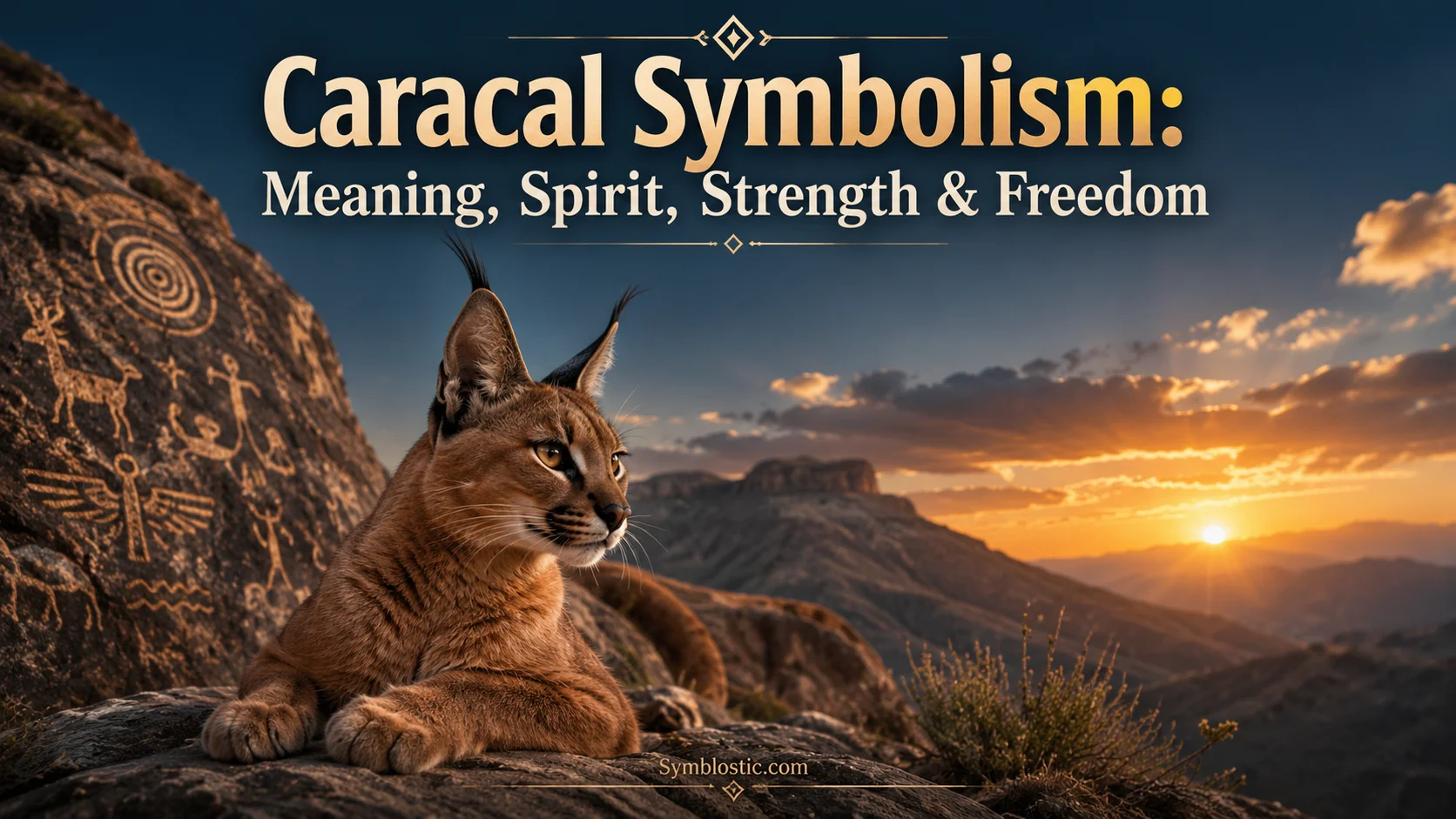
The Caracal Symbolism is especially interesting because this wild cat looks both elegant and powerful. Its tall black ear tufts, focused eyes, reddish-brown coat, and athletic body create a strong visual impression. However, its symbolism goes deeper than appearance.
In the United States, people often interpret the caracal through broader ideas of wildness, independence, confidence, and personal strength. Since caracals aren’t native American wildlife, their meaning usually comes through global wildlife culture, zoos, art, spirituality, tattoos, and modern animal symbolism.
The caracal also has a remarkable history across Africa, the Middle East, and Asia. It was admired by rulers and hunters for its ability to move quietly and leap after birds. Today, those traits make it a natural symbol for patience, precision, adaptability, and knowing when to act.
Quick Answer
Caracal Symbolism commonly represents independence, heightened awareness, agility, courage, patience, and precisely timed action. In the USA, it often symbolizes quiet confidence and untamed individuality, while spiritual interpretations add intuition, transformation, and self-trust.
TL;DR
- Caracals symbolize independence, awareness, agility, and quiet confidence.
- Their famous leaps inspire meanings of opportunity and decisive action.
- Ancient cultures admired caracals for hunting and unusual athletic ability.
- In America, caracals often represent exotic wilderness and individual strength.
- Spiritual interpretations connect them with intuition, boundaries, and patience.
- Modern caracal imagery appears in tattoos, artwork, fashion, and wildlife culture.
What Does the Caracal Symbolize?
The caracal’s symbolism comes largely from its behavior and physical traits. It doesn’t need to be the largest predator to appear powerful. Instead, its strength comes from control, speed, awareness, and precision.
For American readers, that creates a useful modern metaphor. The caracal can represent someone who doesn’t seek attention but remains prepared when an important opportunity appears.
Core Symbolic Meanings
The most common symbolic ideas associated with the caracal include:
- Independence: Moving confidently without depending on a group.
- Awareness: Noticing changes before others recognize them.
- Agility: Adjusting quickly when circumstances change.
- Patience: Waiting instead of forcing the wrong opportunity.
- Precision: Using energy carefully rather than constantly acting.
- Courage: Facing uncertainty without needing to appear fearless.
- Adaptability: Surviving across varied landscapes and conditions.
- Freedom: Maintaining a strong connection to wildness and individuality.
These meanings aren’t fixed religious rules. Instead, they’re modern interpretations inspired by the animal’s real characteristics and cultural history.
What Does a Caracal Look Like Symbolically?
A caracal has a distinctive appearance that makes its symbolism easy to recognize. Its tawny or reddish coat suggests warmth and natural earth tones, while its dark ear tufts immediately separate it from many other wild cats.
Its posture matters, too. An alert caracal with upright ears can suggest awareness, while a crouching caracal may communicate patience and controlled power.
The Symbolism of Its Features
- Black ear tufts: Alertness, listening, and heightened awareness.
- Golden-brown coat: Earthiness, resilience, warmth, and natural strength.
- Focused eyes: Observation, intuition, and careful judgment.
- Long legs: Mobility, speed, and adaptability.
- Athletic posture: Readiness without unnecessary aggression.
- Powerful hind legs: Sudden action and the ability to overcome limits.
The famous ears are particularly important. Their appearance gives the animal a memorable silhouette and has helped inspire interpretations involving listening and perception.
What Is the Historical Meaning of the Caracal?
The caracal has a long relationship with humans across Africa, the Middle East, Persia, and South Asia. Historical records describe people capturing and training caracals for hunting, particularly because of their ability to pursue birds and small game.
In Persian traditions, the animal was known as siyāh-gūsh, meaning “black-eared,” reflecting its distinctive ears. The name caracal itself ultimately traces back through Turkish terminology connected with the idea of a black ear.
Caracals and Royal Hunting
Caracals were sometimes used by rulers and wealthy hunters alongside other trained predators. Their ability to leap suddenly after birds made them especially impressive.
Historical accounts also connect them with hunting traditions in places such as Persia and India. These traditions gave the animal associations with skill, discipline, status, and controlled power.
However, historical use shouldn’t be confused with modern symbolism. Today, many people admire the caracal primarily as a wild species rather than as a hunting animal.
What Is the Caracal’s Connection to Ancient Egypt?
The caracal lived in regions connected with ancient Egyptian civilization, and feline imagery was important in Egyptian art and religion. Archaeological evidence indicates that caracals themselves were represented and, in some cases, mummified.
However, it’s important not to oversimplify this history. Modern internet sources sometimes claim that the caracal had one universally defined role or was simply another form of Bastet. The evidence is more complicated.
Feline Symbolism in Ancient Egypt
Cats and other felines could represent different qualities depending on their context. Protection, power, fertility, guardianship, and the dangerous side of nature were all part of the wider Egyptian feline world.
Caracal imagery therefore fits into a much larger tradition of respecting powerful cats.
For modern readers, the historical lesson is more useful than a single fixed interpretation: the caracal was recognized as an unusual and impressive wild feline long before modern wildlife photography made it famous.
What Does Caracal Symbolism Mean in America?
The caracal has a different cultural position in the United States because it isn’t native American wildlife. Americans are more familiar with native cats such as bobcats, mountain lions, and lynx.
As a result, caracal symbolism in the USA often feels exotic and international. It can represent a connection with wilderness that exists beyond familiar American landscapes.
Modern American Associations
In the United States, caracal imagery may suggest:
- Untamed individuality rather than conformity.
- Exotic wilderness beyond familiar American wildlife.
- Quiet confidence instead of loud dominance.
- Personal freedom and self-directed living.
- Athletic ability and physical readiness.
- Wild beauty without excessive aggression.
- Mystery because the animal is unfamiliar to many Americans.
- Conservation awareness surrounding lesser-known wild cats.
Caracals can also appear in American zoos and wildlife education. These encounters help turn an unfamiliar animal into a recognizable symbol of global biodiversity.
Caracal Meaning in Different American Contexts
| Context | Meaning in the USA | Common Association | Symbolic Emphasis |
| Wildlife art | Exotic natural beauty | Wild landscapes | Freedom |
| Tattoo designs | Individual identity | Strength and independence | Self-direction |
| Spiritual content | Inner awareness | Intuition and patience | Self-trust |
| Fashion and decor | Distinctive style | Luxury and wildness | Confidence |
| Conservation | Rare or unfamiliar wildlife | Protecting habitats | Respect for nature |
The meaning can therefore change with the setting. A tattoo may communicate identity, while a conservation image may communicate responsibility toward wildlife.
What Is the Spiritual Meaning of a Caracal?
Modern spiritual interpretations often treat the caracal as a symbol of intuition, patience, independence, and timing. These ideas usually come from observing the animal rather than from one universally recognized religious tradition.
The caracal’s hunting style makes timing especially important. It may remain still and observant before suddenly making a powerful movement.
Spiritual Lessons Associated With the Caracal
- Trust your observations before making an important decision.
- Protect your personal boundaries without unnecessary conflict.
- Wait for the right moment instead of forcing an outcome.
- Use your abilities with precision rather than constant effort.
- Remain flexible when your environment suddenly changes.
- Step away from distractions when deeper focus is needed.
These interpretations can be meaningful as personal reflection. However, they shouldn’t be presented as universal spiritual facts.
Read More: Dingo Symbolism: Meaning, Spirit & Wild Wisdom
What Does a Caracal Mean as a Spirit Animal?
In contemporary spiritual language, a caracal spirit animal is often interpreted as a reminder to trust yourself. The image can appeal to people who value independence but don’t want strength to become aggression.
The animal’s quiet behavior creates another important lesson. Strength doesn’t always have to be visible.
Caracal Spirit Animal Meaning
A person drawn to this symbolism may connect the animal with:
- Personal boundaries
- Self-reliance
- Intuition
- Patience
- Strategic action
- Emotional control
- Adaptability
- Courage during uncertainty
The healthiest interpretation isn’t “always act alone.” Instead, it can mean knowing when independence helps and when cooperation is wiser.
What Does a Caracal Mean Psychologically?
Psychologically, animal symbols often work because they give abstract feelings a visible form. A person may see a caracal and immediately connect with its alert posture, solitude, or physical confidence.
The caracal can therefore represent a particular mindset: observe first, understand the situation, then act with purpose.
Emotional Associations
Caracal imagery can evoke feelings such as:
- Calm confidence
- Curiosity
- Freedom
- Alertness
- Mystery
- Determination
- Self-protection
- Controlled power
Its symbolism also has a possible shadow side. Independence can become isolation, and awareness can become excessive suspicion if taken too far.
The Shadow Meaning
Every powerful symbol has another side.
A caracal can represent the danger of becoming too guarded. Someone who constantly watches for threats may struggle to relax or trust other people.
Likewise, self-reliance can become stubborn isolation. The stronger interpretation is balance: protect yourself without closing yourself off completely.
What Does a Caracal Mean in Dreams?
There is no scientifically proven universal meaning for dreaming about a caracal. Dream interpretation depends heavily on personal experience, emotions, recent memories, and the situation inside the dream.
Still, modern symbolic interpretation often connects a caracal dream with awareness, independence, hidden ability, or a need for better timing.
Common Dream Scenarios
Seeing a calm caracal may suggest confidence, observation, or a desire for personal space.
Being chased by a caracal can symbolize feeling pressured by something powerful or unfamiliar. The emotional tone matters more than the animal alone.
Watching a caracal hunt may represent patience followed by decisive action.
A friendly caracal can symbolize a growing sense of confidence or comfort with independence.
An attacking caracal may represent fear, boundaries, conflict, or an overwhelming challenge.
Rather than treating a dream as a prediction, it’s more useful to ask what the animal made you feel.
How Is Caracal Symbolism Used in Tattoos and Art?
Caracal tattoos are attractive because the animal has an instantly recognizable silhouette. The tall ears and intense face create a strong design even without elaborate decoration.
In American tattoo culture, a caracal can communicate individuality without using more common predator imagery such as lions, wolves, or tigers.
Popular Symbolic Tattoo Ideas
- A realistic caracal for strength and natural beauty.
- A caracal face for focus and personal identity.
- A leaping caracal for ambition and decisive action.
- A minimalist ear silhouette for subtle awareness.
- A caracal with plants for wilderness and balance.
- A geometric design for precision and controlled energy.
The meaning ultimately belongs to the person wearing the tattoo. A caracal tattoo doesn’t have one official interpretation.
How Is Caracal Symbolism Used in Modern Culture?
Today, caracal imagery appears across wildlife photography, artwork, social media, fashion, home decor, and personal branding. Its unusual appearance makes it especially effective as a visual symbol.
Social media has also expanded interest in lesser-known wild animals. A person who discovers the caracal online may connect with its appearance before learning about its history.
Modern Symbolic Uses
Caracal imagery can communicate:
- Wild identity in personal photography and profiles.
- Confidence in fashion and visual design.
- Adventure in outdoor-themed artwork.
- Mystery in dark or dramatic visual styles.
- Nature appreciation in wildlife collections.
- Individuality in personal artwork and tattoos.
The animal’s unusual appearance is part of its appeal. It feels familiar because it’s a cat, yet unfamiliar because most Americans rarely encounter one.
What Does the Caracal Represent Across Cultures?
The caracal has connections with several regions where it naturally occurs or historically traveled through human trade and hunting networks. Meanings vary, so no single interpretation should be treated as universal.
In Persian literature and historical writing, the caracal was known for its distinctive appearance and hunting ability. In South Asia, rulers used trained caracals for hunting birds and other small game.
A Broader Cultural Picture
Across these traditions, recurring themes include:
- Athletic ability
- Hunting skill
- Elusiveness
- Adaptability
- Wild beauty
- Controlled power
- Association with elite hunting
- Respect for unusual natural abilities
These themes differ from modern American spiritual interpretations. That difference is important because symbolism develops through culture, history, and personal experience.
What Are the Misunderstandings About Caracal Symbolism?
One common mistake is assuming that every animal has one ancient spiritual meaning. In reality, animal symbolism changes between societies and historical periods.
Another problem comes from treating modern “spirit animal” language as though it represents every Indigenous tradition. It doesn’t.
Important Distinctions
The caracal is not native to North America, so American interpretations shouldn’t be presented as ancient Native American caracal traditions.
Likewise, modern spiritual websites sometimes attach highly specific meanings to the animal without identifying a historical cultural source. Those ideas can still work as personal symbolism, but they should be described as modern interpretations.
Finally, the caracal shouldn’t be confused with the lynx simply because both have tufted ears. They are different wild cats with different geographic histories.
How Has Caracal Symbolism Changed Over Time?
The caracal’s symbolic image has shifted from practical admiration toward broader ideas of identity and spirituality. Historically, people often valued the animal because of what it could physically do.
Today, people are more likely to admire what its behavior represents emotionally.
From Hunter to Modern Symbol
Earlier traditions: The caracal was valued for hunting ability, speed, and trainability.
Historical literature: Writers described its unusual appearance, behavior, and relationship with other powerful animals.
Modern wildlife culture: Photography and zoos introduced the animal to wider audiences.
Contemporary symbolism: The caracal now represents independence, intuition, agility, and personal strength.
This shift mirrors a broader change in animal symbolism. People increasingly use wildlife as a language for identity and personal values rather than practical status.
FAQs:
Is a caracal a symbol of strength?
Yes, modern interpretations often connect the caracal with strength. However, its strength is usually portrayed as controlled, agile, and precise rather than aggressive.
What does a caracal symbolize spiritually?
Spiritually, the caracal is often associated with intuition, independence, patience, awareness, and timing. These meanings are modern symbolic interpretations rather than one universal religious doctrine.
What does a caracal tattoo symbolize?
A caracal tattoo can represent independence, confidence, adaptability, freedom, or personal transformation. The exact meaning depends on the design and the wearer’s personal story.
What does seeing a caracal symbolize?
Symbolically, seeing a caracal can be interpreted as a reminder to pay attention and trust your judgment. However, an actual wildlife sighting should be understood first as a natural encounter, not automatically as a supernatural message.
Are caracals native to the United States?
No. Caracals naturally occur across parts of Africa, the Middle East, and Asia rather than North America. In the USA, people generally encounter them through zoos, wildlife collections, media, and conservation education.
What does a caracal represent in dreams?
A caracal dream may personally represent independence, awareness, boundaries, or decisive action. The dreamer’s emotions and circumstances are more important than any fixed dream dictionary definition.
Conclusion:
Caracal Symbolism brings together independence, awareness, agility, patience, courage, and carefully timed action. Its distinctive ears and athletic behavior make it especially powerful as a visual symbol, while its long history with human cultures adds depth to its modern meaning.
In the USA, the caracal often represents something beautifully untamed: the confidence to stand apart, the patience to observe, and the ability to act when the moment is right. Whether you encounter the symbol through a tattoo, artwork, dream, or wildlife experience, its strongest message is simple: quiet strength can be just as powerful as visible force.

1 thought on “Caracal Symbolism: Meaning, Spirit, Strength & Freedom”