
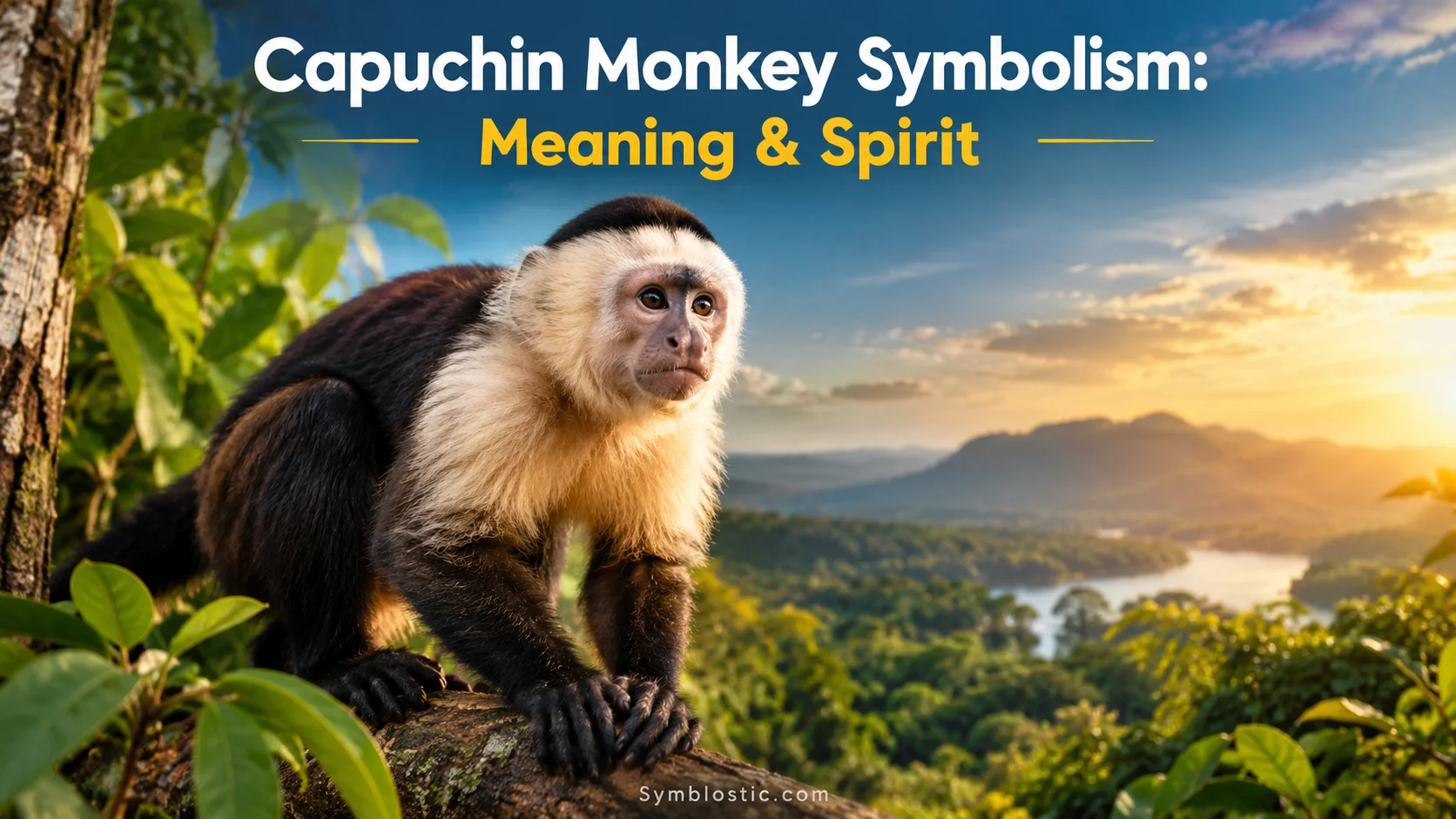
Capuchin Monkey Symbolism often centers on intelligence, curiosity, adaptability, playfulness, and social connection. These small primates are famous for exploring their surroundings, solving problems, manipulating objects, and learning from others.
For American readers, the capuchin can also carry a more complicated meaning. It has appeared in zoos, movies, television, street entertainment, and the exotic-pet trade. As a result, people may see it as funny and clever while overlooking its identity as a wild and socially complex animal.
Today, a capuchin image can represent someone who thinks differently, stays curious, or uses creativity to solve difficult problems. Its symbolism becomes especially interesting when you look beyond its playful appearance and consider what its real behavior tells us.
Quick Answer
Capuchin Monkey Symbolism commonly represents intelligence, curiosity, resourcefulness, playfulness, adaptability, and community. In the USA, it often combines the image of a clever, mischievous monkey with deeper ideas about learning, independence, and social connection.
TL;DR
• Capuchins commonly symbolize intelligence and clever problem-solving.
• Their curiosity represents exploration, discovery, and learning.
• Social groups connect them with friendship, family, and cooperation.
• Their playful behavior can symbolize humor and flexibility.
• American media helped make capuchins familiar and entertaining.
• Modern symbolism increasingly emphasizes wildlife respect and conservation.
What Does the Capuchin Monkey Symbolize?
The capuchin has a surprisingly broad symbolic range. Its behavior makes intelligence and curiosity especially natural associations.
For American readers, the animal can also symbolize the ability to remain flexible when circumstances change. It isn’t simply about being clever. It can represent using what you have in creative ways.
Intelligence and Resourcefulness
Capuchins are skilled at manipulating objects and solving practical problems. Some populations have also developed remarkable forms of tool use.
That makes the monkey a strong symbol of resourcefulness. It suggests finding another method when the obvious solution doesn’t work.
Curiosity and Exploration
Capuchins constantly investigate their surroundings. They touch, inspect, climb, manipulate, and experiment.
Symbolically, this behavior represents a willingness to ask questions rather than accept everything immediately.
Playfulness and Mischief
Monkeys have long been connected with humor and mischief in popular storytelling. Capuchins fit that image particularly well because of their expressive faces and active behavior.
However, playfulness doesn’t necessarily mean irresponsibility. Symbolically, it can suggest maintaining curiosity and humor while dealing with serious challenges.
Capuchin Monkey Appearance and Symbolic Traits
Physical appearance plays an important role in animal symbolism. With capuchins, even their name and distinctive head coloring contribute to the animal’s symbolic character.
Their small size can make them appear harmless and approachable. Yet their dexterity and intelligence create a contrast between appearance and ability.
The Distinctive “Hood”
The name “capuchin” comes from the Capuchin Franciscan friars, whose hooded clothing resembles the dark crown or cap seen on some capuchin monkeys.
That visual connection creates an unusual symbolic association. The animal can appear simultaneously wild and monk-like, although the resemblance is simply the origin of the common name.
Expressive Face
Capuchins have highly expressive faces and active body language. People often interpret these expressions through a human emotional lens.
This contributes to associations with:
• Humor and curiosity
• Alertness and cleverness
• Mischief and spontaneity
• Emotional expressiveness
• Social awareness
These interpretations are symbolic rather than literal descriptions of human emotions.
Historical Roots of Capuchin Monkey Symbolism
The modern symbolism of the capuchin is connected to both the animal itself and older European ideas about monkeys.
The word “Capuchin” became associated with a Franciscan religious order founded in Italy during the early 16th century. The hooded clothing of the order helped inspire the monkey’s common name.
The Monkey in Older European Art
Long before capuchins became familiar in North America, European art often used monkeys as symbols of human behavior.
In medieval and Renaissance traditions, monkeys could represent imitation, uncontrolled desire, foolishness, or the lower side of human nature. They were sometimes shown behaving like humans in exaggerated ways.
However, these meanings should not automatically be applied to capuchins themselves.
Capuchins are New World monkeys native to Central and South America. Their cultural history is different from the European artistic traditions that later influenced how Western audiences viewed monkeys.
From Curiosity to Scientific Interest
As Europeans encountered animals from the Americas, monkeys became part of a growing fascination with the natural world.
Over time, the monkey shifted from an artistic symbol of human weakness toward something else: a subject for observation, science, education, and conservation.
That shift matters because modern Americans usually encounter capuchins through zoos, documentaries, research, entertainment, or online images rather than old religious artwork.
Capuchin Monkey Symbolism in the USA
In the United States, capuchins have developed a particularly recognizable public image.
They are often associated with cleverness, entertainment, curiosity, and unusual intelligence. Movies and television have strengthened that image by placing trained monkeys in humorous or adventurous roles.
Entertainment and Popular Culture
Capuchins have appeared in American entertainment for generations. Their expressive faces and ability to learn behaviors made them especially appealing to filmmakers.
That exposure created a familiar character type: the clever monkey who surprises humans.
However, entertainment can simplify animals. A trained capuchin on screen may look like a naturally cooperative companion, while real capuchins have complex social, environmental, and behavioral needs.
Zoos and Education
Modern American zoos increasingly present primates through education and conservation rather than simple amusement.
This gives the capuchin a more thoughtful role. It becomes a reminder of biodiversity, tropical forests, animal behavior, and the importance of protecting wild habitats.
For many Americans, therefore, the capuchin now sits between popular culture and conservation awareness.
Capuchin Monkey Meaning in American Culture
American symbolism often turns animal traits into personal qualities. The capuchin fits that pattern particularly well.
Its most positive qualities are easy to recognize in everyday life.
What the Capuchin Can Represent
| Context | Meaning in the USA | Common Association | Symbolic Lesson |
| Personal growth | Intelligence | Learning and problem-solving | Think creatively |
| Friendship | Social connection | Groups and cooperation | Stay connected |
| Challenges | Resourcefulness | Finding another solution | Adapt your approach |
| Personality | Playfulness | Humor and curiosity | Keep life flexible |
| Wildlife | Conservation | Tropical forests | Respect wild nature |
The capuchin’s strongest American meaning is therefore not one fixed definition.
Instead, it represents a cluster of qualities. Think, explore, connect, adapt, and keep your curiosity alive are among the clearest modern interpretations.
Spiritual Meaning of the Capuchin Monkey
There is no single universal spiritual meaning for the capuchin monkey. Spiritual interpretations vary by person, tradition, and cultural setting.
In modern spiritual writing, the capuchin is often treated as an animal symbol connected with curiosity, cleverness, cooperation, and adaptability.
A Symbol of Clever Action
The capuchin can represent the idea that knowledge becomes useful when you apply it.
Its symbolic lesson is not simply “be intelligent.” Instead, it can suggest use your abilities in practical ways.
A Symbol of Social Awareness
Capuchins live in complex social groups. Their behavior can therefore inspire symbolic ideas about communication, relationships, and cooperation.
For someone going through a difficult period, the image may represent the value of accepting help rather than trying to solve everything alone.
A Note About “Spirit Animal” Language
The phrase “spirit animal” is widely used in modern American culture, but it has also raised cultural concerns because it can simplify or commercialize Indigenous traditions.
A respectful approach is to describe a capuchin as a personal animal symbol, spiritual symbol, or symbolic guide unless a specific cultural tradition is being discussed accurately.
Capuchin Monkey Symbolism Across Cultures
Monkey symbolism is much broader than capuchin symbolism. Different cultures have interpreted monkeys in very different ways.
In parts of Central and South America, primates have appeared in traditional stories, ceremonies, and cultural representations. Their meanings can include intelligence, humor, social behavior, danger, transformation, or relationships between humans and the natural world.
Indigenous Traditions
Some Indigenous traditions of the Americas include important monkey figures in folklore. However, these traditions are not interchangeable.
For example, the cultural meaning of a monkey among one Amazonian community cannot simply be assigned to every Indigenous group in South America.
That distinction matters. A respectful interpretation recognizes cultural diversity rather than creating one universal “native” monkey meaning.
Broader Monkey Symbolism
Outside the Americas, monkeys have also carried different meanings.
In some Asian religious and cultural traditions, famous monkey figures represent devotion, courage, cleverness, or spiritual discipline. Those meanings belong to particular traditions and should not be presented as if they originated from capuchins.
Emotional and Psychological Meaning of the Capuchin
The capuchin can symbolize several psychological qualities because people naturally connect animal behavior with human personality traits.
Its strongest emotional association is often curiosity.
Curiosity
A capuchin encourages the symbolic question: “What happens if I try something different?”
That makes it appealing to people who value learning, experimentation, and discovery.
Confidence Through Adaptability
The capuchin can also represent confidence in your ability to handle unfamiliar situations.
Instead of demanding perfect conditions, its symbolism encourages practical flexibility.
The Shadow Side
Every symbol has a less flattering side.
The capuchin’s negative associations can include:
• Impulsiveness without considering consequences
• Mischief that creates unnecessary problems
• Curiosity becoming distraction
• Cleverness being used manipulatively
• Social behavior becoming attention-seeking
• Playfulness becoming avoidance of responsibility
These aren’t claims about capuchins being morally good or bad. They are symbolic interpretations of traits people commonly associate with monkeys.
Read More: Guinea Fowl Symbolism: Meaning, Spirit & Protection
Capuchin Monkey as a Spirit or Totem Symbol
People who personally identify with the capuchin often focus on its intelligence and social nature.
The symbol may feel especially meaningful during periods of learning, change, or experimentation.
What It Can Represent
A capuchin symbol can remind someone to:
• Stay curious when facing unfamiliar situations
• Use creativity instead of forcing one solution
• Maintain meaningful relationships with others
• Make room for humor during stressful periods
• Learn through observation and experimentation
• Adapt without abandoning personal values
Rather than predicting the future, these interpretations work better as personal reflections.
Capuchin Monkey in Dreams
Monkey dreams are often interpreted through the dreamer’s personal circumstances rather than a fixed dictionary.
A capuchin appearing in a dream could represent curiosity, social tension, cleverness, playfulness, or a situation that feels unpredictable.
A Playful Capuchin
A friendly or playful monkey may reflect a desire for freedom, humor, or more spontaneity.
It might also point toward a part of your personality that wants more room to explore.
An Aggressive or Frightening Capuchin
A threatening monkey may symbolize conflict, impulsive behavior, or a person whose actions feel unpredictable.
However, the dream’s setting matters. Your emotions during the dream are often more useful than the animal alone.
Capuchin Monkey Tattoos and Modern Symbolism
Capuchin monkey tattoos can carry a very personal meaning.
Some people choose a monkey because they connect with intelligence, humor, independence, or unconventional thinking. Others simply appreciate the animal’s expressive appearance.
Common Tattoo Meanings
A capuchin tattoo may represent:
• Curiosity and lifelong learning
• Cleverness and creative thinking
• Humor and playful personality
• Adaptability through difficult changes
• Friendship and social connection
• Love of tropical wildlife
The design can change the interpretation considerably.
A serious-looking capuchin may emphasize wisdom and observation. A playful design may focus on humor and spontaneity.
Capuchin Monkey in Social Media, Fashion, and Decor
Modern digital culture often uses animal images to communicate personality quickly.
Capuchins work particularly well because their expressions can look humorous, curious, surprised, or mischievous.
Social Media
A capuchin image may communicate a playful mood without requiring many words.
People can also use monkey imagery to express curiosity, absurd humor, unconventional thinking, or a love of wildlife.
Home Decor
Capuchin artwork can create a tropical or nature-inspired atmosphere.
In a more symbolic setting, it can represent curiosity, adventure, and connection with the natural world.
Fashion and Personal Identity
Monkey imagery may appeal to people who don’t want traditional animal symbols.
A capuchin can communicate intelligence and individuality while still feeling lighthearted.
Capuchin Monkey Symbolism, Misuse, and Controversy
The capuchin has a complicated relationship with human entertainment.
For many years, monkeys were trained to perform tricks, appear in movies, or entertain people in public. This history helped create the familiar image of the “funny monkey.”
The Problem With Treating Wild Animals Like Props
A trained animal may look comfortable and entertaining to viewers. However, that doesn’t mean its natural needs are being met.
Capuchins are highly social animals with demanding physical and mental needs. Their intelligence can make captivity especially challenging when their environment lacks appropriate stimulation.
The Exotic-Pet Issue
Capuchins have also appeared in the American exotic-pet trade.
This is one reason their symbolism has changed. The image of a cute, manageable monkey can conflict with the reality of caring for a wild primate.
Modern discussions increasingly emphasize responsible wildlife treatment rather than treating capuchins as miniature human companions.
How Capuchin Monkey Meaning Has Changed Over Time
The meaning of the capuchin has never been completely fixed.
Earlier Western views of monkeys sometimes emphasized foolishness, imitation, temptation, or disorder. Later, scientific research highlighted intelligence, social learning, and complex behavior.
Today, the picture is more balanced.
From Mischief to Intelligence
The “mischievous monkey” remains popular in American entertainment. However, research has made it difficult to view capuchins as merely comic animals.
Their problem-solving abilities, social traditions, and tool use have expanded public understanding of them.
A New Conservation Meaning
There is also a growing connection between capuchins and conservation.
Their dependence on forest ecosystems makes them useful symbols for protecting biodiversity. Their intelligence makes their welfare especially visible to the public.
This creates a modern interpretation that combines curiosity with responsibility.
What Can the Capuchin Teach You?
Animal symbolism becomes most useful when it encourages reflection rather than rigid belief.
The capuchin offers several simple lessons that fit modern American life.
Think Creatively
When one solution fails, look for another.
The capuchin’s reputation for manipulating objects makes it a natural symbol of practical creativity.
Stay Curious
Curiosity keeps people learning.
Instead of assuming you already understand a situation, the capuchin symbol encourages observation and experimentation.
Value Your Community
Capuchins are social animals.
Their symbolism can remind you that independence and connection don’t have to compete. Strong relationships can support individual growth.
Keep Play in Your Life
Play isn’t only for children.
Humor, exploration, and lightness can help people approach problems from different angles.
Respect Wildness
Perhaps the most modern lesson is also the simplest: appreciation doesn’t require ownership.
You can admire the capuchin without turning it into a pet, prop, or human substitute.
FAQs:
What does a capuchin monkey symbolize spiritually?
A capuchin monkey can symbolize curiosity, intelligence, adaptability, social connection, and playful energy. Spiritual interpretations are personal and vary across traditions.
Is the capuchin monkey a symbol of intelligence?
Yes, intelligence is one of its strongest modern symbolic associations. Its problem-solving abilities, dexterity, social learning, and tool use contribute to this interpretation.
What does a capuchin monkey represent in dreams?
A capuchin in a dream may represent curiosity, mischief, social behavior, adaptability, or unpredictable circumstances. The dreamer’s emotions and situation usually provide important context.
What does a capuchin monkey tattoo mean?
A capuchin tattoo can represent cleverness, curiosity, humor, independence, adaptability, or connection with wildlife. The expression and surrounding imagery can change the intended message.
Are capuchin monkeys associated with good luck?
There is no universal tradition that makes capuchins a general symbol of good luck. Some modern personal interpretations may connect monkeys with opportunity, cleverness, and positive change.
Why are capuchin monkeys associated with monks?
The name “capuchin” comes from the Capuchin Franciscan friars. Their hooded clothing resembles the dark cap or crown of hair seen on some capuchin monkeys.
Is the capuchin monkey a good symbol for curiosity?
Yes. Its natural tendency to explore and investigate makes curiosity one of the clearest symbolic qualities associated with the animal.
Conclusion:
Capuchin Monkey Symbolism brings together intelligence, curiosity, adaptability, playfulness, and community. In the USA, the animal also carries a history shaped by entertainment, popular culture, zoos, scientific research, and changing attitudes toward wildlife.
The most meaningful interpretation may be the balance between cleverness and responsibility. A capuchin can remind you to stay curious, think creatively, value your relationships, and approach unfamiliar situations with flexibility. At the same time, its modern symbolism encourages a deeper respect for wild animals as living beings rather than simple entertainment.

1 thought on “Capuchin Monkey Symbolism: Meaning & Spirit”