
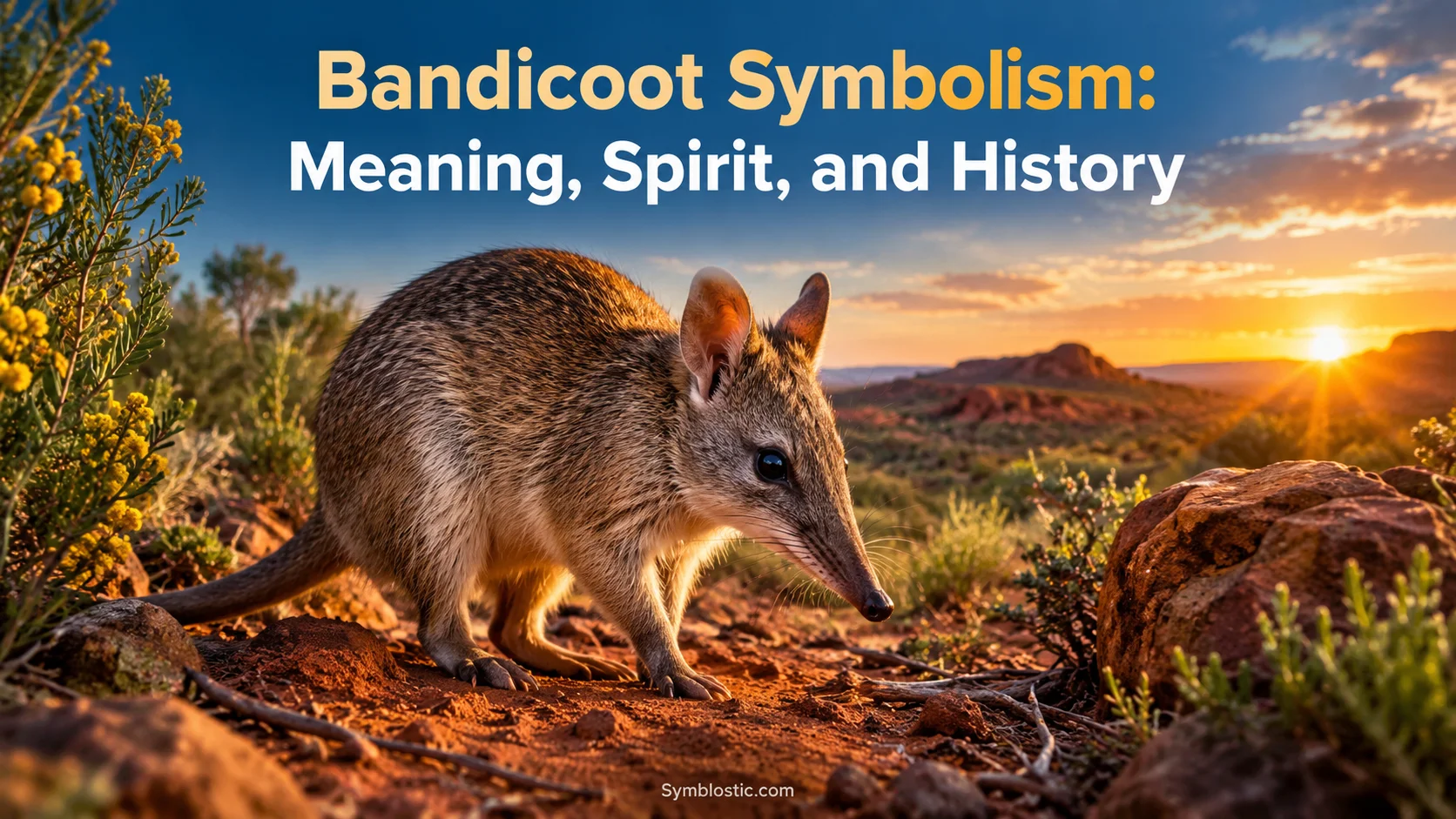
Bandicoots are small Australian marsupials known for their pointed noses, compact bodies, and remarkable ability to survive in challenging environments. Bandicoot symbolism often centers on resilience, adaptability, resourcefulness, and quiet strength.
For American readers, the bandicoot may feel less familiar than animals such as wolves, bears, or eagles. However, its symbolism becomes interesting because it comes from a very different natural and cultural setting. Its life also reflects themes that many people recognize: survival, independence, patience, and adapting when circumstances change.
Unlike some famous animal symbols, the bandicoot doesn’t have one universal spiritual meaning. Its significance depends heavily on Australian Aboriginal traditions, local storytelling, natural history, and modern interpretations. Therefore, it’s important to separate documented cultural traditions from newer spiritual ideas.
Quick Answer
Bandicoot symbolism commonly represents resilience, adaptability, resourcefulness, independence, and survival. In Australian contexts, the animal can also connect with relationships to Country, local ecosystems, and traditional stories, while modern spiritual interpretations often emphasize quietly finding a way forward.
TL;DR
- Bandicoots symbolize resilience and survival in difficult environments.
- Their behavior suggests resourcefulness, patience, and adaptability.
- Australian Aboriginal meanings vary between different cultural groups.
- Their nighttime habits can represent intuition and awareness.
- Modern symbolism often focuses on quiet strength and independence.
- Conservation has added themes of vulnerability and environmental responsibility.
What Does a Bandicoot Symbolize?
The bandicoot is a small animal, but its lifestyle gives it surprisingly rich symbolic possibilities. It searches for food, moves through different habitats, and often remains active when larger animals are less visible.
For American readers, these traits can make the bandicoot a useful symbol of persistence. It represents someone who doesn’t need attention to make progress.
Core Symbolic Meanings
Several meanings are commonly connected with the animal in modern symbolic writing:
• Resilience — surviving despite environmental challenges.
• Adaptability — adjusting to changing surroundings.
• Resourcefulness — using available resources intelligently.
• Independence — moving quietly without depending on others.
• Awareness — noticing details that others might overlook.
• Persistence — continuing to search and work despite obstacles.
These interpretations should not be treated as one ancient universal code. Animal symbolism changes across cultures and periods.
Bandicoot Symbolism in Australian Culture
Australia is the most important cultural setting for understanding the bandicoot. The animal is native to Australia and nearby regions, and different Aboriginal communities have their own traditions involving animals and Country.
Because Aboriginal cultures are diverse, there isn’t one single “Aboriginal meaning” for the bandicoot. Stories, responsibilities, and relationships with animals can differ between language groups and regions.
Connection With Country
In many Indigenous Australian worldviews, animals cannot always be separated from the broader landscape. Plants, animals, people, waterways, ancestors, and places can be understood through interconnected cultural relationships.
That makes a bandicoot more than a decorative animal symbol. In an appropriate cultural context, it may be part of a much larger relationship involving Country, knowledge, identity, and responsibility.
Why This Matters Today
Modern Australia also sees bandicoots through a conservation lens. Several bandicoot species and populations have faced serious pressure from habitat loss, introduced predators, changed fire patterns, and other environmental threats.
As a result, the animal can represent another modern idea:
Survival does not always mean remaining unchanged. Sometimes it means adapting while protecting what matters.
Historical Background of Bandicoots
Bandicoots have a long evolutionary history in Australia. They belong to a distinctive group of marsupials that developed alongside Australia’s unusual wildlife.
Unlike many famous symbolic animals, however, bandicoots were not widely adopted as universal symbols across European history. Their strongest traditional associations developed in Australia rather than ancient Mediterranean or European civilizations.
Indigenous Australian Traditions
Aboriginal Australians have maintained sophisticated knowledge of local animals for thousands of years. Animal behavior could be connected with food, seasons, landscape knowledge, storytelling, and cultural law.
However, specific bandicoot stories should not be generalized across all Aboriginal communities. A story belonging to one cultural group does not automatically represent another.
European Contact
European descriptions of Australian wildlife introduced animals such as bandicoots to audiences outside Australia. Early scientific accounts often focused on anatomy, classification, and natural history.
Over time, popular culture added a different layer. The unusual appearance and name of the animal made it memorable to audiences far beyond its native environment.
What Does a Bandicoot Mean Spiritually?
There is no single universally accepted spiritual meaning for the bandicoot. Modern spiritual interpretations often come from observing its behavior rather than from one shared religious tradition.
Its nocturnal activity is especially important in symbolic readings. Because bandicoots are often active after dark, people may associate them with awareness, intuition, mystery, and finding one’s way without complete visibility.
Common Spiritual Interpretations
Modern spiritual writers may associate the bandicoot with:
• Trusting yourself during uncertain periods.
• Remaining alert when circumstances are unclear.
• Finding practical solutions instead of seeking attention.
• Moving patiently toward a goal.
• Protecting personal boundaries and independence.
• Adapting when an old path stops working.
These are contemporary interpretations rather than universal religious teachings.
Nighttime Symbolism
The darkness surrounding a nocturnal animal can create a powerful metaphor. You may not see the entire path ahead, yet you can still take the next step.
For that reason, the bandicoot can symbolize quiet confidence during uncertain transitions.
Bandicoot Symbolism and the Australian Landscape
A bandicoot’s symbolism becomes clearer when viewed through its environment. Many species live in habitats ranging from forests and woodlands to heathlands and grasslands.
This connection with the ground is particularly interesting. Bandicoots forage by digging and searching beneath surface layers for food.
Earth and Grounding
Digging naturally creates associations with:
- Grounding
- Patience
- Discovery
- Hidden resources
- Practical action
- Connection with the earth
The symbolism is simple. Something valuable may not always be visible on the surface.
A person inspired by the bandicoot might therefore see difficult periods differently. Instead of assuming that nothing is available, they may look more carefully for opportunities.
Bandicoot as a Symbol of Resilience
Resilience is probably one of the strongest modern meanings attached to the bandicoot.
Many bandicoots have faced major environmental pressures. Yet some populations have survived through adaptation, protection, and conservation work.
Quiet Survival
The bandicoot isn’t normally imagined as a dominant predator. It doesn’t symbolize strength through physical power.
Instead, its symbolic strength comes from persistence.
That distinction matters. There are times when survival requires flexibility rather than confrontation.
Lessons From Its Behavior
The bandicoot can therefore represent a different kind of strength:
| Context | Meaning in the USA | Common Association | Symbolic Lesson |
| Survival | Resilience | Overcoming difficulty | Keep adapting |
| Foraging | Resourcefulness | Finding solutions | Look beneath the surface |
| Night activity | Awareness | Intuition and caution | Stay alert |
| Small size | Quiet strength | Humility | Power isn’t always obvious |
| Conservation | Vulnerability | Protection | Survival can require support |
These meanings are modern symbolic interpretations, not fixed cultural rules.
Psychological Meaning of the Bandicoot
Animals often become symbols because people recognize parts of themselves in their behavior. The bandicoot can appeal to people who value independence without needing constant recognition.
Its small size also changes the usual idea of strength. A person doesn’t have to be intimidating to be capable.
What the Bandicoot Can Represent Emotionally
The animal may evoke feelings such as:
• Curiosity about what remains hidden.
• Calmness during uncertain situations.
• Determination without unnecessary conflict.
• Independence from outside approval.
• Hope after difficult experiences.
• Comfort in quiet and private spaces.
For some people, this makes the bandicoot an appealing personal symbol.
The Psychology of Quiet Strength
Modern culture often celebrates visible achievement. Social media can make success appear loud and constant.
The bandicoot suggests another approach. You can make progress quietly without showing everyone what you’re doing.
That idea can be especially meaningful during periods of personal change.
Read More: African Civet Symbolism: Meaning, Spirit, and History
Bandicoot Symbolism in Dreams
Dream symbolism is highly personal, so seeing a bandicoot in a dream doesn’t have one guaranteed interpretation.
However, modern symbolic approaches may connect the animal with hidden opportunities, independence, curiosity, or adapting to unfamiliar conditions.
Common Dream Interpretations
A bandicoot appearing in a dream might symbolically suggest:
• Searching: You may be looking for an answer or opportunity.
• Hidden things: Something important may require deeper attention.
• Adaptation: Your circumstances may be changing.
• Independence: You may need more personal space.
• Persistence: A goal may require continued effort.
The emotional tone of the dream matters more than a fixed dream dictionary.
A frightened bandicoot creates a different impression from a calm one. Your feelings during the dream can provide the most useful clue.
Bandicoot Symbolism in Tattoos and Art
Bandicoot tattoos are relatively uncommon compared with wolves, snakes, eagles, or butterflies. That rarity can actually make the image more personal.
Someone choosing a bandicoot may want an animal that represents resilience without using a common symbol.
Tattoo Meanings
A bandicoot tattoo can symbolize:
- Survival after hardship
- Australian connection
- Adaptability
- Environmental awareness
- Individuality
- Quiet determination
The design itself can change the message.
A realistic bandicoot may emphasize nature and conservation. A stylized design may feel more playful or personal.
Art and Illustration
Bandicoots can also appear in educational artwork, children’s media, wildlife projects, and Australian cultural materials.
However, artists should avoid presenting specific Indigenous designs as generic decoration. Cultural artwork can have important community and ownership contexts.
Bandicoot Symbolism in Modern American Culture
Most Americans encounter bandicoots through wildlife information, Australian media, games, books, or internet culture rather than traditional American symbolism.
That distance gives the animal a somewhat unusual quality.
Why Americans May Find It Symbolically Interesting
The bandicoot doesn’t carry the same heavy symbolic history as an eagle or lion. Therefore, people can approach it with fewer established assumptions.
It can become a symbol of:
• Uniqueness and individuality.
• Curiosity about unfamiliar cultures.
• Appreciation for unusual wildlife.
• Resilience without dominance.
• Connection with Australian nature.
The animal’s relative unfamiliarity can also make it attractive for creative identities and personal artwork.
Cross-Cultural and Spiritual Connections
Bandicoot symbolism should remain centered on Australia because that is where the animal’s cultural and ecological history is strongest.
Still, broader animal symbolism can provide useful comparisons. Across many cultures, small ground-dwelling animals are sometimes connected with survival, alertness, fertility, hidden knowledge, or the earth.
These similarities don’t mean the cultures share one symbolic system. They simply show that humans often find meaning in animal behavior.
A Respectful Approach
When discussing Indigenous Australian symbolism, specificity matters.
It is better to say that some Australian cultural traditions associate particular animals with particular stories or responsibilities than to claim every Aboriginal group gives the bandicoot the same meaning.
This distinction protects cultural accuracy and avoids turning diverse traditions into one generalized belief system.
Bandicoot Symbolism in Conservation
Conservation has become an important part of the animal’s modern identity.
Bandicoots face different threats depending on species and location. Habitat destruction, predators, altered environments, and human development can all affect populations.
From Symbol to Responsibility
This creates a meaningful modern interpretation.
The bandicoot can symbolize protecting something small before it disappears.
That idea extends beyond wildlife. It can represent local habitats, vulnerable traditions, quiet communities, or personal values that need protection.
Why Conservation Changes Symbolism
Older animal symbolism often focused on what animals represented to humans.
Modern conservation adds another question:
What do humans owe the animals sharing their environment?
That shift makes the bandicoot a symbol not only of survival, but also of responsibility.
Misunderstandings and Controversies
Bandicoot symbolism has fewer major controversies than symbols connected with religion, politics, or national identity. Still, some misunderstandings are worth recognizing.
First, there is no single spiritual definition that applies everywhere. Websites sometimes present modern interpretations as ancient facts without explaining their source.
Second, Indigenous Australian traditions are diverse. Calling one interpretation “the Aboriginal meaning” can erase important cultural differences.
Common Misunderstandings
• Assuming every Aboriginal community shares identical animal traditions.
• Treating modern spiritual claims as documented ancient beliefs.
• Confusing fictional bandicoot characters with real animal symbolism.
• Using Indigenous imagery without understanding its cultural context.
• Assuming conservation symbolism represents every bandicoot species equally.
A careful approach keeps cultural history and modern personal interpretation separate.
How Bandicoot Symbolism Has Changed Over Time
The symbolic image of the bandicoot has developed alongside changing attitudes toward Australian wildlife.
Traditional relationships with animals existed long before European scientific classification. Later, European observers largely approached bandicoots as unusual specimens within natural history.
Today, the animal is increasingly viewed through ecology, conservation, cultural heritage, and popular media.
From Unfamiliar Animal to Cultural Symbol
The progression can be understood simply:
Traditional knowledge → scientific description → popular recognition → conservation symbol → personal symbolism
Modern audiences can therefore see several meanings at once.
The bandicoot may be a biological species, a cultural subject, a conservation concern, or a personal symbol. These meanings can coexist without being identical.
What Does the Bandicoot Represent Today?
Today, the strongest symbolic themes are practical rather than grand.
The bandicoot represents the ability to continue functioning when circumstances aren’t ideal. It suggests that strength can be quiet, flexible, and difficult to notice.
Modern Symbolic Themes
For many people, the animal can represent:
• Resilience without aggression.
• Independence without isolation.
• Curiosity without recklessness.
• Adaptation without losing identity.
• Conservation without romanticizing nature.
• Progress without needing public attention.
That combination makes the bandicoot a surprisingly useful modern symbol.
FAQs:
What does a bandicoot symbolize spiritually?
A bandicoot can symbolize resilience, adaptability, awareness, and quiet strength in modern spiritual interpretations. However, there isn’t one universal spiritual meaning for the animal.
What does seeing a bandicoot mean?
Symbolically, seeing a bandicoot may represent the need to adapt, stay alert, or look beneath the surface. The meaning can also depend on your personal circumstances and feelings.
Are bandicoots spiritually significant to Aboriginal Australians?
Some Aboriginal Australian traditions include native animals within stories, cultural knowledge, and relationships with Country. However, meanings differ between communities, so there isn’t one universal Aboriginal interpretation of the bandicoot.
What does a bandicoot represent in dreams?
A bandicoot in a dream can symbolize searching, hidden opportunities, independence, or resilience. Your emotions during the dream are often more meaningful than a fixed interpretation.
What does a bandicoot tattoo symbolize?
A bandicoot tattoo may represent survival, individuality, adaptability, Australian nature, or environmental awareness. Its meaning depends largely on the person’s reason for choosing the animal.
Is a bandicoot a good spirit animal symbol?
For people who use the term spiritually, the bandicoot can represent resourcefulness, patience, and adapting to change. However, “spirit animal” traditions have specific cultural histories and shouldn’t be treated as a universal concept.
Conclusion:
Bandicoot symbolism centers on resilience, adaptability, resourcefulness, awareness, and quiet strength. Its strongest cultural roots are Australian, while modern interpretations have expanded into conservation, psychology, art, dreams, and personal identity.
The animal offers an especially useful reminder that strength doesn’t always look dramatic. Sometimes it means staying alert, working patiently, adapting to change, and continuing forward when nobody is watching.

1 thought on “Bandicoot Symbolism: Meaning, Spirit, and History”