
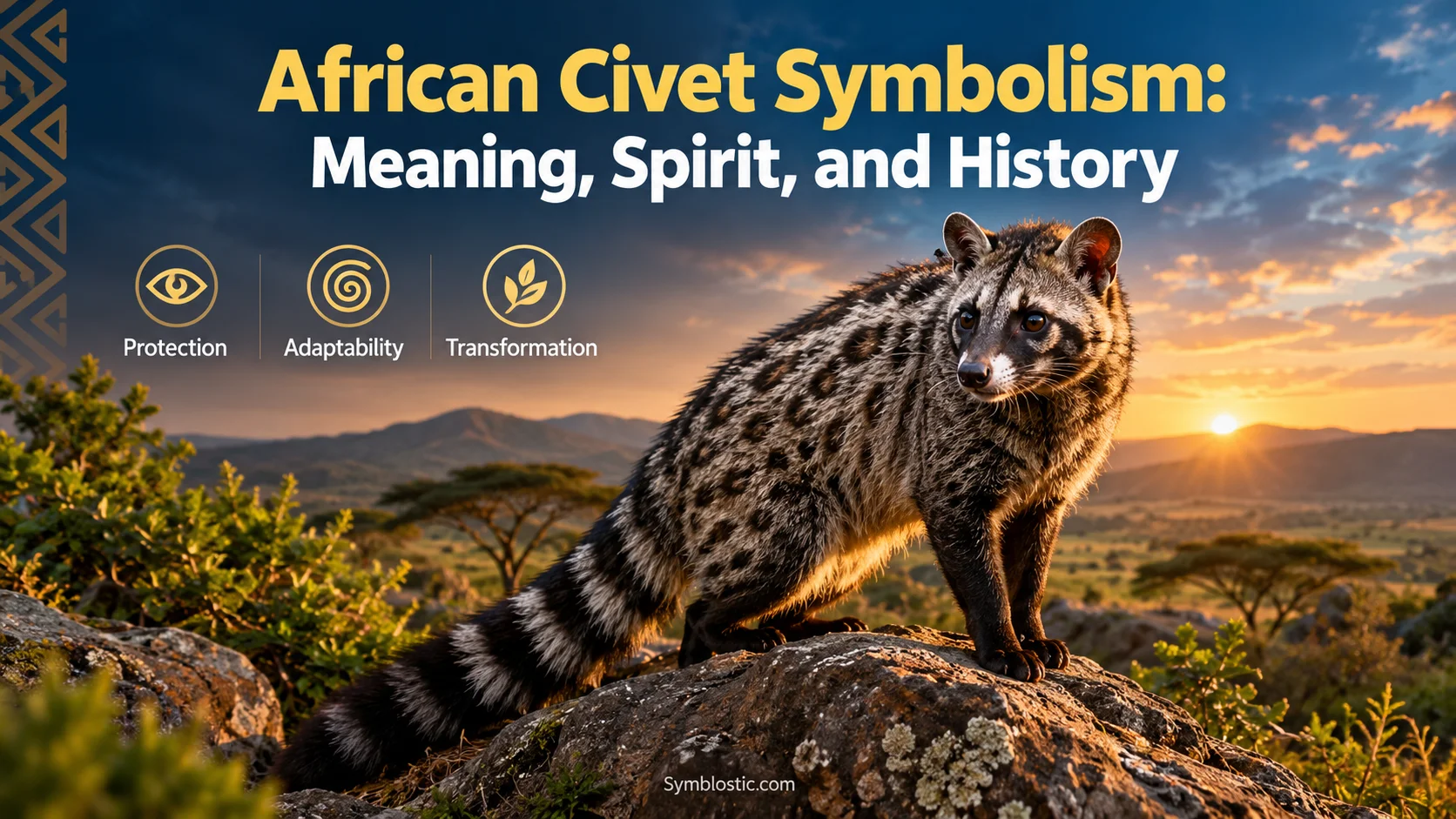
The African civet symbolism comes from a fascinating animal that lives mostly out of sight. With its spotted coat, masked face, strong scent, and nighttime habits, the African civet naturally invites ideas about mystery and hidden knowledge.
For American readers, the animal has an especially unusual place in symbolism. The African civet isn’t native to the United States, so most people encounter it through wildlife education, documentaries, zoos, photography, books, or discussions of traditional uses.
However, symbolic meanings don’t come from appearance alone. The civet’s behavior also shapes interpretation. It is mainly nocturnal, usually solitary, and highly dependent on scent to communicate and mark territory.
Because of these traits, the African civet can represent quiet confidence, personal boundaries, adaptability, and awareness of things that aren’t immediately visible.
Quick Answer
African civet symbolism commonly represents mystery, independence, adaptability, hidden awareness, and the power of using subtle strengths. In a spiritual context, some people interpret the animal as a reminder to trust your senses and move carefully through uncertain situations.
TL;DR
- The African civet symbolizes mystery, solitude, awareness, and adaptability.
- Its nighttime behavior connects it with the hidden and unknown.
- Its scent marking can represent identity and personal boundaries.
- In America, it is mainly viewed through wildlife and cultural education.
- Civet musk has a long history in fragrance and traditional practices.
- Modern interpretations often focus on quiet strength and observation.
What Does the African Civet Symbolize?
The African civet has several symbolic meanings based on its physical traits and behavior. Its symbolism is especially connected to what happens beyond ordinary human attention.
Mystery and the Unknown
The civet is active mainly at night. It spends much of the daytime hidden in vegetation or sheltered places.
As a result, it can symbolize the parts of life that remain unseen.
This doesn’t necessarily mean something negative. Instead, mystery can represent curiosity, intuition, privacy, and the willingness to explore unfamiliar territory.
Independence and Quiet Strength
African civets are generally solitary animals. They don’t depend on large groups to survive.
Symbolically, this can represent someone who feels comfortable standing alone. The message is less about isolation and more about self-reliance.
The Main Symbolic Associations
People who interpret the African civet symbolically may connect it with:
- Mystery and hidden knowledge
- Independence and self-reliance
- Adaptability during uncertain situations
- Awareness of surroundings
- Personal boundaries and identity
- Quiet confidence instead of attention-seeking
These meanings are interpretations rather than universal rules. A person’s culture and personal experience can change what the animal represents.
African Civet Appearance and Its Symbolic Meaning
The African civet has a striking appearance that makes it easy to interpret symbolically. Its long body, short legs, dark facial markings, spots, stripes, and raised dorsal crest create a distinctive visual identity.
Spots, Stripes, and Contrast
Its patterned coat can suggest camouflage and complexity. The animal doesn’t have a simple appearance that immediately blends into every environment.
Symbolically, this can represent having multiple sides to your personality. It may also suggest that appearances don’t always reveal the whole story.
The Raised Crest
When threatened, an African civet can raise its crest. This makes the animal appear larger and more intimidating.
That behavior creates an interesting symbolic lesson. Strength doesn’t always require attacking first.
Instead, sometimes confidence means making your boundaries clear before conflict develops.
A Face That Looks Like a Mask
The civet’s facial markings can resemble a natural mask. Symbolically, masks often represent privacy, hidden identity, or the difference between what people show and what they keep private.
For that reason, the civet can represent the idea that every person has an inner world others don’t immediately see.
Why Is the African Civet Associated With Mystery?
The strongest reason is simple: the African civet lives much of its life when humans are least active.
A Nocturnal Animal
African civets are predominantly nocturnal. Their activity often increases around sunset and continues into the night.
That behavior naturally connects the animal with darkness, quiet observation, and the unseen.
However, nighttime symbolism doesn’t automatically mean danger. Night can also represent rest, imagination, reflection, and freedom from social pressure.
Moving Without Drawing Attention
The civet is not an animal that relies on dramatic displays. It can move through vegetation while remaining difficult to observe.
This creates a useful symbolic contrast with animals commonly associated with dominance.
The civet suggests that being unnoticed can sometimes be an advantage.
For someone dealing with a complicated situation, that idea can feel powerful. You don’t always need to announce your next move.
Historical Roots of Civet Symbolism
Civet symbolism is closely connected with the animal’s long relationship with people. However, historical records don’t support one single worldwide meaning.
The History of Civet Musk
Civets produce a strongly scented secretion from specialized glands. The substance became valuable in fragrance traditions because small amounts could influence a perfume’s scent.
Civet material was used in parts of Africa and Asia and later became known in European markets. Historical sources describe civet as a substance used in perfume, medicine, and other scent-related practices.
Because fragrance was often associated with wealth and ceremony, civet became connected with ideas such as luxury, rarity, and sensuality.
From Practical Substance to Symbol
The history is important because symbolic meanings often grow from practical relationships.
People didn’t necessarily look at a civet and immediately decide it represented luxury. Instead, the animal’s unusual scent became valuable.
Over time, that association helped create a cultural connection between civets and rare or powerful fragrances.
A Complicated History
The history also has an uncomfortable side. Traditional collection of civet secretions sometimes involved keeping animals in captivity and handling them for their musk.
Modern attitudes toward animal welfare have changed how many people view this practice.
That shift matters when discussing civet symbolism today.
African Civet Symbolism in the United States
The African civet has a different symbolic position in America than it does in places where civets are part of the local environment.
An Exotic Wildlife Symbol
In the United States, most people don’t encounter African civets in the wild. Instead, they may learn about them through zoos, wildlife programs, nature photography, documentaries, or educational materials.
Because of this, American symbolism tends to focus on the animal’s unusual traits.
The civet can therefore represent exotic nature, wilderness, mystery, and biodiversity.
A Symbol of the Unfamiliar
American culture often uses unfamiliar animals as symbols of exploration. The African civet fits this pattern because many Americans have never seen one outside photographs or controlled settings.
Its unfamiliarity can encourage curiosity about African ecosystems.
Nature Education and Conservation
Today, the animal can also symbolize the importance of understanding less famous species.
People often recognize lions, elephants, giraffes, and cheetahs first. The civet represents a quieter part of African wildlife.
That makes it useful as a symbol of overlooked nature.
| Context | Meaning in the USA | Common Association | Notes |
| Wildlife education | Curiosity and biodiversity | African ecosystems | Often presented as an unusual nocturnal mammal |
| Tattoos | Mystery and independence | Individual identity | Meaning depends heavily on the design |
| Fragrance history | Rarity and sensuality | Traditional perfume | Modern views also consider animal welfare |
| Spiritual interpretation | Intuition and awareness | Night and hidden knowledge | Personal belief shapes interpretation |
| Art and decor | Exotic nature | Wilderness and visual contrast | Often chosen for its distinctive appearance |
African Civet Spiritual Meaning
Spiritual interpretations of the African civet usually focus on its natural behavior rather than a single religious doctrine.
Trusting Your Senses
The civet relies heavily on smell and other senses while moving through darkness.
Symbolically, this can suggest paying attention to information that isn’t immediately visible.
For some people, that becomes a reminder to slow down and notice subtle signals.
Protecting Your Personal Space
The animal uses scent marking to communicate territory.
In symbolic language, this can represent healthy boundaries. It suggests knowing what belongs to you and communicating where your limits are.
Moving Through Uncertainty
Night is an important part of the civet’s world.
Spiritually, some people interpret this as a metaphor for moving through uncertain periods without knowing every answer in advance.
The lesson isn’t necessarily to fear darkness. Instead, it can encourage patience, observation, and careful movement.
African Civet Symbolism in African Cultural Contexts
It is important not to describe Africa as having one single belief system. The continent contains thousands of communities, languages, histories, and traditions.
Diverse Local Meanings
Historical and modern research shows that African carnivores, including civets, have been used in different cultural settings.
Some communities have used animal parts, skins, or other materials in traditional practices. The reasons vary by place and tradition.
Therefore, claims that every African culture considers the civet a particular sacred symbol would be misleading.
Strength and Prestige
Research on wildlife use in parts of Central Africa records civet materials appearing in cultural contexts.
In some settings, animal skins have been associated with strength, prestige, ceremony, or social identity.
These examples should be understood as local traditions rather than universal African symbolism.
Respecting Cultural Differences
A responsible interpretation avoids turning a complex tradition into a simple spiritual label.
For American readers, this distinction is useful. It shows that symbolism develops from specific communities and histories rather than from a universal dictionary of meanings.
Read More: Grosbeak Symbolism: Meaning, Spirit & History
Emotional and Psychological Meaning of the African Civet
Animal symbolism often works because people recognize their own emotions in animal behavior.
When the Civet Represents Solitude
Someone who enjoys privacy may identify with the civet’s solitary lifestyle.
The symbol can suggest that being alone isn’t always loneliness. Sometimes solitude provides space to think, recover, create, or make decisions.
When It Represents Caution
The civet’s nighttime behavior can also suggest careful observation.
A person may use the symbol when they value thinking before acting. It can represent awareness without unnecessary confrontation.
When It Represents Hidden Strength
The civet isn’t visually dominant like a lion. Yet it has physical defenses and distinctive behaviors that help it survive.
This creates a powerful psychological message:
You don’t have to look powerful to possess strength.
That idea can appeal to people who prefer calm confidence over loud displays.
African Civet Symbolism in Dreams
Dream interpretations involving animals are highly personal. There isn’t one scientifically established meaning for dreaming about an African civet.
Still, symbolic traditions often use the animal’s traits as starting points.
Seeing a Civet in the Dark
A civet appearing at night might symbolize something you haven’t fully understood.
It could represent curiosity about an uncertain situation. It might also reflect a desire to explore something privately.
A Civet Watching You
If the animal seems to be observing you, the dream may feel connected with awareness.
Symbolically, this can suggest that you are paying closer attention to your surroundings or to something you previously ignored.
An Aggressive or Threatened Civet
A defensive civet can represent boundaries.
The image may remind you of a situation where you feel pressured or where you need to communicate your limits more clearly.
Dream symbolism should be treated as reflection rather than prediction.
African Civet Symbolism in Tattoos and Art
The African civet’s appearance makes it an unusual choice for visual symbolism.
Tattoo Meanings
A civet tattoo may be chosen to express:
- Independence without isolation
- Mystery and private knowledge
- Connection with wild places
- Adaptability during difficult periods
- Appreciation for unusual animals
- Quiet strength and personal boundaries
The design can change the meaning significantly.
For example, a moonlit civet may emphasize mystery. A detailed wildlife portrait may focus more on nature and conservation.
Art and Home Decor
Civet imagery can also work in nature-inspired interiors.
Its spotted coat creates a strong visual pattern, while its association with nighttime wildlife gives artwork a more mysterious character.
However, using an animal image doesn’t automatically mean the owner follows a spiritual tradition. Sometimes the appeal is simply aesthetic.
Civet Musk, Perfume, and the Meaning of Scent
Scent is one of the most important parts of civet history.
Why Civet Musk Became Valuable
Civet secretion has been used historically in perfumery. Its strong smell can seem unpleasant when concentrated, but it can contribute to complex fragrance blends in very small amounts.
This unusual contrast helped give civet a fascinating cultural reputation.
Symbolic Meaning of Scent
Scent is invisible, yet it can strongly affect memory and emotion.
That makes civet symbolism especially interesting. The animal can represent influence without visibility.
Something doesn’t have to be seen to leave a lasting impression.
Modern Ethical Considerations
Modern fragrance practices have changed substantially, and animal welfare is now an important concern.
Consumers may also encounter synthetic alternatives designed to reproduce aspects of traditional fragrance materials.
This has shifted civet symbolism from luxury alone toward questions about ethics, nature, and responsible use.
Misunderstandings and Controversies
Civet symbolism can become misleading when different species, cultures, or traditions are mixed together.
Civets Are Not Cats
Despite the old common name “civet cat,” African civets are not members of the cat family.
They belong to the family Viverridae, a group of carnivorous mammals that includes civets and related species.
Calling every civet a “cat” can therefore create confusion.
Not Every Civet Has the Same Symbolism
There are several civet species across Africa and Asia.
Their behaviors, habitats, cultural histories, and relationships with people aren’t identical.
Therefore, symbolism associated with one species shouldn’t automatically be assigned to another.
Avoiding Universal Spiritual Claims
Modern websites sometimes describe animal symbolism as if every culture agrees on the same spiritual message.
That approach is too simple.
African civet symbolism is better understood as a collection of interpretations influenced by behavior, history, local traditions, and modern spiritual practices.
How African Civet Symbolism Has Changed Over Time
The meaning of the civet has never remained completely fixed.
From Useful Animal to Symbol
Historically, people interacted with civets for practical reasons. Their meat, skins, scent, and other materials could have cultural or economic value in particular regions.
Today, many people encounter the animal primarily as wildlife.
That change has moved attention toward ecology and conservation.
From Luxury to Ethical Awareness
Civet musk once carried strong associations with valuable fragrance.
Modern audiences are more likely to ask how such materials were obtained and whether animals were harmed.
As a result, the symbolism can now include both luxury history and ethical reflection.
From Mystery to Personal Identity
Modern spiritual interpretations often focus on personal qualities.
The civet may represent someone who is private, observant, adaptable, and comfortable working outside the spotlight.
That interpretation fits contemporary interest in animal symbolism as a form of personal identity.
What Does the African Civet Teach Us Today?
The most useful symbolic lessons come from observing the animal rather than forcing a mystical meaning onto it.
Quiet Doesn’t Mean Weak
The civet isn’t a loud or highly social animal.
Yet it has effective ways to protect itself and communicate.
This can symbolize confidence without constant attention.
Privacy Can Be Valuable
Modern life encourages people to share almost everything.
The civet offers a very different image.
Its symbolism can remind you that some experiences, plans, and emotions can remain private.
Adaptability Matters
The animal survives in environments where careful movement and awareness matter.
For a modern reader, this can represent staying flexible when circumstances change.
The deeper message is simple: you can move carefully without standing still.
FAQs:
What does an African civet symbolize spiritually?
It can symbolize mystery, intuition, awareness, independence, and personal boundaries. These spiritual meanings are modern interpretations rather than universal religious teachings.
What does seeing a civet mean?
A civet encounter may simply be a wildlife experience, especially in areas where the species occurs naturally. Symbolically, some people connect seeing one with paying attention to hidden details or trusting their instincts.
Is the African civet a good symbol?
Yes, it can be a positive symbol of adaptability, privacy, observation, and quiet strength. Its meaning depends on the context and the person using the symbol.
What does a civet symbolize in dreams?
A civet in a dream may represent mystery, solitude, caution, or something operating outside your normal awareness. The details of the dream matter more than any fixed interpretation.
Why is the civet associated with perfume?
Civets produce a strong glandular secretion that historically became valuable in perfumery. This history helped associate civets with fragrance, rarity, luxury, and sensuality.
Is a civet the same as a cat?
No. African civets aren’t cats, although their older common names sometimes include “civet cat.” They belong to the viverrid family.
Conclusion:
African civet symbolism centers on mystery, independence, awareness, adaptability, and quiet strength. Its nighttime lifestyle makes it a natural symbol for hidden things, while its solitary behavior can represent self-reliance and personal space.
In the United States, the African civet is mainly understood through wildlife, nature education, art, fragrance history, and modern spiritual interpretation. Its meaning is therefore different from traditions that developed in regions where civets live alongside people.

1 thought on “African Civet Symbolism: Meaning, Spirit, and History”