
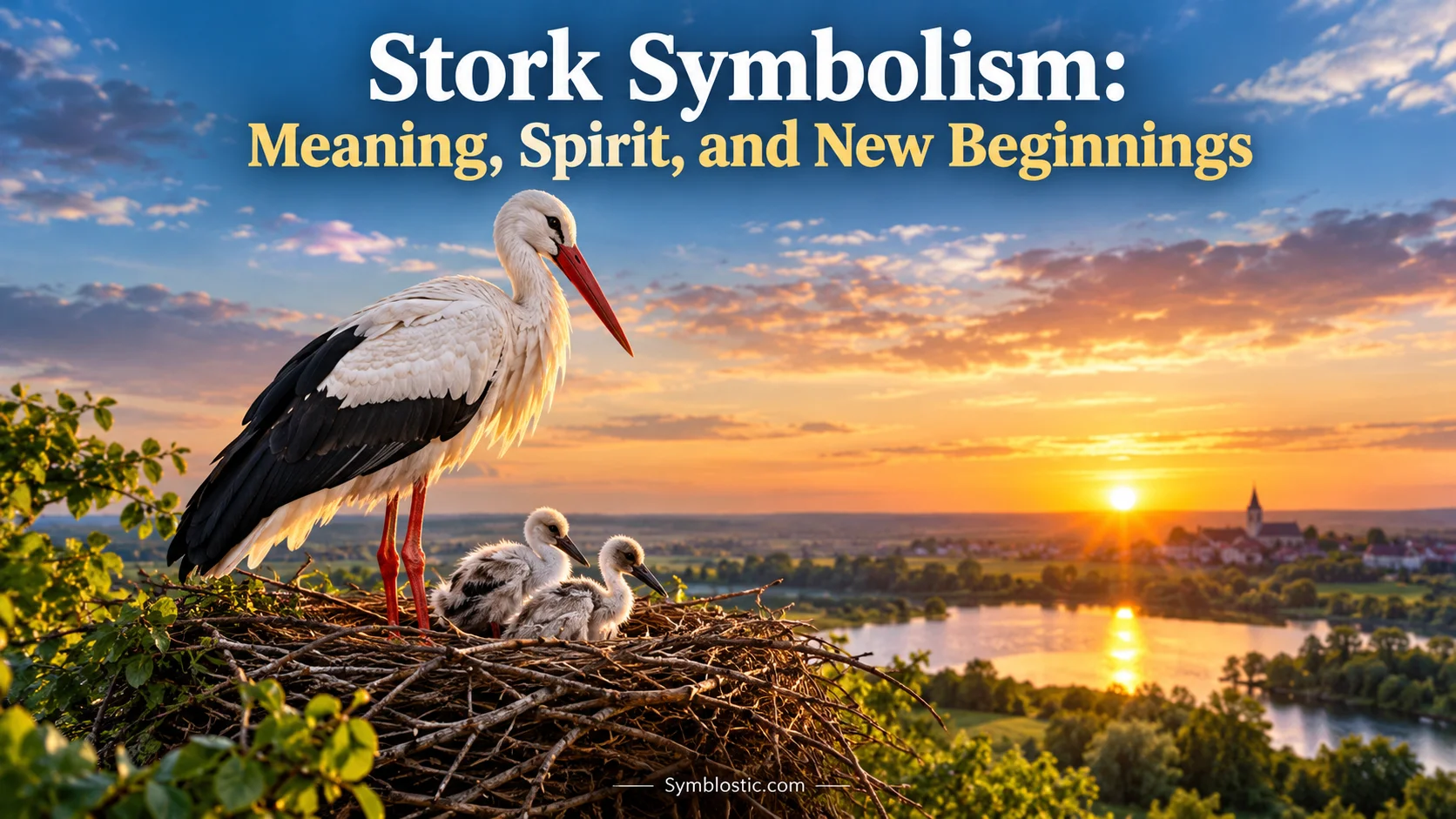
A stork is more than a tall, graceful bird with long legs and a striking beak. Across stories, artwork, and popular traditions, it often represents birth, family, good fortune, and the promise of a fresh start. For many Americans, the stork is especially familiar as the legendary bird that delivers newborn babies.
However, stork symbolism reaches beyond this familiar story. Its appearance in a nest, its careful movements through wetlands, and its seasonal journeys can inspire thoughts about patience, protection, loyalty, and change. These associations make the bird meaningful in family celebrations, spiritual reflection, and nature-inspired art.
The meaning also depends on context. A stork flying across the sky might suggest freedom or a new journey, while one standing beside its nest may bring family and home to mind. Understanding these different interpretations helps you appreciate why this bird remains such a recognizable symbol in American culture and beyond.
Quick Answer
Stork symbolism in the United States most commonly represents birth, new beginnings, family, hope, and good fortune. In broader cultural and spiritual interpretations, the stork may also suggest renewal, patience, protection, and the arrival of positive change.
TL;DR
- Birth: The stork is famously associated with delivering newborn babies.
- Family: Its nest often represents home, care, and parental protection.
- Renewal: Its movements and seasonal journeys suggest fresh beginnings.
- Good fortune: Some traditions connect storks with prosperity and favorable change.
- Spiritual growth: The bird can represent patience, awareness, and life’s transitions.
- Modern meaning: Stork images appear in baby announcements, nursery art, tattoos, and family gifts.
What Does a Stork Symbolize?
Storks have a distinctive appearance that makes them easy to recognize. Their long legs, pointed bills, broad wings, and tall bodies create an image of elegance and alertness. Depending on the species, their feathers may be mostly white, black, or a combination of both.
In symbolic art, these physical features often support ideas about grace, watchfulness, movement, and the ability to adapt. However, these meanings come from human interpretations rather than a universal symbolic code.
The Main Symbolic Meanings
The most familiar associations include:
- Birth and creation: The arrival of a baby or the beginning of something new.
- Family and protection: Caring for children, maintaining a home, and supporting loved ones.
- Hope and renewal: A new chapter after uncertainty, loss, or change.
- Good fortune: The possibility of happiness, abundance, or welcome news.
- Patience and awareness: Observing carefully and waiting for the right moment.
These meanings can overlap. For example, someone decorating a nursery with a stork may be celebrating both a new child and the hope of a loving family life.
Why the Stork Is Such a Recognizable Symbol
Few birds have a popular story as closely connected to one life event as the stork does to childbirth. That association gives it a clear meaning even for people who know little about birds or folklore.
At the same time, the stork’s natural behavior offers other points of connection. Its nest-building, parental care, and long-distance movements provide familiar images of responsibility, preparation, and change.
Stork Symbolism in American Culture
In the United States, the stork is most strongly linked with babies, pregnancy announcements, and family celebrations. The image appears in greeting cards, nursery decorations, birth announcements, and gifts for expecting parents. It offers a gentle, playful way to celebrate a major life event.
However, American stork symbolism isn’t limited to childbirth. Its familiar image can also express optimism, family continuity, and the excitement of welcoming someone into a household.
The American Baby-Delivery Tradition
The story of a stork carrying a baby in a cloth bundle is widely recognized in American popular culture. Illustrations often show the bird holding a small bundle in its long beak and flying toward a waiting family.
This story gives adults a simple, child-friendly way to talk about birth. Historically, adults in many societies used folklore to explain reproduction to children without discussing the subject in detail.
Today, the image is usually playful rather than literal. Parents may use it on invitations, baby shower decorations, or announcement cards to communicate happy news.
Family, Home, and Celebration
The stork also works as a symbol of family life because it naturally builds nests and raises young. These behaviors make it an appealing image for people celebrating a new stage of family life.
Common American uses include:
- Baby shower invitations featuring a stork carrying a bundle.
- Nursery wall art representing a child’s arrival.
- Birth announcements shared with friends and relatives.
- Keepsake ornaments marking a baby’s first year.
- Greeting cards celebrating pregnancy, adoption, or a growing family.
The traditional baby-delivery image doesn’t need to define every use. A stork can also represent the wider experience of building a home, caring for others, and embracing change.
Historical Origins of Stork Symbolism
The history of stork symbolism includes ancient stories, European folklore, and changing ideas about family life. Although the familiar baby-delivery image feels timeless, its popularity developed gradually through different cultural traditions.
Ancient Greek and Roman Beliefs
In ancient Greek and Roman writing, storks were sometimes presented as examples of care between parents and children. Stories claimed that young storks repaid their parents’ care when the older birds became weak.
These accounts helped connect the bird with family duty, gratitude, and respect for older generations. They also show how people used animal behavior to teach human values.
However, ancient stories shouldn’t automatically be treated as scientific observations. Some details reflected the beliefs and moral lessons of their authors rather than verified bird behavior.
European Folklore and the Baby Legend
The familiar baby-delivery story became especially influential in northern and central Europe. White storks often nested near human homes, including rooftops and chimneys, making them visible parts of everyday life.
Their seasonal return also offered a natural connection to spring, fertility, and new life. Over time, folklore developed the idea that storks carried babies to waiting families.
The Danish writer Hans Christian Andersen helped popularize the story through his fairy tale The Storks, published in the nineteenth century. Later illustrations, children’s books, advertisements, and cartoons spread the image internationally.
How the Legend Reached American Popular Culture
American audiences inherited the story through European cultural traditions and mass entertainment. During the nineteenth and twentieth centuries, the stork became a convenient image for discussing childbirth with children.
The story also suited greeting cards and printed announcements because one simple picture communicated a major family event. As a result, the stork became familiar even to Americans living far from the bird’s natural habitat.
Spiritual Meaning of a Stork
Spiritually, the stork can represent renewal, patience, family protection, and the arrival of a new chapter. These interpretations are personal and cultural, not universal rules that every spiritual tradition shares.
For people who enjoy finding meaning in nature, the bird can serve as a reminder to notice change and welcome opportunities for growth.
A Symbol of New Life
The stork’s strongest spiritual association is the beginning of life. Because its traditional image is connected with newborn children, it may represent the creation of something precious or the start of a meaningful journey.
This doesn’t have to mean pregnancy or parenthood. A person starting a career, moving to a new home, or recovering confidence after a difficult period might also find the symbolism meaningful.
A Reminder to Practice Patience
Storks spend time searching for food, caring for their young, and maintaining their nests. These ordinary behaviors can inspire a symbolic lesson about preparation and steady effort.
Rather than expecting every change to happen immediately, the stork may encourage you to build a strong foundation. In this interpretation, progress comes through consistent care instead of rushing toward a result.
Protection and Family Bonds
A stork near its nest can evoke the desire to protect what matters most. Its symbolism may therefore resonate with parents, caregivers, and people who value close family connections.
Still, seeing a stork doesn’t prove that a spiritual event is taking place. You can appreciate its personal meaning without treating it as a prediction or supernatural guarantee.
Stork Symbolism Across Different Cultures
Stork traditions vary across regions, and the bird’s meaning can change depending on local history. Looking at these differences helps American readers understand that familiar symbolism isn’t necessarily universal.
European Traditions
Across parts of Europe, storks became associated with childbirth, fertility, good fortune, and household well-being. In some communities, a stork nesting on a roof was considered a welcome sign.
The birds’ return in spring helped reinforce associations with renewal and continuity. Their visible nests also made them familiar symbols of home and family life.
Ancient Egyptian Connections
Ancient Egyptian art and religious ideas included several large wading birds associated with creation, the soul, and cycles of life. However, identifying every such bird as a stork would be misleading.
The deity Bennu, often connected with creation and renewal, is generally represented as a heron-like bird, not securely identified as a stork. This distinction matters because popular accounts sometimes blend different bird traditions into one simplified story.
Other Cultural Interpretations
Different societies have developed their own stories about birds, fertility, and family care. Some traditions associate storks with prosperity or favorable events, while others emphasize their seasonal movements and relationship with the natural world.
However, it’s important not to assign one meaning to an entire continent, religion, or ethnic group. Local stories differ, and some modern spiritual interpretations have no established historical connection to a particular tradition.
Stork Symbolism and Emotional Meaning
A stork can bring up feelings of hope, tenderness, anticipation, and belonging. In the United States, these emotions often arise because the bird is linked with pregnancy announcements and welcoming a new child.
However, personal experiences shape symbolism just as much as shared cultural stories do. Someone who remembers a stork decoration from childhood may feel nostalgia, while another person may connect the bird with a fresh start.
Hope and Anticipation
The image of a stork carrying a baby suggests that something wonderful is on its way. Consequently, people may associate it with looking forward to a better future.
This meaning can apply to many kinds of change, including a new relationship, a creative project, or a major personal milestone.
Care and Responsibility
The nest can symbolize the work involved in creating a secure home. It reminds people that love often requires attention, time, and practical support.
For parents and caregivers, this interpretation may feel especially relevant. It recognizes that family life involves both joyful beginnings and everyday responsibilities.
Nostalgia and Childhood Memories
The stork often appears in classic illustrations, children’s stories, and family keepsakes. Therefore, it can bring back memories of childhood or a family’s earlier stages.
For some people, the image feels comforting and familiar. Others may see it as old-fashioned, especially when they prefer more direct language about childbirth and family life.
What Does Seeing a Stork Mean?
Seeing a stork can inspire thoughts about change, family, or new opportunities, especially if you already associate the bird with renewal. Its meaning depends on where you see it and what it brings to mind.
In the United States, actual stork sightings are less common in many regions than sightings of familiar backyard birds. However, wood storks live in parts of the southeastern United States, particularly around wetlands and coastal habitats.
Seeing a Stork in Nature
A stork standing in shallow water may suggest patience and awareness because the bird appears focused on its surroundings. Watching one fly overhead may inspire thoughts of freedom, movement, or a transition into a new phase.
These are reflective interpretations rather than established predictions. The bird’s presence alone doesn’t indicate that a particular event will happen.
Seeing a Stork Near Your Home
In European folklore, a stork nesting on a house could symbolize good fortune and the possibility of a new child. In modern American life, a stork image near a home may similarly evoke family happiness and welcoming new beginnings.
If you encounter a real stork near your property, however, its presence has a natural explanation. The area may offer suitable nesting locations, food, or wetland habitat.
Seeing a Stork Repeatedly
Some people interpret repeated encounters with the same animal as an invitation to reflect on a personal theme. If you keep noticing storks, you might consider whether family, responsibility, or change has become important in your life.
Still, repetition doesn’t establish a supernatural message. You can use the experience as a prompt for reflection without assuming the future has been revealed.
Read More: Manakin Symbolism: Meaning, Spirit, and Hidden Wisdom
Stork Symbolism in Dreams
A stork appearing in a dream may bring family, creativity, renewal, or responsibility to mind. However, dreams don’t have one fixed meaning, and their significance depends on the dreamer’s experiences and feelings.
Dreaming of a Stork Carrying a Baby
This image may reflect thoughts about parenthood, family expansion, or a new responsibility. It could also symbolize an idea or project that you’re preparing to develop.
The dream doesn’t predict pregnancy or guarantee that a particular wish will come true. Consider what the image means to you and what changes you’re currently experiencing.
Dreaming of a Stork’s Nest
A nest may suggest safety, belonging, and the need to create a stable foundation. If the nest contains chicks, you might connect it with caring for someone or nurturing a new opportunity.
By contrast, an empty nest could bring up independence, transition, or memories of a previous stage of life. Your emotional response to the dream often matters more than the image alone.
Dreaming of a Flying Stork
A flying stork may symbolize movement, hope, or the desire to move forward. If the bird seems calm, the dream might feel reassuring; if it appears lost, it may reflect uncertainty.
Rather than searching for a single universal answer, think about the dream’s setting and your own associations. That approach allows the symbolism to remain personal rather than turning it into a prediction.
Stork Symbolism in Tattoos, Art, and Home Decor
Stork imagery offers a recognizable way to express family values, personal growth, and affection. In modern America, it appears in nursery decorations, illustrations, keepsakes, and sometimes tattoos chosen to mark important life experiences.
Stork Tattoos
A stork tattoo can represent the arrival of a child, the importance of family, or a major personal transition. Some people may choose a realistic bird, while others prefer a simple outline or a traditional baby-carrying design.
Common interpretations include:
- Family commitment: A lasting reminder of loved ones and shared responsibilities.
- New beginnings: A symbol of rebuilding, growth, or starting a different chapter.
- Parenthood: A personal tribute to welcoming or raising a child.
- Hope and resilience: A reminder to keep moving through periods of change.
The meaning ultimately belongs to the person wearing the tattoo. A stork doesn’t automatically communicate one specific life story to everyone who sees it.
Nursery Art and Home Decorations
Stork illustrations remain popular in nurseries because they communicate the idea of a new baby immediately. Soft colors, clouds, nests, and bundled infants often create a gentle, welcoming design.
However, the bird can also appear in broader nature-themed decorations. A realistic stork painting may reflect an interest in wildlife, wetlands, or the beauty of long-legged wading birds rather than childbirth.
Social Media and Birth Announcements
On social media, the stork can work as a visual shorthand for pregnancy news, birth announcements, and family celebrations. Its meaning is easy to recognize, making it useful when a short caption accompanies a photograph.
Some families choose the traditional image because it feels nostalgic. Others prefer photographs or personal illustrations that better reflect their own experiences.
Positive and Negative Meanings of Stork Symbolism
Stork symbolism is generally positive in modern American popular culture. Birth, hope, family, and good fortune dominate its familiar image, although older stories sometimes include darker themes.
Positive Associations
The most common positive meanings include:
- Welcoming a new family member.
- Celebrating love and parental care.
- Finding hope during a period of change.
- Building a secure and supportive home.
- Appreciating patience and the return of new opportunities.
These associations are flexible enough to suit both family celebrations and personal reflection.
Complicated or Negative Associations
Some older European tales used the stork to reward good behavior or punish wrongdoing. In certain versions of Andersen’s The Storks, the story includes the delivery of a dead infant as a punishment within the tale.
That darker element is rarely central to modern American stork decorations. Nevertheless, it shows that folklore can contain moral lessons and troubling ideas alongside comforting images.
The symbolism can also feel uncomfortable when people treat childbirth as the only meaningful form of family life. Not everyone wants children, and not every family follows the same path.
A respectful modern interpretation leaves room for different experiences, including adoption, chosen family, infertility, loss, and child-free living. The stork may symbolize renewal and care without implying that parenthood is necessary for a fulfilling life.
Stork Symbolism in American Wildlife and Nature
Beyond folklore, storks have a real place in American wildlife. The wood stork is a native wading bird found in parts of the southeastern United States, where it depends on wetlands for feeding and nesting.
This natural connection adds another layer to the bird’s symbolism. For some Americans, a stork can represent the importance of protecting wildlife, preserving habitats, and respecting the natural cycles that sustain life.
The Wood Stork in the United States
The wood stork differs in appearance from the familiar white stork shown in baby-delivery illustrations. It has a mostly white body, black flight feathers, and a dark, slightly curved bill.
Wood storks feed in shallow wetlands, where they catch fish and other small aquatic animals. Their dependence on suitable feeding and nesting areas makes wetland conservation important to their future.
A Symbol of Balance and Conservation
In nature-inspired art, the wood stork may represent the connection between wildlife and healthy ecosystems. Its presence can encourage people to think about habitat protection and the responsibility humans share toward the natural world.
This interpretation differs from traditional European baby folklore. Rather than focusing on family expansion, it emphasizes ecological balance, awareness, and the protection of living things.
How Stork Symbolism Has Changed Over Time
Stork symbolism has evolved as societies have changed their relationships with nature, family, and childhood. What began as a collection of local stories gradually became an internationally recognizable image of birth.
From Folk Belief to Children’s Story
In older European traditions, storks were associated with family duty, seasonal change, and household fortune. Their visible nests and predictable migrations made them natural subjects for stories about life and renewal.
Later, fairy tales and children’s literature helped popularize the idea that storks delivered babies. The nineteenth century was especially important because the story offered families a gentle explanation for childbirth at a time when adults often avoided discussing reproduction openly with children.
From Children’s Stories to Modern Family Celebrations
During the twentieth century, the stork became familiar through cartoons, printed cards, nursery products, and advertising. These images made the bird recognizable even to people who had never seen a real stork.
Today, the symbol remains useful because it communicates a joyful event quickly. At the same time, its meaning has expanded to include broader ideas of hope, caregiving, and fresh beginnings.
A Modern, More Inclusive Interpretation
Modern readers can appreciate the stork’s history without accepting every traditional assumption attached to it. The bird can celebrate a new child, but it can also represent creativity, personal growth, and the start of a new chapter.
This broader interpretation keeps the symbol meaningful for different households and life experiences. It also separates a charming folk story from biological facts and personal beliefs.
Stork Symbolism at a Glance
The same stork image can communicate different ideas depending on its setting. This comparison summarizes common interpretations in American culture and broader symbolic traditions.
| Context | Common Meaning | Typical Association |
| Baby announcement | Birth and celebration | Welcoming a newborn |
| Nest near a home | Family and good fortune | European folklore |
| Flying stork | Change and renewal | Movement into a new chapter |
| Stork tattoo | Personal growth or family bonds | Individual identity |
| Stork in a dream | New responsibilities or hope | Personal reflection |
| Wood stork in wetlands | Wildlife protection | Conservation and ecological balance |
These meanings are interpretive, not universal. A stork’s significance depends on cultural background, personal experience, and the context in which the bird appears.
FAQs:
What Does a Stork Symbolize Spiritually?
A stork may symbolize new beginnings, family care, patience, and renewal. Some people also interpret it as a reminder to welcome change, although spiritual meanings vary between individuals and traditions.
Why Is a Stork Associated With Babies?
The association developed largely through European folklore, especially traditions in northern Europe. Stories about migrating storks and their nesting behavior eventually inspired the idea that the birds delivered newborns to families.
Is Seeing a Stork a Sign of Good Luck?
Some European traditions considered a stork near a home a sign of good fortune. Today, people may interpret a sighting positively, but there is no evidence that seeing one predicts future events.
What Does a Stork Tattoo Mean?
A stork tattoo can represent parenthood, family loyalty, hope, or a fresh start. Its meaning depends on the design and the personal experiences of the person wearing it.
What Does a Stork Mean in a Dream?
A stork in a dream may bring up themes of family, creativity, responsibility, or change. However, dreams don’t have fixed meanings, and a stork dream doesn’t predict pregnancy or a specific future event.
Are Storks a Symbol of Fertility?
Yes, storks are associated with fertility in several folk traditions, particularly those connected with European childbirth stories. This association is cultural rather than evidence that the birds influence human fertility.
What Does a Stork Nesting Near a House Mean?
In some European folklore, a stork nesting near a home symbolized prosperity, family happiness, or good fortune. In practical terms, a real stork chooses a nesting site based on habitat and other natural conditions.
Conclusion:
Stork symbolism brings together birth, family, hope, protection, and new beginnings. In the United States, the bird is best known for its traditional role in baby-delivery stories, but its wider meaning also includes personal growth, patience, and the importance of caring for others. Its history connects ancient family lessons, European folklore, children’s literature, and modern American celebrations.
Today, you can appreciate the stork as both a cultural symbol and a remarkable bird. Whether you encounter it in a nursery illustration, a tattoo, a dream, or a wetland, consider what it represents in your own life. Sometimes, its most meaningful message is simply to welcome change, nurture what matters, and remain open to a new chapter.

1 thought on “Stork Symbolism: Meaning, Spirit, and New Beginnings”