
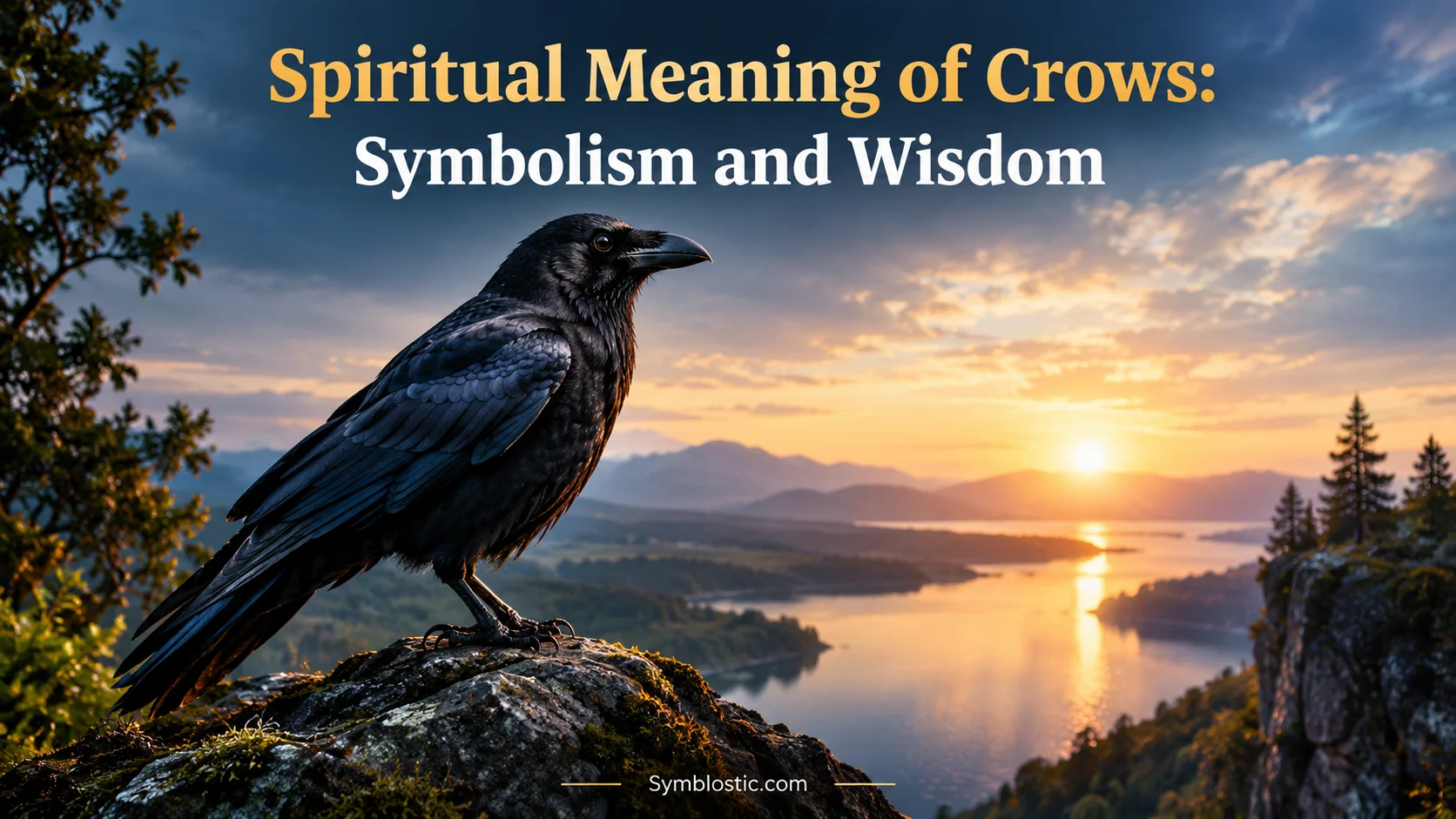
Crows have fascinated people for centuries because of their intelligence, dark feathers, and mysterious calls. The spiritual meaning of crows often centers on transformation, wisdom, intuition, and the connection between the known and unknown. In the United States, these familiar black birds appear in folklore, literature, art, and spiritual discussions.
Seeing a crow on a fence, hearing one call from a tree, or noticing several crows gathered together can make an ordinary moment feel meaningful. Some people interpret these encounters as reminders to pay attention, accept change, or trust their instincts. Others simply appreciate crows as remarkable animals with complex behavior.
However, crow symbolism doesn’t have one universal meaning. Interpretations vary across cultures, religious traditions, personal experiences, and historical periods. A crow may represent intelligence and adaptability to one person, while another may associate it with mystery, death, or an approaching transition.
Understanding this symbolism means looking beyond superstition. By exploring American folklore, older cultural traditions, psychology, and modern spiritual beliefs, you can discover why crows continue to capture the human imagination.
Quick Answer
The spiritual meaning of crows in American culture commonly includes intelligence, transformation, intuition, and mystery. In spiritual interpretations, a crow may symbolize a period of change, heightened awareness, or the need to examine a situation more carefully. Across different traditions, crows can also represent creation, prophecy, protection, or the boundary between life and death.
TL;DR
- Crows commonly symbolize intelligence, adaptability, mystery, and transformation.
- In American folklore, they often appear as clever, watchful, or mysterious birds.
- Spiritually, a crow may encourage reflection and awareness during uncertain times.
- Some cultures associate crows with creation, prophecy, ancestors, or spiritual knowledge.
- Crow encounters don’t automatically predict death, bad luck, or future events.
- Modern crow tattoos and artwork often express independence, resilience, and personal transformation.
What Do Crows Symbolize?
Crows are striking birds with glossy black feathers, strong beaks, and sharp, observant eyes. In the United States, their appearance often brings together ideas of intelligence, mystery, survival, and change. Their symbolism comes partly from real behavior and partly from stories people have told about them.
Intelligence and Awareness
Crows can recognize human faces, remember threats, and solve problems. Their ability to learn from experience makes them powerful symbols of observation and practical wisdom.
Spiritually, a crow may represent the importance of looking beyond first impressions. It can remind you to notice patterns, question assumptions, and respond thoughtfully instead of acting on impulse.
Transformation and Mystery
The crow’s dark feathers and familiar calls have long inspired mysterious associations. Because these birds appear in forests, fields, neighborhoods, and city streets, they can seem at home in many different worlds.
Their symbolic meanings often include:
- Wisdom: Learning from experience and paying attention to details.
- Transformation: Moving through change and adapting to new circumstances.
- Mystery: Exploring uncertainty and questions without easy answers.
- Resilience: Finding opportunities and surviving difficult conditions.
- Intuition: Listening to your instincts while remaining open to evidence.
These interpretations aren’t fixed rules. Your personal experiences and cultural background can influence which meaning feels most relevant.
Historical Origins of Crow Symbolism
Crow symbolism developed over many centuries through observation, oral storytelling, religious traditions, and literature. In America, these older associations overlap with European folklore and Indigenous knowledge, creating a complex picture rather than one shared belief.
Ancient Associations
In ancient Greek mythology, crows were associated with Apollo, a god connected with prophecy and knowledge. Stories involving Apollo linked the bird with messages, divine attention, and the consequences of human behavior.
However, ancient traditions didn’t always portray crows positively. Some stories connected them with betrayal, punishment, or unfavorable news. This mixture of admiration and suspicion helped establish the bird’s lasting symbolic complexity.
Folklore and Medieval Beliefs
In parts of medieval Europe, crows and ravens became associated with death, battlefields, and supernatural forces. Their scavenging behavior made them familiar sights around places where animals or people had died.
However, their presence also had practical explanations. These birds searched for food and adapted to human settlements, so their appearance near death didn’t mean they caused or predicted it.
How Older Beliefs Reached America
European settlers brought familiar bird superstitions and stories to North America. Over time, these ideas mixed with American literature, local folklore, and changing attitudes toward wildlife.
The result is a symbol that can represent either danger or intelligence. Today, both interpretations remain visible in American storytelling, although many people now appreciate crows primarily for their remarkable behavior.
Crow Symbolism in American Culture
In the United States, crows occupy an unusual place between everyday wildlife and symbols of the mysterious. They’re common enough to appear in suburban yards, parking lots, farms, and city parks, yet their dark appearance and loud calls still capture attention.
A Familiar American Bird
The American crow is widespread across much of the country. Its adaptability has helped it thrive in rural and urban environments, making it a familiar part of everyday American life.
For many Americans, crows suggest resourcefulness and survival. They make use of available food, recognize dangers, and adjust their behavior to changing surroundings.
Literature, Film, and Halloween
American popular culture often uses crows to establish a mysterious atmosphere. A crow perched on a bare branch can make a scene feel suspenseful without any dialogue.
Their black feathers also fit naturally into Halloween imagery, alongside bare trees, moonlit skies, and haunted houses. However, this association is largely a cultural and artistic convention, not proof that crows represent evil.
What Crows Can Represent in the United States
| Context | Common symbolic meaning | Why it resonates |
| Everyday wildlife | Adaptability and intelligence | Crows thrive in changing environments |
| Halloween imagery | Mystery and suspense | Their appearance suits gothic scenes |
| American literature | Knowledge or ominous warnings | Writers use their calls to shape mood |
| Personal spirituality | Change and awareness | Encounters can prompt reflection |
| Nature photography | Beauty and resilience | Their dark feathers create striking contrasts |
These meanings can overlap. A crow in a garden may simply be searching for food, while the same bird in a poem might represent an unanswered question.
Spiritual Meaning of Seeing a Crow
Seeing a crow can feel significant when it appears during a difficult decision, a personal transition, or a reflective moment. In contemporary spiritual interpretations, people often treat such encounters as invitations to pause and consider what’s happening in their lives.
A Reminder to Pay Attention
A crow’s alert behavior makes it a natural symbol of awareness. Spiritually, seeing one may encourage you to notice details you’ve overlooked or reconsider an assumption.
For example, if you’re facing a major decision, a crow encounter might remind you to gather information before choosing a direction. The meaning comes from your reflection, not from a proven supernatural message.
A Symbol of Change
Some spiritual traditions associate crows with transitions between life stages. Their appearance may feel especially meaningful when you’re ending a relationship, changing careers, moving homes, or developing a new sense of identity.
Rather than predicting what will happen, the crow can serve as a personal reminder that change is part of life. It may encourage patience, courage, and a willingness to learn.
A Personal Spiritual Interpretation
Consider three questions when a crow catches your attention:
- What was happening in your life when you noticed it?
- Which feeling did the encounter bring forward?
- Is there a practical decision or concern you need to examine?
Your answers may help you develop a meaningful interpretation without assuming the bird has delivered a literal message.
Spiritual Meaning of One Crow, Two Crows, or a Group
The number of crows you see sometimes influences modern spiritual interpretations. However, number-based meanings vary widely, and no universal tradition assigns the same message to every sighting.
Seeing One Crow
One crow is often interpreted as a symbol of independence, attention, or personal awareness. It may encourage you to trust your judgment while considering the facts.
For someone entering a new chapter, a single crow might represent the courage to make an individual choice. It doesn’t automatically mean loneliness, danger, or an approaching loss.
Seeing Two Crows
Some contemporary spiritual interpretations connect two crows with partnership, balance, or communication. This meaning can resonate when relationships or shared decisions are on your mind.
However, two crows may simply be a bonded pair or members of the same social group. Their natural behavior provides a useful alternative to a supernatural explanation.
Seeing Many Crows Together
Large groups of crows can gather at feeding sites or communal roosts. In spiritual symbolism, people may interpret their presence as a sign of community, collective awareness, or the importance of cooperation.
Their gathering can also feel intense because of the noise and movement involved. Understanding their social behavior can make the experience fascinating without making it frightening.
Crow Symbolism in Indigenous and Other Cultural Traditions
Crow and raven stories appear in many cultures, but their meanings aren’t interchangeable. In particular, Indigenous nations across North America have distinct histories and teachings, so it’s important to avoid treating them as one tradition.
Indigenous North American Traditions
In some Indigenous storytelling traditions, ravens and other corvids appear as creators, tricksters, teachers, or agents of change. These stories may explain the world’s origins, explore human behavior, or communicate knowledge about relationships with the natural world.
However, stories differ by nation and community. Raven traditions among some Pacific Northwest peoples, for example, shouldn’t automatically be presented as beliefs shared by every Native American nation.
Celtic and European Folklore
Crows and ravens appear in European folklore, including stories involving battle, fate, prophecy, and supernatural knowledge. In some Celtic narratives, ravens are associated with powerful figures and the aftermath of conflict.
These associations helped reinforce the bird’s connection with mystery. Yet European traditions also recognize corvids as clever, watchful creatures, showing that their symbolism isn’t exclusively negative.
Spiritual Interpretations in Other Cultures
In Japanese cultural and religious contexts, the three-legged crow known as Yatagarasu is associated with divine guidance in certain traditions. In parts of South Asia, crows also appear in ancestral observances, including Hindu practices that honor departed relatives.
These examples illustrate how one family of birds can carry different meanings across societies. Their significance depends on the particular story, religious practice, or community involved.
Read More: Spiritual Meaning of Ear Ringing: Signs and Symbolism
The Psychological Meaning of Crows
A crow can trigger strong emotions because people naturally connect images with memories, beliefs, and personal experiences. Its black feathers, sharp calls, and watchful behavior may inspire curiosity in one person and uneasiness in another.
Why Crows Can Feel Mysterious
People often associate darkness with the unknown. Since crows are black and frequently appear in dramatic settings, they fit easily into stories about secrets, uncertainty, and hidden knowledge.
However, these associations are learned rather than universal. Someone who enjoys birdwatching may see a crow as an intelligent neighbor instead of a symbol of danger.
What a Crow Might Represent Personally
Your response to a crow may reflect something happening in your own life. For example, you might connect its adaptability with a challenge you’re learning to manage.
A crow could also bring memories of a loved one, a meaningful place, or a childhood story. These associations can be emotionally important even when they don’t establish a supernatural connection.
Using Symbolism for Reflection
You can explore a crow’s meaning without treating every encounter as a prediction. Instead, use the experience to identify feelings or questions that deserve your attention.
- Curiosity: What have you wanted to understand more clearly?
- Courage: Where might you need to face uncertainty?
- Adaptability: What changes could benefit from a flexible approach?
- Awareness: Are you overlooking something important?
- Connection: Which relationships deserve more time and care?
The value of symbolic reflection lies in what it helps you notice. It doesn’t require you to believe that birds control your future.
Crow Tattoos, Art, and Modern Spirituality
Crows have become recognizable symbols in contemporary art, tattoo designs, clothing, and personal spiritual practices. Their dark silhouettes work well in minimalist designs, while detailed illustrations can highlight their feathers, eyes, and expressive posture.
Crow Tattoos and Personal Identity
A crow tattoo can communicate different values depending on the design and the person wearing it. Some people choose the bird because they admire its intelligence, while others connect it with personal change or remembrance.
Common interpretations include:
- A flying crow representing freedom, independence, or a new direction.
- A perched crow expressing patience, observation, or quiet confidence.
- A crow with a moon representing mystery and the unknown.
- A crow with flowers combining darker imagery with growth and renewal.
- Several crows suggesting community, family, or shared experiences.
These meanings are personal conventions, not fixed definitions. The wearer’s story often matters more than the design itself.
Crow Imagery in Home Decor
Crow artwork can create a dramatic atmosphere in homes, studios, and reading spaces. Black bird silhouettes, botanical prints, and woodland scenes often complement gothic, rustic, or nature-inspired interiors.
However, crow decor doesn’t necessarily communicate spiritual beliefs. Some people simply appreciate the bird’s appearance or its connection with wildlife.
Crows on Social Media
Online, crows often appear in videos featuring their intelligence, unusual habits, and interactions with people. They also fit into gothic aesthetics, folklore discussions, nature photography, and conversations about spiritual signs.
A post describing a crow as a messenger may express an individual’s belief rather than a fact about the animal. Understanding that distinction helps readers appreciate personal interpretations without mistaking them for established cultural teachings.
The Meaning of Crow Calls, Dreams, and Repeated Encounters
Hearing a crow call, dreaming about one, or repeatedly noticing crows can feel significant. In spiritual discussions, these experiences are sometimes interpreted as invitations to become more aware of emotions, relationships, or changing circumstances.
Hearing a Crow Caw
A crow’s call may sound harsh or dramatic, especially in a quiet neighborhood. Symbolically, some people connect it with communication, attention, or the need to speak honestly.
In nature, however, crows use different calls for various social situations. Their vocalizations can relate to territory, family communication, or perceived threats rather than a message intended for humans.
Dreaming About a Crow
Dream interpretations depend on personal associations and the details of the dream. A calm crow might suggest intelligence or independence to one person, while a frightening crow might reflect uncertainty or anxiety.
Consider the bird’s behavior and your feelings during the dream. Instead of assuming it predicts the future, ask whether it connects with a concern or experience you’re processing.
Repeatedly Seeing Crows
Repeated encounters can make a bird feel like a personal symbol. Once you start paying attention to crows, you may also notice them more often than before.
This is partly explained by selective attention: we tend to notice things that have recently become important to us. You can still find personal meaning in these encounters without assuming they prove a supernatural pattern.
Negative Crow Symbolism, Superstitions, and Misunderstandings
Crows sometimes carry associations with death, bad luck, witchcraft, or evil. These images remain common in horror films, gothic fiction, and traditional superstitions, especially in American popular culture.
Do Crows Mean Death or Bad Luck?
No reliable evidence shows that seeing a crow predicts death or misfortune. Their association with death partly reflects their natural scavenging behavior and their presence around remains.
A crow appearing near a house, cemetery, or road isn’t proof that something bad will happen. These are ordinary places where birds may find food, shelter, or suitable perches.
The Phrase “Murder of Crows”
The expression “murder of crows” is a traditional collective name that adds a dramatic tone to the bird’s reputation. It doesn’t describe the birds as evil or establish anything about their behavior.
In everyday scientific discussion, terms such as flock or group are more neutral. Crows may gather to feed, roost, defend themselves, or interact with other members of their social groups.
Avoiding Cultural Misrepresentation
Online spiritual content sometimes presents a single crow meaning as universal. This can erase important differences among Indigenous nations, religious traditions, and individual beliefs.
A respectful interpretation identifies its cultural context and distinguishes traditional teachings from modern personal spirituality. It also avoids turning an unfamiliar belief into a stereotype.
How Crow Symbolism Has Changed Over Time
Crow symbolism has shifted as societies changed their relationships with wildlife, religion, storytelling, and science. In modern America, older fears coexist with a growing appreciation of crows as intelligent and socially complex animals.
From Ominous Bird to Intelligent Survivor
Historically, scavenging and dark plumage contributed to the crow’s association with death and misfortune. Later literature and popular entertainment strengthened its mysterious image.
Today, scientific research has helped broaden public understanding. Studies of American crows have documented their social behavior, memory, problem-solving skills, and ability to learn from experience.
The Influence of Modern Spirituality
Contemporary spiritual communities often interpret crows as symbols of transformation, intuition, or personal growth. These interpretations draw loosely from older folklore while also reflecting modern interest in mindfulness and self-discovery.
However, a modern spiritual interpretation shouldn’t automatically be described as an ancient belief. Keeping that distinction clear preserves the historical context while allowing personal meaning to evolve.
What the Modern Crow Represents
For many people today, the crow brings together several seemingly different qualities. It can be intelligent yet mysterious, familiar yet unsettling, and adaptable without losing its distinctive character.
That complexity helps explain its lasting appeal. The crow remains a powerful symbol partly because it resists a single, simple interpretation.
FAQs:
What does it mean when a crow visits you?
In modern spiritual interpretations, a crow’s visit may symbolize awareness, adaptability, or change. In practical terms, the bird may have found food, a safe perch, or a familiar place to rest.
Is seeing a crow a good or bad omen?
A crow isn’t inherently a good or bad omen. Some traditions associate crows with warnings or mystery, while other interpretations emphasize wisdom, protection, or transformation.
What does a black crow symbolize spiritually?
A black crow commonly represents mystery, intelligence, resilience, and the unknown in contemporary spiritual discussions. Its meaning depends on cultural context and personal interpretation rather than feather color alone.
What does hearing a crow caw mean spiritually?
Some people interpret a crow’s call as a reminder to listen carefully, communicate clearly, or pay attention to their surroundings. Scientifically, crows call for several reasons, including communication with family members and responses to threats.
What does it mean to see a crow after someone dies?
Some people find comfort in associating a crow with remembrance or a continuing emotional bond with someone who has died. However, there’s no reliable evidence that a crow’s appearance proves a deceased person is communicating with you.
Why do crows gather in large groups?
Crows gather for feeding, social interaction, and communal roosting. American crows may form especially large winter roosts, so a gathering doesn’t automatically carry a spiritual meaning.
Conclusion:
The spiritual meaning of crows brings together intelligence, transformation, awareness, resilience, and mystery. In the United States, their symbolism reflects a blend of folklore, literature, everyday encounters, and modern spiritual interpretations. Across other cultures, crows and ravens also appear in stories about creation, guidance, ancestors, and the unknown.
However, no single interpretation explains every crow encounter. A crow may inspire reflection, remind you of someone important, or simply reveal the remarkable behavior of a familiar bird. Its presence doesn’t automatically predict danger or confirm a supernatural message.

1 thought on “Spiritual Meaning of Crows: Symbolism and Wisdom”