
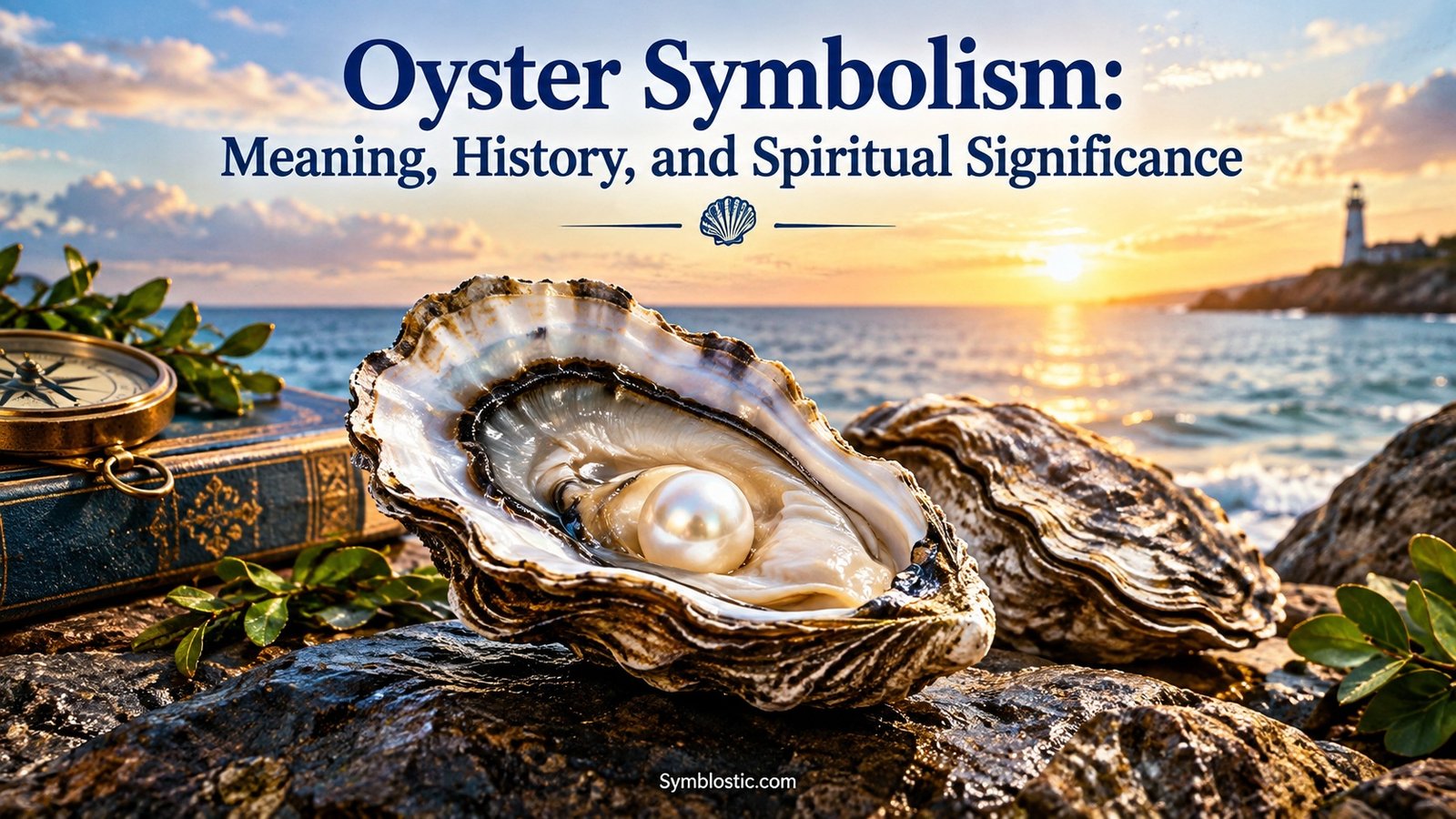
The Oyster Symbolism is closely tied to hidden beauty, protection, patience, and the value of something discovered beneath a rough exterior. An oyster looks simple and ordinary from the outside, yet it can hold a pearl that becomes a symbol of beauty and rarity.
In the United States, oysters carry meanings beyond spirituality. They connect to coastal life, hard work, community, seafood traditions, environmental restoration, and the history of places such as the Chesapeake Bay and Gulf Coast. Their shells also appear in art, jewelry, home decor, and fashion.
At the same time, oysters have much older symbolic connections. Ancient Mediterranean art linked the shell with beauty, birth, fertility, and the sea. Over centuries, religious art, literature, and popular culture added new layers to those meanings.
Quick Answer
Oyster symbolism in the USA commonly represents hidden beauty, resilience, protection, patience, and prosperity. Because a pearl can develop inside an oyster, the image often suggests that something valuable can emerge from difficulty or an ordinary beginning.
TL;DR
- Oysters often symbolize hidden beauty and inner worth.
- Their hard shells suggest protection and emotional boundaries.
- Pearls connect oysters with patience, transformation, and rarity.
- In America, oysters represent coastal heritage and community.
- Ancient art connected shells with beauty, love, and fertility.
- Modern designs use oysters to express mystery and resilience.
What Does an Oyster Symbolize?
Hidden Beauty and Inner Worth
The most familiar meaning comes from the contrast between the shell and what lies inside. An oyster may look rough, closed, and unremarkable, yet it can contain something precious.
Because of this contrast, the oyster can represent people whose value isn’t immediately visible. It reminds us that appearances don’t always reveal what exists beneath the surface.
Protection and Boundaries
The oyster’s shell provides another powerful symbol. It creates a physical barrier between the soft creature and the outside world.
Therefore, an oyster can represent emotional protection, privacy, and healthy boundaries. In personal symbolism, it may suggest someone who opens up slowly but deeply.
Patience and Transformation
Pearls don’t appear instantly. Their association with time makes the oyster a natural symbol of patience.
The broader message is simple: meaningful growth can take time. Something beautiful may develop gradually while remaining hidden from view.
Oyster Symbolism in American Culture
A Symbol of Coastal America
In the United States, oysters have a particularly strong connection with coastal communities. They have supported food traditions, fishing families, businesses, and local economies for centuries.
The Chesapeake Bay provides one of the clearest examples. Indigenous peoples harvested oysters long before European settlement, and oysters later became a major colonial and commercial resource.
By the late 19th century, the Chesapeake oyster industry had become enormous. Oysters were shipped far beyond the coast and became an important part of American commercial life.
Oysters and American Community
Oysters aren’t only about individual wealth or beauty. They also symbolize community.
In Chesapeake communities, oyster harvesting became part of family life and local identity. Festivals, shared meals, working boats, and seafood traditions helped connect generations.
The oyster can therefore represent:
• Coastal heritage and regional identity
• Hard work connected to the water
• Family traditions passed between generations
• Community meals and shared celebration
• Respect for marine resources
The Idea of “White Gold”
American oyster history also created associations with prosperity. In parts of the Chesapeake, oysters were sometimes described as a form of “white gold.”
This language reflected their economic importance. For many workers, oysters weren’t simply food. They were a source of income, trade, and opportunity.
That history gives the oyster a distinctly American meaning of work creating abundance.
Oyster Shells and American History
Indigenous Chesapeake Traditions
Oysters have a much deeper American history than the colonial period. Archaeological evidence shows that Indigenous communities around the Chesapeake harvested shellfish for thousands of years.
Large shell deposits, often called shell middens, reveal how important oysters were as food and as part of settled coastal life.
However, there wasn’t one single Indigenous oyster tradition. The Chesapeake contained many different communities, languages, and cultures, so it’s better to avoid assigning one universal spiritual meaning to all Indigenous peoples.
Colonial and Industrial Expansion
European settlement dramatically changed oyster harvesting. As American cities grew, demand increased, and improved transportation allowed oysters to travel farther.
During the 19th century, oysters became especially important to cities along the East Coast. Oyster houses, markets, restaurants, and processing businesses became part of urban culture.
The oyster therefore carries two connected historical ideas: natural abundance and industrial exploitation.
Decline and Restoration
Overharvesting, habitat damage, disease, and environmental changes later reduced many oyster populations.
Today, restoration efforts have added another layer of meaning. The oyster can symbolize recovery, environmental responsibility, and rebuilding something that was once damaged.
That makes its modern symbolism more hopeful than simply nostalgic.
Oyster Shell Symbolism in Art and Myth
Aphrodite and the Sea
One of the best-known shell associations comes from ancient Greek and Roman art.
Aphrodite, the Greek goddess associated with love and beauty, became strongly connected with the sea and shell imagery. Roman artists continued similar traditions through representations of Venus.
Over time, the shell became a visual symbol of beauty, femininity, birth, and attraction.
Renaissance Art
This connection became especially famous in European Renaissance art. Artists repeatedly used the shell as a visual reference to Venus and the sea.
The shell could suggest that beauty had emerged from the mysterious power of nature. As a result, shell imagery became recognizable even outside its original mythological setting.
Why the Shell Matters
The shell itself can suggest several ideas:
• Beauty emerging from nature
• Birth and emergence
• Feminine beauty in classical art
• The mystery of the sea
• Protection surrounding something delicate
Not every shell image has these meanings today. Context matters greatly.
What Does an Oyster Mean Spiritually?
Inner Wisdom
Spiritual interpretations often focus on the hidden nature of the oyster.
Its closed shell can represent looking inward rather than constantly seeking answers outside yourself. The pearl then becomes a metaphor for wisdom, insight, or personal growth.
This interpretation is especially common in modern spiritual writing.
Resilience Through Difficulty
The pearl also creates a powerful transformation metaphor. Something valuable develops within a protected environment over time.
For this reason, people may use the oyster to represent resilience after difficult experiences. However, this should be understood as symbolic language rather than a universal religious teaching.
Patience and Trust
An oyster doesn’t reveal its contents immediately. Symbolically, that can encourage patience.
The message is not that every hardship automatically produces something beautiful. Instead, the image can remind people that growth is often gradual and difficult to see while it’s happening.
Oyster and Pearl Symbolism
The Pearl as Hidden Treasure
The pearl is perhaps the strongest reason oysters have become symbols of hidden value.
A pearl is concealed until the shell opens. That simple image creates a powerful comparison with personal potential.
Someone may appear ordinary at first but possess unusual creativity, strength, kindness, or wisdom.
Transformation
Pearls are also associated with transformation because their formation happens gradually.
Consequently, oyster and pearl imagery often appears in designs about personal change, new beginnings, and overcoming challenges.
Beauty After Difficulty
Modern symbolism sometimes describes the pearl as beauty created through irritation or adversity.
That idea can be meaningful, but it shouldn’t be taken too literally. Not every painful experience produces a positive result, and people shouldn’t feel pressured to find a “lesson” in suffering.
The symbolism works best as an image of possibility and growth.
Oyster Symbolism in Love and Relationships
Love Beneath the Surface
Because the oyster protects something precious inside, it can represent private or deeply held love.
An oyster-themed gift may suggest that the relationship has value that outsiders don’t necessarily see. The closed shell can also represent intimacy and trust.
Beauty and Attraction
The historical connection between shells and Aphrodite gives oyster imagery another romantic layer.
In art and jewelry, shells can suggest sensuality, beauty, femininity, and the attraction of the sea.
However, modern viewers may simply see an elegant coastal symbol without recognizing its classical background.
Commitment and Patience
Pearls take time to develop, so pearl and oyster imagery can also suggest lasting relationships.
The symbolism works particularly well for anniversaries, wedding themes, and meaningful jewelry.
Read More: Pufferfish Symbolism: Meaning, Spirit & Protection
Oyster Symbolism in Psychology
The Outer Shell
From a psychological perspective, the oyster offers an easy metaphor for emotional defenses.
A person may appear distant or guarded while having a rich inner life. The shell represents the boundary, while the interior represents private thoughts and feelings.
This isn’t a psychological diagnosis. It’s simply a useful metaphor for understanding how people sometimes protect vulnerable parts of themselves.
Introversion and Privacy
Oyster imagery may appeal to people who value quietness and personal space.
It can represent:
• A preference for privacy
• Emotional depth beneath a calm exterior
• Careful trust and gradual openness
• Strong personal boundaries
• Quiet confidence rather than attention-seeking
The Search for Hidden Value
The pearl also encourages people to look beyond first impressions.
In that sense, oyster imagery can support a broader psychological theme: what appears ordinary may contain unexpected value.
Oyster Symbolism in Tattoos
Common Tattoo Meanings
Oyster tattoos can carry personal meanings that depend on the design.
An open oyster with a pearl usually emphasizes hidden beauty or personal transformation. A closed shell may focus more on privacy, protection, or emotional boundaries.
Popular Design Choices
Tattoo designs may combine oysters with other coastal imagery.
Common combinations include:
• Oyster shells with pearls
• Waves surrounding an oyster
• Seashells with flowers
• Pearls with initials or dates
• Realistic oysters with ocean textures
A tattoo can also represent a connection to a coastal hometown, family tradition, or memorable place.
Why Context Matters
There isn’t one universal meaning for an oyster tattoo. The surrounding imagery often changes the message.
For example, an oyster beside a compass may suggest travel or coastal identity. An oyster with a pearl may focus more strongly on transformation.
Oyster Symbolism in Home Decor and Fashion
Coastal Decor
Oyster shells fit naturally into American coastal design.
They can appear in decorative bowls, serving pieces, wall art, table settings, and holiday arrangements. Their rough texture adds an organic contrast to polished interiors.
Jewelry and Accessories
Pearls have long been associated with elegance, while shell shapes can create a more relaxed coastal look.
Together, oysters and pearls can balance two ideas: natural simplicity and refined beauty.
Modern Social Media Aesthetics
On social platforms, oyster and pearl imagery often appears in content about coastal living, quiet luxury, self-care, beauty, and ocean-inspired fashion.
These modern meanings aren’t fixed. Internet trends can quickly change how familiar symbols are presented.
Oyster Symbolism in American Holidays and Food Traditions
Thanksgiving and Community Meals
Oysters have appeared in American holiday cooking for generations, particularly in regional traditions.
Oyster stuffing, oyster stew, and other dishes became part of family meals in various parts of the country. This gives the oyster a meaning connected to hospitality and gathering.
Regional Festivals
American coastal communities continue to celebrate oysters through festivals and local food events.
These events transform the oyster from a simple food into a marker of regional pride.
From Working Food to Gourmet Culture
Oysters have also shifted socially. Once eaten widely as an inexpensive food, they later became associated with restaurants, raw bars, and upscale dining.
This change demonstrates how symbolism can evolve with economics and culture.
What Does an Oyster Mean in Dreams?
A Closed Oyster
A closed oyster in a dream may be interpreted symbolically as privacy, hidden potential, or something not yet revealed.
However, dream meanings aren’t universal. Personal memories and emotions are usually more important than a fixed symbolic dictionary.
An Open Oyster
An open oyster may suggest discovery or revelation within a personal symbolic reading.
For example, someone experiencing a major life change might see the image as representing something previously hidden becoming visible.
Finding a Pearl
Finding a pearl inside an oyster is often associated with discovering something valuable.
That could symbolize an opportunity, personal strength, meaningful relationship, or new understanding.
Again, the most useful interpretation depends on what the oyster means to the individual.
Misunderstandings and Controversies
Not Every Oyster Symbol Is Spiritual
An important distinction is that oysters aren’t inherently spiritual objects.
A person may use an oyster image simply because they enjoy seafood, coastal culture, marine biology, or its visual beauty.
Symbolic interpretations are cultural associations, not universal rules.
Avoiding One Universal “Ancient Meaning”
Online discussions sometimes present one meaning as if every ancient culture agreed about oysters.
History is more complicated. Different societies used shells and marine imagery in different ways, and meanings changed over time.
It’s more accurate to say that certain shell traditions became associated with beauty, fertility, birth, or the sea in specific historical contexts.
Environmental Concerns
The oyster’s history also includes overharvesting and habitat loss.
Therefore, modern oyster symbolism can carry an environmental message. Restoration projects have made the oyster an example of how natural systems can be damaged and gradually rebuilt.
That interpretation is especially relevant in American coastal communities today.
How Oyster Symbolism Has Changed Over Time
From Food to Cultural Symbol
For early coastal communities, oysters were first and foremost an important food and natural resource.
Later, commercial expansion turned oysters into valuable commodities. Their importance then spread into American restaurants, cities, festivals, and regional identity.
From Mythology to Art
In classical and European art, shell imagery became closely connected with beauty and the sea.
Modern audiences may recognize that visual language without knowing its mythology. The symbol survived even as its original religious context faded.
From Abundance to Restoration
American oyster history also moved from abundance toward decline and restoration.
This creates an unusual modern meaning. The oyster can now symbolize not only prosperity but also environmental recovery and responsibility.
From Pearl to Personal Growth
Today, the pearl inside an oyster is often used as a metaphor for personal development.
The modern message is simple: valuable things can remain hidden until the right moment reveals them.
Oyster Symbolism at a Glance
| Context | Meaning in the USA | Common Associations | Notes |
| Pearl | Hidden value | Beauty, rarity, growth | Often used as a personal metaphor |
| Shell | Protection | Privacy, boundaries, safety | Meaning depends on surrounding imagery |
| Coastal culture | Heritage | Seafood, family, community | Especially strong in coastal regions |
| Ancient art | Beauty | Love, fertility, sea imagery | Connected to specific classical traditions |
| Environmental use | Restoration | Renewal, resilience, habitat | Increasingly relevant today |
FAQs:
What does an oyster symbolize spiritually?
An oyster can symbolize hidden wisdom, protection, patience, and transformation. The pearl inside often represents valuable growth that develops gradually.
What does an oyster symbolize in love?
An oyster can represent private love, emotional protection, beauty, and patience. The pearl may also symbolize something precious that develops over time.
What does an oyster symbolize in America?
In the United States, oysters often represent coastal heritage, hard work, community, food traditions, and prosperity. Chesapeake history gives the symbol especially strong cultural importance.
What does finding a pearl in an oyster symbolize?
Finding a pearl can symbolize discovering hidden value or realizing personal potential. It may also represent a rewarding result after patience and growth.
What does an oyster shell symbolize?
An oyster shell commonly represents protection, privacy, resilience, and the boundary between the outside world and a vulnerable interior.
Are oysters symbols of good luck?
Oysters and pearls can be associated with prosperity and good fortune in modern symbolic interpretations. However, there isn’t one universal tradition that defines oysters as a good-luck symbol.
Conclusion
Oysters carry a surprisingly rich range of meanings. Their rough exterior and delicate interior make them natural symbols of protection, hidden beauty, patience, resilience, and transformation. The pearl adds another layer by showing how something precious can remain hidden until it is discovered.
In the United States, Oyster Symbolism has an especially strong connection to coastal heritage. From Indigenous Chesapeake communities to American oyster workers, family meals, festivals, restaurants, and modern restoration efforts, oysters have shaped both culture and local identity.

1 thought on “Oyster Symbolism: Meaning, History, and Spiritual Significance”