
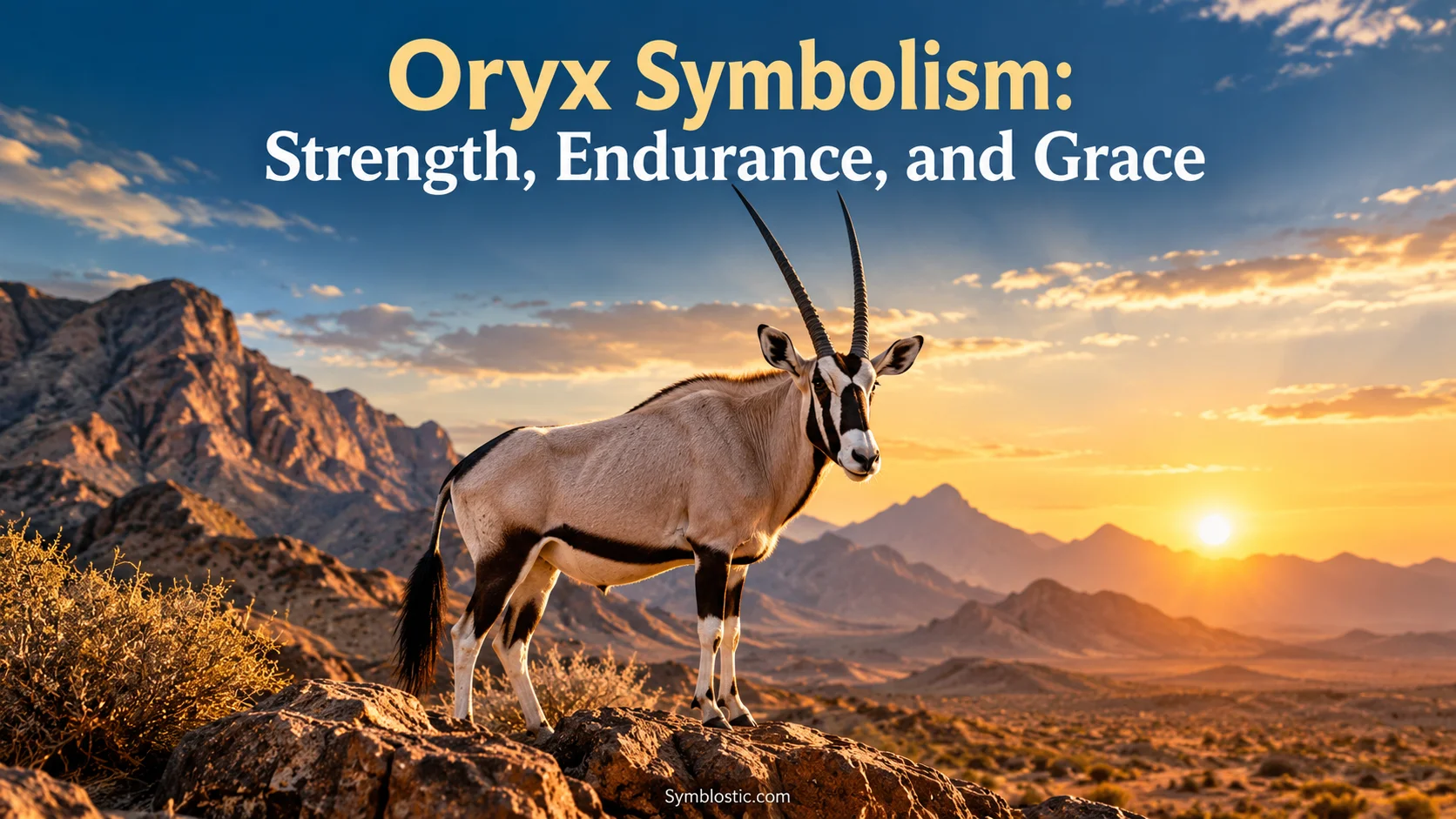
The meaning of oryx symbolism often centers on strength, endurance, balance, and the ability to thrive under difficult conditions. With long, straight horns, a striking facial pattern, and a powerful body, the oryx stands out as one of the desert’s most impressive animals. Its appearance suggests both quiet confidence and remarkable resilience.
For readers in the United States, the oryx may be less familiar than the deer, wolf, or eagle. However, its striking features and desert habitat make it a compelling symbol in wildlife photography, nature-inspired art, and modern spiritual reflection. The animal reminds us that strength doesn’t always require aggression and that survival often depends on patience.
Oryx species live in parts of Africa and the Arabian Peninsula, where heat, limited water, and sparse vegetation can create demanding conditions. Their ability to survive in these environments has helped inspire associations with self-reliance and adaptability.
Still, oryx symbolism doesn’t have one universal meaning. Historical accounts, regional traditions, personal beliefs, and modern interpretations can emphasize different qualities. Understanding the animal’s natural behavior alongside its cultural associations offers a more grounded way to explore what it represents.
Quick Answer
In modern American symbolism, the oryx commonly represents strength, endurance, independence, and resilience. Its desert adaptations also inspire spiritual interpretations involving balance, patience, resourcefulness, and the ability to move through difficult periods without losing direction.
TL;DR
- Oryx symbolism centers on endurance, strength, balance, and resilience.
- Its desert habitat inspires associations with patience and resourcefulness.
- Long horns can represent protection, confidence, and personal boundaries.
- Spiritually, the oryx may symbolize persistence through difficult transitions.
- In the United States, it appears in wildlife art and conservation stories.
- Its meanings vary by culture, context, and individual experience.
The Historical Background of Oryx Symbolism
The oryx has lived alongside human communities in African and Arabian landscapes for thousands of years. Its importance comes from more than its appearance; the animal has also been part of local environments, hunting traditions, and artistic representations.
Oryx in Ancient Art and Life
Oryx appear in the broader history of North African and Arabian wildlife imagery. Their distinctive horns and recognizable body shape made them suitable subjects for animal art and depictions of the natural world.
In regions where oryx lived, people encountered them as wildlife rather than merely as abstract symbols. Their presence could connect to food, hunting, landscape knowledge, and the challenges of living in dry environments.
However, historical depictions don’t always reveal a single spiritual meaning. An image of an oryx may reflect observation, artistic skill, cultural importance, or a combination of these purposes.
The Meaning of the Oryx’s Horns
The oryx’s horns are among its most recognizable features. Depending on the species, they may appear long and nearly straight or curve backward like a scimitar.
These horns naturally suggest strength and defense to modern viewers. As a symbolic interpretation, they can represent the ability to protect yourself while remaining composed.
It’s important, however, to distinguish artistic interpretations from documented historical beliefs. There isn’t one established ancient tradition that assigns every oryx the same symbolic meaning.
Oryx Symbolism in the United States
In the United States, the oryx doesn’t have the same widespread cultural recognition as the bald eagle, bison, or white-tailed deer. Instead, its symbolism often develops through wildlife education, conservation, desert imagery, and personal interpretations.
A Symbol of Adaptability
American audiences often encounter oryx through zoos, nature documentaries, wildlife photography, and conservation stories. These settings highlight the animal’s ability to survive in demanding environments.
Its desert adaptations offer a useful image of practical resilience. Rather than escaping every challenge, the oryx survives through behaviors and physical traits suited to its surroundings.
Conservation and Hope
The scimitar-horned oryx provides a particularly meaningful example. After disappearing from the wild, it became the focus of international breeding and reintroduction efforts.
By 2023, conservation efforts had helped the species move from the International Union for Conservation of Nature’s Extinct in the Wild category to Endangered. This recovery story gives the oryx a modern association with restoration, cooperation, and renewed possibility.
For American readers, especially those familiar with wildlife conservation, the oryx can therefore represent more than toughness. It can also symbolize the value of sustained effort and collective responsibility.
The Spiritual Meaning of Oryx
In contemporary spiritual reflection, the oryx can represent inner strength, patience, self-trust, and the ability to maintain direction during uncertainty. These are modern symbolic interpretations inspired by the animal’s physical traits and natural environment, not universal religious teachings.
Strength Without Aggression
An oryx looks powerful because of its size, horns, and upright posture. Yet its survival doesn’t depend on constant confrontation.
Spiritually, this contrast can represent quiet confidence. You can establish boundaries, protect your values, and respond firmly without seeking unnecessary conflict.
Endurance During Difficult Times
The oryx’s ability to cope with dry conditions makes it a compelling symbol of persistence. Its adaptations show how survival can depend on conserving resources and responding to the environment.
If you’re experiencing a difficult transition, you might use the oryx as a reminder to focus on what you can manage. Progress may require patience, careful choices, and consistent effort rather than dramatic action.
Balance and Self-Reliance
Oryx symbolism can also encourage a balance between independence and awareness. The animal relies on its adaptations while responding to its surroundings and, often, moving with other oryx.
This offers a useful personal reflection: self-reliance doesn’t mean refusing support. It means understanding your strengths while recognizing when cooperation can help you move forward.
Oryx Symbolism Across Different Cultures
The oryx inhabits regions with diverse histories, languages, and cultural traditions. Its meaning can therefore vary across African and Arabian societies, and modern interpretations shouldn’t be mistaken for beliefs shared by every community.
African Connections
Several oryx species are associated with African grasslands, dry regions, and desert margins. In southern Africa, the gemsbok, a name commonly used for the southern oryx, is a recognizable part of regional wildlife and nature imagery.
Its impressive horns and ability to live in arid landscapes make it an understandable symbol of strength and endurance. However, the specific cultural meaning of the animal depends on local histories and traditions.
Arabian Connections
The Arabian oryx is native to the Arabian Peninsula and has become a notable symbol in regional wildlife conservation. Its recovery has also helped strengthen its association with the protection of natural heritage.
In these settings, the oryx may evoke a connection to the desert and its wildlife. Still, it would be inaccurate to assign one spiritual interpretation to all Arabian cultures.
Respecting Cultural Differences
When exploring oryx symbolism, it’s helpful to separate documented cultural practices from personal spiritual beliefs. Modern ideas about animal guides and symbolic messages may draw inspiration from wildlife without belonging to a specific historical tradition.
This distinction allows you to appreciate the oryx’s cultural importance without inventing ancient meanings or treating diverse societies as interchangeable.
Read More: Spirit Animal Quiz: Discover Your Symbolic Animal Guide
The Psychological Meaning of the Oryx
Animals often become symbols because their visible traits connect with human feelings and experiences. The oryx’s strong frame, alert posture, and desert habitat can inspire thoughts about confidence, patience, and emotional steadiness.
What the Oryx May Represent Emotionally
For some people, the oryx represents the kind of strength that develops through difficult experiences. Its image may feel reassuring during periods when life demands patience or independence.
Others may connect with its alertness and composed appearance. These qualities can symbolize careful decision-making rather than reacting immediately to pressure.
Personal Values Reflected in Oryx Imagery
If you’re drawn to the oryx, consider which of its characteristics feels most meaningful to you.
- Persistence: Continuing toward a goal despite setbacks.
- Confidence: Recognizing your abilities without needing constant approval.
- Boundaries: Protecting your time, values, and personal space.
- Patience: Allowing progress to develop at a sustainable pace.
- Resourcefulness: Using what you have instead of waiting for perfect conditions.
- Cooperation: Recognizing that shared effort can accomplish more.
These associations aren’t psychological diagnoses or universal truths. They’re ways to explore the qualities that an animal’s image brings to mind.
Oryx Tattoos, Art, and Modern Design
Oryx imagery can work especially well in designs that emphasize clean lines, long horns, and a strong silhouette. In contemporary American art, it may appeal to people interested in wildlife, desert landscapes, and symbols of personal resilience.
Oryx Tattoo Meanings
An oryx tattoo can communicate different ideas depending on its style and setting. A realistic design may express admiration for wildlife, while a minimalist outline may focus on strength or balance.
Common personal interpretations include:
- A standing oryx representing stability and self-confidence.
- An oryx in motion symbolizing progress and determination.
- Horn-focused artwork expressing protection and strong boundaries.
- An oryx beneath the sun representing endurance in challenging conditions.
- A herd representing connection, cooperation, and shared direction.
These interpretations are creative possibilities rather than established tattoo traditions. The meaning ultimately depends on the wearer.
Home Decor and Fashion
Oryx illustrations can complement desert-inspired interiors, natural materials, and wildlife photography collections. Their angular horns and pale coats also create strong visual contrast in modern artwork.
In fashion, an oryx motif may suggest a preference for nature-inspired design or African wildlife imagery. However, wearing an animal image doesn’t automatically communicate a spiritual belief or cultural identity.
Social Media and Digital Art
On social media, an oryx image can accompany messages about persistence, personal growth, or appreciation for unusual wildlife. Its distinctive shape also lends itself to logos, illustrations, and digital backgrounds.
When using imagery inspired by a particular region or community, context matters. Respectful design avoids presenting a culture’s specific traditions as generic decoration.
Oryx Symbolism in Dreams and Personal Encounters
Dreaming about an oryx or seeing one unexpectedly may inspire questions about its meaning. Contemporary symbolic interpretations often focus on strength, independence, and the need to adapt, but these associations aren’t reliable predictions of future events.
Dreaming of an Oryx
A calm oryx in a dream might bring to mind confidence or steadiness. An oryx running across a desert could suggest movement, freedom, or a desire to overcome obstacles.
However, dreams don’t have one fixed interpretation. Your emotions, memories, and recent experiences may influence why the animal appeared.
Seeing an Oryx in Real Life
If you encounter an oryx at a zoo, wildlife reserve, or conservation center, the experience may encourage reflection about nature and survival. You might connect the animal with an ongoing challenge or simply admire its unusual appearance.
A meaningful encounter doesn’t need to be supernatural. Sometimes, the experience of observing an unfamiliar animal is enough to inspire curiosity and appreciation.
Using the Encounter as a Reflection
Ask yourself what stood out about the animal. Was it the horns, its calm posture, its movement, or the environment around it?
Your answer can help you identify a personal association without assuming the encounter carries a universal message.
Misunderstandings About Oryx Symbolism
Because the oryx is less familiar to many Americans, modern descriptions sometimes give it meanings that sound more historically established than they are. Separating biological facts from symbolic interpretations helps keep these discussions accurate.
Is the Oryx an Ancient Spiritual Messenger?
There is no single, widely documented belief that makes every oryx a spiritual messenger. Some modern spiritual writers may interpret encounters with the animal as guidance, but such readings should be described as personal beliefs.
Similarly, the oryx’s horns don’t prove that it represents supernatural protection in every culture. That association is an interpretation inspired by a real defensive feature.
Does Oryx Symbolism Always Mean Strength?
Strength is a common modern interpretation, but the oryx can inspire other ideas. Its survival strategies may suggest restraint, resourcefulness, environmental awareness, or the importance of conserving energy.
A narrow interpretation can overlook these qualities. Endurance, for example, doesn’t always mean pushing harder; sometimes it means adjusting your approach.
Avoiding Unsupported Cultural Claims
Be cautious with claims that assign a single meaning to all African or Arabian traditions. These regions contain many distinct communities, and their beliefs cannot be reduced to one symbolic definition.
It’s more accurate to say that the oryx can represent resilience in modern interpretation than to claim that every culture has historically viewed it that way.
How Oryx Symbolism Has Evolved
The oryx’s modern symbolic meaning reflects both its long relationship with human environments and recent conservation developments. While older associations may draw from its physical appearance and desert habitat, contemporary meanings increasingly include environmental responsibility and recovery.
From Wildlife to Symbol of Resilience
Historically, the oryx was part of the natural landscape for communities living within its range. Its horns, movement, and desert adaptations made it recognizable, but not every encounter necessarily carried a spiritual meaning.
Today, wildlife education helps people understand the animal’s specialized adaptations. Those facts provide a grounded foundation for interpreting the oryx as a symbol of persistence and resourcefulness.
The Influence of Conservation
The scimitar-horned oryx’s return to the wild has given the animal a particularly hopeful modern association. Its recovery demonstrates how breeding programs, scientific research, international cooperation, and local conservation work can contribute to protecting a species.
This story adds a new dimension to oryx symbolism. The animal can represent not only individual endurance but also the power of collective effort.
A Broader Modern Meaning
In contemporary American settings, the oryx may stand for personal determination, wildlife appreciation, or environmental hope. These meanings can coexist without requiring a single spiritual explanation.
Its symbolism continues to develop as people learn more about the animal and encounter it through art, education, and conservation stories.
FAQs:
What does an oryx symbolize spiritually?
An oryx commonly represents endurance, inner strength, adaptability, and balance in modern spiritual interpretations. These meanings are inspired by its desert adaptations rather than a universal religious doctrine.
What does the oryx represent in dreams?
An oryx in a dream may bring to mind confidence, patience, or the desire to overcome challenges. However, dream meanings are personal and shouldn’t be treated as predictions.
What do oryx horns symbolize?
Oryx horns can symbolize protection, confidence, and personal boundaries in modern artwork and spiritual reflection. In nature, their primary roles include defense and competition.
Is the oryx a symbol of resilience?
Yes, resilience is a common modern symbolic association. The animal’s adaptations to dry environments and the recovery of the scimitar-horned oryx both provide meaningful examples of persistence.
What does an oryx tattoo mean?
An oryx tattoo may express strength, independence, patience, or admiration for wildlife. Its exact meaning depends on the design and the personal story behind it.
Why is the oryx important in conservation?
The oryx is important because some species have faced severe population declines. The scimitar-horned oryx, in particular, became a major conservation success after reintroduction efforts helped restore a wild population.
Conclusion:
Oryx symbolism brings together strength, endurance, balance, and resilience. In modern American interpretations, the animal can represent the ability to face difficult conditions without losing direction. Its distinctive horns and desert adaptations also inspire ideas about confidence, patience, and self-reliance.
Beyond personal symbolism, the oryx offers a powerful conservation story. The recovery of the scimitar-horned oryx shows how persistence and cooperation can help restore wildlife after serious losses. This meaning extends beyond individual determination to include shared responsibility for the natural world.

1 thought on “Oryx Symbolism: Strength, Endurance, and Grace”