
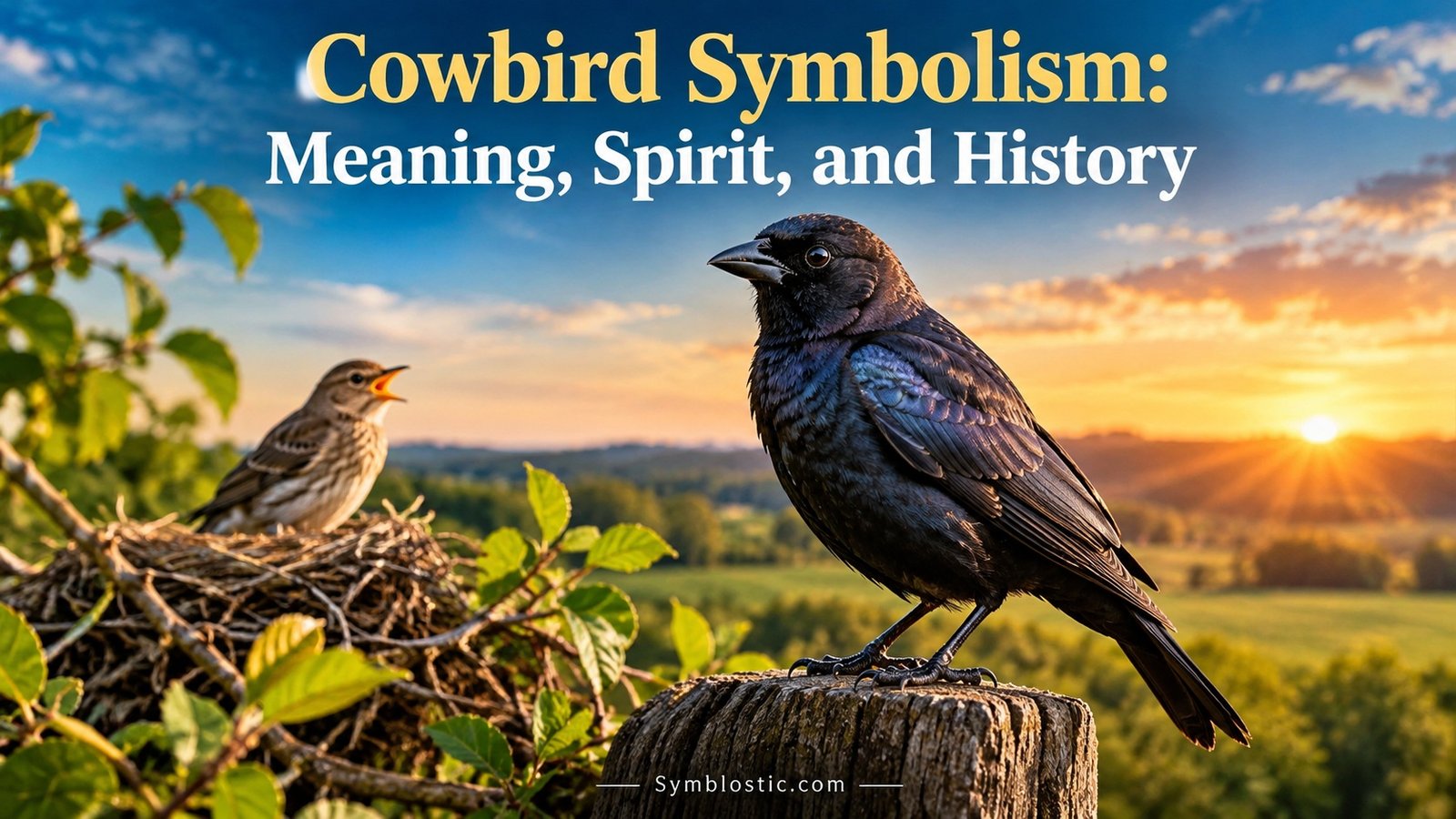
The Cowbird Symbolism people notice today comes from a fascinating mix of nature, American history, and human interpretation. The bird is strongly connected with open landscapes, cattle, movement, survival, and unusual family behavior.
In the United States, the brown-headed cowbird has a particularly interesting story. Before European settlement, it followed bison across the Great Plains. Later, it adapted to cattle, farms, roads, and changing landscapes.
Because of its unusual nesting behavior, the cowbird can represent both positive and negative ideas. It may suggest adaptability, independence, opportunity, or survival. However, it can also symbolize deception, taking advantage of others, or living outside expected rules.
That contrast makes the cowbird especially interesting as a symbolic animal. Its meaning depends heavily on context, personal experience, and the message someone wants the bird to express.
Quick Answer
Cowbird symbolism in the United States commonly represents adaptability, movement, survival, independence, and unconventional behavior. Because cowbirds place their eggs in other birds’ nests, they can also symbolize deception, opportunism, or complicated relationships.
TL;DR
- Cowbirds symbolize adaptability and survival in changing environments.
- American history connects them strongly with bison, cattle, and open plains.
- Their unusual nesting behavior creates darker symbolic meanings.
- Spiritually, they may represent independence, change, and unconventional paths.
- Modern interpretations often focus on boundaries, resilience, and personal freedom.
What Does a Cowbird Symbolize?
A cowbird can carry several meanings at once. Unlike symbols with one fixed interpretation, this bird presents a strong contrast between cooperation and exploitation.
For American readers, its natural history provides the clearest starting point. Cowbirds developed a close relationship with grazing animals and became highly successful at adapting to human-altered landscapes.
The Main Symbolic Meanings
Common interpretations include:
• Adaptability: surviving by adjusting to changing surroundings.
• Freedom: moving across wide landscapes without being tied to one place.
• Resourcefulness: finding unusual ways to survive difficult conditions.
• Independence: following an individual path rather than traditional expectations.
• Deception: using another bird’s nest for raising its young.
• Opportunity: recognizing and using favorable circumstances.
The important point is that these meanings aren’t equally positive. A cowbird tattoo, dream, artwork, or sighting may emphasize either side of this contrast.
Cowbird Symbolism in American History
The American story of the cowbird begins on the Great Plains. Brown-headed cowbirds historically followed large grazing animals, especially bison, while feeding on insects disturbed by their movement.
This behavior explains the bird’s common name. Later, cattle became an important substitute for the large herds that had shaped its environment.
From Bison to Cattle
Cowbirds didn’t need to follow human expansion because they were simply “helped” by people. Instead, changes to the landscape created new opportunities for them.
As forests were cleared and agricultural areas expanded, cowbirds found more open feeding spaces. Their range expanded dramatically across the eastern United States during the nineteenth century.
This history gives the bird a strong American theme of adaptation through change.
A Symbol of the Changing American Landscape
The cowbird can represent how nature responds when human environments change.
That doesn’t always mean the response is good or bad. Instead, it shows that some species can exploit new conditions while others struggle.
For this reason, the cowbird can symbolize survival in an unpredictable world.
The Spiritual Meaning of a Cowbird
Spiritual interpretations of birds often focus on movement, observation, freedom, and communication. However, cowbird spirituality is less standardized than the symbolism of animals such as eagles, owls, or doves.
A cowbird sighting may therefore be interpreted personally rather than as a universal spiritual message.
Possible Spiritual Meanings
People may connect a cowbird with:
• Adaptation during major life changes
• Freedom from traditional expectations
• Learning to recognize opportunities
• Protecting personal boundaries
• Finding strength in difficult circumstances
• Questioning relationships that feel unbalanced
The bird’s behavior can also encourage reflection. Its survival strategy isn’t conventional, yet it has worked remarkably well.
For some people, that makes the cowbird a reminder that unusual paths aren’t automatically unsuccessful.
Cowbird Meaning in Native American Contexts
The cowbird has a long ecological connection with the Great Plains and bison. However, it’s important not to describe one single “Native American meaning” as though every Indigenous nation shared the same belief.
Native American cultures are diverse, with different histories, languages, spiritual systems, and relationships with animals.
Connection With Bison Country
The cowbird’s relationship with bison is historically important. It followed herds across open grasslands and benefited from insects disturbed by grazing animals.
This ecological relationship can be understood as a reminder of interconnected life on the plains.
However, specific spiritual claims about cowbirds should be treated carefully. Modern websites sometimes present broad claims about “Native American cowbird symbolism” without identifying a particular nation or documented tradition.
Respecting Cultural Differences
A responsible interpretation separates documented cultural traditions from modern spiritual interpretations.
That distinction matters because symbolic meanings aren’t automatically shared across every Indigenous community.
What Does a Cowbird Mean in American Culture?
In American culture, the cowbird is more closely associated with nature, ranching, birdwatching, and ecological change than with a national religious tradition.
Its connection with cattle gives it a distinctly rural American image.
The Ranch and Prairie Connection
Cattle country provides one of the easiest ways to understand the cowbird’s American identity.
The bird can appear around:
• Ranches and grazing fields
• Rural roads and fence lines
• Open grasslands and prairie edges
• Farms and agricultural areas
• Parks with large open spaces
This setting gives the cowbird associations with wide landscapes, self-reliance, movement, and rural life.
An Unusual American Symbol
The cowbird isn’t as famous as the bald eagle or American robin. Still, its story reflects an important part of American environmental history.
It shows how wildlife can respond to dramatic changes in land use. That makes it an interesting symbol of adjustment and survival.
Cowbird Symbolism and Adaptability
Adaptability may be the strongest positive meaning associated with the cowbird.
The species has survived major changes in the American landscape. Its relationship with bison shifted toward a relationship with cattle and other altered environments.
A Symbol of Flexibility
A cowbird can represent someone who doesn’t depend on one fixed environment.
Instead, the symbolic message becomes:
Change your approach when circumstances change.
That doesn’t necessarily mean abandoning your values. It can mean finding a different way to achieve a goal.
Why This Meaning Matters Today
Modern life often rewards flexibility. People change careers, move across states, rebuild relationships, and adapt to new social environments.
Because of this, the cowbird can become a surprisingly useful symbol for resilience.
Cowbird Symbolism and Deception
The darker side of the cowbird comes from its breeding behavior.
Brown-headed cowbirds don’t build their own nests to raise their young. Instead, females lay eggs in the nests of other bird species.
Why This Creates a Negative Meaning
The host bird may incubate the cowbird egg and eventually feed the cowbird chick.
In some cases, the larger cowbird chick receives resources that would otherwise support the host’s own offspring.
This behavior naturally creates symbolic associations with:
• Deception and hidden intentions
• Taking advantage of another person
• Manipulation within relationships
• Competition for limited resources
• Breaking expected social rules
However, calling the bird “evil” would confuse animal behavior with human morality.
The cowbird isn’t making a moral choice in the human sense. Its behavior evolved because it helps the species reproduce.
Cowbird Symbolism and Boundaries
Another modern interpretation comes from the idea of boundaries.
A cowbird entering another bird’s nest creates a powerful image of something crossing a boundary without permission.
For people thinking about relationships, this can become a metaphor for recognizing when someone has taken too much.
A Reminder About Personal Limits
The symbolic lesson might be simple:
Helping others shouldn’t always mean sacrificing yourself.
This interpretation can apply to friendships, families, workplaces, and social groups.
At the same time, the symbol can work in the opposite direction. Someone may identify with the cowbird because they feel forced to survive without conventional support.
That makes the symbol more complex than simply “good” or “bad.”
Cowbird Symbolism and Freedom
Cowbirds spend much of their lives moving through open environments. Their association with bison and cattle strengthens this image of mobility.
As a result, they can represent freedom and independence.
What Freedom Can Mean
For one person, the cowbird may represent traveling without roots. For another, it may mean refusing to follow a traditional life plan.
The symbol can therefore fit people who value:
• Independence over conformity
• Exploration over routine
• Flexibility over rigid plans
• Self-direction over outside expectations
• Movement over staying in one place
However, freedom also brings responsibility. The cowbird’s darker behavior reminds us that independence can affect other people.
Read More: Orchid Mantis Symbolism: Meaning, Spirit & History
Cowbird Symbolism and Psychological Meaning
Animals often become mirrors for human emotions. People notice certain behaviors and use them to think about their own experiences.
The cowbird’s unusual lifestyle can trigger mixed feelings.
Positive Emotional Associations
A person might associate the bird with courage, flexibility, or determination.
Someone experiencing major change may find its survival strategy encouraging.
The cowbird can also represent confidence in finding another route when the obvious route doesn’t work.
Negative Emotional Associations
Other people may focus on the bird’s parasitic nesting behavior.
That can bring up feelings about betrayal, manipulation, unfairness, or competition.
Therefore, a cowbird image may feel empowering to one person and uncomfortable to another.
Cowbird Symbolism in Dreams
Dream symbolism is highly personal. There isn’t one scientifically established meaning for dreaming about a cowbird.
Still, people often interpret animal dreams through the animal’s known behavior and their own emotions.
Common Interpretations
A cowbird appearing in a dream might encourage reflection on:
• A relationship with unclear boundaries
• A major change requiring flexibility
• Someone relying heavily on your support
• A desire for greater personal freedom
• Fear of being taken advantage of
• An unconventional decision you’re considering
The emotion inside the dream matters as much as the bird itself.
A peaceful cowbird may suggest curiosity or independence. A threatening one may reflect concerns about trust or boundaries.
Cowbird Symbolism in Tattoos and Art
Cowbird tattoos are relatively uncommon compared with eagle, raven, owl, or swallow designs. That rarity can actually make the image more personal.
Someone choosing a cowbird may want a symbol that feels unusual and layered.
What a Cowbird Tattoo Can Express
A tattoo might represent:
• Surviving circumstances that weren’t ideal
• Independence from traditional expectations
• A connection with prairie landscapes
• Personal transformation through change
• A complicated relationship with trust
• Learning to protect personal boundaries
The visual design can change the message.
A cowbird flying over a prairie may emphasize freedom. A close portrait may focus more on identity and resilience.
Cowbirds in Home Decor, Media, and Social Life
Cowbirds aren’t major holiday symbols in the United States. Still, bird imagery is common in American homes, gardens, nature artwork, and outdoor-themed decor.
A cowbird can fit particularly well into rustic or prairie-inspired designs.
Modern Visual Uses
You might see cowbird imagery in:
• Wildlife photography
• Birdwatching communities
• Nature journals
• Prairie-themed artwork
• Rustic home decoration
• Educational materials
• Personal social media posts
The bird’s unusual story also makes it useful for educational content. Its appearance can spark conversations about evolution, behavior, and changing American landscapes.
Cowbird Symbolism: Positive and Negative Meanings
The cowbird is a good example of why animal symbolism isn’t always simple.
Its natural behavior creates both admiration and criticism. The following comparison shows how the same bird can produce very different interpretations.
| Context | Meaning in the USA | Common Association | Symbolic Tone |
| Prairie | Freedom and movement | Open landscapes | Positive |
| Cattle ranch | Adaptation | Rural America | Positive |
| Survival | Resourcefulness | Flexibility | Positive |
| Nest behavior | Deception | Exploitation | Negative |
| Relationships | Boundary crossing | Unequal support | Cautionary |
| Personal growth | Unconventional choices | Independence | Mixed |
This duality is important. A symbol doesn’t have to represent only one emotional quality.
Misunderstandings About Cowbird Symbolism
Many online animal-symbolism claims sound more certain than the evidence allows.
This is especially common when websites assign one universal spiritual meaning to a species.
Symbolism Isn’t the Same as Biology
The cowbird’s behavior is biological, not a moral lesson created by the bird.
For example, brood parasitism may look deceptive from a human perspective. Scientists describe it as an evolved reproductive strategy.
Therefore, saying “cowbirds represent dishonest people” is an interpretation, not a biological fact.
Be Careful With Cultural Claims
The same caution applies to cultural symbolism.
A statement that all Native American traditions interpret cowbirds in one specific way is too broad.
A respectful approach identifies specific traditions when evidence exists. Otherwise, it presents the interpretation as a modern symbolic reading.
How Cowbird Meaning Has Changed Over Time
Cowbird symbolism has shifted alongside America’s landscape.
Before widespread European settlement, the bird was strongly connected with bison and prairie ecosystems. As cattle ranching expanded, its relationship with livestock became a more familiar part of American life.
From Buffalo Bird to Controversial Species
Cowbirds were once commonly associated with buffalo because they followed herds across the plains.
Today, conservation discussions sometimes portray brown-headed cowbirds differently. Their brood parasitism can harm vulnerable songbird populations, especially in fragmented habitats.
This has produced an unusual change in public perception.
The same bird can be viewed as a fascinating native species and as a conservation challenge.
A Symbol of Ecological Change
That contradiction makes the cowbird especially relevant today.
It demonstrates how a species can benefit from environmental changes caused by people while creating new pressures for other wildlife.
Its story is therefore less about simple good and evil and more about ecological balance.
Why Cowbird Symbolism Still Matters Today
Cowbird symbolism remains interesting because the bird reflects problems many people recognize in modern life.
People constantly deal with change, competition, independence, relationships, and boundaries.
The cowbird represents these ideas in a particularly unusual way.
A Symbol With Two Sides
Its positive side says:
Adapt. Survive. Keep moving. Find another path.
Its cautionary side says:
Respect boundaries. Don’t exploit support. Consider the effects of your choices.
Together, these meanings make the cowbird a symbol of complicated survival.
That complexity may be more useful than assigning the bird one fixed spiritual message.
FAQs:
What does a cowbird symbolize spiritually?
A cowbird can symbolize adaptability, independence, movement, and survival. Some modern interpretations also connect it with boundaries and unconventional choices.
Is seeing a cowbird a good omen?
There is no universal rule saying a cowbird is either good or bad luck. Many people interpret a sighting through their personal circumstances and feelings.
What does a cowbird represent in Native American culture?
There isn’t one universal Native American meaning for the cowbird. Different Indigenous nations have distinct traditions, so broad claims should be treated carefully.
Why are cowbirds associated with deception?
Cowbirds lay their eggs in other birds’ nests, leaving host birds to incubate and raise their young. Humans may interpret this behavior as deceptive, although it is an evolved survival strategy.
What does a cowbird mean in a dream?
A cowbird dream may symbolize adaptability, independence, complicated relationships, or concerns about boundaries. The dreamer’s emotions and personal circumstances provide important context.
What does a cowbird tattoo symbolize?
A cowbird tattoo can represent resilience, freedom, unconventional thinking, adaptation, or personal boundaries. The surrounding imagery can strongly influence its meaning.
Are cowbirds considered bad birds?
No. Cowbirds are native North American birds with a natural reproductive strategy. However, their brood parasitism can create conservation problems for some vulnerable songbirds.
Conclusion:
Cowbird symbolism is powerful because it contains both positive and challenging meanings. In the United States, the bird connects with open plains, bison, cattle, movement, adaptation, and the changing American landscape.
Its unusual nesting behavior adds another layer. It can symbolize deception, opportunism, boundary crossing, or survival outside traditional expectations. Yet these interpretations should remain symbolic rather than moral judgments about the animal.

1 thought on “Cowbird Symbolism: Meaning, Spirit, and History”