
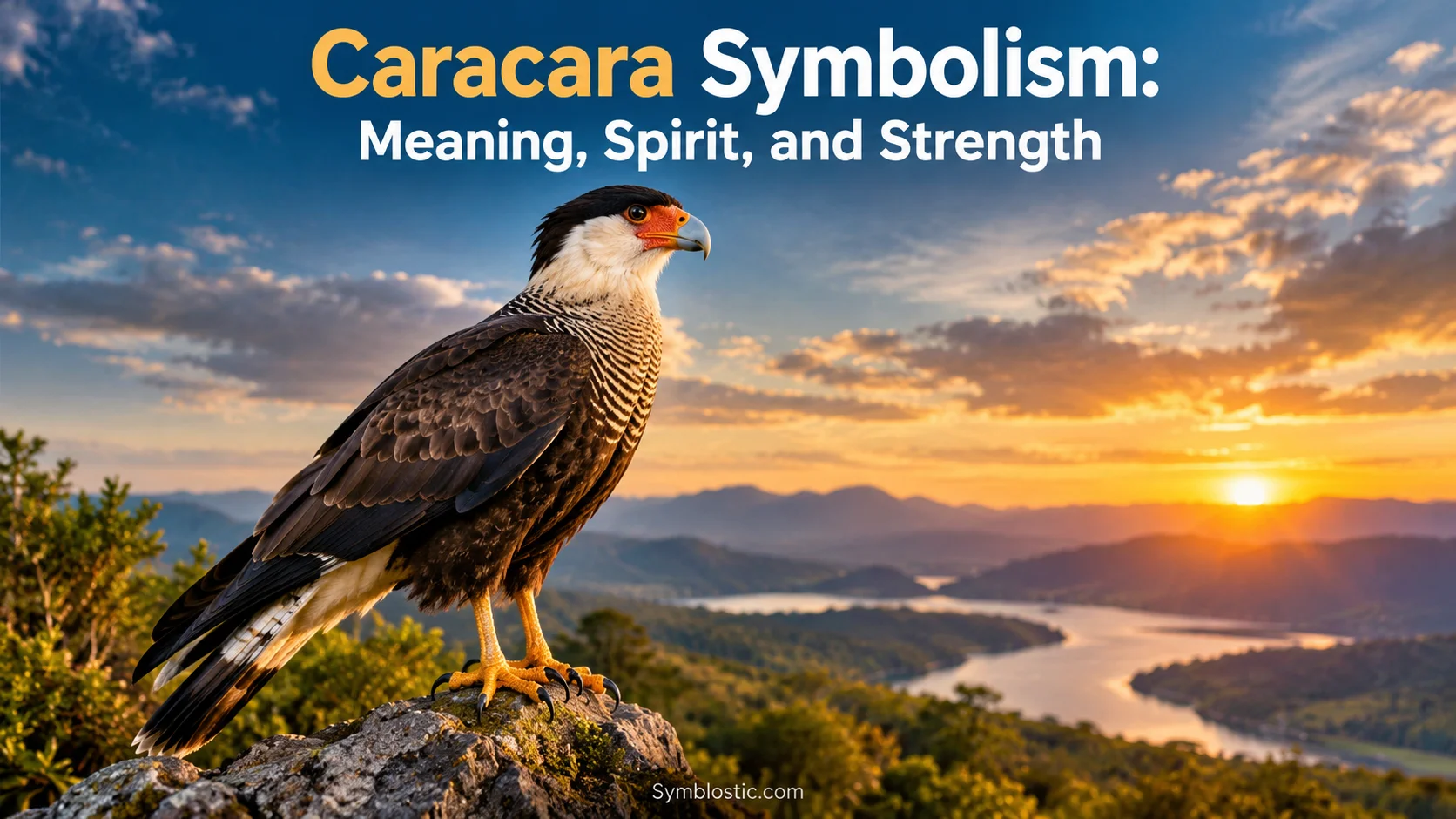
The Caracara Symbolism reflects a fascinating mix of strength, intelligence, adaptability, independence, and survival. The caracara is a distinctive raptor related to falcons, yet its behavior sets it apart from many familiar birds of prey.
In the United States, the Crested Caracara is especially associated with Florida, Texas, Arizona, open landscapes, and the American Southwest. It can hunt, scavenge, walk across the ground, and take advantage of changing conditions. These traits make it an interesting symbol of resourcefulness and flexibility.
Today, people may connect the caracara with courage, clear vision, freedom, resilience, and the ability to survive difficult circumstances. However, these symbolic meanings are interpretations rather than fixed universal rules.
Quick Answer
Caracara Symbolism commonly represents strength, adaptability, intelligence, courage, independence, and resourcefulness. In the USA, its unusual combination of aerial power and ground-based survival can symbolize staying flexible while protecting your goals. In broader spiritual interpretations, it may also represent vision, transformation, guidance, and resilience.
TL;DR
- Caracaras symbolize adaptability, courage, intelligence, and resourcefulness.
- In the USA, they are strongly connected with Florida and the Southwest.
- Their behavior represents flexibility rather than relying on one survival strategy.
- Spiritual interpretations often connect them with vision and personal strength.
- Their scavenging behavior can symbolize renewal rather than simply death.
- Modern designs often use the bird to represent freedom and independence.
What Does a Caracara Symbolize?
The caracara has a striking appearance and unusual behavior. Unlike many people expect from a falcon, it spends considerable time walking and searching for food on the ground.
That combination gives the bird a richer symbolic meaning for modern readers. It isn’t only about flying high or hunting from above.
Strength and Courage
The caracara is a powerful raptor with a bold presence. It can defend food and territory against larger or more numerous birds.
Therefore, it can represent courage without unnecessary aggression. Its strength is practical, flexible, and connected to survival.
Adaptability and Intelligence
Caracaras use different feeding methods. They hunt living prey, search for insects, take fish, investigate debris, and consume carrion.
This behavior makes adaptability one of the most natural modern interpretations. The symbolic lesson is simple: survival can depend on using whatever abilities and opportunities are available.
Freedom and Independence
Like other birds of prey, the caracara is visually connected with open skies and wide landscapes. However, its behavior adds another layer.
It doesn’t simply soar above everything. Instead, it moves between sky and ground. Symbolically, that can represent independence while remaining connected to practical reality.
Caracara Appearance and Symbolic Meaning
The physical appearance of the Crested Caracara strongly influences how people interpret it. Its black crest, white neck, dark body, and yellow-orange facial skin create a dramatic contrast.
Its long legs and broad wings also give it an unusual appearance for a falcon. Cornell describes it as a bulky, long-legged raptor that can move comfortably both on the ground and in the air.
Colors of the Caracara
The bird’s colors can support several symbolic interpretations:
• Black: mystery, authority, depth, and transformation
• White: clarity, openness, balance, and awareness
• Yellow-orange: energy, confidence, vitality, and alertness
• Brown in juveniles: growth, learning, development, and transition
These color associations aren’t exclusive to caracaras. They come from broader human symbolism and modern visual interpretation.
The Crest and Face
The dark crest gives the caracara a distinctive, almost commanding appearance. Its colorful facial skin adds warmth to an otherwise black-and-white body.
As a result, artwork featuring the bird may emphasize confidence, individuality, and bold identity.
Historical Background of Caracara Symbolism
Caracaras have long attracted human attention across Central and South America. The Crested Caracara is particularly prominent in folklore and legends, and its name is linked to an Indigenous South American word associated with its call.
Historical observers were also fascinated by the bird’s unusual combination of traits. European and American naturalists often struggled to fit it neatly into familiar ideas about birds of prey.
Ancient and Pre-Columbian Connections
Caracaras have sometimes been discussed in connection with pre-Columbian eagle imagery in Mesoamerica. Some researchers have proposed that certain historical depictions could represent caracaras or related birds.
However, this interpretation remains a matter of scholarly discussion. It shouldn’t be presented as a settled fact about every ancient eagle image.
The distinction matters because symbolic traditions can become simplified over time. A modern association doesn’t necessarily prove that ancient people assigned exactly the same meaning.
The Caracara in Natural History
John James Audubon encountered a caracara in Florida during the early nineteenth century and described its unusual appearance and behavior.
Later naturalists continued to find the bird remarkable because it combines traits associated with falcons, scavengers, and ground-feeding birds. That unusual identity contributes to today’s symbolism of versatility and independence.
Caracara Symbolism in the USA
In the United States, caracara symbolism is strongly shaped by geography and wildlife culture. The Crested Caracara occurs in parts of Florida, Texas, Arizona, and other areas near the southern edge of its range.
For American readers, the bird therefore carries a particularly strong connection with open ranchland, prairies, scrub, wetlands, and the Southwest.
Florida and Texas Connections
Florida has an especially important relationship with the Crested Caracara. The species uses open landscapes and nesting sites such as cabbage palms.
Its conservation history also adds another symbolic layer. In Florida, the bird has faced habitat pressures and historical persecution.
Today, its presence can represent the value of protecting unusual native wildlife. In that sense, the caracara may symbolize resilience and coexistence with changing landscapes.
American Ideas of Independence
American culture frequently connects birds of prey with freedom and independence. Eagles and hawks are obvious examples.
The caracara offers a slightly different version of that idea. It represents independence without depending entirely on soaring or hunting.
| Context | Meaning in the USA | Common Associations | Notes |
| Open landscape | Freedom and independence | Ranches, prairies, Southwest | Strong regional connection |
| Wildlife conservation | Resilience | Florida, habitat protection | Based on real conservation history |
| Bird imagery | Courage and vision | Raptors, open skies | Broader raptor symbolism |
| Scavenging behavior | Renewal and practicality | Adaptation, survival | Can challenge negative assumptions |
| Ground movement | Flexibility | Resourcefulness, awareness | Unusual for a falcon relative |
Spiritual Meaning of the Caracara
Spiritual interpretations of caracaras vary widely. There isn’t one universal spiritual meaning shared by every culture or religious tradition.
Modern spiritual writing often connects the bird with courage, protection, awareness, guidance, and adaptability. These interpretations usually come from observing the bird’s behavior and turning those traits into personal metaphors.
A Symbol of Vision
Birds are often used as symbols of seeing beyond immediate circumstances. The caracara fits this idea because it spends time watching its surroundings from elevated perches.
Spiritually, someone may interpret a caracara sighting as a reminder to step back and look at a situation more clearly.
A Symbol of Transformation
Because caracaras eat both living prey and carrion, they can inspire symbolism around cycles of change.
Rather than treating death only as something negative, this interpretation focuses on nature’s ability to reuse what already exists. The caracara can therefore represent letting go, transformation, and renewal.
Protection and Guidance
Some contemporary spiritual interpretations describe raptors as protective or guiding figures. Caracaras may be included in that broader tradition.
However, such meanings should be understood as personal or modern spiritual interpretations, not universal religious teachings.
Caracara Meaning in Dreams
Seeing a caracara in a dream can be interpreted in several ways depending on the dream’s setting and emotional tone.
Dream symbolism is subjective. The same bird could represent freedom for one person and confrontation for another.
Common Dream Interpretations
• Flying caracara: freedom, perspective, or expanding awareness
• Walking caracara: practicality, patience, or grounded thinking
• Attacking caracara: conflict, boundaries, or personal defense
• Calm caracara: confidence, observation, or emotional control
• Young caracara: growth, learning, or developing independence
• Caracara pair: partnership, loyalty, or shared protection
The most useful interpretation usually considers what the bird was doing and how you felt.
Read More: Condor Symbolism: Meaning, Spirit & Renewal
Emotional and Psychological Associations
The caracara’s unusual behavior creates interesting emotional associations. It doesn’t fit neatly into one category.
It can be fierce but practical. It can fly but also walk. It can hunt but also scavenge. Therefore, it can symbolize the ability to use different approaches when circumstances change.
What the Caracara Can Represent
A person drawn to caracara imagery might associate it with:
• Independence without isolation
• Strength without constant confrontation
• Intelligence and careful observation
• Flexibility during uncertain periods
• Confidence in unfamiliar environments
• Practical survival and persistence
These associations aren’t psychological diagnoses. They are symbolic ideas people may attach to the bird.
The Power of Being Adaptable
One of the strongest lessons in caracara imagery is adaptability.
People sometimes associate strength with having one dominant ability. The caracara suggests another model: being capable of changing strategies when conditions change.
That makes the bird especially relevant to modern ideas about resilience.
Caracara Symbolism in Tattoos
Caracara tattoos can carry personal meanings related to independence, strength, freedom, and transformation.
The bird’s unusual shape also makes it visually distinctive. A tattoo artist can emphasize its crest, wings, face, or grounded stance depending on the intended message.
Popular Symbolic Approaches
A flying caracara can emphasize freedom and ambition. Meanwhile, a standing bird can represent grounded strength and awareness.
Some designs may combine the bird with mountains, desert landscapes, plants, feathers, or the sun. These additions can shift the overall message toward nature, exploration, renewal, or personal growth.
Caracara in Art, Decor, and Modern Culture
Caracaras work well in modern wildlife art because they have a dramatic silhouette. Their black-and-white plumage also creates strong visual contrast.
In American home decor, a caracara image can suggest a connection with wilderness and open landscapes. It may appeal especially to people interested in birding, ranch culture, conservation, or Southwestern themes.
Social Media and Identity
Online, bird imagery is often used to express personality. A raptor may communicate independence, confidence, freedom, or a connection with nature.
A caracara offers a less common alternative to eagle and hawk imagery. That rarity can itself become part of the appeal, especially for people who prefer unusual wildlife symbols.
What Does Seeing a Caracara Mean?
Seeing a caracara doesn’t have a scientifically established spiritual message. Its meaning depends on the observer’s beliefs, experiences, and cultural background.
Still, people may treat an encounter as a personal reminder to remain observant and adaptable.
Possible Personal Reflections
If you encounter a caracara, you might reflect on:
• Where you need greater flexibility
• Whether you’re overlooking a practical solution
• How you’re protecting important boundaries
• Whether you need a wider perspective
• What personal strength you’ve developed through change
These are reflective interpretations rather than predictions about future events.
Caracara Symbolism and Scavenging
The caracara’s scavenging behavior can create confusion. Some people associate scavengers only with death, danger, or bad luck.
However, scavenging is a normal ecological behavior. Caracaras also hunt living prey and consume many other foods.
From Death to Renewal
Symbolically, scavenging can represent the transformation of something finished into something useful.
That creates a more positive interpretation of the bird’s feeding behavior. The caracara can represent finding value, opportunity, or nourishment in difficult circumstances.
This idea is especially relevant to modern symbolism because many people use transformation as a metaphor for personal growth.
Misunderstandings and Controversies
Caracara symbolism can become distorted when modern spiritual claims are presented as ancient facts.
For example, saying that every caracara sighting has one fixed spiritual meaning would go beyond the available evidence. Symbolism changes across communities and individuals.
Avoiding Cultural Overstatement
The bird has connections with Indigenous South American language and Central and South American folklore. Those traditions should not be collapsed into one generic “ancient meaning.”
Likewise, proposed connections between caracaras and particular pre-Columbian images require careful wording. Historical interpretation is more complicated than assigning one symbolic definition.
Scavenger Does Not Mean Negative
Another misunderstanding comes from the word “scavenger.” In nature, scavenging is an important feeding strategy.
Therefore, using the caracara as a symbol of something evil or corrupt would be a modern interpretation, not an inherent meaning of the species.
How Caracara Symbolism Has Changed Over Time
The caracara has moved through several different symbolic frameworks. Earlier observers often focused on its strange appearance and unusual feeding habits.
Modern audiences may instead emphasize adaptability, intelligence, conservation, and individuality.
From Strange Raptor to Symbol of Resilience
Historical naturalists sometimes viewed the bird through the categories they already knew. Today, its unusual behavior is often treated as exactly what makes it fascinating.
Its ability to move between hunting and scavenging, sky and ground, illustrates a broader modern idea: strength can come from flexibility.
A Growing Conservation Meaning
In the United States, conservation has added another layer to the bird’s modern identity. Its Florida history demonstrates how human attitudes toward wildlife can change.
A species once viewed by some ranchers as a threat can later become part of conservation efforts and protected habitat. That shift supports symbolism around changing perspectives and coexistence.
Caracara Symbolism in American Wildlife Culture
The caracara occupies a distinctive place among American birds of prey. It isn’t as culturally dominant as the bald eagle, yet its unusual behavior makes it memorable.
For American readers, the caracara can therefore represent something different from traditional eagle symbolism. It suggests that power doesn’t always need to look familiar.
Why the Bird Stands Out
The caracara’s identity comes from several contradictions:
• Falcon relative with unusually ground-based behavior
• Predator that also scavenges
• Powerful raptor with highly flexible feeding habits
• Wild bird strongly connected with working landscapes
• Bold appearance combined with practical behavior
These contrasts make the caracara especially useful as a symbol of complexity.
FAQs:
What does Caracara Symbolism mean?
Caracara Symbolism commonly represents strength, adaptability, courage, intelligence, and independence. In modern spiritual interpretations, it can also suggest vision, transformation, and guidance.
Is the caracara a symbol of good luck?
There is no universal tradition making the caracara a fixed good-luck symbol. Some people may personally interpret an encounter as an encouraging sign of resilience or opportunity.
What does a caracara represent spiritually?
Modern spiritual interpretations often connect the caracara with awareness, courage, protection, adaptability, and personal transformation. These meanings vary by belief system and individual experience.
What does seeing a caracara mean?
A caracara sighting can simply be an encounter with a distinctive wild raptor. Symbolically, some people interpret it as a reminder to stay observant, flexible, and confident.
Is a caracara an eagle or a falcon?
The Crested Caracara belongs to the falcon family. Despite its eagle-like or vulture-like appearance, it isn’t an eagle.
Why is the caracara associated with scavenging?
Caracaras regularly consume carrion, but they also hunt and eat many kinds of living prey. Symbolically, this behavior can represent resourcefulness, renewal, and making use of changing opportunities.
Conclusion:
Caracara Symbolism brings together strength, adaptability, intelligence, independence, and resilience. In the United States, the bird’s connection with Florida, Texas, Arizona, open landscapes, and conservation gives these meanings a distinct American context.
At the same time, spiritual interpretations can add ideas of vision, transformation, and guidance. Rather than treating one meaning as universal, consider the caracara’s real behavior and the personal message its unusual nature suggests to you.

1 thought on “Caracara Symbolism: Meaning, Spirit, and Strength”